San Diego’s Clergy Offer Solace to Immigrants—and a Shield Against ICE
In no other US city has the faith community mobilized at such a large scale to defend immigrants against the federal government.
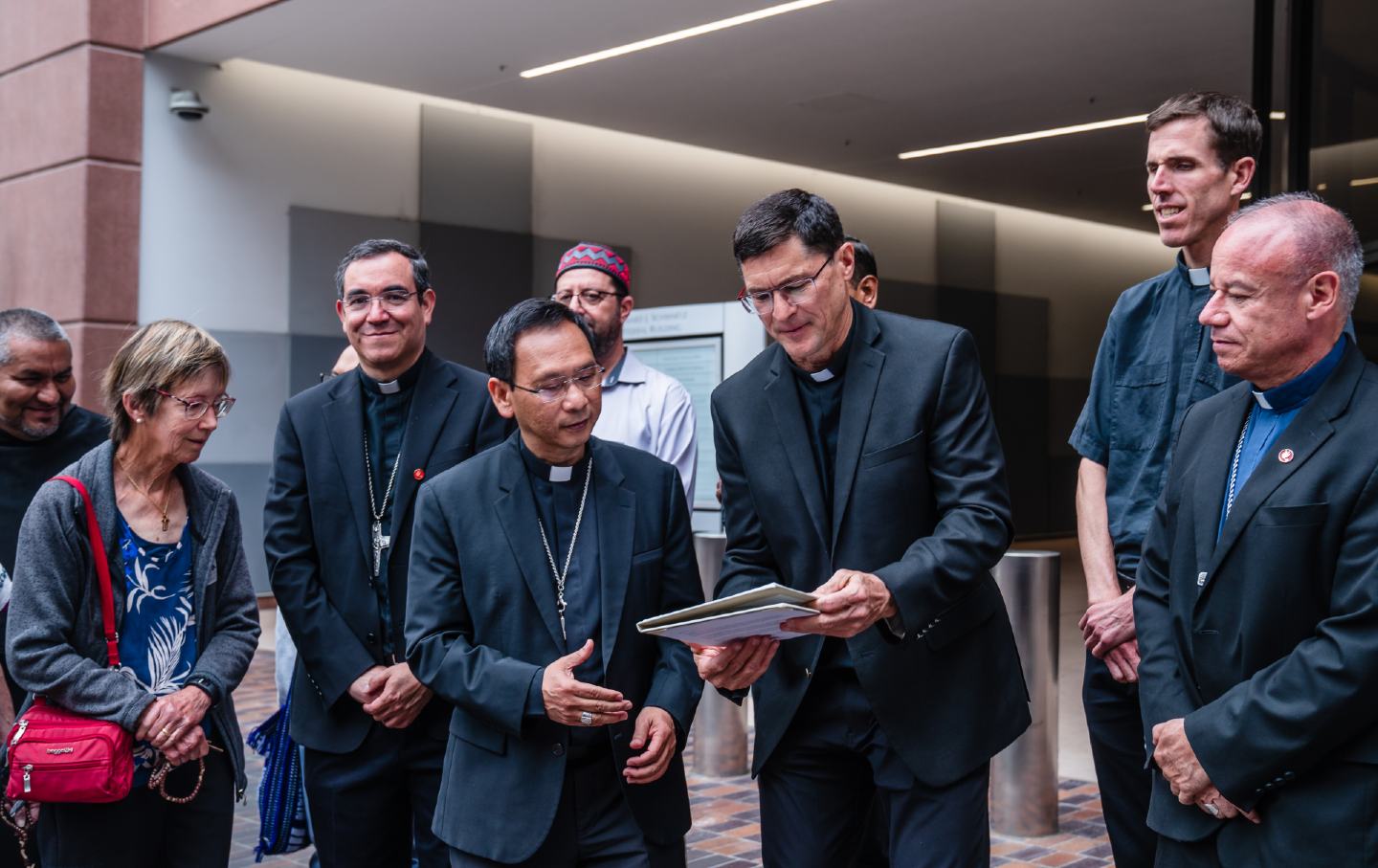
San Diego Bishop-Designate Michael Pham, center left, and Father Scott Santarosa, center right, stand next to other faith leaders in front of the Edward J. Schwartz federal building on June 20, 2025, in San Diego, California. Pham and other faith leaders attended to help support refugees, immigrants, and asylum seekers while their cases are heard before administrative law judges of the Department of Homeland Security.
(Ariana Drehsler / Getty Images)San Diego—Sitting in his second-floor office in Our Lady of Guadalupe church in the Barrio Logan district of San Diego, Father Scott Santarosa explained the moral urgency of chronicling in-person what ICE is doing to families around the United States. With a framed poster of murdered El Salvadoran priest Oscar Romero looming over his desk, he told me, “Someone needs to bear witness to the dignity of the people in this incredibly dark moment and dark place.”
Santarosa is the US version of a liberation theologian. He is highlighting the stories of the country’s disappeared migrants, much as Romero read aloud, on the radio, the names of the victims of El Salvador’s dirty war. Early in Trump 2.0’s war on immigrants, San Diego’s Bishop Michael Pham discovered that ICE was less likely to engage in mass arrests of immigrants when clergy members were present. So he decided that clergy would go to the courthouse every day that it was in session, and he put Santarosa in charge of the project known as FAITH—Faithful Accompaniment In Trust & Hope.
Father Santarosa embraced the assignment. Trained by the San Diego Organizing Project, he and hundreds of volunteers head to the federal courthouse to offer solace to immigrants summoned for check-ins. By doing what the government asks, these immigrants are at risk of being grabbed by masked ICE agents. If they don’t check in, however, their immigration cases are automatically voided, and they expose themselves to an even greater risk of deportation.
Santarosa is a tall, lean man with a tough-as-nails persona under his kindly smile. He and his volunteers accompany migrants on the journey from the elevator to the courtroom, hoping their presence makes it less likely the migrants will be detained during this process. They monitor the ICE “check-ins” at a second-floor office adorned with a poster emblazoned with the Stars and Stripes and the words, “With honor and integrity, we will safeguard the American people, our homeland and our values,” and they show up at the Intensive Supervision Appearance Program (ISAP) venue. ISAP is an ICE program in which migrants who aren’t immediately detained are fitted with ankle monitors. They also hold mass vigils outside the downtown courthouse. Santarosa is under no illusions: He knows that his actions will not by themselves gum up the deportation machine, but he believes that small gestures can add up to a moral force. “You’re David going up against Goliath,” he acknowledged. “But you’re David who hasn’t been to the gym. All the odds are against you. It’s kind of crazy. But that’s the story of our faith; we’re called to do crazy things.”
Inside the Edward J. Schwartz federal building, teams of volunteers do two- and three-hour shifts. The FAITH volunteers simply offer moral solace: hugs, tissues to wipe away tears, and promises to contact the families of those about to be detained in the makeshift ICE facility in the basement of the building. Alongside them are Detention Resistance volunteers who photograph and record interactions with ICE agents and immigrants. That group is compiling a database of information that it hopes will one day be used to hold Trump’s agencies legally accountable for seizing immigrants out of their communities and into fast-track deportation proceedings.
Stephanie Gut has spent most of the last six months organizing shifts of volunteers. She told me that “part of the power of bearing witness is sharing the story with others.” Over the past few months, these volunteers have encountered much heartbreak, and many of them now regard it as a kind of religious imperative to inform the broader community about what they are seeing. “People are being deprived of their dignity in this process,” Patricio Gaffey, one of the volunteers, said. “I felt called to come down and let people know they’re not alone. It’s tugging on the veil of secrecy and letting the light shine on the darkness that is being perpetrated. What happens in this federal courthouse is like a different country.”
In many cities, residents have formed rapid-response networks to push back against ICE, but arguably in no other US city has the faith community mobilized at such a large scale and as efficiently as in San Diego. “People show up to do it,” Santarosa said. “Little old women are doing it—showing up with their rosary beads. Bishop Pham feels like whatever happens to immigrants, people are going to be able to say, ‘The church stood with me.’ The church ought to stand with people when they’re going up against the odds, against injustice, when they’re looked at as being expendable, deportable.”
The work is, however, emotionally grueling, and the volunteers often need to debrief outside the courthouse afterward to decompress. “The most horrendous part is to see the families torn apart,” explained 66-year-old Nancy Francis, who has been at the courthouse with Detention Resistance for most of the past eight months. “To see people being separated and families crying and hanging on to their loved ones.”
Since FAITH and Deportation Resistance volunteers began showing up at the courtroom, and in the face of lawsuits against ICE’s practice of snatching people in the courtroom corridors, the agency’s tactics have shifted. Today there are fewer masked agents stalking the hallways with binders containing photos of immigrants they hope to grab. More of the arrests are being made in private ICE offices during mandated “check-ins” for the immigrants. That’s hardly a total victory, but the FAITH volunteers feel that they have reduced the overall number of people being seized and deported.
Moreover, prodded by immigrant rights advocates, the cities of Vista and San Diego and the county of San Diego have passed, or are in the process of passing, ordinances banning ICE from accessing city- or county-owned properties—such as schools, recreation centers, social service spaces, libraries, and the like—without a warrant. The measures also bar those local governments from doing business with companies that contract with ICE to help them run their detention and deportation machines.
For a county once regarded as reliably conservative, San Diego’s immigration politics have shifted remarkably quickly in the Trump era. The more federal agents and agencies overreach in how they demonize immigrants, the more residents are pushing back. And the more those residents push back, the more they create new political alliances aimed at protecting the community from Trump’s hard-right agenda. “Something has been tapped into in the public of San Diego,” Santarosa said. “Because what is happening is unjust.”