
Can Mamdani Deliver? “Yes! It’s an Unqualified Yes!”
Dean Fuleihan, Mamdani’s incoming first deputy mayor, speaks exclusively about how the mayor-elect will make his agenda a reality.
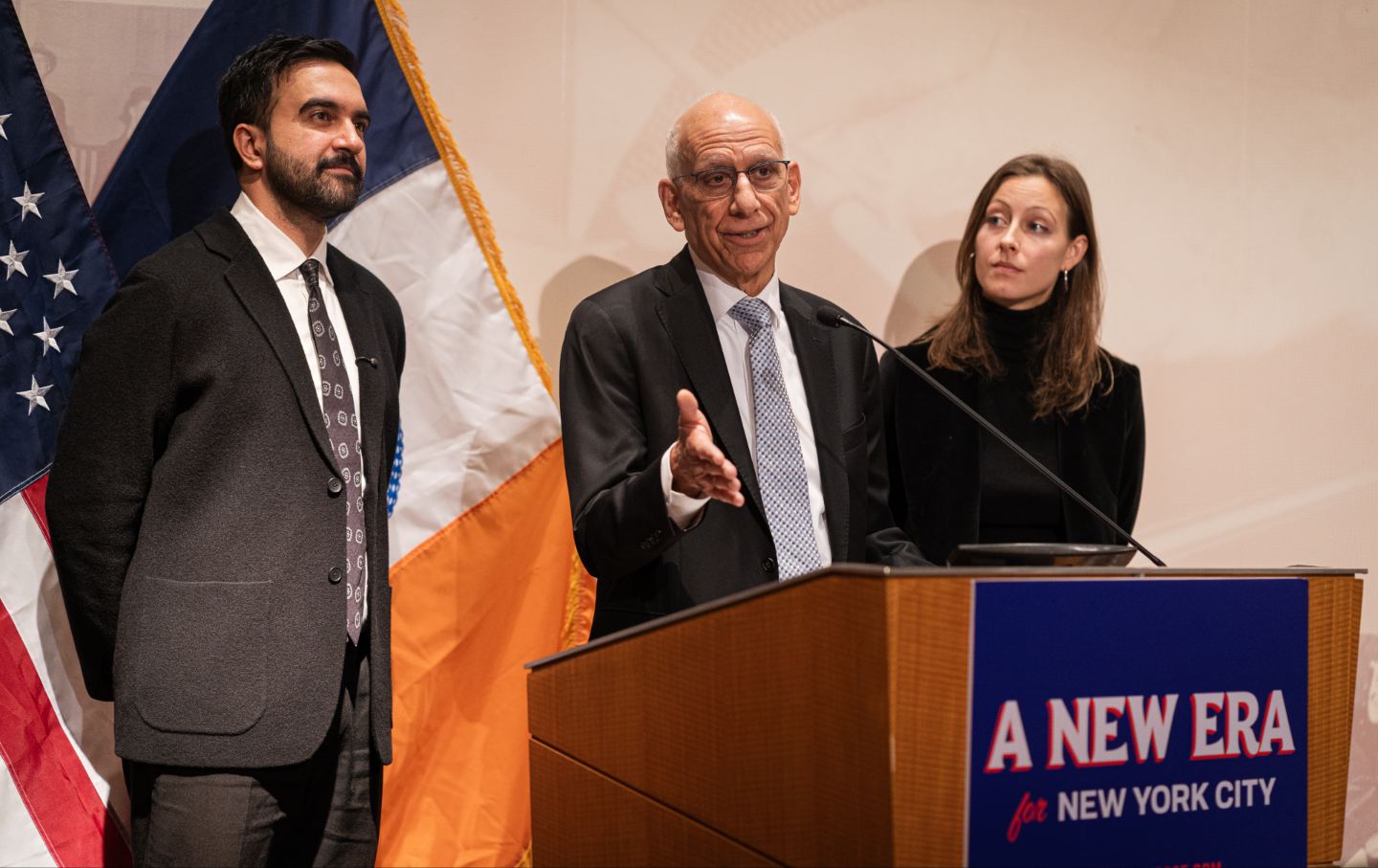
Dean Fuleihan, the incoming first deputy mayor of New York, speaks at a news conference on November 10, 2025.
(Steve Sanchez / Sipa USA via AP)Dean Fuleihan is absolutely confident that Zohran Mamdani can deliver on the ambitious agenda—addressing everything from transportation to rent stabilization and childcare—that inspired New Yorkers to give the mayor-elect a mandate to run the nation’s largest city.
And when Fuleihan, Mamdani’s pick to serve in the powerful position of first deputy mayor, speaks, it pays to listen. He’s one of the most experienced hands in New York City and state government.
After decades of service as the “budget guru” for Democrats in the New York State Legislature, he worked as director of the New York City Mayor’s Office of Management and Budget under former Mayor Bill de Blasio. He then served as first deputy mayor—a position that plays a critical role in defining the scope and direction of municipal administrations—during de Blasio’s second term, before being appointed by New York Governor Kathy Hochul to the New York State Financial Control Board.
Now, at age 74, Fuleihan is back in city government, as Mamdani’s pick to help him guide the city in a moment of immense challenge. And immense opportunity.
The selection of Fuleihan—along with that of longtime Mamdani aide and primary campaign manager Elle Bisgaard-Church to serve as the new administration’s chief of staff—was hailed as a masterstroke by former Obama White House director of political affairs and US ambassador to South Africa Patrick Gaspard. A savvy observer of New York City governance who has been a key member of the Mamdani camp, Gaspard says. “Mayor-elect Mamdani is pulling together an A team and this announcement is the perfect combo of a steady hand with a movement punch. Dean Fuleihan has been a shoulder-to-the wheel public servant who has always moved the levers of government with working families front of mind. Elle Bisgaard-Church is a policy innovator who had the audacity to build the biggest grassroots movement we’ve experienced in NYC in generations. This is brilliant.”
After Mandani’s announcement of the selection, Fuleihan went to work immediately in the new mayor’s transition office. It was there that he spoke exclusively with The Nation about why he began advising Mamdani last winter, why he remains so enthusiastic about the affordability agenda on which the new mayor ran and won, and why—unlike all the naysayers who tried to suggest during the bitter mayoral campaign that the 34-year-old Mamdani lacks the experience and wherewithal to govern the metropolis—he thinks New York’s 111th mayor is exactly what the city needs.
(This interview has been lightly edited.)
—John Nichols
THE NATION: During the mayoral campaign, Zohran Mamdani’s critics constantly questioned whether he could deliver on the ambitious platform he outlined. You’re someone who is deeply experienced in government. Is your decision to take this job a signal that you believe that [Mamdani can] get the job done?
DEAN FULEIHAN: Yes, the answer is “yes.” It’s an unqualified “yes!”
It would be a shame if we were at a point where addressing the serious concerns of New Yorkers was not given the highest priority —recognizing that, OK, these are challenging things, but that affordability is a crisis, and he’s [determined] to address it. It was clear in the campaign, and it was clear from every conversation I had with him, well before the primary, that [Mamdani had] an ambitious agenda, an aggressive agenda. But he intended to achieve it, and that’s what was so appealing. That’s why I’m so happy to be joining this administration and to be part of a team that’s gonna deliver on this [program].
So my answer, my simple answer, is “yes. “ And I actually have a hard time understanding why people think that’s so complicated.
THE NATION: One of the frustrating things about our politics, in so many instances, is that it has become so constrained in its vision that it is hard for many people to imagine that someone could get elected on an affordability agenda, and actually—with a lot of hard work, with a lot of struggle—deliver on it. But it’s your sense, as someone with a great deal of experience in local and state government, that this administration can deliver on the promise of a visionary campaign.
FULEIHAN: My answer is that we have to deliver on it. He ran on a commitment [to do these things] and he received an incredible amount of support for that commitment—and really love and hope.
This is what we’re in government for. I mean, we’re in government to do difficult things.
There are people out there struggling, and they’re having a difficult life…. It should be our privilege to deliver on those commitments to them.
THE NATION: You mentioned that you started talking with Zohran Mandani before the primary. When did you get interested in his candidacy?
FULEIHAN: I was interested in him from the beginning. He was running a campaign that was certainly [unlike] anything I had seen before. We connected in late winter and started a dialogue that’s been pretty consistent since then. I’ve been helping and advising him—and advising the team.
His courage of conviction, his consistency of conviction, didn’t waver during the primary or after the primary. It is incredible and was more than admirable. From the very beginning, I said to him I would do anything I could to help him in any way that was possible. Now, I’m doing it, and I’m really excited about that opportunity.
THE NATION: I’m interested in your assessment of the most significant challenges the administration is going to face. Where do you see the biggest hurdles?
FULEIHAN: I see it as a whole. I don’t see it as one problem—and sometimes it gets portrayed as that: “Oh, what’s gonna happen with Washington?” “Is Albany gonna be cooperative?”
It’s much more than that. [Mamdani] is so defined on the affordability question, and every New Yorker you talk to knows exactly what that agenda is. We have to deliver that agenda. But we also have to make sure that everything operates; that everybody in New York City feels this is a government that’s making sure that we’re doing the day-to-day things that we’re supposed to do in managing a city. That’s a part of the job that I’m here to make sure happens.
At the same time, while we’re doing that, we have to be thinking about how we achieve that policy agenda. How do we negotiate that policy agenda in New York City and in Albany? And then—and New York is not alone in this—[we have to be looking at] what is happening with the federal government? What are the consequences, with regard to the federal government, for the city of New York, as well as the residents of the city?
So, I see this as many levels that have to be addressed at the same time.… We’re going to be building through this transition to make sure that, when we start, we are doing all those things.
THE NATION: You obviously know state government exceptionally well. Do you think that the relationship that Governor Hochul and the incoming mayor that was built during the late stages of the campaign can actually develop into a strong working relationship where the state backs the city up on critical issues?
FULEIHAN: Yes.
You were very gentle about the de Blasio relationship with Andrew Cuomo [who, as governor, frequently, and sometimes intensely, clashed with the former mayor].
I don’t think there’s any question that this [relationship with Hochul] has gotten off with the right kind of respect. We’re going to be able to work with that and use that. This will not mirror the relationship [with Cuomo], which I think was an unfair relationship on the part of the governor at the time. That is not going to happen here.
[Mamdani and Hochul] have many of the same interests. It’s interesting how much the governor has been out there on universal childcare. She did a tax credit last year in the budget. That sort of gets forgotten, and it shouldn’t be forgotten, because this is an area that she clearly cares about.
So, OK, here we have an area that everybody said, “Oh, it’s too much, it’s too expensive,” and all of a sudden you have the mayor-elect of New York City and the governor of New York State saying we have to do this. This is important. We have to address the problems of the pressures on families. We have to address child poverty.
THE NATION: It must help that the state of New Mexico is implementing universal childcare right now. That’s one example on childcare. But many of the things that Mandani talked about during the campaign are things that have been done elsewhere. So they are realistic initiatives.
FULEIHAN: Yes. Look, we’ve seen this before. With de Blasio, obviously, the very first thing he [set out to do] was universal pre-K, and everybody, everybody said that was not possible. The bureaucracy said it would take five years. The governor said there’s no way—you start with a pilot, and we won’t fund it.
And what happened? We did it in two years, and no one I know, literally no one, says that that wasn’t a good thing, that that wasn’t a positive thing. So government actually can do things quickly, can move quickly. It’s our obligation to make sure that we’re doing that.
THE NATION: But you do have a unique circumstance, however, when you are coming in with a mayor that the president of the United States has been starkly critical of. The president has made threats about withholding federal funds and doing all sorts of other things that could undermine the administration. How do you anticipate maneuvering through that challenge to build a relationship with the federal government?
FULEIHAN: Look, the mayor-elect has been very clear about this. We’re going to defend the rights of New Yorkers. And we’re going to look, in every way possible, [to see] if there’s things we can do with the federal government—he also said he would do that.
We’re gonna work with the governor. We’re not alone in this. We’re gonna ask a lot of those people who represent this city and this state, and we’re going to address it.
But what we’re not gonna do is let [threats from Republicans in DC] stop the commitments that we made, that the mayor-elect made to those who voted for him, and those who did not vote for him but still want this agenda.
THE NATION: So you’ve got 47 years of governing experience. That’s more than a dozen years longer than Zohran Mandani has been alive. What does his decision to choose you as first deputy mayor say? Obviously, there is a respect for experience. And then, also, on your part, there is a respect for the enthusiasm of somebody who is coming in trying to change things. Give me a sense of how we should wrap our heads around the fact that a guy with 47 years of experience is coming in to work for a guy who’s 34 years old?
FULEIHAN: I think you said it in asking the question, right? He is bringing vision, energy, hope, and he’s looking around and saying, I also need experience—but experience to get things done.
I’ll take it as a compliment that, from the very beginning, we talked about how you make government work to get an ambitious agenda done, and there are ways to do that. And, so, I’m attracted to every message that the mayor-elect has articulated, I believe in it, I believe it can be done. We need to make it happen. It’s that important that, at this point in my career, yes, it’s worth doing. It’s an obligation that we should be doing
THE NATION: The mayor-elect identifies as a democratic socialist. How do you identify your ideology, your partisanship?
FULEIHAN: I’m obviously a Democrat. I’ve worked my whole life with [Democrats]. I wouldn’t be here if I didn’t feel complete alignment with his agenda. Complete! Whatever you call it.
THE NATION: What drew you to politics in the first place? What brought you to a lifetime of public service?
Popular
“swipe left below to view more authors”Swipe →FULEIHAN: I come from an immigrant family, My father was an immigrant from Lebanon. My mother’s parents were immigrants from Lebanon, and her first language walking into school was Arabic, not English.
They did what we want to hear, right? They struggled, they succeeded. Part of that success was instilling in me, in my brothers, a commitment to public service, and a responsibility to make sure, whatever opportunities we were provided in this country, that other people get the very same opportunities. [Growing up], it was a constant politically active dinner table—always talking about politics and policies both in the US and around the world.
It’s been really a life calling: If you have the ability to have one of these positions [in government], it’s an incredible privilege. It can be hard, sure, but everybody out there is working hard. And the affordability crisis is just magnifying that pressure on them. We have to be able to give back and make that life better.
THE NATION: The announcement of your selection was made at Roosevelt House, where Franklin Delano Roosevelt made some of his transition announcements. That wasn’t a coincidence. It seems to suggest an ambition to do things at the scale that an FDR would have.
FULEIHAN: Absolutely. Look, it’s a wonderful place. It’s a wonderful institution. For me, it’s a wonderful institution because it’s part of the City University of New York, and I have now spent three years at the City University, at the Institute for State and Local Governance. It was a great opportunity for me to thank the leadership at both CUNY and the Institute, and to remind everybody of the importance of that institution to the fabric of New York. It really is part of it. It looks like New York City, it helps New York City, it’s incredible and it’s an amazing institution.
And, yes, being there at the Roosevelt House made multiple statements about the incoming administration.
THE NATION: Which will arrive with an ambitious agenda. And you’re not waiting until [Mamdani’s Inauguration Day] January 1 to get started.
FULEIHAN: I’m in the temporary transition office, and we’re already working.
More from The Nation

Eric Schmitt Deserves to Be Mocked Forever Eric Schmitt Deserves to Be Mocked Forever
In this week’s Elie v. U.S., our justice correspondent relives the senator’s glorious face-plant. Plus: why John Roberts also deserves our mockery.
The Moral Clarity of Tennessee Gubernatorial Candidate Jerri Green The Moral Clarity of Tennessee Gubernatorial Candidate Jerri Green
Even before her state botched another execution, gubernatorial candidate Jerri Green was telling Tennesseans that “the death penalty has always been inhumane, expensive, and biase...

Draw Peace, Defy Censorship Draw Peace, Defy Censorship
Censorship targets those who dare to challenge power. Yet cartoonists keep drawing. Every line is an act of courage and freedom and a step toward peace.

Reclaiming Worker Power in the Age of AI Reclaiming Worker Power in the Age of AI
When every price and wage is personalized, organizing gets harder. Here’s how we’re fighting back in New York City.
Trump Is Trusting Tech Companies to Self-Police AI. What Could Go Wrong? Trump Is Trusting Tech Companies to Self-Police AI. What Could Go Wrong?
Trump’s refusal to heed the warnings from within the tech industry might end up being his most asinine legacy.

