Trump’s Deep-State Conspiracy Theories Are Getting Beyond His Control
The president’s denial of the existence of government material on Jeffrey Epstein isn’t going over well with his followers.
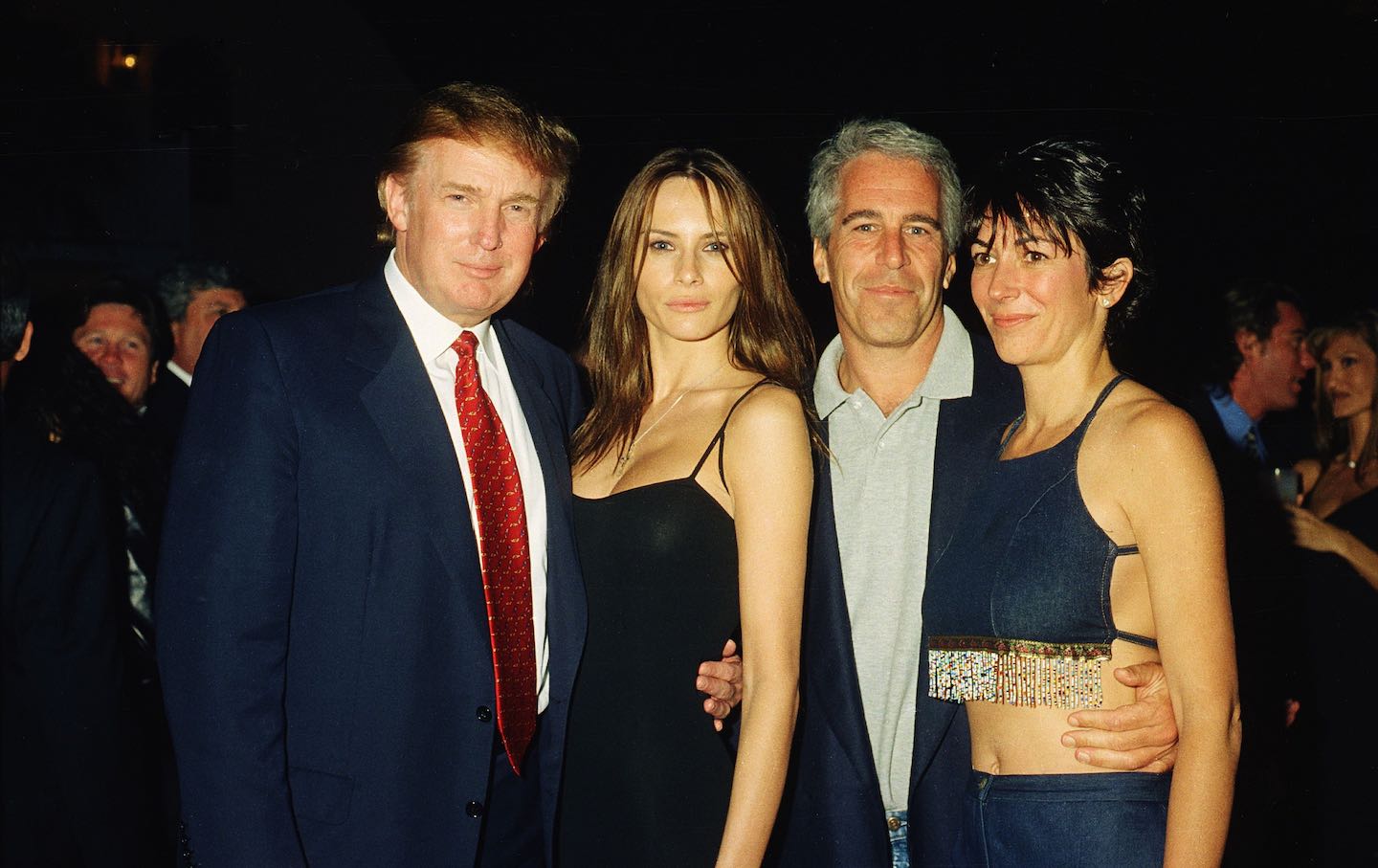
Donald Trump and his then-girlfriend Melania Knauss with Jeffrey Epstein and Ghislaine Maxwell at the Mar-a-Lago club, Palm Beach, Florida, in February 2000.
(Davidoff Studios / Getty Images)What if they held a deep-state reckoning and nobody came? That’s the quandary now convulsing Donald Trump’s MAGA movement, as speculation continues to build over law enforcement documents related to the gruesome Jeffrey Epstein scandal. Anticipation over long-touted Epstein disclosures came to a head in Republican circles last week, when an unsigned memo from the Justice Department announced that a master list of Epstein clients supposedly in the government’s possession didn’t really exist. (US Attorney General Pam Bondi now claims that she misspoke in a brash February announcement, amid an earlier Epstein contretemps with the FBI, that this list was “on her desk”—what she meant then, she now says, was a much broader Epstein file.) The Justice memo also reiterated that Epstein, who died in custody in 2019, had killed himself, seeking to dam up another vast tributary of MAGA conspiracy theorizing.
Bondi’s reversal was the opening salvo in a series of claims and counterclaims about the status of Epstein documents that is brewing into a full-on internal MAGA revolt. Speaking at Charlie Kirk’s Turning Point USA conference in Florida over the weekend, Tucker Carlson reprised theories that Epstein—whose rise to gaudy wealth and prominence as a former private-school math teacher has never been plausibly accounted for—was an agent for the Israeli intelligence service Mossad, using his network of trafficked sex captives as fodder for blackmail shakedowns. (In a subsequent NBC News interview, Carlson also cast doubt on the existence of an Epstein client list, joining a motley chorus of MAGA media eminences in the “nothing to see here” refrain.)
Other big-name MAGA-treneurs have dissented loudly from Bondi’s effort to tamp down further Epstein-fueled speculation on the right. Laura Loomer, a longtime impresario of deep-state conspiracy theories, has tried to stoke an internecine intel war within the White House, insisting that either Deputy FBI Director Dan Bongino—who touted much breathless Epstein speculation in his earlier podcasting career—or Bondi will be resigning soon. (Related speculation that Bongino’s boss, Kash Patel, who also exuberantly promoted Epstein conspiracies as a civilian MAGA influencer, would also resign over the Epstein nondisclosures from the Justice Department appears to be subsiding, at least for now.)
Over the weekend, the infighting built up to the point where Trump himself intervened. In an extended rant on Truth Social, the president characteristically tried to wave away the most recent bout of conspiracy mongering in his movement with a still more baroque and implausible conspiracy theory. Trump acknowledged that there was indeed an Epstein client list—but insisted that it was a fabrication concocted by his deep-state enemies. “Why are we giving publicity to Files written by Obama, Crooked Hillary, Comey, Brennan, and the Losers and Criminals of the Biden Administration?” Trump lamented. “They created the Epstein Files, just like they created the FAKE Hillary Clinton/Christopher Steele Dossier that they used on me, and now my so-called ‘friends’ are playing right into their hands.”
Trump’s familiar litany of deep-state victimology wasn’t unusual. But what was a departure from the norm was the MAGA faithful’s refusal to take the bait. Trump’s Truth Social post has been swarmed with replies from detractors asserting that they’re not about to do his bidding. “You can’t call the Epstein files fake, say nobody cares and warn MAGA to fall in line,” went one reply among thousands to Trump’s heavily ratioed post. Even practiced Trump sycophants in the right-wing media like Buzzfeed washout Benny Johnson have called out the president’s clumsy bid to wave the whole crisis away.
It’s unlikely, of course, that the MAGAverse’s Epstein-dissident faction will hit upon the Occam’s razor explanation for Trump’s slipperiness on the issue: Trump was himself a longtime Epstein crony, who was filmed partying with the predator and is on the record describing Epstein as a “fun” and “terrific” guy, as well as a fellow appraiser of young female flesh. “It is even said that he likes beautiful women as much as I do,” Trump told New York magazine in 2002, “and many of them are on the younger side. No doubt about it—Jeffrey enjoys his social life.” The feeling may well have been mutual, according to journalist Michael Wolff, who has compiled more than 100 hours of interviews with Epstein for a biography of the trafficker. In one interview, Epstein claimed to be “Donald Trump’s closest friend for 10 years.” Wolff also says that Epstein showed him photos of Trump with topless young women sitting on his lap—the sort of thing that might have easily found its way into whatever Epstein files the government is now conspicuously clinging to.
Yet the fact that even the person of Trump is unable to either seal or dispel the MAGA Epstein obsession is testimony to how completely the culture of conspiracy mongering has overtaken the American right. Trump can’t contain the right-wing dogma of deep-state speculation that he’s conjured into being, since, without such dark materials, the modern right has no viable approach to mass politics. The policy agenda of the conservative movement has always been vastly unpopular, as polling on both the abysmal Trump spending bill and the White House’s authoritarian immigration policies reminds us.
Going back to the heyday of McCarthyism, the perennial challenge for political organizers on the right, then, has been to galvanize the movement faithful behind an acute persecution complex. The political fortunes of the GOP remain yoked to demagogic visions of a yeoman “real America” laid low by faithless, scheming elites and corrupted by their perversions and excesses. In its every proclamation to the public, the pseudo-populist right rages against the shadowy but ever-cunning forces behind the controlled demolition of American virtue, from the Warren Court to George Soros. As John Ganz wrote in an analysis of the folly of Never Trump Republicanism:
More than principle, the presence of threat and an enemy is the most important driver of right-wing energy, and since the end of the Cold War, the hunt for enemies has become ever more desperate.… Again and again, conservative intellectuals have fastened themselves like barnacles onto demagogic movements such as the ones led by McCarthy or Trump; if they don’t, they risk cutting themselves off from mass politics entirely. That specter always means doom for right-wing intellectuals, since it effectively dispels what small amount of influence they can have, as well as their subscribers, viewers, and donors.
Jeffrey Epstein is an ideal candidate for this brand of attack: As a secretive and debauched Jewish financier from the Upper East Side of Manhattan, he’s an all-purpose avatar of the MAGA right’s culture-of-conspiracy obsessions. Indeed, a key reason Epstein can’t be dislodged from the roster of MAGA villains is that his crimes so closely track the mythology behind the large and influential QAnon cult that’s spurred much of the religious ferment in the MAGA world. The Epstein client list is a central document in QAnon belief, since it would furnish confirmation of the central pillar of Q dogma: that a global ring of liberal pedophiles is controlling the world. (Trump’s longtime alliance with Epstein is, of course, dismissed as a false-flag claim in Q theology.)
As Trump has now learned, this spiritually driven animus toward the deep state won’t be dispelled by a social media lecture—or by any other standard Beltway gambit to pack off an unpleasant controversy to the margins of public attention. This is why MAGA influencers, usually so quick to appease and please the movement’s overlord, aren’t caving this time: Long after Trump is gone, they’ll need to continue relying on the persecution narratives stoked by the Epstein scandal in order to stay in business. While the right’s latest Epstein fracas isn’t likely to transform Trump into an enemy of the movement that launched him into power, it could still turn him into something at least as toxic: a threat to gothic fables of power that its leaders have staked their own careers on.
Become a Sustaining Donor This September
Between the reemergence of right-wing red-baiting and Donald Trump’s use of the chilling National Security Presidential Memorandum–7 to criminalize left political organizing, we’re seeing McCarthyism reborn before our eyes.
This assault on democracy cannot be ignored or wished away. Resisting it requires bravery in the face of threats and repression, a steadfast commitment to the truth, and the unwavering belief that we can—and will—overcome this darkness.
We must have an independent media that sets the record straight, unearths corruption and abuses of power, and advances a politics of justice and dignity for all if we’re to win this fight.
That’s why I’m writing to you today. This September, The Nation needs to add 100 monthly donors to sustain our progressive journalism. Your contribution makes the next investigative report, the next truth-speaking column, and the next pathbreaking essay all possible.
I hope you’ll support our work with a recurring donation today. If you donate $10 or more a month, we’ll send you a brand new “Hands Off the Free Press!” sticker to recognise your commitment to our cause. Please, donate today.
Onward,
Katrina vanden Heuvel
Editor and Publisher, The Nation