Lost in Texas
Say their names.






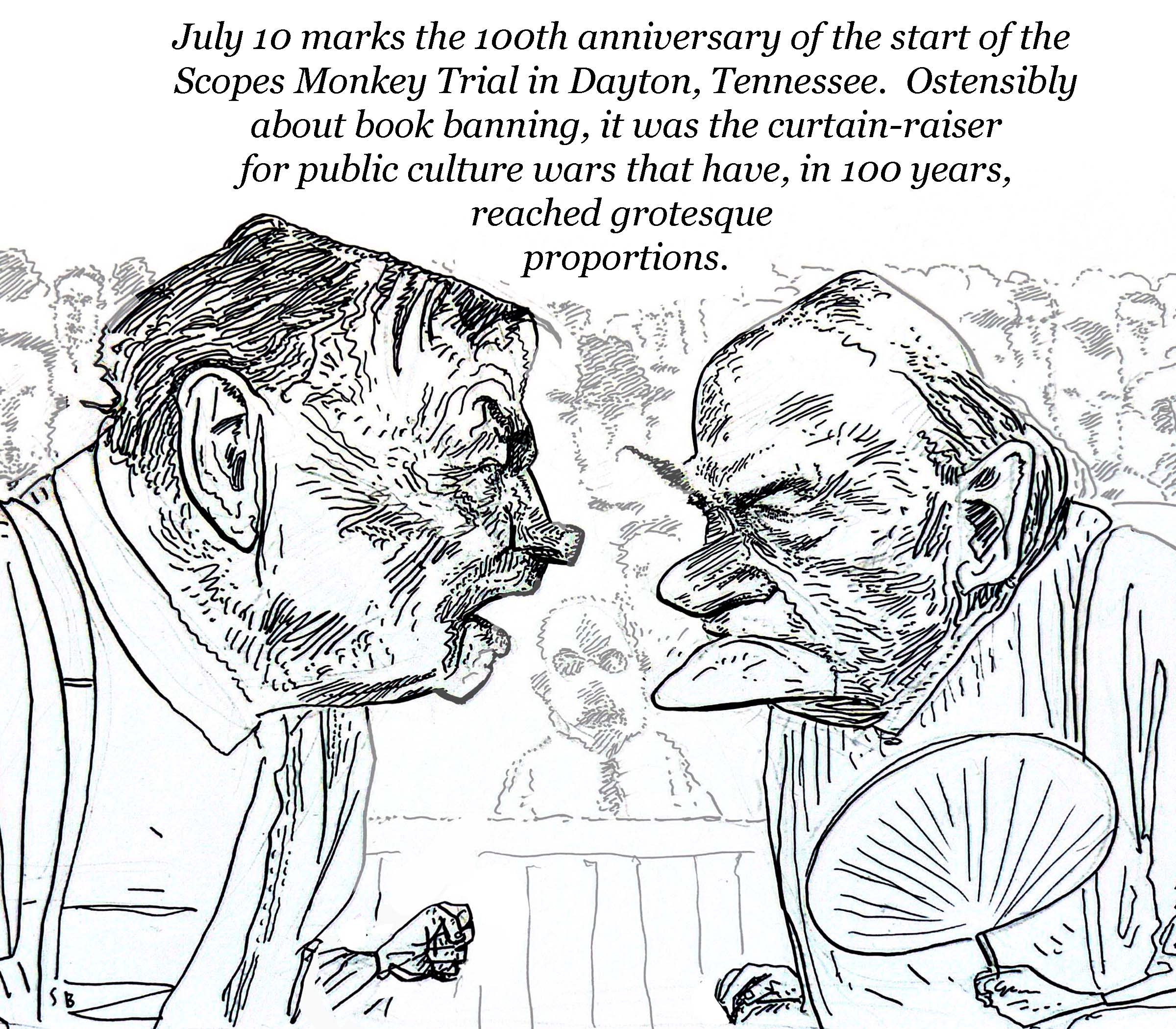
July 10 marks the 100th anniversary of the beginning of the Scopes Monkey Trial in Dayton, Tennessee. The trial was, ostensibly, a challenge to the Butler Act, which forbade the teaching of evolution in the public schools of Tennessee. The ACLU decided to set up a test case where John Scopes, a young teacher, would invite prosecution by state authorities for teaching science. This touched off what was then called the Trial of the Century. The titanic attorneys were William Jennings Bryan for the prosecution and Clarence Darrow for the defense. Bryan, former (three time) presidential candidate and secretary of state, was a theatrical, leather-lunged orator from the Midwest. Darrow was also from the Midwest, but Chicago and the most distinguished trial lawyer of his, or perhaps any, time in the United States. They went head to head, in a colorful dialectic, which reads as great entertainment. In fact, the trial became a popular play on Broadway and film in Hollywood.
What is interesting to me about these two men and the times in which this clash took place, is that they were both practically socialists. Bryan, a progressive Democrat, representing the dispossessed and impoverished farmers of America and Darrow, likewise, a crusader for the downtrodden, had actually voted for Bryan in his presidential runs. But by 1925, in the post-World War I era, a time of frightening social and technological change, paranoia and Red Scare, Bryan’s progressives had cleaved off into a prohibition-advocating, Bible-thumping army. Their descendants are of course, ascendant in America right now, a grotesque caricature version of the alienated, paranoid conservative. Regardless of how progressive they had been, seeing change and recognizing differences in others, brought them great emotional and political upheaval. Darrow can be said, then, to represent an urban, educated, humanistic US. Their clash is will replicate again in the times of Joseph McCarthy and Eisenhower or Gingrich and Clinton or Donald Trump versus the whole world. The Monkey Trial was the signal of how far off the rails into delusion this country could go. And a curtain raiser to 21st century politics in America.