
Does Trump’s Biggest Crypto Backer Really Exist?
The strange saga of a shadowy UAE company’s $100 million investment in World Liberty Financial, the Trump-aligned crypto trader
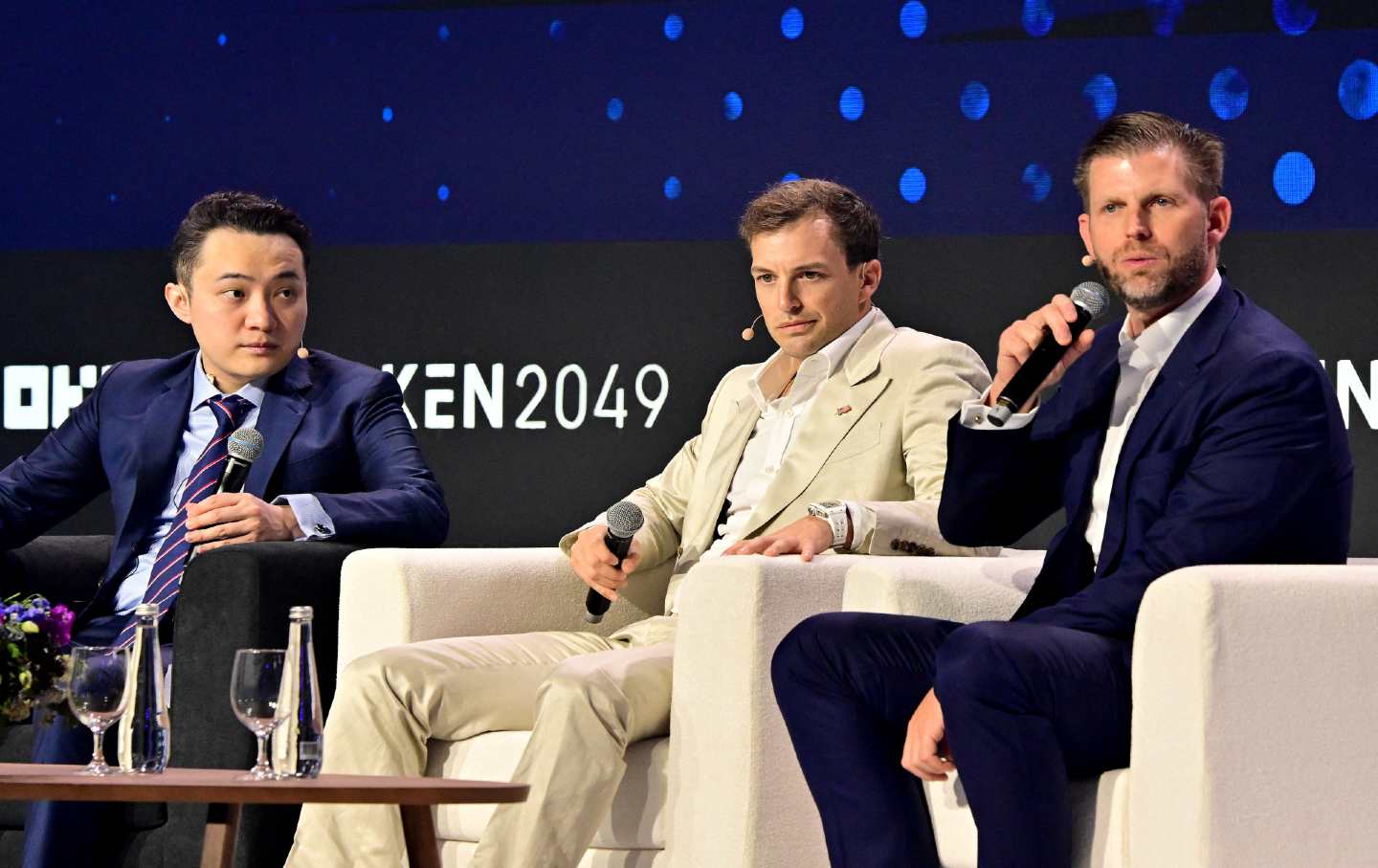
Justin Sun, head of the Tron crypto exchange (L) talks with World Liberty Financial cofounder Zach Witkoff (C) and Eric Trump of the Trump Organization at a May crypto conference in Dubai
(Giuseppe Cacace / AFP via Getty Images)
On June 26, a Dubai-based company called Aqua 1 Foundation announced a $100 million investment in World Liberty Financial, the crypto company closely affiliated with the families of President Donald Trump and Steve Witkoff, the Trump administration’s Middle East diplomatic envoy. As is typical for these kinds of deals, Aqua 1 was buying $100 million worth of $WLFI, a crypto token created by World Liberty Financial. According to the terms of the agreement between Trump and World Liberty Financial, Trump receives 75 percent of the revenue from token sales, meaning that the president was now possibly $75 million richer. And Aqua 1 Foundation—whose existence was completely unknown before it published its June 26 press release—had become one of the largest benefactors for Trump’s crypto businesses, outspending Tron founder Justin Sun, who put $75 million into $WLFI and about $19 million into $TRUMP, the president’s memecoin. (The Securities and Exchange Commission announced shortly after that purchase that it was pausing its multibillion-dollar fraud case against Sun.)
In the annals of Donald Trump’s crypto corruption, the $100 million Aqua 1 Foundation deal stands out for more than just its size: There’s very little evidence that Aqua 1 Foundation exists at all. The Aqua 1 website, which was registered on May 28, 2025, contains no information about the company beyond some fintech buzzwords and an e-mail address. The company’s original X account was suspended, as was an account for an apparently affiliated company called BlockRock RWA (“RWA” refers to the practice of creating blockchain tokens for “real world assets”). Searching public databases, including of businesses in the United Arab Emirates, I’ve been unable to find any corporate registration, official filings, or other documents attesting to the existence of World Liberty Financial’s newest and biggest investor.
The only person who has been publicly identified in connection with Aqua 1 Foundation is a man named Dave Lee, who claims to have cofounded the company. On Lee’s X account, which was registered in December 2023 and has a cartoon avatar, he’s only posted a handful of times, with all of the messages appearing after June 27, 2025. He lists his location as “São Paulo-NY-HK-Abu Dhabi” and responded to one questioner in Portuguese. And that is where the trail ends. I’ve been unable to find any other social media or professional profiles associated with a Dave Lee in his capacity as leader of what is supposed to be a very well-heeled Middle Eastern crypto fund doing business with the first family.
Dave Lee did not respond to several X messages requesting comment. Aqua 1 Foundation did not respond to an e-mail sent to the address listed on its website. David Wachsman, the CEO of a communications firm that works with World Liberty Financial, acknowledged receiving a list of questions—about Aqua 1’s corporate registration, funding, and personnel—but did not provide answers before publication.
In crypto industry media, the Aqua 1 Foundation investment was duly reported as another lucrative deal for the United States’ leading crypto entrepreneur. Some blockchain watchers noted that World Liberty Financial’s official crypto wallet sent $800 million worth of $WLFI tokens to a wallet at the address aqua1.eth across three separate transactions in early June. The aqua1.eth wallet in turn sent $80 million worth of USDT—the Tether stablecoin that is pegged to the US dollar.
Aqua 1 Foundation appeared to get its USDT from a wallet on Bybit, a UAE-based exchange that North Korean hackers recently pillaged for $1.5 billion, as well as a wallet on OKX, a large crypto exchange that earlier this year pleaded guilty to violating US anti–money laundering laws and agreed to pay a $504 million fine.
It’s unclear where the real money powering this deal originated. Cryptocurrency allows for a degree of discretion and pseudonymity, if not total privacy, in financial transactions. Someone can spin up a website and press release and send $80 million worth of crypto to the US president’s associates without leaving the couch. It’s possible that Aqua 1 Foundation is a real Emirati company, but it’s just as possible that it could be a front for any number of foreign financial or political interests seeking favors from Trump.
As I’ve reported for The Nation, President Trump has jumped into the deep end of the crypto industry’s fetid waters, partnering with entrepreneurs and companies formerly subject to federal criminal and regulatory investigations. DWF Labs frontman Andrei Grachev, who put $25 million into World Liberty Financial, pleaded guilty to fraud in a Russian criminal court. Tron executive Justin Sun, whose SEC troubles have recently dissipated, has returned to the United States after bouncing between the Caribbean and Asia on a St. Kitts passport. (He famously bowed out of a scheduled space flight on one of Jeff Bezos’s Blue Origin rockets in 2021, which set him back a cool $28 million, citing a “scheduling conflict”; he’s now again discussing catching a future Blue Origin flight.)
While Trump has made hundreds of millions of dollars from lending his name to crypto schemes, he stands to make much more, particularly if his dollar-pegged stablecoin, known as USD1, takes off. On a recent day, USD1 was the third-most-traded stablecoin in crypto markets, with $3.37 billion in volume. Congress is on the verge of passing legislation that will help further legalize stablecoins and give them better access to US banking and markets. In the new, lightly regulated crypto scene, Trump and his associates could make billions.
With USD1, Trump has some powerful industry partners lending support to the token, including DWF Labs, Sun’s Tron network, a wealthy Hong Kong–based family office, a “decentralized hedge fund” called Re7 Labs, and Binance, the world’s largest crypto exchange. Binance cofounder Changpeng Zhao, or CZ, has said he is seeking a pardon from Trump after serving four months in federal prison as part of a plea deal over Binance’s violation of anti–money laundering laws. MGX, an Emirati investment fund, recently completed a $2 billion investment in Binance using World Liberty Financial’s USD1 stablecoin.
“We have believed from the beginning,” wrote Aqua 1 Foundation cofounder Dave Lee, referencing the company’s zeal for USD1, in one of his few public posts. “We @Aqua1Fund have been building with @worldlibertyfi behind the scenes for a while now—this $100M move is just the public start,” Lee wrote in another post.
If Aqua 1 Foundation has been working with World Liberty Financial since the president’s primary crypto venture launched in September 2024, there’s little to no evidence of the relationship in the public record. Trump did travel to the UAE in May 2025, where he announced “over $200 billion in commercial deals between the United States and the United Arab Emirates.” Two weeks later, someone began registering websites and social media accounts for Aqua 1 Foundation.
The president’s latest crypto benefactors, whoever they turn out to be, stand to gain enormously from their $100 million investment. Until now, the $WLFI token has only been a “governance token,” granting its holders the right to vote on proposed changes to the World Liberty Financial platform. But the token itself has been nontransferrable—meaning that anyone buying it was putting money into a token that couldn’t be sold or moved. That’s about to change. World Liberty Financial recently put out a vote to “unlock” $WLFI tokens, allowing them to be moved between wallets—a change that won the fulsome support from the current holders of $WLFI. Soon, $WLFI will be tradable on public markets, and its early backers will be able to cash out—ensuring, in turn, that the most flagrantly corrupt president in American history will once again line his pockets.
More from The Nation

My Family’s Dark, Hidden History With Institutionalization My Family’s Dark, Hidden History With Institutionalization
My great-great-grandfather was the namesake of an infamous institution for the disabled. From long-neglected records of the property, the lives of forgotten people were uncovered....
Abby Martin on the Climate Cost of US Empire Abby Martin on the Climate Cost of US Empire
The filmmaker discusses military pollution, her reporting in Hawai’i, and why the climate and antiwar movements belong together.
The White Man Can Always Take What You Have The White Man Can Always Take What You Have
In this week's Elie v. US, our justice correspondent breaks down the real message of the attacks on Ilhan Omar. Plus: the anti-trans case that will come for us all.

Where Is the Outrage Over Trump’s Racist Targeting of Ilhan Omar? Where Is the Outrage Over Trump’s Racist Targeting of Ilhan Omar?
The establishment press and some Democrats are strangely mute over the president’s flagrant abuse of the legal system.
America’s UN-Healthcare Treatment America’s UN-Healthcare Treatment
The UnitedHealth group CEO’s savings plan.

