Don’t Let Trump Desensitize You to the Horrors of His Latest Travel Ban
The first time Trump did this, we flocked to the airports in protest. This ban is no less racist—and it may even be more dangerous.
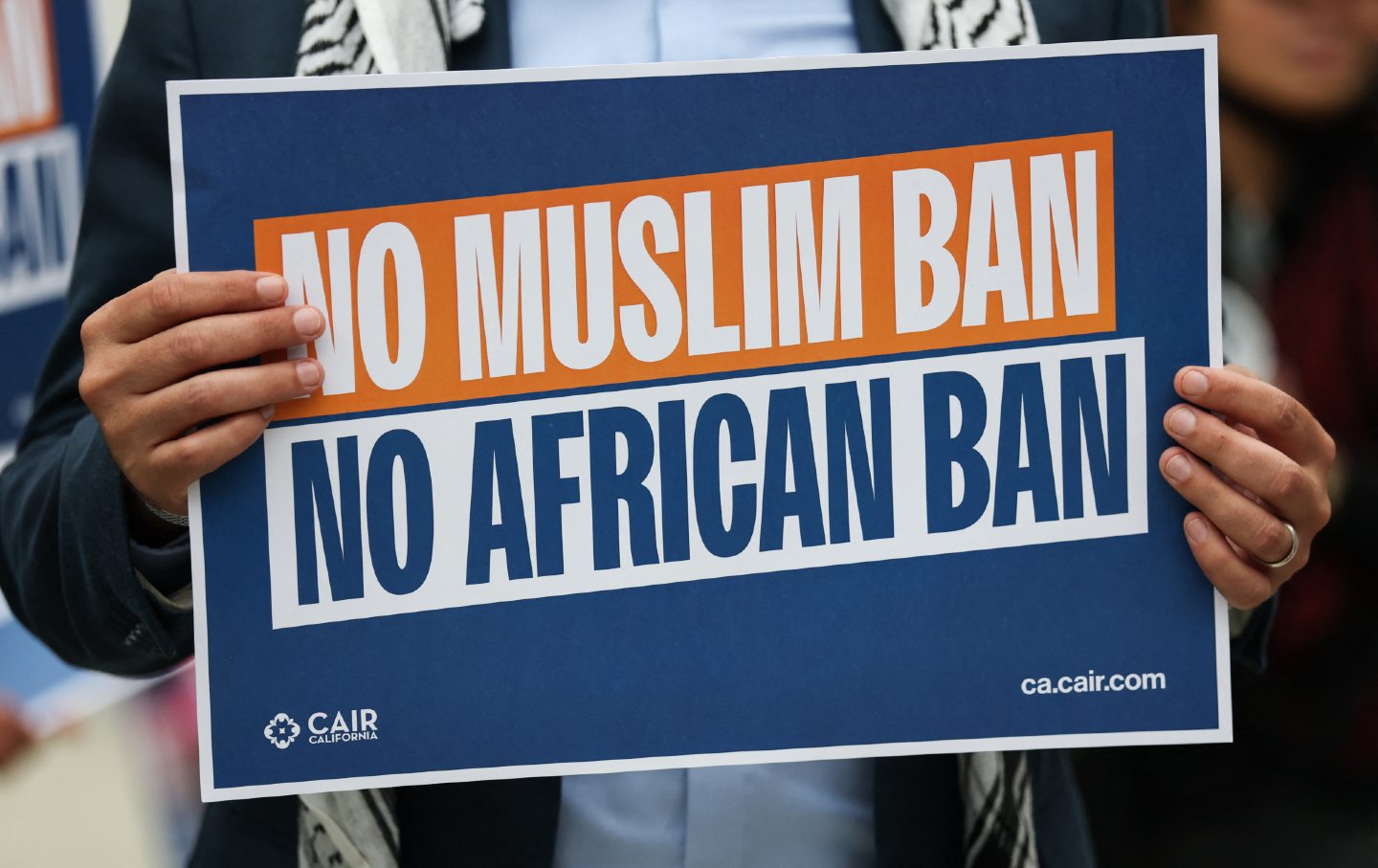
A demonstrator holds a placard during a protest Trump’s latest travel ban at Los Angeles International Airport on June 9, 2025.
(Patrick T. Fallon / AFP via Getty Images)Last week, President Donald Trump signed a sweeping travel ban barring entry to citizens from Afghanistan, Myanmar, Chad, Republic of Congo, Equatorial Guinea, Eritrea, Haiti, Iran, Libya, Somalia, Sudan, and Yemen. Trump was following through on a proclamation he made the day he took office for his second term. It is an attempt to demonize Black and Muslim noncitizens as inherently criminal and dangerous. And if we don’t act, the executive order will further normalize their mistreatment.
As justification for the ban, Trump proffered that he had considered “foreign policy, national security, and counterterrorism” goals. Trump also tried to tie the executive order to a June 1 attack in which a man is accused of using a makeshift flamethrower and hurling Molotov cocktails at demonstrators demanding the release of Israeli hostages. That attack was carried about by an Egyptian citizen—Egypt is not on the ban list. It is worth noting that no terrorist incident in the United States has been perpetrated by a citizen from any of the 12 countries included in the ban. Other reasons, such as high rates of visa overstays from the named countries, also fall short; many unlisted countries have far higher rates of overstays.
Despite having no rationale that can stand up to scrutiny, Trump has the power to do this. In 2018’s Trump v. Hawaii, a five-person majority in the Supreme Court ruled that the president’s first travel ban was “squarely within his powers under the Immigration and Nationality Act.”
In lumping together these 12 countries and then trying to connect them to an attack carried out by a citizen of a separate country altogether, Trump exemplifies the attitude of the administration and his supporters. This brash and demeaning perspective sees African or Muslim or Middle Eastern countries as indistinguishable in their want, desperation, and potential to harm Americans. To attempt to link one or another to concrete reasons beyond vague and evasive notions is to accord them too much attention and effort altogether.
The truth is that many of those affected have much to offer the United States. One affected person I spoke with just as news of the ban was released is a medical professional from Libya who would have qualified for the O-1 or extraordinary ability visa upon completing his training. Now, because of the ban, he will have to leave the United States prior to adjusting status or having a way of returning. While the situation is crushing for him, it is also costly to the United States, which will lose a highly trained medical professional who could have saved thousands of lives over the span of his career. In a country with an aging population like the United States, the loss is acute. And there are countless similar stories. Trump’s ban is not designed to help the country but to satisfy the xenophobia of the MAGA base.
The ban will be especially harmful for Haiti, the only country on the list in the Western Hemisphere—and, not coincidentally an overwhelmingly Black country. Haitians won’t be able to travel to the United States for complex medical care or to flee the gang violence that killed 5,000 people last year.
Most of the countries on the travel-ban list, including Haiti, are the ones Trump referred to as “shithole” countries in his first term. In this second term, he’s added to this view a description of Africans as the oppressors of white people. When South African President Cyril Ramaphosa visited the Oval Office less than a month ago, Trump blindsided him with accusations that a genocide of white farmers is taking place in his country. “Now this is very bad, those are burial sites right there. Burial sites. Over a thousand. Of white farmers,” Trump said, referring to a video that shows a road lined with white crosses with a procession of mourners paying respects.
Trump, of course, was wrong. The video Trump was referring to is of a protest that took place after six white farmers were murdered in South Africa—the crosses did not represent specific victims and even the son of the people who had been killed affirmed that there was no targeted “genocide” in South Africa. Those are details lost on Trump and his MAGA base. A white genocide in Africa is just too useful to discard simply because it is made up.
The African nations on the list—as Chad’s president, Mahamat Deby Itno, put it—have “no planes to offer, no billions of dollars to give.” These are precisely the reasons the Trump administration chose these countries: They do not have the money or international clout to clap back. This means that Trump can target them and appease the racist impulses of nativist MAGA adherents without much cost. Adding Iran and Afghanistan to the mix will further sate the Islamophobes disappointed that the Muslim ban from the first administration had to be altered.
The bans accomplish another, even more nefarious Trump administration objective. Having presented a more qualified list than the draft list of over 40 countries that the State Department had been reviewing, there is the insinuation that this action is limited and considered and thus not so bad. This process is how inhumane and arbitrary acts against citizens of entire countries are normalized. When Trump imposed travel bans the first time, people rallied at airports and filled the streets. But this time, the American public is numb. This is just another of a seemingly unending list of horrors of draconian immigration enforcement actions. The sheer volume of depraved and racist actions against noncitizens can be paralyzing. Not only do the travel bans and the attendant immigration actions constrain and ban Black and Muslim noncitizens, but they also help ensure that US citizens are anesthetized to the brutality around them and perpetrated in their name.

