Trump’s Dirty Tricks Were Tried in Argentina First
Eviscerating the public sector? Javier Milei showed Trump and Musk how it’s done.
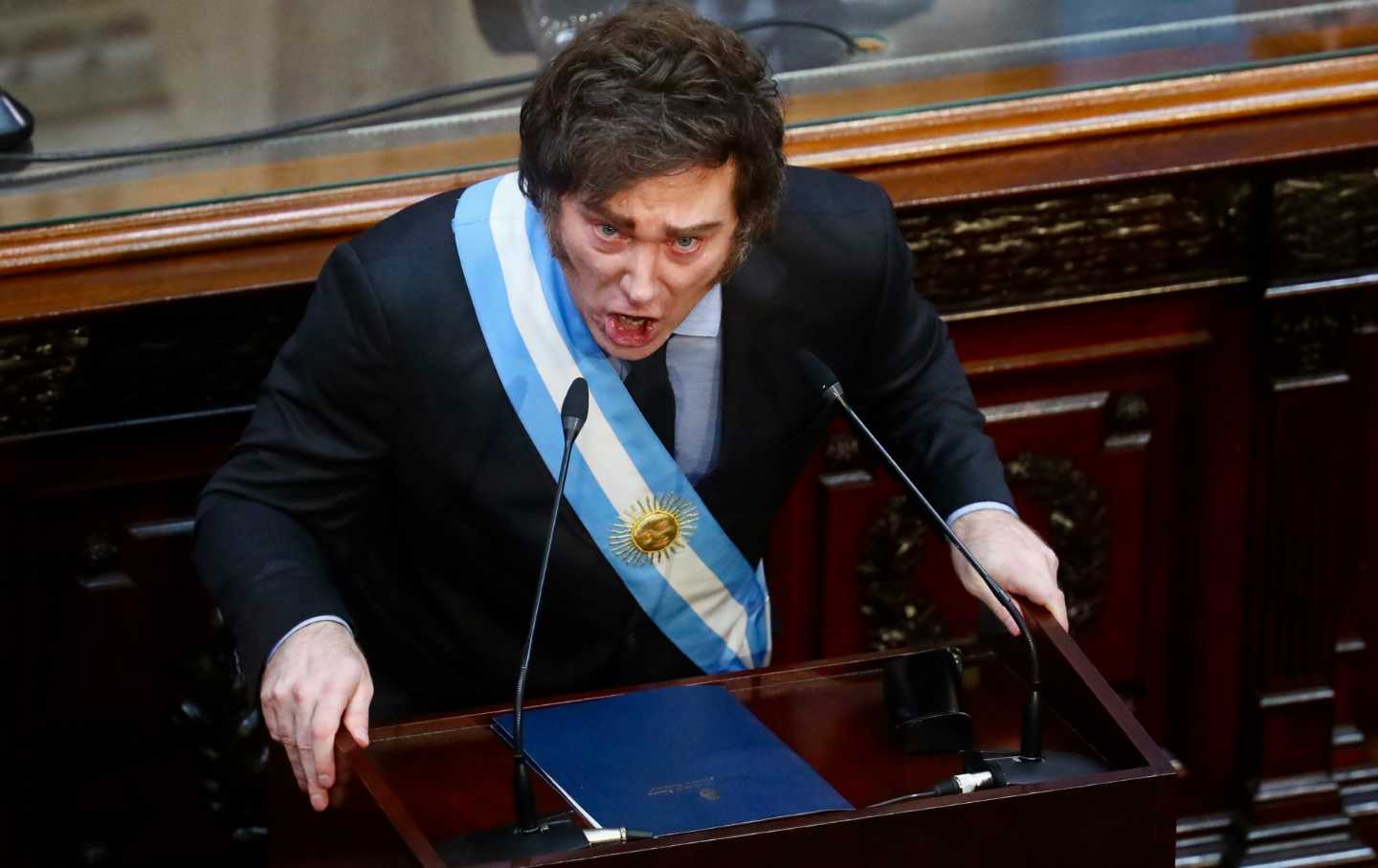
Buenos Aires—I have been over into the future, and it doesn’t work. For anyone curious about where Elon Musk’s economic storm troopers may be headed, a trip to Argentina is instructive. Even before President Javier Milei gifted the Boer billionaire a chain saw onstage at February’s Conservative Political Action Conference, the US right has long been fascinated by this country’s cherub-faced caudillo. And not just because he espouses a libertarianism that would sanction a free market in the sale of human organs—and, potentially, human children. Or because of his claims to have cloned his dead pet dog, whose canine counsel he reportedly consults through a medium.
Milei may be crazy enough to make Donald Trump look normal—though the red posters I saw on every avenue here asking “¿Que hacemos con el rey loco?” (“What can we do about the mad king?”) seemed pertinent to both leaders. For political prognosticators, Milei matters because after winning the 2023 election, he issued executive orders shredding Argentina’s public sector. Yet he remains popular enough to give his party, La Libertad Avanza, currently a minority in both houses of the National Congress, a decent chance to improve its position significantly in this year’s midterm elections—in a country where more than half the population (and 42 percent of households) are stuck below the poverty line. Even Milei’s recent cryptocurrency scandal doesn’t seem to have made much of a dent.
So many moves in the Project 2025 playbook were tried out here first, from terminating state employees with probationary status to gutting and then shuttering entire government departments (including the housing ministry, despite skyrocketing rents and shrinking pensions forcing increasing numbers into poverty and homelessness).
What’s Milei’s secret sauce? Deep fear of inflation plays a big role. Under his predecessor, the Peronist Alberto Fernández, inflation rose to an annual rate of 211 percent in 2023. Prices for food and healthcare more than doubled. In December of that year alone, prices rose 25.5 percent. That’s more in a single month than Americans experienced during Joe Biden’s entire presidency.
A year later, monthly inflation had fallen to 2.7 percent—still high by US standards, but then Argentina is not the United States. Manufacturing plays a minor role in the economy here, which is based on service industries and agricultural exports. Nor does the country enjoy the benefits of serving as the world’s reserve currency, which so far has allowed the US to continue exporting its debt. Finally, at least for now, Americans are not haunted by the memory of a dictatorship like the junta that ruled here from 1976 to 1983, waging a vicious dirty war against its own citizens, during which 30,000 Argentines were murdered or disappeared.
This is a country where every cab driver can quote you the “blue rate” to exchange pesos for dollars (currently about 25 percent higher than the official rate of roughly 1,000 to 1) and where the middle class tends to keep its savings in dollars—often in cash. But it is also a place where successes in the fictitious economy preempt criticism of the actual underlying economy, whose structural weaknesses (lack of investment, reliance on imports) Milei has done little to address. Eventually, those chickens will come home to roost, though a fresh round of funding from the IMF might delay the reckoning.
Can Trump and Musk pull off a similar conjuring trick? They certainly seem eager to try. But other worlds remain possible—as we hope to remind you in this issue, which brings Natasha Hakimi Zapata on how Argentina’s neighbor Uruguay achieved green energy independence in record time; Elie Mystal on how neoliberalism was born in the skies; David Montgomery on Cuba’s continuing torments; and Eamon Whalen’s fascinating cover story on the state of American men and boys.
Plus our new columnist David Klion reviewing the rise and rise of Stephen Miller, Karrie Jacobs on Atlanta’s Ringstrasse, Bill Fletcher Jr. on the African Pasionaria Andrée Blouin, Adam Hochschild on the spy game, and Jorge Cotte on the return of Severance.
By the time you read this, I’ll be back at my desk—and perhaps the Democratic opposition to Trump will have figured out how to actually oppose his and Musk’s power grabs. A few days after I arrived here, Milei announced he was going to bypass the National Congress and name Supreme Court justices himself by decree. You can be sure our new rulers are paying close attention.
D.D. Guttenplan
Editor
Become a Sustaining Donor This September
Between the reemergence of right-wing red-baiting and Donald Trump’s use of the chilling National Security Presidential Memorandum–7 to criminalize left political organizing, we’re seeing McCarthyism reborn before our eyes.
This assault on democracy cannot be ignored or wished away. Resisting it requires bravery in the face of threats and repression, a steadfast commitment to the truth, and the unwavering belief that we can—and will—overcome this darkness.
We must have an independent media that sets the record straight, unearths corruption and abuses of power, and advances a politics of justice and dignity for all if we’re to win this fight.
That’s why I’m writing to you today. This September, The Nation needs to add 100 monthly donors to sustain our progressive journalism. Your contribution makes the next investigative report, the next truth-speaking column, and the next pathbreaking essay all possible.
I hope you’ll support our work with a recurring donation today. If you donate $10 or more a month, we’ll send you a brand new “Hands Off the Free Press!” sticker to recognise your commitment to our cause. Please, donate today.
Onward,
Katrina vanden Heuvel
Editor and Publisher, The Nation