Lisa Murkowski Tells Trump: “Greenland Is Not For Sale”
The Alaska Republican is bluntly rejecting the president’s colonial ambitions.
The GOP Senator Standing Up to Trump’s Colonial Madness
Lisa Murkowski demanded that the president respect that “Greenland is not for sale.”
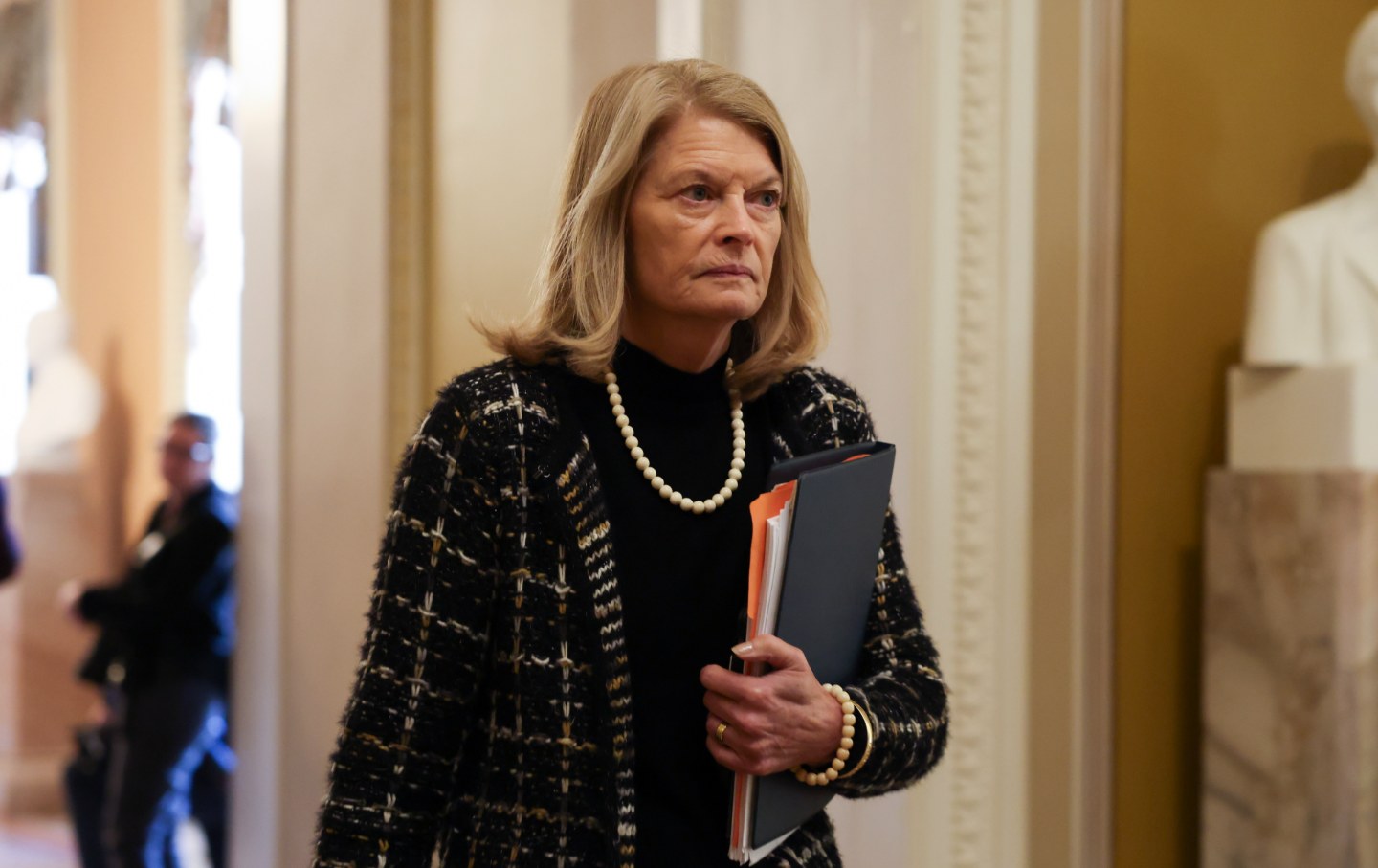
Senator Lisa Murkowski (R-AK) heads to the Senate Chamber on January 22, 2025.
(Kayla Bartkowski / Getty Images)Alaska Republican Senator Lisa Murkowski is absolutely and unequivocally refusing to go along with Donald Trump’s increasingly aggressive maneuvering to make Greenland a part of the United States. In fact, she has joined one of Greenland’s most prominent political figures in bluntly pushing back against the American president’s scheming to buy—or, perhaps, simply claim—the island that is home to 57,000 people.
“Greenland is not for sale,” declared Murkowski and Greenlandic parliamentarian Aaja Chemnitz after consulting this week. “The question has been asked and firmly answered by the government of Greenland, Naalakkersuisut.”
That was a stark response to what critics have identified as the president’s “Napoleonic tendencies” and “Dreams of a New American Empire.”
Murkowski’s intervention matters because it is coming not just from global leaders or members of the media, but from a senior Republican senator, even if that senator’s influence may have been diminished by the fact that she is one of the few independent thinkers left in Trump’s GOP.
Murkowski, who did not vote for Trump in 2016, 2020, or 2024, has emerged as the Senate’s leading Republican dissenter since Trump returned to the White House. She was the first GOP senator to announce that she would vote against confirming Pete Hegseth, the president’s scandal-plagued pick to lead the Department of Defense (two other Republicans, Susan Collins of Maine and Mitch McConnell of Kentucky, later joined her), and she has expressed skepticism about other Trump picks. She has criticized the president’s pardons of insurrectionists and “strongly disagreed” with his executive order to rename Denali, the Alaskan peak that is North America’s tallest mountain, for former Republican President William McKinley—saying, “Our nation’s tallest mountain, which has been called Denali for thousands of years, must continue to be known by the rightful name bestowed by Alaska’s Koyukon Athabascans, who have stewarded the land since time immemorial.”
Murkowski represents a state with ties to Greenland, because they are both Arctic regions with large populations of Indigenous people and strategic positions in the world. With her deep roots in what was for almost a century an American territory, the chair of the Senate Committee on Indian Affairs knows the history of the long struggle for representation that ended with Alaska statehood in 1959. And Murkowski has an independent streak that has seen her win four Senate elections as a labor-friendly, pro-choice Republican who draws significant support from Democrats and independents. Unlike other GOP senators, who fear that Trump and his allies might move to unseat them in party primaries, Murkowski has confidence in her political resilience. In 2010, Republican primary voters rejected her in favor of a Tea Party acolyte. In response, Murkowski ran in the general election as a write-in candidate—and won.
But even with that record, her willingness to stand up to the latest Trump juggernaut has been striking—so much so that an Associated Press writer in Juneau termed her current positioning as “stunning for a congressional Republican who has faced his wrath before and yet remains unbowed by pressure to embrace his agenda.”
Murkowski’s intervention on behalf of Greenland is especially significant because she is aligning with international critics of the expansionist vision that Trump has outlined in speeches, press conferences, and conversations with global leaders—including “a contentious, aggressive telephone call” with Prime Minister Mette Frederiksen of Denmark, the European Union member state that includes Greenland as a self-governing Arctic region with its own language and culture. Chemnitz represents Greenland in the Danish parliament as a member of the island’s pro-independence Inuit Ataqatigiit party. She also chairs the Standing Committee of Parliamentarians of the Arctic Region, of which Murkowski is a cochair.
After the committee of parliamentarians met over the weekend, Murkowski and Chemnitz issued a statement that noted Trump’s talk about purchasing Greenland, along with increasing global attention to the fact that the largest non-continental island in the world “is strategically located for defense, shipping, and more. It is also a storehouse for all sorts of minerals, the building blocks of society that will determine who leads—and controls—the industries of the future.” The statement firmly asserted, “The United States, like Denmark, should recognize that the future will be defined by partnership, not ownership. To ensure our alliance reaches its full potential, Americans must view Greenland as an ally, not an asset. Open for business, but not for sale.”
Murkowski and Chemnitz explained, “The future does not require us to redraw the borders on that [map of the Arctic], but to work harder than ever across them,” and called—in a clear reference Trump’s territorial ambitions—for “a larger acceptance of the Arctic as a region of shared responsibility whose opportunities cannot be seized, and whose challenges cannot be overcome, by any one nation on its own.”
Become a Sustaining Donor This September
Between the reemergence of right-wing red-baiting and Donald Trump’s use of the chilling National Security Presidential Memorandum–7 to criminalize left political organizing, we’re seeing McCarthyism reborn before our eyes.
This assault on democracy cannot be ignored or wished away. Resisting it requires bravery in the face of threats and repression, a steadfast commitment to the truth, and the unwavering belief that we can—and will—overcome this darkness.
We must have an independent media that sets the record straight, unearths corruption and abuses of power, and advances a politics of justice and dignity for all if we’re to win this fight.
That’s why I’m writing to you today. This September, The Nation needs to add 100 monthly donors to sustain our progressive journalism. Your contribution makes the next investigative report, the next truth-speaking column, and the next pathbreaking essay all possible.
I hope you’ll support our work with a recurring donation today. If you donate $10 or more a month, we’ll send you a brand new “Hands Off the Free Press!” sticker to recognise your commitment to our cause. Please, donate today.
Onward,
Katrina vanden Heuvel
Editor and Publisher, The Nation