The Media’s Plan for Trump’s Next Term: “Lifestyle Coverage”
On the eve of the president-elect’s inauguration, mainstream outlets have announced their intention to retreat from politics.
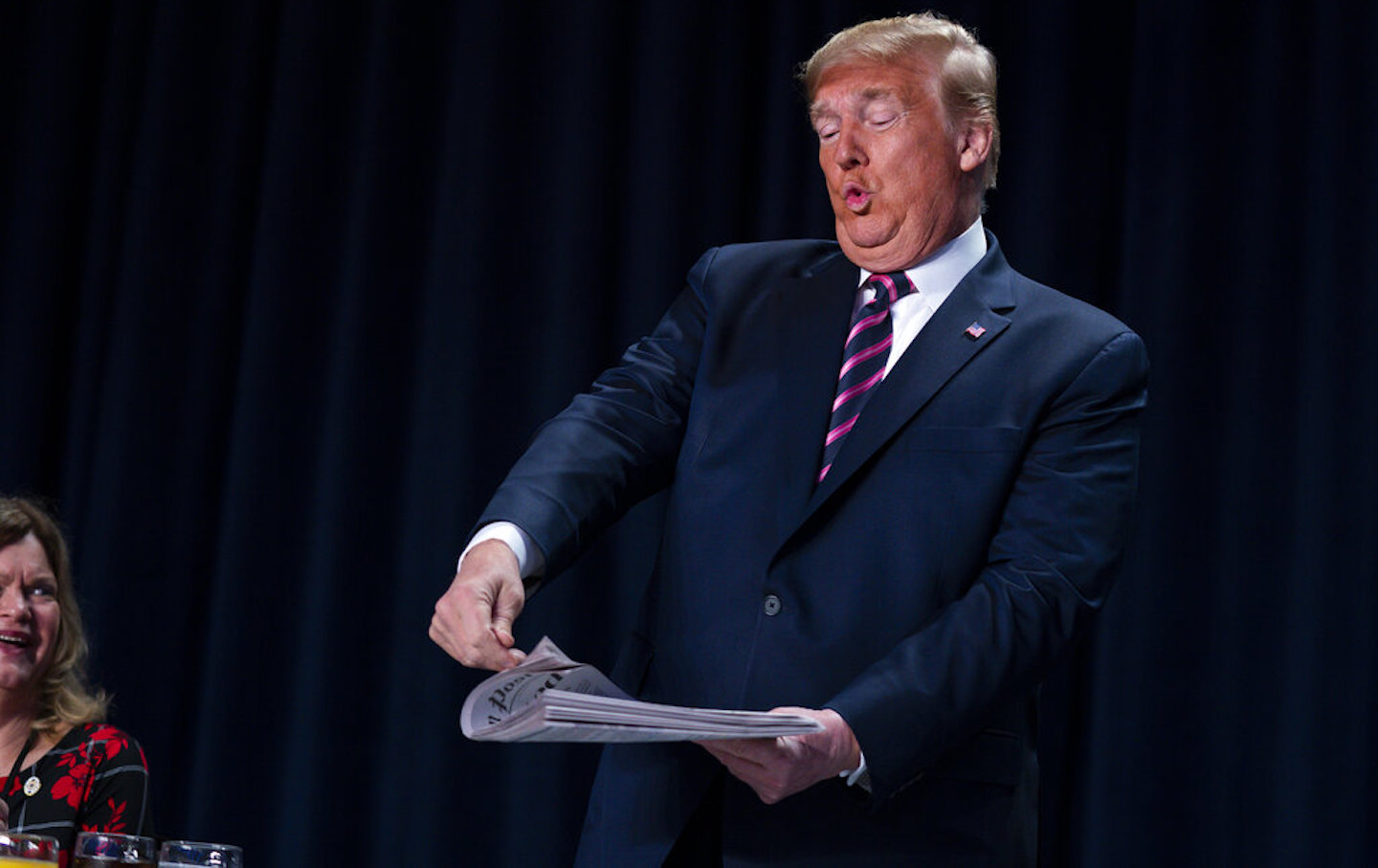
Donald Trump reacts to a newspaper at the 68th annual National Prayer Breakfast, at the Washington Hilton, on February 6, 2020.
(Evan Vucci / AP Photo)
If the de facto slogan for mainstream journalism under the first Trump administration was The Washington Post’s self-serious and erratically observed clarion call “Democracy Dies in Darkness,” the rallying cry for media companies under a second Trump term appears to be “you deserve a break today.” After journalists have documented a long series of unprecedented abuses of executive power under the presidency of a Roy Cohn protégé setting policy on a broad Mob-like calculus of punishment and tribal exclusion, media managers are sizing up the prospect of a resurgent MAGA siege of power with the wan shrug of practiced brand managers.
“One of the things that we recognize is that there’s nobody who just only cares about politics and nothing else,” Katie Palmer, the executive editor of the liberal resistance outlet HuffPost, told the media marketing trade sheet Digiday. “You can follow politics really closely, but also need advice on your marriage. We do try to recognize that people need a little bit of everything.” So HuffPost will meet the existential challenge to democracy presented by an unshackled Trump White House with a boost to the site’s lifestyle coverage, Digiday reports, including an increased focus on “the American family.”
Palmer’s complacent click-chasing strategy is far from an outlier. Josh Awtry, an audience development executive at Newsweek, explained that his brief for the coming year is to achieve “more interactivity with our readership.” And that, in turn, means watering down hard news and political coverage. “Many days, the majority of our audience comes from Google Discover,” Awtry said, which “favors increasingly softer, lifestyle- and consumer-focused” sorts of content. Yes, the aggressive agenda that Trump and his enablers have pledged to bring to his initial days in office will boost traffic with a steady string of scandal and breaking news, but the recent market swoons of formerly resistance-branded properties like The Washington Post and MSNBC—whose CEO Rashida Jones resigned on the cusp of the new Trump presidency—have media marketers skittish about embracing a politics-first coverage model. “I think the general feeling in market [sic] is a news site that solely exists around a breaking news desk is not going to be able to continue to create long-term renewable [direct] advertising partnerships,” says Blair Tapper, another engagement maven for the UK Independent, which has recently expanded its US operations and is—wait for it—planning “to build out lifestyle coverage this year in the areas of travel, personal finance and culture,” Digiday reports.
The quest for maximal “interactive” and how-to engagement in the digital-media world is something I experienced at depressingly close remove during my tenure as a news executive for Yahoo. The basic formula has changed little since then: Digital producers launch brand partnerships, video snippets, and interactive gimmicks under a hazy mission to deliver bland and occasionally titillating content to distracted digital users. You then keep them queued up for more via e-mail newsletters, glorified product reviews, games, and other lifestyle fluff. The strategy may fatten bottom lines as far as engagement is concerned, but it’s a far cry from journalism as any sort of civic social practice, which operates mostly by telling readers precisely what they don’t want to hear—news of corruption, self-dealing, bigoted mendacity, brute economic privilege, and other unfortunately chronic features of our public life.
One anecdote stands out among countless others from my tenure at Yahoo’s market-prostate news shop: After the Obama administration released the president’s long-form birth certificate in response to Donald Trump’s bullshit campaign to call Obama’s citizenship into question, one of my bosses told me that we should “get the birther view” on this latest development. When I explained that there was, in fact, no empirically coherent “birther view”—that this was all a racialized panic ginned up by bad ideological actors, and that we’d cover it in precisely that fashion—I realized my news-managing days in Silicon Valley were numbered; the fluff-first model of digital engagement left vanshingly little space for traditional news judgment, and all sorts of room for malevolent ideologues, liars, and garden-variety hustlers to wreak havoc.
And now, more than a dozen years later, the dominant model of digital information in our flailing republic has, against all odds, gotten immeasurably worse. That’s the unmistakable message behind Facebook founder Mark Zuckerberg’s MAGA makeover on the eve of Trump’s return to the White House: Meta, Facebook’s dystopian parent company, is suspending content moderation reviews for posts on Instagram and Facebook, Zuckerberg announced, and will rely instead on the user-generated system of “community notes” that has rendered Elon Musk’s X platform a right-wing paranoiac shit show.
As Siva Vaidyanathan observes, Zuckerberg’s hard-right rebrand is an extension of the bro billionaire’s world-conquering megalomania; in that respect, it follows the basic arc that saw Musk transformed into an apostle of “dark gothic MAGA.” And Zuckerberg has visited all the stations of the cross for an eager billionaire MAGA recruit: a seven-figure donation to Trump’s inauguration, the ritual sacrifice of Meta’s DEI program, a ring-kissing junket to Mar-a-Lago, and a star turn on the Joe Rogan podcast assailing the “cultural elites” creating media discourse and calling for their “repopulation” by “a new class of creators”—i.e., endlessly indulged plutocratic assholes like Zuckerberg and Musk.
You don’t need to exert yourself much to see where this formula leads. As the LA wildfires rage on, X, Facebook, and other moderation-averse sites are choked with delusional right-wing conspiracy theories about what touched them off and what’s prevented their immediate dousing. The culprits include DEI initiatives, Ukraine military support, Chinese subversion, and—yes—the Jews. President-elect Donald Trump has offered slightly sanitized variations on the same basic themes, falsely claiming that the Biden administration failed to fund emergency disaster relief efforts and inventing out of whole cloth a smelt-conservation program that, as he fondly imagines, diverted water from Angelenos in the fires’ paths. Reliable on-the-ground reports on the disaster come overwhelmingly from local and nonprofit reporters, as the LA-based journalist and union activist Matt Pearce notes:
Our local news broadcasters have produced incomparable visuals and news-making interviews about the latest on the ground. Our local news photographers have produced stellar work showing the tragedy and heroism of civilians and firefighters on the front lines; they’re not the ones damaging firefighting planes with unauthorized amateur drones in closed disaster zones. When Patrick Soon-Shiong became a source of misinformation on Elon Musk’s X app about the Los Angeles Fire Department’s finances, his own newsroom at the Los Angeles Times corrected the record about an enormously complex budget issue. The traditional press corps will continue playing a central role in deciphering the knotty policy and political issues unfolding around what went wrong in these fires that policymakers will need to confront.
The contrast supplies a bracing split-screen effect for anyone seeking reliable information in the crisis, Pearce writes: “While my colleagues in L.A.’s local news industry put their lives on hold and even their lives on the line to cover the fires in Altadena and the Palisades, the profit-driven tech platforms where many of us now get information sat back as conspiracy theories and hate-mongering about our neighbors’ suffering proliferated.”
It’s no exaggeration to say that this acute disparity in honest reporting is a preview of what’s to come. Indeed, one telling bit of local news initiative involved a firefighter’s viral edit from a livestream on the fires that showed Musk berating a Los Angeles Fire Department official over nonexistent water shortages. As the official patiently explained that the LA system wasn’t short on water at all—that the sheer scale of the blazes overtaxed an urban fire control regimen that wasn’t designed to combat wild fires—Musk abruptly cut off his livestream, looking like the chastened ignoramus he is. Meanwhile, our mainstream political press is already staging debates over Trump’s bid to annex Greenland as though there were a sane policy discussion buried within it, The Washington Post offers up a phoned-in scorecard endorsement of most of Trump’s mobbed-up and incompetent cabinet nominees, and an emboldened incoming Trump White House is administering loyalty oaths to civil servants working on national-security matters. Don’t worry, though—each new week will bring a fresh stream of how-tos, listicles, weird tricks, and celebrity gossip, as the MAGA right continues to pillage, bully, and lie.
Become a Sustaining Donor This September
Between the reemergence of right-wing red-baiting and Donald Trump’s use of the chilling National Security Presidential Memorandum–7 to criminalize left political organizing, we’re seeing McCarthyism reborn before our eyes.
This assault on democracy cannot be ignored or wished away. Resisting it requires bravery in the face of threats and repression, a steadfast commitment to the truth, and the unwavering belief that we can—and will—overcome this darkness.
We must have an independent media that sets the record straight, unearths corruption and abuses of power, and advances a politics of justice and dignity for all if we’re to win this fight.
That’s why I’m writing to you today. This September, The Nation needs to add 100 monthly donors to sustain our progressive journalism. Your contribution makes the next investigative report, the next truth-speaking column, and the next pathbreaking essay all possible.
I hope you’ll support our work with a recurring donation today. If you donate $10 or more a month, we’ll send you a brand new “Hands Off the Free Press!” sticker to recognise your commitment to our cause. Please, donate today.
Onward,
Katrina vanden Heuvel
Editor and Publisher, The Nation