Republicans Are Hazardous to Your Health
A new study shows that states dominated by conservatives have markedly worse health outcomes.
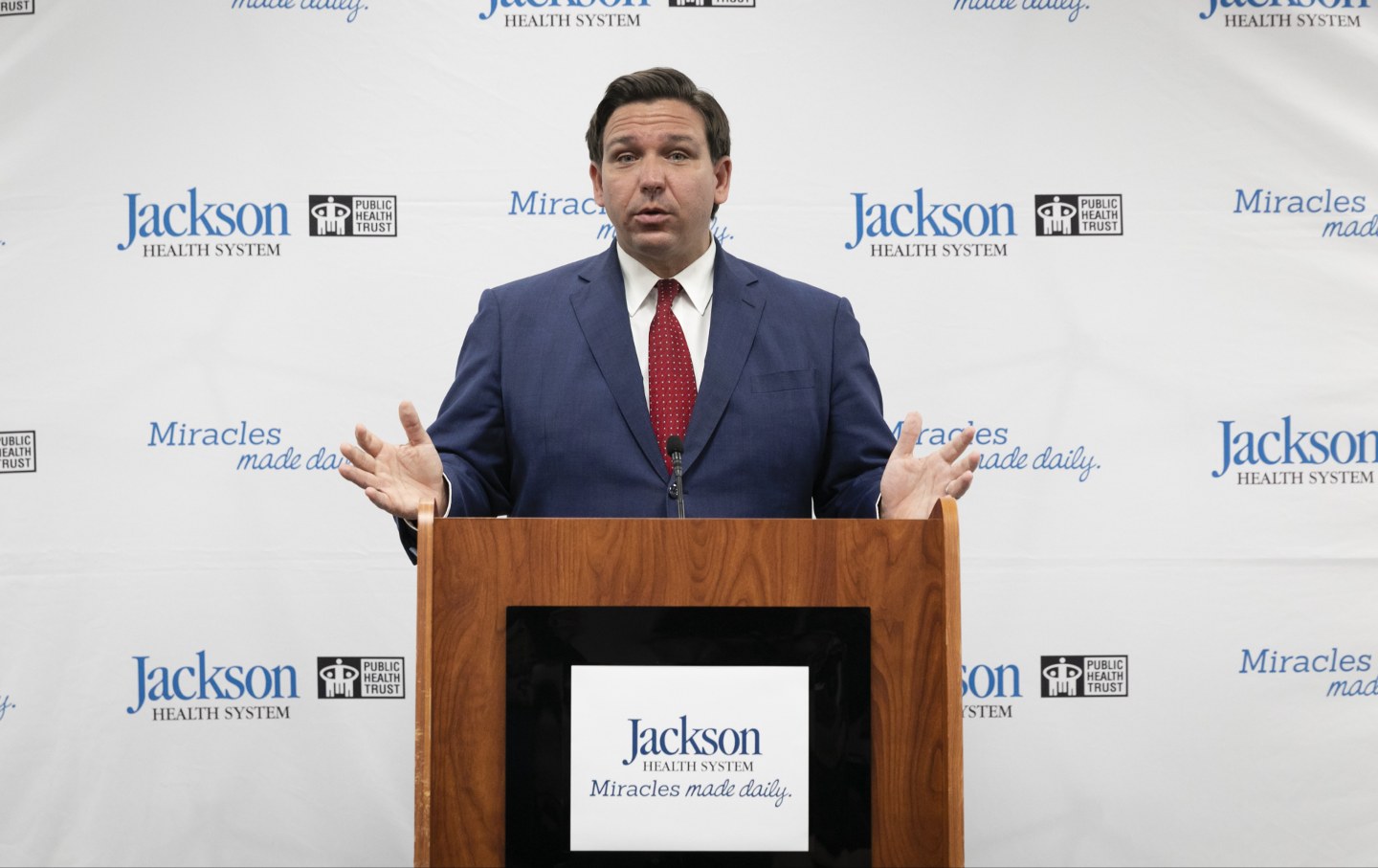
Ron DeSantis, governor of Florida, speaks during a press conference at Jackson Memorial Hospital in Miami, Florida, on Monday, July 13, 2020.
(Eva Marie Uzcategui / Bloomberg via Getty Images)As we hurtle toward the November elections, I thought it was worth talking about how our votes affect our health and the health of our communities. In that regard, a new working paper from researchers at Harvard and Drexel universities caught my eye. It’s called “Politicians, power, and the people’s health: US elections and state health outcomes, 2012–2024.”
While there is a robust literature emerging on the “political determinants” of health, this new paper, led by Nancy Krieger, one of the most eminent social epidemiologists in the country, frames this discussion with a broader than usual definition of state-level political characteristics and uses the most current data on a set of health outcomes to interrogate the impact of politics on our health.
In addition to the political lean of voters in states across the United States, Krieger and colleagues look at the voting records of those states’ US senators and representatives, which party controls each state, and a large set of economic and social policies enacted at the state level. This gives a more comprehensive picture of t the local political environment across the country. Then the authors look at eight health outcomes: infant mortality; overall premature mortality; health insurance status; Covid and flu vaccination for children and the elderly; maternity care deserts and; food insecurity.
Sadly, the authors found that greater local political conservativism was associated with worse health outcomes, even after considering poverty rates for each state in the analysis, which was likely to attenuate their results, as poverty itself is a strong driver of ill health.
The authors are quick to say that this is a descriptive study—it doesn’t establish a cause-and-effect relationship between a state’s politics and health outcomes, and there may be other factors at work that are driving the results. However, this paper reinforces insights from other researchers who have looked at possible links between state politics and health outcomes and come to similar conclusions. This isn’t surprising: State policies on a variety of issues, from health care (e.g., Medicaid expansion) and public health, to other “determinants of health,” including taxation, education, the social safety net, immigration, and abortion, are all going to affect health outcomes.
Politicians make policy choices for many different reasons, not all of them connected to health. But it’s inevitable that some of those decisions will affect public health, all the same. Conservative states simply make poor choices. As the saying goes, facts may just indeed have a liberal bias. Wishing it were otherwise doesn’t make it so. As Election Day approaches, Krieger and her colleagues’ piece reminds us that downballot choices are as important to our lives as who enters the White House next January.
Another report came out late last month, from the Commonwealth Fund, called “Mirror, Mirror 2024: A Portrait of the Failing U.S. Health System—Comparing Performance in 10 Nations.” While the Harvard study points toward disparities in state health outcomes in the US, the Commonwealth Fund compares our outcomes to our rich nation peers’. The killer conclusion: “The U.S. continues to be in a class by itself in the underperformance of its health care sector. While the other nine countries differ in the details of their systems and in their performance on domains, unlike the U.S., they all have found a way to meet their residents’ most basic health care needs.”
This is a devastating critique, but it’s not new. It’s the biggest thing no one talks about in the US. I’ve said it before: We are letting a public health disaster unfold in slow motion. We’re in the mid-40s in life-expectancy rankings compared to other countries and will slide further down over the next few decades if nothing changes. The Commonwealth Fund points towards some key problems for us: a lack of investment in primary care; the administrative inefficiency caused by the plethora of health insurance products in the US; the consolidation of hospitals and physician practices that are driving up prices; our weak social safety net and public health system; and social and economic policies that make things worse.
Unlike the article by Nancy Krieger and her colleagues, the Commonwealth Fund report doesn’t make the link between our politics and our health outcomes. Here, things get tricky: This isn’t a Republican vs. Democratic dilemma. Both parties have contributed to our national downfall.
If conservative states are making bad choices compared to more liberal ones, our whole political system is making bad choices compared to other countries around the world. Take that in. It means that, while our electoral choices this November are critical, we need a more radical transformation (radical by American standards, not global ones, as dozens and dozens of countries have made better choices for themselves) to lift us up to a healthier future.