Bernie Among the Billionaires
The fiery populist spoke alongside party plutocrats, raising question of who is really in charge of the Democratic Party.
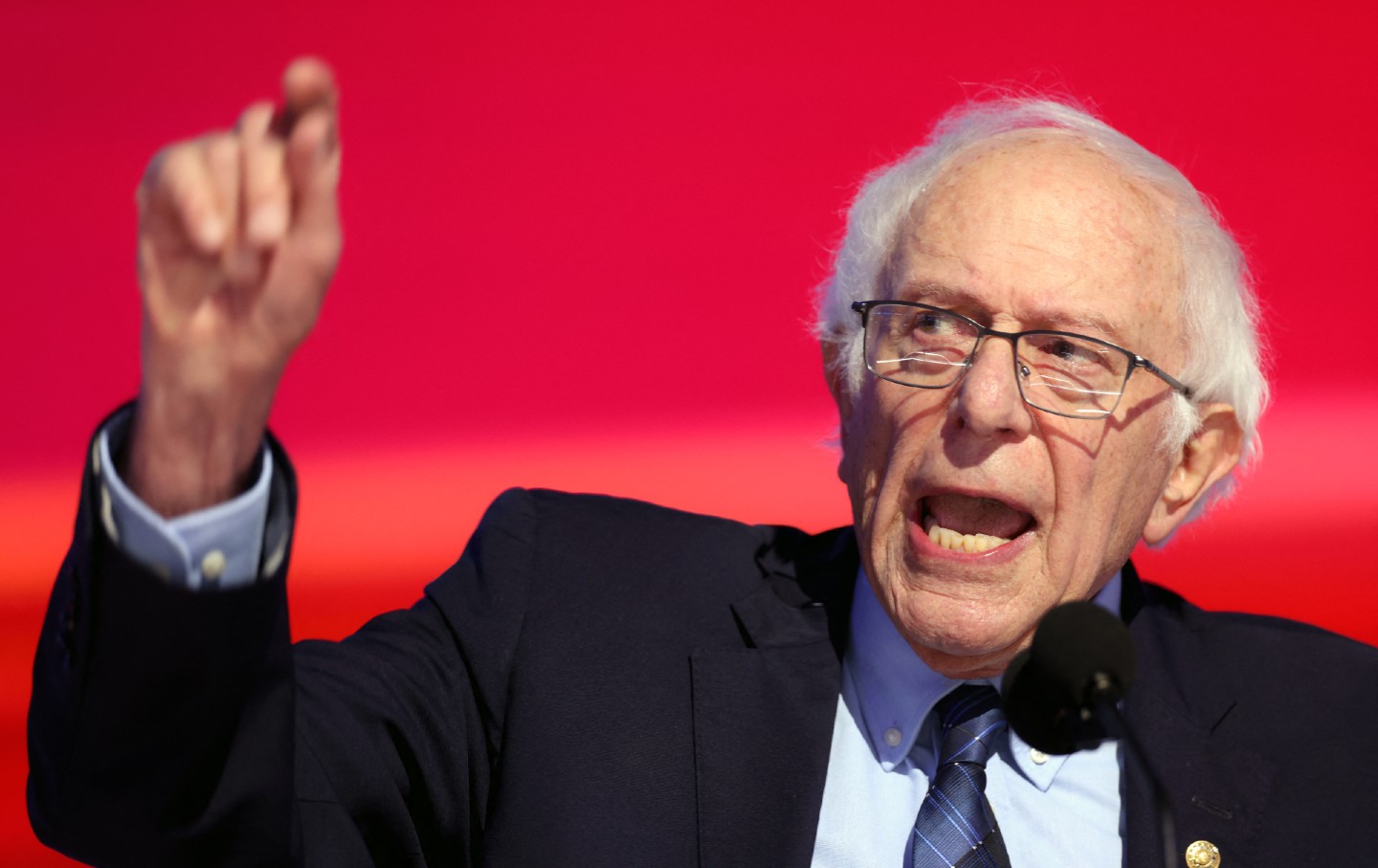
Senator Bernie Sanders speaks on the second day of the Democratic National Convention at the United Center in Chicago on August 20, 2024.
(Charly Triballeau / AFP via Getty Images)
Not surprisingly, Bernie Sanders gave the most substantive speech at the Democratic National Convention, one that did not bask in the good vibes of a party now headed by a youthful, energetic presidential nominee. Sanders has always been a policy-first politician, one obsessively focused on using the power of the state to create a more egalitarian America. Sanders bluntly and relentlessly used his 12 minutes to celebrate the achievements of the Biden administration and to highlight all the work that can be done if the Democrats win the White House as well as the House and Senate.
Sanders thundered that “we need to join the rest of the industrialized world and guarantee healthcare to all people as a human right, not a privilege. We need to raise the minimum wage to a living wage. We need to pass the PRO Act so that workers can organize into unions.” He further called for continued fights against Big Pharma to lower drug prices as well as battles against other “corporate monopoly monoliths” such as “Big Oil, Big Agriculture, [and] Big Tech.”
In making this full-throated case for economic populism, Sanders didn’t shy away from naming the forces that would stand in the way of this program. Sanders excoriated “these oligarchs” and “the billionaire class” who “tell us we should not tax the rich” and “tell us we should not take on price gouging.” Mindful of the recent primary defeats of Representatives Jamaal Bowman and Cori Bush, both of whom had been targeted in primary challenges massively funded by AIPAC and other interest groups, Sanders insisted that “billionaires in both parties should not be able to buy elections including primaries.”
This populist message was pointed and urgent, but also complicated by the fact that Sanders shared a stage with representatives of the billionaire class. Sanders was followed by Illinois Governor J.B. Pritzker, scion of a family that owns the Hyatt Hotel chain, as well as former American Express CEO Ken Chenault (perhaps not a billionaire, but certainly a voice for the corporate monopolies that Sanders had condemned).
Pritzker even joked that the audience should “take it from an actual billionaire, Trump is rich in only one thing, stupidity.” Although the audience enjoyed the quip, it was redolent of an earlier time. In 2016, when Democrats frequently mocked Trump as “not a real billionaire.” This was always a counterproductive argument, since it is contradicted by Trump’s lavish lifestyle (which might not be that of a billionaire but is shared by only a small number of Americans) and the reactionary implication that there is something admirable about real billionaires. In 2024, the more common (and genuinely populist) Democratic line is that Trump is an out-of-touch rich guy who looking out only for himself and his buddies.
Chenault was not boastful of his wealth but did take comfort in his belief that “Kamala Harris understands that government must work in partnership with the business community. She knows that a market-based economy needs a strong and effective government.”
The Democratic Party is a coalition, which means that its different factions pursue divergent agendas within the frame of the party. Some of those contradictions can be seen in the fact that the robust social democracy of Bernie Sanders shared the stage with the billionaire boasts of Pritzker and the business-community boosterism of Chenault. One way to frame this contradiction is to say that Sanders’s movement for a populist revolution is in danger of being co-opted by a fundamentally pro-capitalist party.
But that framing misses the fact that the Democratic Party has in fact changed and abandoned the neoliberal orthodoxy that governed the presidencies of Bill Clinton and Barack Obama. Certainly both Biden and Harris, thanks in no small part to the strong showing Sanders had in the 2016 and 2020 Democratic Party primaries, have pursued a much more robust program of government intervention in the economy than any Democrats in recent decades. In other words, Sanders has to some extent co-opted the Democrats as much as been co-opted by them.
As Robert L. Borosage recently noted in The Nation:
The centrist Washington consensus of the Clinton era is no more. While Obama’s two terms could be characterized as a continuation of the Bill Clinton years (with, as one pundit put it, Hillary running in 2016 for Clinton’s fifth term), Trump’s victory in 2016 and Biden’s four years began a dramatic break. The neoliberalism that Clinton and Obama championed—deregulation, free trade, fiscal austerity—has proved a failure…. On the eve of the convention, The New York Times reported on the “quietly held bond” between Hillary Clinton and Harris, but progressives have won the argument inside the party.
More from the 2024 Democratic National Convention:
Pritzker and Chenault are themselves proof of the change. Pritzker might be a billionaire, but he has governed as a strong progressive, making real allies with the party’s left. For his part, Chenault in his speech praised Harris for knowing that the way to help the economy is not to “give people like me a tax cut” but rather use tax money to “grow the middle class.” Chenault claimed Harris would be “both pro-business and pro-worker.”
There remains, of course, a fundamental divide between Sanders on the one hand and wealthy Democrats such as Pritzker and Chenault on the other. Sanders’s politics are rooted in class war: He wants to limit the power of the 1 percent to help the majority. Pritzker, by contrast, speaks of a politics of national unity based on being “kind.” Sanders wants justice; Pritzker wants kindness. The dispute between these two paths has yet to be settled. And the billionaire class, as it has shown in its campaign against Bowman and Bush, has plenty of weapons in its arsenal.
Still, even as the struggle continues, Sanders can take comfort in the fact that in the war for the soul of the party, he is winning.