Palestinian Olympians Are Competing as Their World Burns
Palestinian Olympians will make history in Paris, despite unfathomable conditions of genocide.
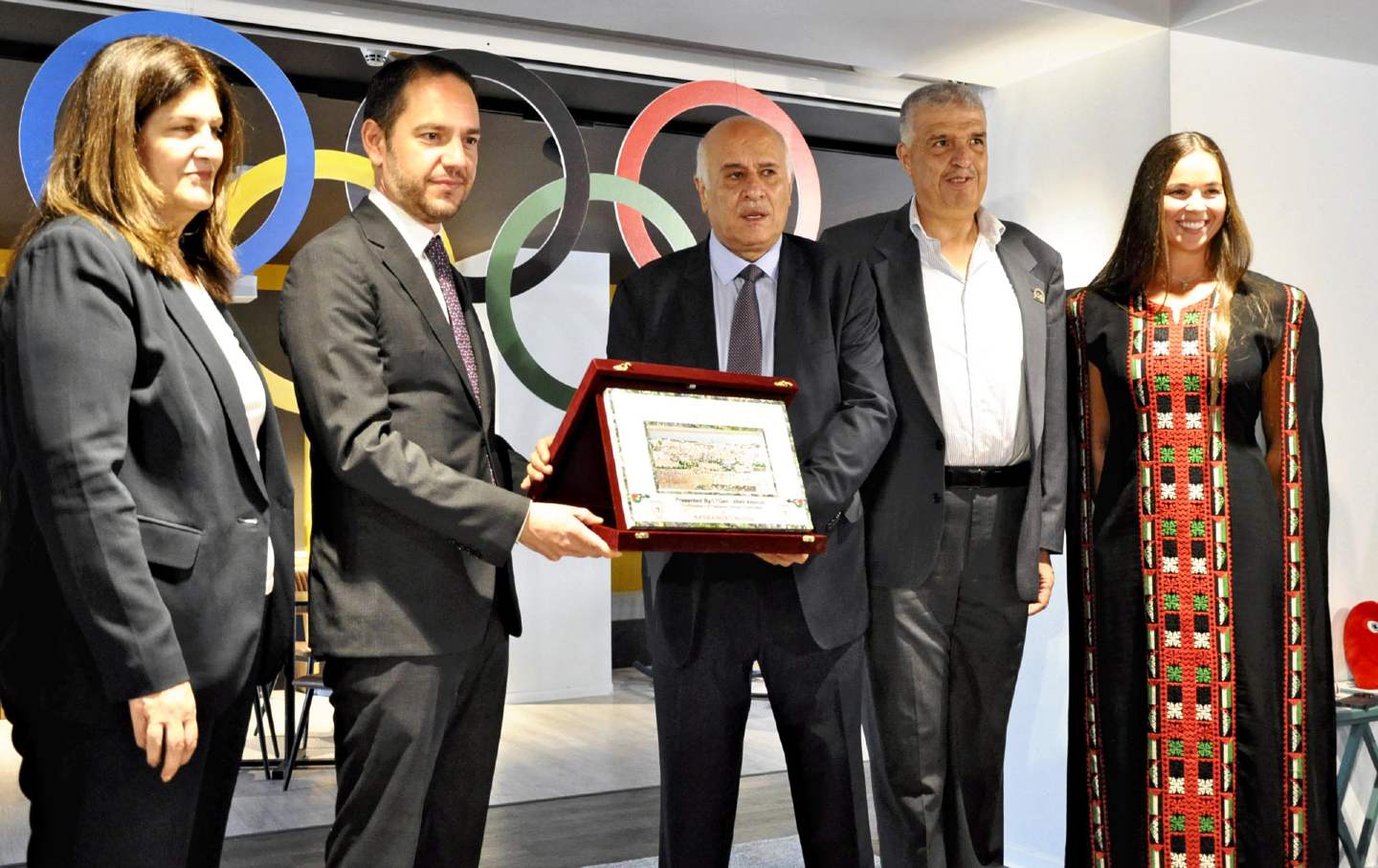
A send-off party for Olympic and Paralympic Games to cheer eight Palestine athletes held in Ramallaj, the West Bank, on July 14, 2024.
(Yomiuri Shimbun / AP Photo)
Eight Palestinian athletes are ready to compete at the 2024 Paris Summer Olympics. Seven of them have secured what are called “universality places,” which permit athletes from nations that have underdeveloped sports programs to take part in the games even if they come up short of formally qualifying. More than 100 countries have access to this program, although for many, including Palestine, “underdevelopment” is International Olympic Committee platitudinous palaver for a place decimated by economic or military means.
The one Palestinian competitor who bested all foes on his journey to the games is an 18-year-old Taekwondo fighter named Omar Ismail. He will be the first Palestinian to ever compete at the Olympics in any combat sport. Going for gold in the 128-pound (58 kg) category, the wiry Ismail entered the qualifying tournament as an underdog, ranking fifth. But he took down opponents from Saudi Arabia, the UAE, and Afghanistan in a fashion that belied his young age. One would never know—unless they were looking at his baby-faced visage—that as recently as two years ago, Ismail was competing solely in youth competitions. Posting on his Instagram after achieving entry, Ismail wrote, “Very proud and happy to say that I’ve made it this far. All thanks to my amazing coach and the Palestinian federation for being the best support system anyone can have. A chance of a lifetime indeed; and now one step closer to an Olympic medal.”
Of course, Ismail and the other Palestinian athletes are competing with an unfathomable weight on their shoulders. Despite almost vanishing from the US media, Israel’s genocidal war against Gaza, as well as rising violence against Palestinians in the West Bank, continues. Every day, it seems, another hospital or displacement camp is bombed, while the world can barely be troubled to bear witness. Israel’s total war strategy, where every Palestinian, even children, are seen as Hamas and therefore legitimate—or simply unfortunate—targets, has been normalized for US consumers as just another blip in the media cycle. But Ismail and the other Olympians are well aware that their performance at the games matters beyond Paris. “I’m thinking of kids in Palestine…in Gaza, also, and I hope they can see me as a role model,” he said in a phone interview with NBC News. Ismail is also known for displaying the Palestinian flag for the cameras after competing with a keffiyah around his shoulders.
Ismail and his fellow Palestinian Olympians will compete while activists call for excluding Israel from the games, not only for continuing this endless war on civilians throughout Palestine but also for the toll it has taken on the Palestinian athletic community. More than 400 Palestinian athletes and coaches have been killed since the Hamas attacks of October 7. Among them is Majed Abu Maraheel, 61, the first Palestinian to ever compete in the Olympic games, back in 1996 in Atlanta. Marahedel died in Gaza from kidney failure after the Israeli Defense Forces denied him access to lifesaving medical care that was awaiting him in Egypt.
In addition to these horrors, sports facilities across Gaza have been destroyed by Israeli bombs. Some stadiums have been used by the IDF for detention and torture. Activists have also pointed out the hypocrisy of the IOC’s sanctions on Russian Olympic athletes, in response to the invasion of Ukraine, given the absence of any similar sanctions for competitors from Israel. Meanwhile, Israel announced earlier this month that even more land would be seized for illegal Israeli settlements. This is the burden that 18-year-old Ismail and the other Palestinian Olympians bear as they set out to make history in Paris.
One of them, the 24-year-old Palestinian American swimmer Valerie Tarazi, recently received a master’s degree from Auburn University and plans to pursue a PhD. She says she is competing to “speak up for the people who can’t.” Her roots are in Gaza. “I say I’m one of the luckiest Palestinians in the whole world because I’m not there—but at the same time, I’m one of the unluckiest Palestinians in the world because I can’t be there because it’s not safe enough,” she said. “It weighs on all of us every single day.”
That these athletes are competing at all makes them heroes. But that they have to do so under these conditions—the conditions of genocide—is a tragedy, one the world cannot abide. Omar Ismail will make history in Paris; his very presence is a testimony to rejecting defeat. But symbolic resistance can only take us so far in the battle for justice and peace.