Economy / Column / March 29, 2024

LA’s Forgotten Strike

Hotel workers have been demanding fair wages and benefits for months—and owners are starting to cave.

Sasha Abramsky

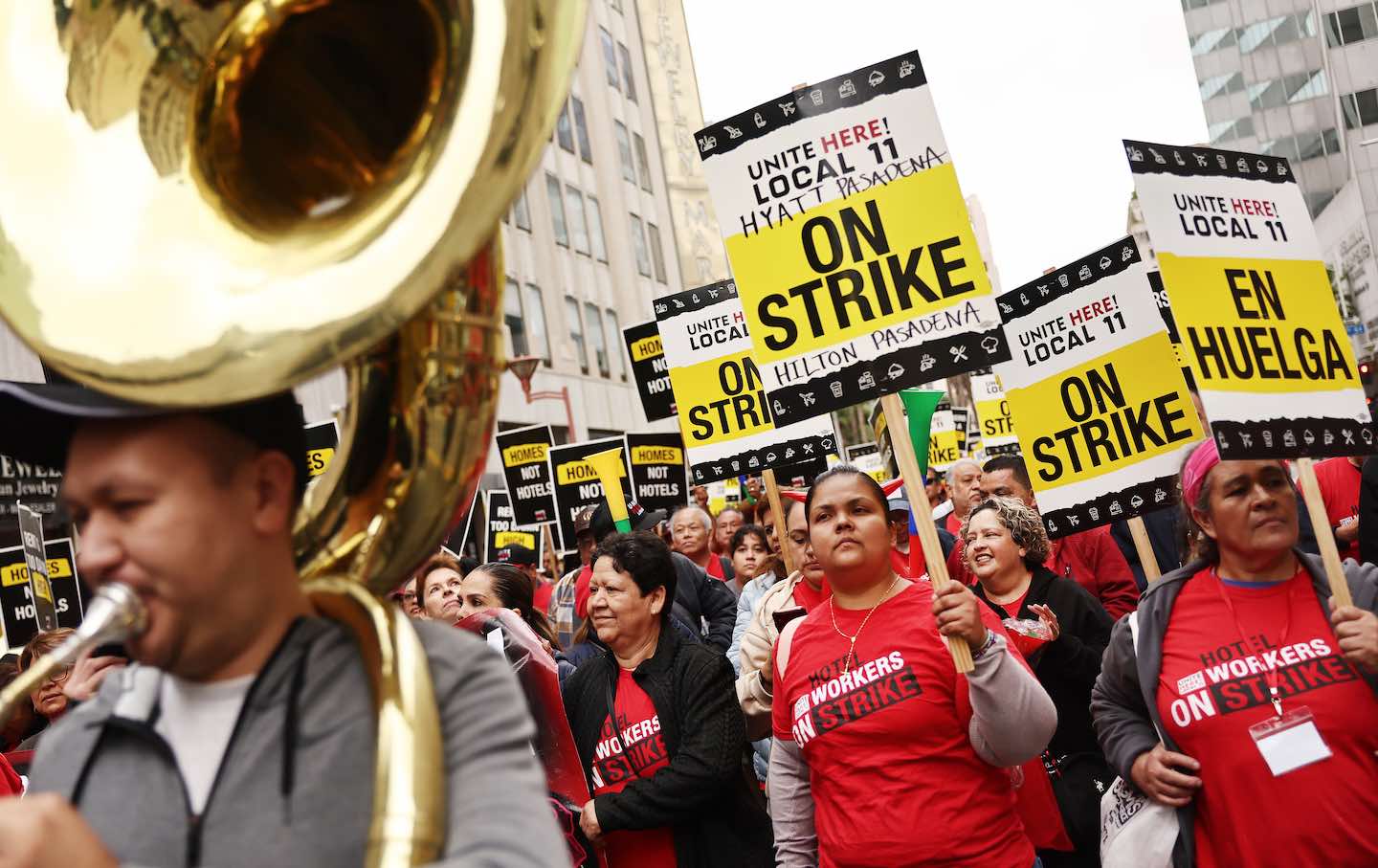
Hotel workers with Unite Here Local 11 march through downtown LA on October 25, 2023.

(Mario Tama / Getty Images)

Months after the end of the screenwriters’ and actors’ strikes, another Los Angeles labor action continues apace. The city’s forgotten strike is that of the hotel workers organized by Unite Here! Local 11, who have been engaged in a series of rolling strikes against dozens of LA-region hotels. Even as workers’ contracts have expired, the hotels have balked at agreeing to new contracts with union negotiators.

In recent weeks, an increasing number of owners have cried uncle and settled with their workers, agreeing to improved pay rates, better benefits packages and stronger worker protection measures. As of this week, thirty-four hotels have agreed to new contracts, which include a $5-per-hour initial pay increase, translating to a 20 percent hike in wages, and a cumulative pay increase of $10 per hour by 2027 for room attendants, cooks, and other non-tipped workers. The hotels also agreed to continue paying the vast majority of health insurance premiums for employees and their families, with the workers themselves not having to pay more than $20 per month.

This continues an emphasis that Local 11—one of a slew of progressive, activist, service-sector unions that have risen to the forefront of labor organizing in Los Angeles, Las Vegas, and other western cities in recent years—has placed on winning not just better wages, but, equally importantly, better benefits: since 2018, the union has secured pension contribution increases from the hotels totaling 600 percent. As a result, their pension fund is one of America’s best funded for service workers. They have also pushed for equitable hiring opportunities for people with criminal justice convictions, and for increased protections for immigrant workers. Cumulatively, this package represents an extraordinary win for labor in the country’s second-largest city.

Many other hotels, however, including well-known Downtown hotels such as the Hotel Figueroa, have, so far, refused to settle with the union. In February, more than one hundred non-unionized food and beverage operators who were trying to unionize were fired at the Figueroa. That same month, several striking workers were shot at with ball bearings by unknown assailants, as they walked the picket line outside the hotel—one was hit in the head. In the wake of these developments, Local 11 called for a boycott of the hotel. They also called for a boycott of the Maya Hotel, in Long Beach, which has also seen violence against striking workers.

“We’ve been doing this fight for eight months now,” says Nohelia Gonzalez, 52, who has worked as a housekeeper at the Figueroa for the past three years. “The hotel knows what’s been going on, that we’ve fighting for this contract for months now, and they’ve chosen not to listen to us.”

The union is particularly incensed about the firing of the non-unionized workers and has asked the city’s district attorney to open an investigation to determine whether the action violates the new Los Angeles Hotel Workers’ Retention Ordinance. This measure came out of the pandemic, putting in place protections for temporarily laid-off workforces so that they would be rehired as the hotels bounced back from the pandemic closures. Local 11 alleges that the hotel closed the restaurant on February 11 and reopened two days later with brand new workers, thus doing an end-run around the unionization efforts.

For Gonzalez, this speaks to a broader issue: what the union sees as management’s disregard for the basic needs of its workforce. One of the union’s biggest complaints is that workers are paid too little to allow them to afford housing, in LA’s expensive housing market, that is near their place of employment. Gonzalez herself commutes two hours each way, on two busses and the LA Metro, from her $2,250 per month rental unit. On the $24 per hour that she currently earns—a wage that in some states generates at least a degree of economic stability, but in California doesn’t allow workers to build up savings and security—she can’t afford to pay the higher rents that landlords charge nearer the center of the city.

“So we’re going to continue to fight,” Gonzalez says. The union is, according to spokesperson Maria Hernandez, urging would-be customers at the Figueroa “not to eat, sleep, party, spend money, patronize the hotel until a contract is signed, workers are brought back, and there’s an end to the violence.”
Disobey authoritarians, support The Nation

Over the past year you’ve read Nation writers like Elie Mystal, Kaveh Akbar, John Nichols, Joan Walsh, Bryce Covert, Dave Zirin, Jeet Heer, Michael T. Klare, Katha Pollitt, Amy Littlefield, Gregg Gonsalves, and Sasha Abramsky take on the Trump family’s corruption, set the record straight about Robert F. Kennedy Jr.’s catastrophic Make America Healthy Again movement, survey the fallout and human cost of the DOGE wrecking ball, anticipate the Supreme Court’s dangerous antidemocratic rulings, and amplify successful tactics of resistance on the streets and in Congress.

We publish these stories because when members of our communities are being abducted, household debt is climbing, and AI data centers are causing water and electricity shortages, we have a duty as journalists to do all we can to inform the public.

In 2026, our aim is to do more than ever before—but we need your support to make that happen. 

Through December 31, a generous donor will match all donations up to $75,000. That means that your contribution will be doubled, dollar for dollar. If we hit the full match, we’ll be starting 2026 with $150,000 to invest in the stories that impact real people’s lives—the kinds of stories that billionaire-owned, corporate-backed outlets aren’t covering. 

With your support, our team will publish major stories that the president and his allies won’t want you to read. We’ll cover the emerging military-tech industrial complex and matters of war, peace, and surveillance, as well as the affordability crisis, hunger, housing, healthcare, the environment, attacks on reproductive rights, and much more. At the same time, we’ll imagine alternatives to Trumpian rule and uplift efforts to create a better world, here and now. 

While your gift has twice the impact, I’m asking you to support The Nation with a donation today. You’ll empower the journalists, editors, and fact-checkers best equipped to hold this authoritarian administration to account. 

I hope you won’t miss this moment—donate to The Nation today.

Onward,

Katrina vanden Heuvel 

Editor and publisher, The Nation

Sasha Abramsky

Sasha Abramsky is the author of several books, including The American Way of PovertyThe House of Twenty Thousand Books, Little Wonder: The Fabulous Story of Lottie Dod, the World's First Female Sports Superstar, and Chaos Comes Calling: The Battle Against the Far-Right Takeover of Small-Town America. His latest book, American Carnage: How Trump, Musk, and DOGE Butchered the US Government, is available for pre-order and will be released in January.

More from The Nation

The Warner Bros. Discovery flag alongside the American one, outside Warsaw’s TVN broadcasting studio

One Buyout After Another One Buyout After Another

The multibillion-dollar takeover bids targeting Warner Bros. Discovery show how Trump’s corrupt model of governance-by-payback could destroy Hollywood.

Ben Schwartz

President Trump speaks at a November 18 dinner in honor of Saudi Prince Mohammed Bin Salman.

The Grim Spectacle of Trump’s Gaudy Saudi Summit The Grim Spectacle of Trump’s Gaudy Saudi Summit

A weeklong debauch brought together tech insiders and the leaders of a brutal monarchy to keep stoking the AI bubble.

Jacob Silverman

Transition cochair Lina Khan speaks during a press conference at the Unisphere on November 5, 2025, in the Queens borough of New York City.

What Does Lina Khan’s Trust-Busting Mean for New York City? What Does Lina Khan’s Trust-Busting Mean for New York City?

Under-scrutinized monopolies—like the fire truck oligopoly—hinder municipal functions.

Katrina vanden Heuvel

A grocery store in Dorchester, Massachusetts, warns customers that SNAP benefits have been suspended.

A Brief History of Right-Wing Attacks on Food Stamps A Brief History of Right-Wing Attacks on Food Stamps

A trip through The Nation’s archives offers essential insights into why Republicans have long tried to weaken SNAP—and why they’re trying to kill it now.

Richard Kreitner

Donald Trump, joined by Republican lawmakers, signs the One Big Beautiful Bill Act into law.

Trump Has Just Condemned More Americans to Hunger Trump Has Just Condemned More Americans to Hunger

The administration’s decision to fast-track a bunch of changes to food stamps—including new work requirements—is as stupid as it is cruel.

Elie Mystal

Jaime Solorio, an immigrant H-2A worker recruited in Mexico, digs post holes for wire supports for planting apple trees

Trump Drops the Hammer on Farmworkers Trump Drops the Hammer on Farmworkers

At the end of the season, he cuts wages of 400,000 workers by a third.

David Bacon