
Nebraska’s New Racist “Stand Your Ground” Law Puts Us All in Danger
A society of armed individuals carrying concealed weapons, who perceive strangers as attackers and have no duty to de-escalate, doesn’t make anyone more safe.
Lincoln, Neb.—Last week—February 26—marked 12 years since the senseless and brutal killing of Trayvon Martin, an innocent 17-year-old Black boy, at the hands of a man who was acting as a vigilante. The memory of Trayvon has frequently been invoked by politicians as threats from gun violence and the national consciousness around racism have intensified over the past several years, but the landscape has not improved. At least 35 states have since enacted some form of the “stand your ground” law that allowed Martin’s murderer to walk free. Such laws—defining how and where a person can defend themselves when they feel their life is in danger—are directly linked to rising gun deaths and racist violence in the United States.
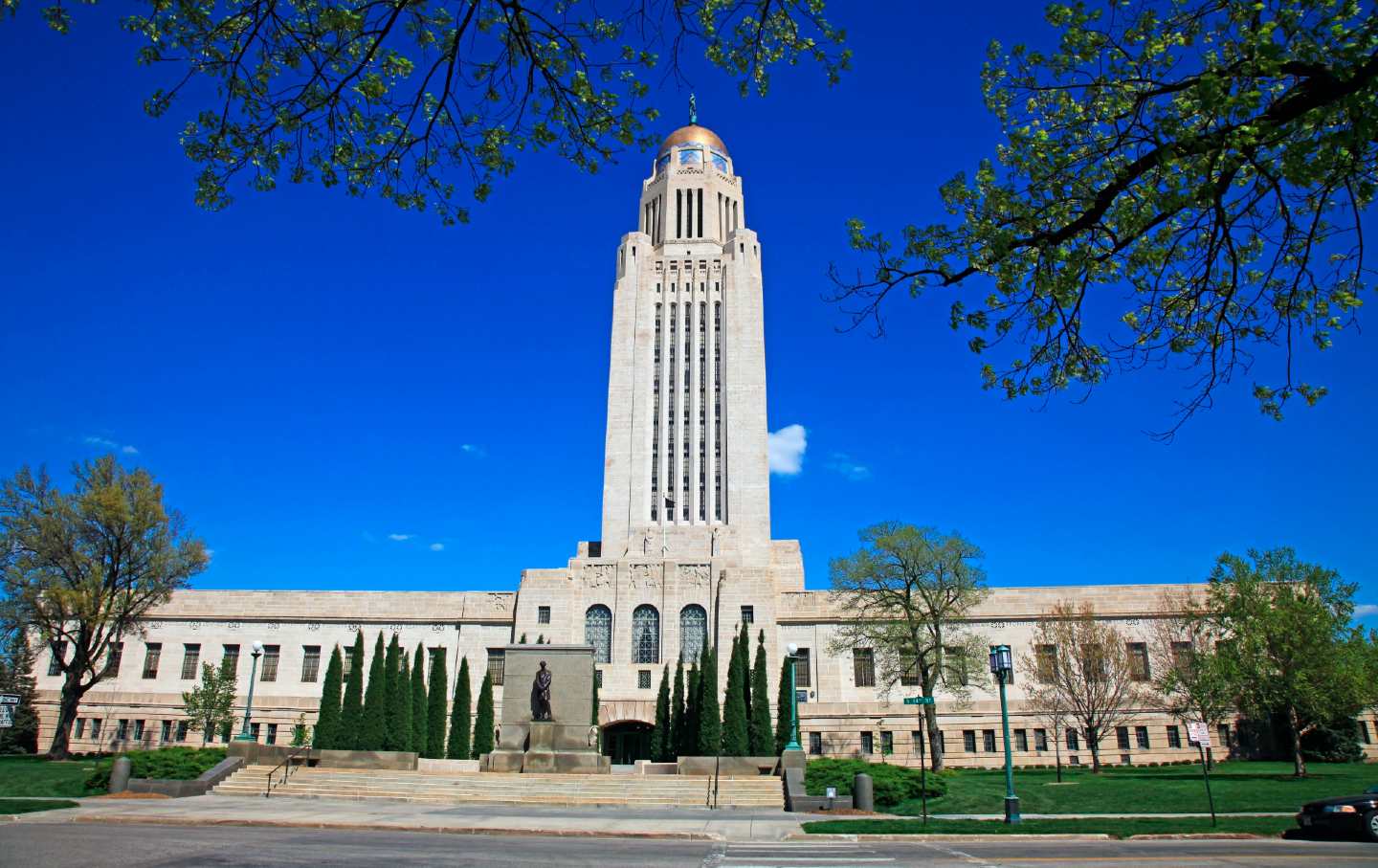
When I speak of politicians, I’m included in that group. I have the privilege of serving my second term in the Nebraska Legislature, where we convene every January and introduce bills for the first 10 days of the session. On the bitterly cold ninth day of our latest session, as Nebraskans recovered from several successive blizzards, my colleague Senator Brian Hardin introduced a Nebraska version of the “stand your ground” bill, bringing our state into the national conversation about when it is OK to shoot someone dead just because you feel afraid of them.
“Stand your ground” laws are part of a political effort backed by the National Rifle Association and the American Legislative Exchange Council (ALEC) to increase access to firearms in all states. ALEC is known for creating model legislation with corporate partners and then working with elected officials in statehouses across the country to get these bills introduced. “Stand your ground” laws, which protect and expand the market for the firearms sold by the weapons companies that bankroll the NRA and ALEC’s multimillion-dollar lobbying and influence operations, are understood to be laws that provide no duty for a person to retreat from an attacker in any place in which such a person is lawfully present. Under these laws, people have the right to use reasonable force—even deadly force—against a perceived attacker.
Many of the same states that have adopted “stand your ground” laws have also adopted “constitutional carry” laws, or laws that allow for any person not otherwise prohibited from possessing a firearm to be able to carry a concealed gun without any sort of training or permitting process. In Nebraska, we also recently passed our own constitutional carry bill, which Governor Jim Pillen enthusiastically proclaimed was “just the start” for expanding access to firearms in our state.
Anyone ought to be able to understand the danger of a society of armed individuals carrying concealed weapons, who perceive strangers as attackers and have no duty to de-escalate.
Yet the capitol was buzzing on the day Senator Hardin introduced his bill, LB 1269. For all of the political commotion and controversy, the changes proposed in the text of the bill do seem modest. The bill does not even contain the words “firearm” or “gun.” Nebraska already is considered a “castle doctrine” state, in that our laws do not require a person to retreat from danger while in their home. What LB 1269 does is broaden existing justification defenses—self-defense, defense of others, and defense of property—to apply to defendants outside the home.
The usual crowd of proponents and opponents who regularly spar over gun regulation appeared for the public hearing for LB 1269 in the Nebraska Legislature’s Judiciary Committee. But because the bill jeopardizes settled legal precedent, prosecutors strongly opposed it, arguing that it brings uncertainty to areas of settled law that will make it more difficult for them to prosecute wrongdoers. Other opponents included the ACLU of Nebraska, which rarely sides with prosecutors, who argued that in states with “stand your ground” laws, a white shooter is 350 percent more likely to have their homicide ruled “justified” when the victim is Black.
To these ingredients, the bill’s sponsor added the catalyst of racism. In his closing remarks in the committee hearing, Senator Hardin, a white business consultant from western Nebraska whose legislative district is 0.72 percent Black, invoked Trayvon Martin as justification for supporting the bill.
Acknowledging that this is “an emotionally charged issue,” he rationalized that “the fact is that the evidence has demonstrated that [Trayvon Martin] was in fact the aggressor, and he attacked first, and so self-defense applied.” Terrell McKinney, one of two Black senators in our 49-member Legislature, rightfully took issue with this characterization. Senator McKinney, whose district includes much of the predominantly Black community of North Omaha, and borders my own district, countered in the hearing that Martin was not the aggressor but left his home to get some snacks and was followed by a vigilante.
McKinney noted that in states with “stand your ground” laws, when Black people assert the rights of self-defense purported to exist in these laws, they are more likely than white people to be denied. He explained that these laws harm Black people in concurrent ways: They hurt people of color because Blacks are disproportionately targeted by armed citizens, and because affirmative defenses or immunities are more often denied to Black defendants who are charged with crimes.
My colleague is correct. Residents of McKinney’s legislative district are persistently overrepresented in Nebraska’s overcrowded prisons. Overall, Nebraska locks up people of color at far higher rates than the nation as a whole. Among the nation’s 100 largest metro areas, Omaha’s Black male incarceration rate was the 11th highest—almost double the rate of Detroit, Los Angeles, and Atlanta, and higher than in Chicago, St. Louis, Cleveland, and New Orleans. McKinney saw the bill for what it is: a legal and statutory threat to Black people in Nebraska.
Popular
“swipe left below to view more authors”Swipe →Many states have refused to adopt “stand your ground” laws—20 of our sister states, according to Everytown For Gun Safety—and so should Nebraska. Supporters of LB 1269 talk about public safety and the right of people to be secure in their homes and in public. With a personal ethic rooted in reproductive justice, I know that the fight to keep children, families, and all individuals safe is inextricably linked to the urgent fight to end gun violence. I believe in supporting everyone’s right to dignity, autonomy, and community safety, and I oppose measures that make our communities less safe and that have the potential to hurt Nebraskans of color the most. To truly advance our shared public safety goals, I urge my colleagues to find solutions by addressing the root causes of poverty, crime, and racism, and implementing real harm reduction strategies.
Nebraska’s “stand your ground” bill is not a solution; rather, it’s a continuation of the status quo that has led to an unacceptable lack of protection for Black life and equal justice under the law. That is the case in Nebraska and throughout the entire country as we continue to struggle out of the trauma of racist violence.
More from The Nation
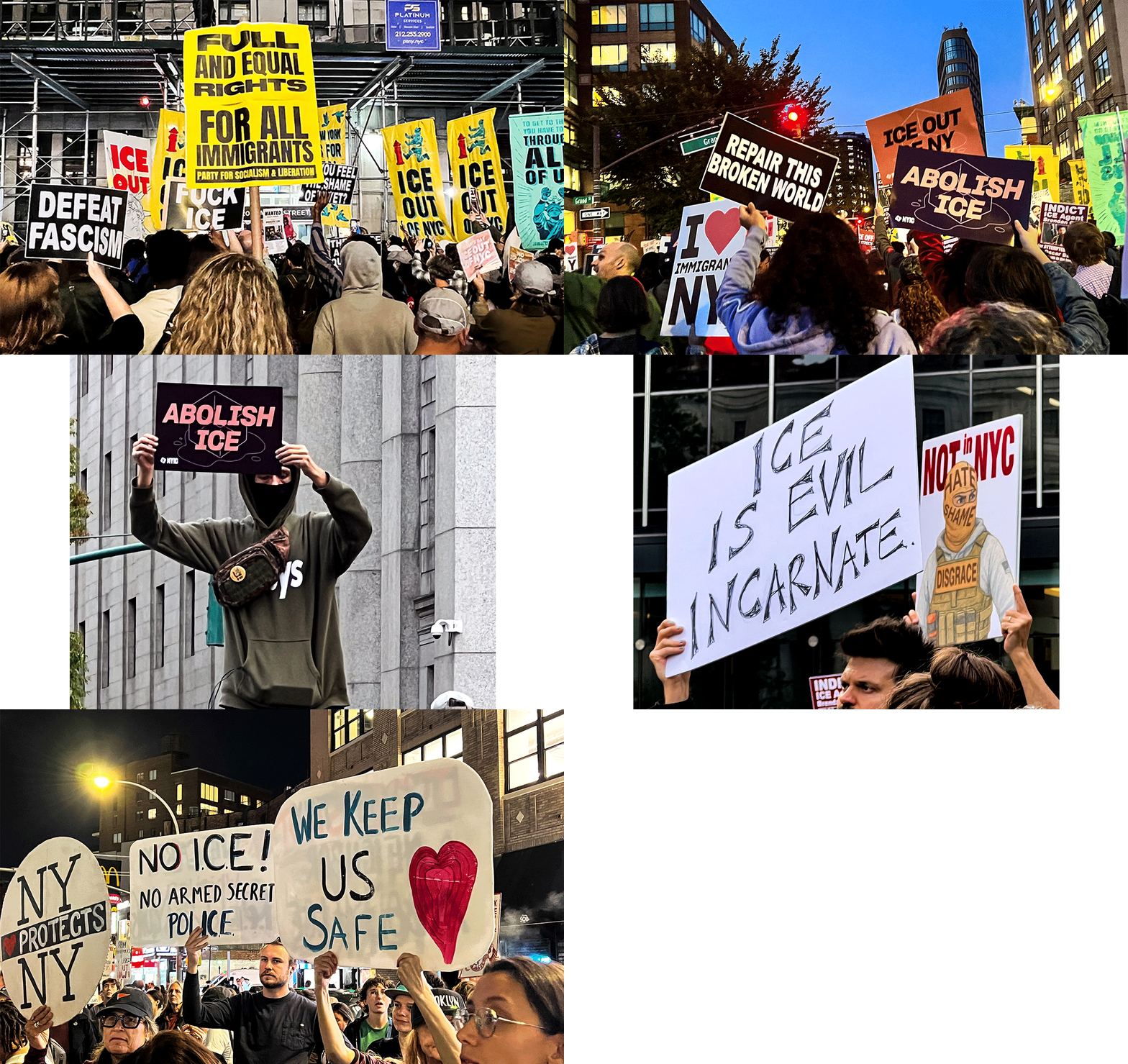
Abolish ICE Abolish ICE
Demonstrators take to the streets in protest against an ICE shooting in New York City. Foley Square, October 2026.
Mamdani Is Facing Heat Over the NYPD. Here’s What He Should Do. Mamdani Is Facing Heat Over the NYPD. Here’s What He Should Do.
The mayor is being given a series of false choices over his public-safety agenda. But there is another way forward.
Why Calling Anti-Trans Hate a “Distraction” Is So Troubling Why Calling Anti-Trans Hate a “Distraction” Is So Troubling
It’s a familiar line in the midterms: Anti-trans attacks are a “distraction” from “kitchen-table” issues. That sends a chilling message about whose rights are worth fighting for.
So What Is Socialism, Anyway? So What Is Socialism, Anyway?
In a world dominated by neoliberal market fundamentalism, “socialism” is what will make a more moderate, regulated form of capitalism work for most people.
Will the GOP’s Big Money Save Jon Husted in Ohio? Will the GOP’s Big Money Save Jon Husted in Ohio?
Former senator Sherrod Brown is leading in most polls, but a tidal wave of spending may prop up the struggling incumbent.
James Talarico Is Preaching a Gospel of Pluralism James Talarico Is Preaching a Gospel of Pluralism
He’s not the only progressive doing it.

