
Why Is Biden Risking a New Regional War in the Middle East?
The president’s foreign policy is mired in a deeply retrograde and one-sided view of Israel.
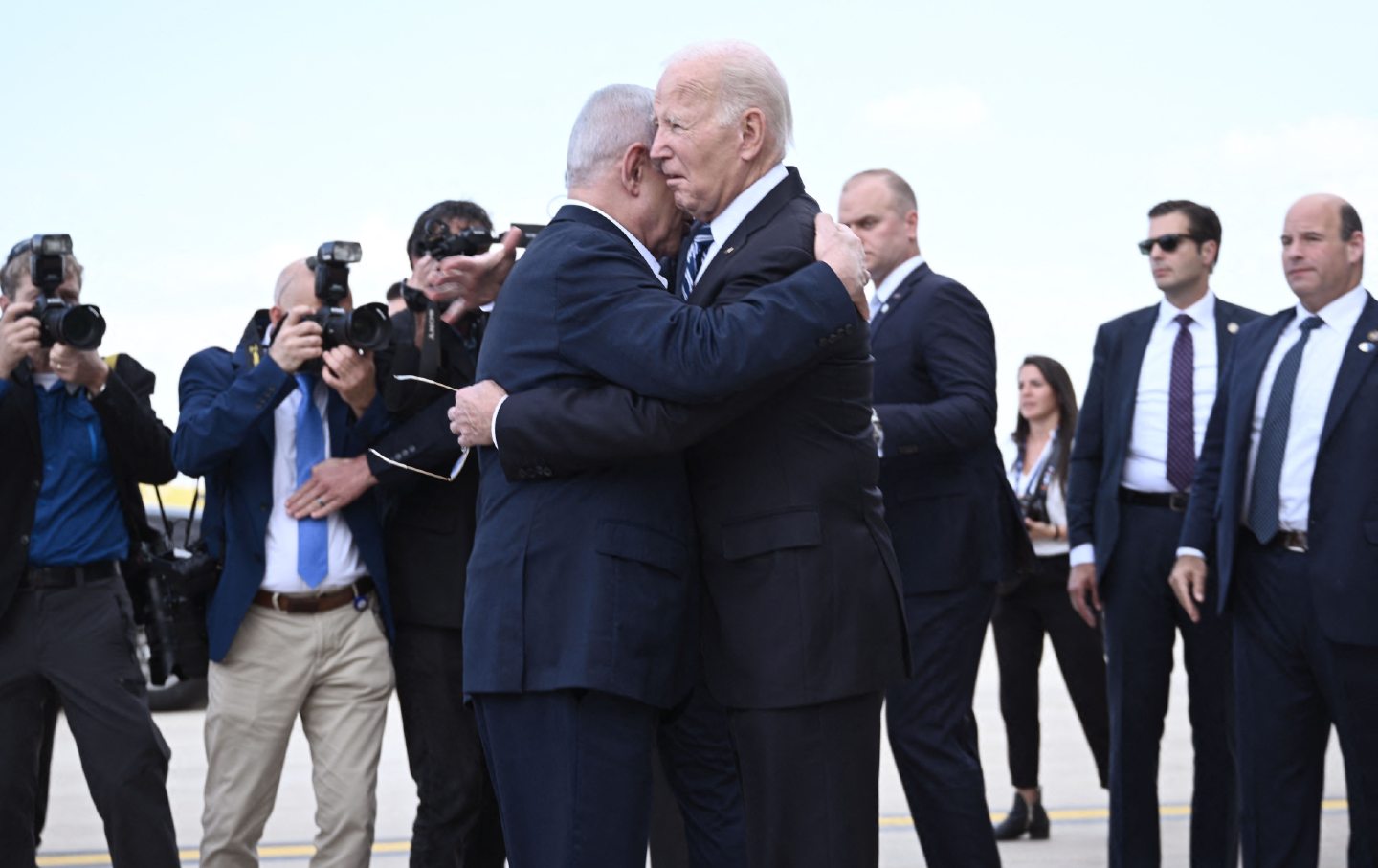
The Biden administration, under fire for an increasingly unpopular policy of near-unconditional support for the Israeli government as it indiscriminately bombs civilians in Gaza, has resorted to the transparently desperate measure of claiming credit for keeping a terrible situation from getting even worse. The White House line on the Middle East is that Biden, behind closed doors, has used his close ties with Benjamin Netanyahu to prevent potentially reckless escalation that would have led to an even larger loss of life in Gaza and the outbreak a wider war. Or, as The New York Times reported on Sunday, “Biden’s advisers and allies said his personal involvement has averted a broader war and influenced Israel’s approach, even if not as much as he would hope.”
The problem with such a counterfactual boast is that it is impossible to prove. The reality of what has happened is bad enough to make such claims seem dubious if not ridiculous. As of Thursday, at least 22,000 Palestinians—the majority of whom were civilians—have been killed in Gaza, in addition to the 1,139 Israelis killed by Hamas in the October 7 massacre. According to the United Nations, 85 percent of the population of Gaza has been displaced—and roughly half face starvation. In the face of such horrific suffering, it takes real gall to brag about having moderated Israeli policy.
The claim about staving off a regional war is an even more glaring example of whistling past the graveyard, since the likelihood of a much larger conflict is intensifying by the day. Throughout the region, American and Israeli forces are exchanging fire with a variety of Palestinian and allied groups (which often have Iranian support), including Hezbollah in Lebanon, the Houthi movement in Yemen, and militias in Syria and Iraq.
On December 27, CNN reported, “Escalating attacks on US troops and commercial shipping and incidents often involving Iran and its proxies are causing new concerns that Israel’s war in Gaza could widen into a regional conflagration with grave political and economic consequences.”
The news network added, “The rising possibility of US combat deaths and the worsening security situation from the Indian Ocean to the Red Sea and stretching through Iraq, Syria, Lebanon and Israel represents an unwelcome new foreign crisis as President Joe Biden’s reelection year dawns… Warnings by Israel that its war against Hamas in Gaza will last for months, despite US pressure for a ratcheting down of the intensity of the conflict, threaten to heighten the chances war could spin out of control and drag the US further in.”
On Tuesday, a drone attack in Beirut left six dead, including senior Hamas leader senior Saleh al-Arouri. In response, Hezbollah announced that his killing “will not pass without punishment.” Al-Arouri’s assassination came in the wake of earlier high-profile assassinations, including a Christmas day air strike that killed Sayyed Razi Mousavi, an Iranian general. As The Guardian notes,
Israel’s presumed targeted assassination earlier this week of Sayyed Razi Mousavi, a senior IRGC commander in Syria, crossed one of the invisible red lines that have so far allowed Israel and Iran to avoid head-to-head confrontation. Mousavi was a big fish, in charge of coordinating Iran’s dealings with Hezbollah and the Syrian regime. Iran has vowed to exact terrible retribution on Israel.
The Middle East is a tinderbox just waiting for the right spark to set off an explosion. The Israel government seems more than willing to provide that spark, with a constant stream of provocative actions that could easily spiral out of control into a larger war. On the other side, Iran and its various allied militias seem also eager to flex some muscle by showing an ability to thwart American and Israel plans.
The current escalation highlights the contradiction of Biden’s policy in the region. His oft-stated desire to back Israel to the hilt runs the risk of provoking the larger regional war Biden wants to avoid. The ongoing bloodbath in Gaza and the West Bank makes a regional war a constant—and growing—danger.
Writing in The Nation, foreign policy analyst Trita Parsi observed:
America and Israel’s interests have never been fully aligned on Gaza. But as Israel’s bombardment of the narrow strip has continued for almost 100 days, the Netanyahu government is shifting in a direction that directly threatens the stated goals of the Biden administration: Israel wants to expand the war into Lebanon and appears to welcome open warfare against so-called Axis of Resistance—Hezbollah in Lebanon, the Houthis in Yemen, and the revolutionary government in Iran. The assassination of Hamas deputy leader Saleh al-Arouri in Beirut makes that clear. So far, President Joe Biden has refused the one step that can prevent both this escalation and the US from getting dragged into yet another war in the Middle East: a cease-fire in Gaza.
Popular
“swipe left below to view more authors”Swipe →The roots of this incompetence are both institutional and personal. Since the late 1960s, Israel has been one of the major pillars of American hegemony in the Middle East. Along with US alliances with Egypt and Saudi Arabia, the bond with Israel allows Washington to thwart any Arab nationalism that defies its will. The ties between the American national security state and Israel are deep, although also open to question if Israel’s actions provoke an anti-Americanism that might one day change the cost-benefit bottom line of the alliance.
But beyond this long-standing structural reality, Biden’s personal investment in Israel also has deep roots. In a deeply researched Mother Jones article, reporter Noah Lanard documented that, even among American politicians, the intensity of Biden’s fervent support for a maximalist indulgence of Israeli foreign policy is rare. Examining Biden’s record over five decades, Lanard found “instinctive sympathy for Israel contrasted by incuriosity about Palestinians; an increasingly outdated view of the domestic politics on the issue; and a deep commitment to a repeatedly disproven belief that peace will only come from there being ‘no daylight’ between Israel and the United States.”
In the early 1970s, Biden was mentored by the late Washington Senator “Scoop” Jackson, an ultra-hawk on foreign policy. Biden hasn’t shifted one iota from the position he learned from Jackson, that no distance between the United States and Israel should be allowed. Characteristically, in the Obama administration, Biden sabotaged attempts to limit Israeli settlements in the West Bank. As he once told Israeli ambassador Michael Oren, “Israel could get into a fistfight with this country and we’d still defend you.”
Given Biden’s record, his “no daylight” policy is also no surprise—but that doesn’t mean it is without a cost. In holding fast to “no daylight” even in the face of Israeli’s ferocious war in Gaza, Biden is not just putting his presidency at risk but bringing the entire world to the brink of the abyss.
More from
Jeet Heer 

Even Republicans Are Waking Up to Trump’s Corruption Even Republicans Are Waking Up to Trump’s Corruption
And, somewhat shockingly, so are Democratic elites.

Where Is the Outrage Over Trump’s Racist Targeting of Ilhan Omar? Where Is the Outrage Over Trump’s Racist Targeting of Ilhan Omar?
The establishment press and some Democrats are strangely mute over the president’s flagrant abuse of the legal system.

The Real AI Threat Is Already Here The Real AI Threat Is Already Here
Never mind some future apocalypse—AI is being used right now to cause enormous suffering.

Elon Musk’s James Talarico Smear Blew Up In His Face Elon Musk’s James Talarico Smear Blew Up In His Face
But that doesn’t mean the danger from Musk’s lies is over.

Does America First Really Mean Israel First? Does America First Really Mean Israel First?
Mike Huckabee’s aide shows how an extremist agenda dominates Trump’s Middle East policy.

The Death Penalty Has Become a Torture Machine The Death Penalty Has Become a Torture Machine
Christa Pike's botched lethal injection proves there is no humane form of execution.

