
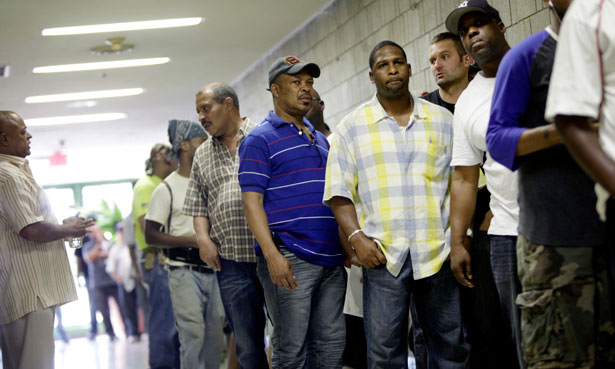
Job seekers wait in line at a construction job fair. (AP Photo/Seth Wenig)
Editor’s Note: Each week we cross-post an excerpt from Katrina vanden Heuvel’s column at the WashingtonPost.com. Read the full text of Katrina’s column here.
Turmoil in Egypt. Edward Snowden’s travel plans. Immigration reform’s fortunes. Obamacare’s troubles. The Weiner-Spitzer return to politics. There’s no shortage of items absorbing political energy and media bandwidth. But simmering below all of this is a crisis that goes without the immediate attention it demands. Last Friday morning, the Bureau of Labor Statistics reported yet another month of lackluster jobs numbers. While Washington has long since lost any sense of urgency regarding the jobs crisis, this is an issue that continues to poll at the top of Americans’ concerns.
Our economy is stuck at just over 2 percent growth, and the rate of productivity is worse than anemic. We have hit a point where an unemployment rate of 7.6 percent inspires cheers of “it could’ve been worse!” The result is a painful “new normal” for too many of our fellow Americans.
Few commentators even mention that most of the 195,000 jobs added last month, as well as the ones added in the last few years, are low-paying, temporary, part time and usually without benefits. Much of the job growth we have seen is in restaurant, retail and temporary work—the sort of jobs that rarely offer basic security, let alone a foothold for people to climb into the middle class.
For working families, the struggle is painful, persistent and real: Hourly wages have plummeted to record lows, while executive pay has soared to record highs. There is no longer an income gap; there is now an income gulf. In 1978, the average American chief executive earned 26.5 times more than the average worker. Today, that gap is four times larger, with chief executives taking home 206 times more than average workers.
Editor’s Note: Each week we cross-post an excerpt from Katrina vanden Heuvel’s column at the WashingtonPost.com. Read the full text of Katrina’s column here.

