
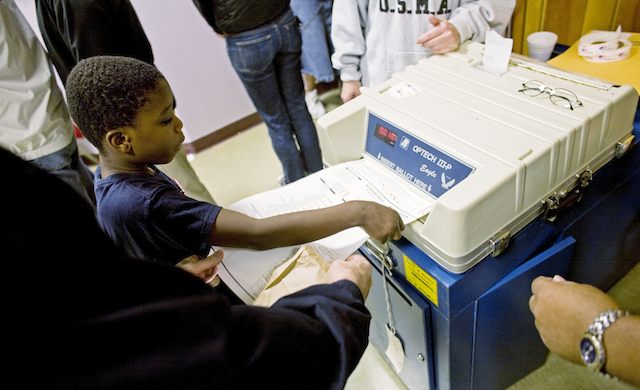
Milwaukee resident Truman Brown, 8, helps his father Noel Rosado vote on Election Day 2008. Photo: Darren Hauck/Stringer/Getty Images
Wisconsin was considered the state with the strictest photo voter ID law, until yesterday when Judge David Flanagan ordered a temporary injunction on the law until an upcoming trial determines if the law should be scrapped permanently. The lawsuit, brought by the NAACP and immigration rights group Voces de la Frontera, was filed last year, and is one of four against Governor Scott Walker’s administration over its photo voter ID laws.
The news is welcome considering Flanagan had previously denied the NAACP’s motion to block the law, saying they needed more people to demonstrate irreparable harm by the law. At the time, in February, the NAACP had lined up forty people who described difficulties trying to obtain IDs to vote.
However, Flanagan ruled back then that the issue was important enough that it deserved a trial. That trial is scheduled for April 16. Yesterday’s temporary injunction basically freezes the law until then, meaning the law won’t be in effect for the state’s April 3 primary. As for the more people the NAACP needed to convince the judge, they got back up from Wisconsin poli sci professor Kenneth Mayer whose research found that over 220,000 people in the state lacked the kind of ID needed to vote under the new law.
Wisconsin’s voter ID law, which went into effect on February, says that you can only present a state driver’s license, a state non-driver ID, a card issued by a US uniformed service, a Passport, a certificate of naturalization issued not more than two years before the election, an ID card from a federally recognized Indian tribe, or a student ID that must contain a signature, an issue date, and an expiration date no later than two years after the election. Universities that have IDs that don’t comply with those stipulations have been scrambling to create voter IDs for their students.
Governor Walker Tweeted after the announcement, “Photo ID to vote is a common sense law that will ultimately be upheld. Need it for library, cold med & public assistance.”
He’s probably a little heated now. The NAACP case was just the latest blow against his photo ID agenda. On Monday, March 5, another judge granted another lawsuit against the governor challenging his voter ID law. Walker tried to swat away this one, waged by the League of Women Voters, but Judge Richard Niess said that the League is the best plaintiff for the case. Said Judge Niess:
“This is the same cohort of citizens that shows up in the circuit courts in increasing numbers, day in and day out, without lawyers, in foreclosure proceedings, collection actions and family matters,” Niess wrote. “Who will advocate for them on these constitutional issues that affect their fundamental, inherent and constitutional right to vote, if not the plaintiffs, or entities like the plaintiffs?”
Finally, the ACLU filed a suit against Wisconsin’s voter ID law in federal court, making the case that it violates the Voting Rights Act because it discriminates against people of color. You can read the stories of some of the impacted voters ACLU is filing on behalf of here.

