Southeast Asia Is in an Uproar Over Gaza
From political mommy bloggers to McDonald’s boycotts, frustration with Israel and the US’s approach to Gaza has reverberated across the region. Now, there are implications for China.
In March, Malaysian Prime Minister Anwar Ibrahim made a visit to Germany where he spoke alongside Olaf Scholz, his German counterpart. The two leaders had a title in common, but when the press conference inevitably turned to Israel’s war in Gaza, it was a study in contrasts. Scholz stuck to a dry and rehearsed response that focused on Israel’s right to defend itself. Anwar, meanwhile, launched into an impassioned speech decrying the “selective” and “ambivalent” attitude that some Western countries had about what was happening in Gaza, saying that they’ve ignored “60 years of atrocities.” Anwar’s speech was quickly clipped and uploaded and, in short order, it went viral, drawing praise for his empathy and callouts of hypocrisy.
While Biden did delay some arms transfers to Israel, his administration has by and large been quite comfortable with the pulverization of Gaza, where the death toll is racing towards 35,000. But it also finds itself needing to grow comfortable with a world in which American credibility is plummeting, especially in a region crucial to its strategic competition with China. Washington has devoted time, energy, and resources into pitching itself as an alternative to Beijing’s growing influence in Southeast Asia—but its unwavering support for Israel has undercut this position.
It can be difficult to glean conclusions across a place as diverse as Southeast Asia, where countries vary dramatically in size, GDP, and religious affiliations. “The State of Southeast Asia,” a yearly survey from Singapore’s ISEAS Yusof Ishak Institute, is read as a rough barometer of regional sentiment. Every year, the survey questions around 2,000 elites, such as government officials, think-tankers, and members of nongovernmental organizations from the 10 Southeast Asian nations. This year, it found that the top geopolitical concern in the region was Israel’s war on Gaza. More than 46 percent of respondents listed the ongoing conflict as their top concern. “Despite its geographical distance,” the report summarized, “the conflict has reverberated strongly across this diverse multi-racial and multi-religious region.”
Notably, concerns around the war outpaced the tensions in the South China Sea, a localized problem to which there are more tangible connections. Numerous regional countries have competing claims to the highly strategic waterways and the island’s shoals within them. Last week, vessels from the Philippines were fired on with water cannons by Chinese coast guard ships in an act of harassment that is becoming troublingly routine. Russia’s invasion of Ukraine was the third most concerning geopolitical event: The conflict has never been seen in the region as a sort of final stand for democracy, as Biden and some European countries have cast it.
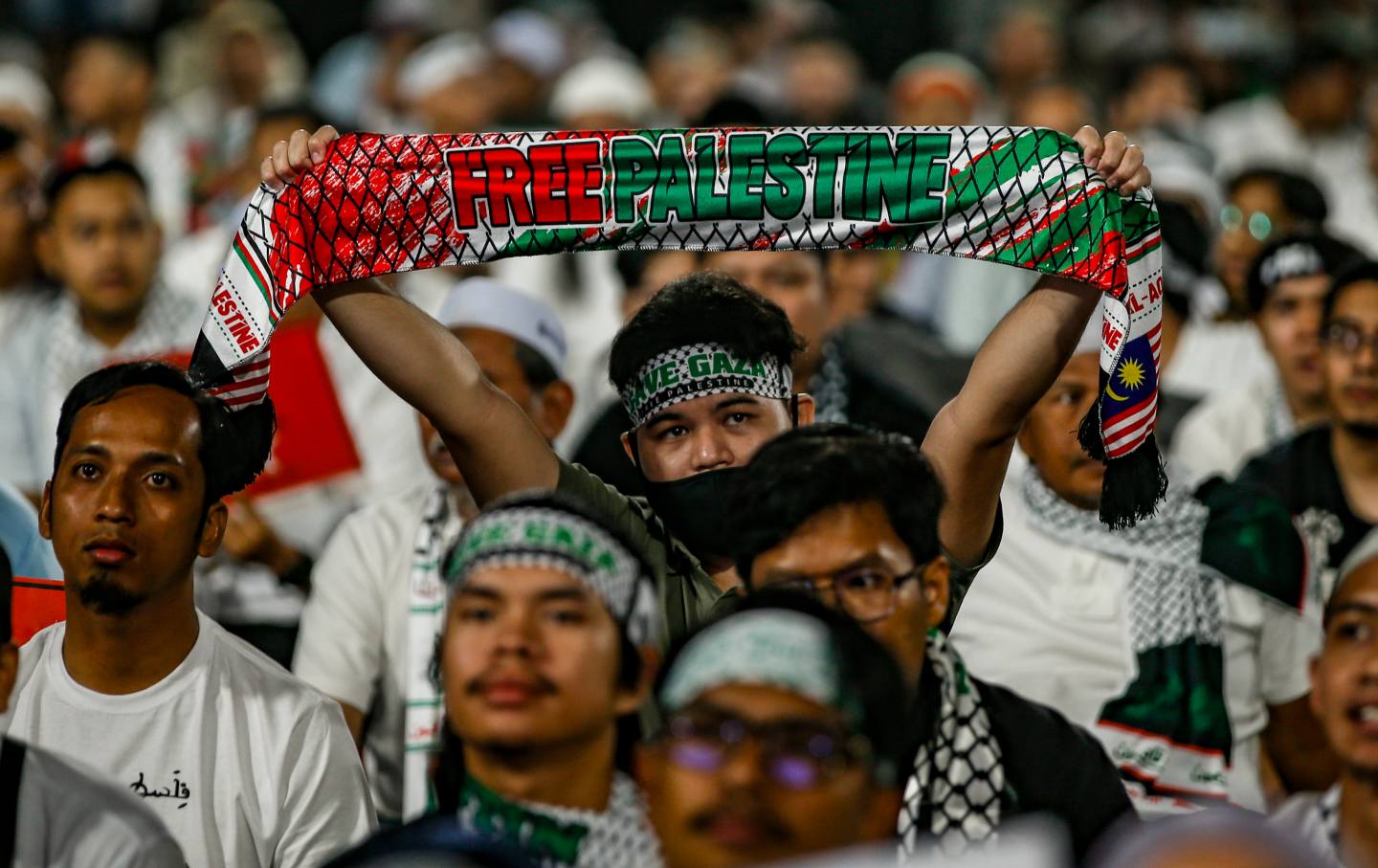
On Langkawi, a Malaysian resort island dotted with mangrove swamps and rain forest, support for Palestine is unmissable. Palestinians flags outnumber Malaysian ones outside of homes and shops. A freshly painted mural of the flag takes up an entire wall outside a small hotel. At the night market, Palestinian soccer jerseys and T-shirts hang for sale on racks next to pink Lionel Messi kits. Muslim-majority Malaysia does not recognize Israel and has long rallied for Palestine. But for a beach town, the amount of support is remarkable.
People there and in Indonesia, the world’s most populous Muslim country, have sustained boycotts of McDonalds and Starbucks that have cut into the companies’ bottom lines. “The most pronounced impact that we’re seeing is in the Middle East and in Muslim countries like Indonesia and Malaysia,” McDonald’s CEO Chris Kempczinski said in an earnings call earlier this year. This week, the company announced that it missed quarterly profit estimates for the first time in two years. Kempczinski said that the company was “not expecting to see any meaningful improvement” on the boycotts until the conflict ceased.
Support extends beyond the Muslim-majority countries. In Singapore, often poorly stereotyped as sterile, the conflict has drawn in people who have never thought of themselves as political. Singaporean fitness influences and mommy bloggers have become outspoken advocates for Palestine on social media, making space for political infographics in their usual content stream. On a recent episode of Yah Lah BUT, a podcast where the hosts discuss the city-state’s current events, Oon Shu An, a well-known Singaporean actress, shared her story of ambivalence to activism, one that has played out countless times: “I’m very new to this…. for me, the education only started after October 7,” she said, tearing up at moments while she spoke. “What really stunned me is how long I hadn’t looked for and when I started looking into what had been happening in Palestine I was shocked.”
Others have taken greater risks. Last month, a handful of individuals stood up on a skywalk between two massive trees artificial enough to be Avatar props, one of Singapore’s most iconic tourist destinations. There, they unfurled a massive banner calling for their country to end its arms trade with Israel. In a city-state where protests are virtually nonexistent, where a man was criminally charged for holding up a sign of a smiley face just a few years ago, it was a supremely bold move.
Slowly and incrementally, Singapore’s position appears to be shifting. In December, the country voted at the United Nations in favor of an immediate humanitarian cease-fire and earlier this year it said that the Israeli military has “gone too far.” Singapore, along with the rest of the members of the Association of Southeast Asian Nations, a regional bloc, last week backed a Palestinian bid to become a full UN member.
Biden has so tightly tethered the United States to Israel that the two have become largely indistinguishable during the current conflict. After years of being peppered with questions about America’s gun policies, the queries I get now at dinners and parties almost exclusively pertain to explaining the two countries’ relationship. Chong Ja Ian, an assistant professor of political science at the National University of Singapore I spoke to recently, noted that America’s unflinching support for Israel “has really created a lot of frustration and eroded support for the US in this part of the world.” There is also a sense that the American position smacks of hypocrisy. Abdul Kadir Jailani, a high-ranking Indonesian diplomat, said the Biden administration always stresses the importance of maintaining the liberal international order in the region. Now, he told me, the American position “would certainly undermine the US credibility, and reveal serious problems within the notion of the rules based order.”
This bodes poorly for any administration, but especially one that has placed competing with and containing China at the center of its foreign policy. Biden has been attempting to do this at home through a number of measures, including sweeping trade regulations and economic sanctions. Abroad, there are few places where this competition is as pronounced as the “Indo-Pacific region,” as it is known in government circles and by policy wonks. To date, this has mostly been a security lead initiative, which has entailed expanding the US armed forces’ presence in the region and firming up partnerships with other countries—mostly through military cooperation. The trade component is, at best, largely forgotten and, at worse, openly mocked in policy circles for being little more than a trivial afterthought.
When confronted with a hypothetical question of which strategic partner to align with, slightly over 50 percent of respondents to the ISEAS survey chose China rather than the United States. It was the first time since the question was first asked in 2020 that responses tipped in Beijing’s favor. “With China’s ways of doing things, and offering an alternative international order that is inclusive, fair, and with shared prosperity, it is going to be tougher for the US, especially in a few countries receiving a lot of China assistance,” Saifuddin Abdullah, a former Malaysian minister of foreign affairs, who has been vocal critic of the US and Israel’s response to the October 7 attacks, told me.
Given Washington’s current fixation with China, this would seem to be a problem worth addressing—and quickly. That however, seems unlikely, for that would take exerting leverage to rein in Israel. After the killing of aid workers, nationwide campus protests, and widespread disapproval among American voters of Biden’s handling of Gaza, only an all-out assault on the city of Rafah has drawn the threat of some repercussions, but even those seem doubtful.
Support The Nation’s June Fundraising Campaign
With the midterm elections now firmly upon us, the question is whether Democratic candidates will do more than merely occupy ballot lines as mild alternatives to the red-hot crisis that is Donald Trump.
As Trump spends over $1 billion a day on a globally destabilizing war on Iran and admits that he doesn’t “think about Americans’ financial situation,” millions across the country are struggling with the surging costs of essentials. Democrats must seize this moment and advance bold, small-“d” populist ideas—not settle for cynical caution that once again snatches defeat from the jaws of victory.
The Nation elevates progressive ideas, movements, and elected officials achieving real change across the country into the national conversation. At the same time, our journalists are exposing how crypto and AI-funded super PACs are spending hundreds of millions of dollars to knock out candidates they oppose, reporting on the devastating impact of the Supreme Court’s evisceration of the Voting Rights Act, and sounding the alarm on attempts by red states to quickly redraw electoral maps, disenfranchising Southern Black voters.
We can play this critical role because of support from readers like you. This June, we’re raising $20,000 to power The Nation’s independent journalism in the run-up to November’s immensely consequential elections.
It’s in our power to build a more just society, and your support at this critical moment brings us closer to that bold vision. I hope you’ll donate today.
Onward,
Katrina vanden Huevel
Editor and Publisher, The Nation
More from The Nation
Pope Leo’s First Encyclical Is a Game Changer Pope Leo’s First Encyclical Is a Game Changer
Yes, it’s a warning about the dangers of AI. But that’s the tip of the iceberg.
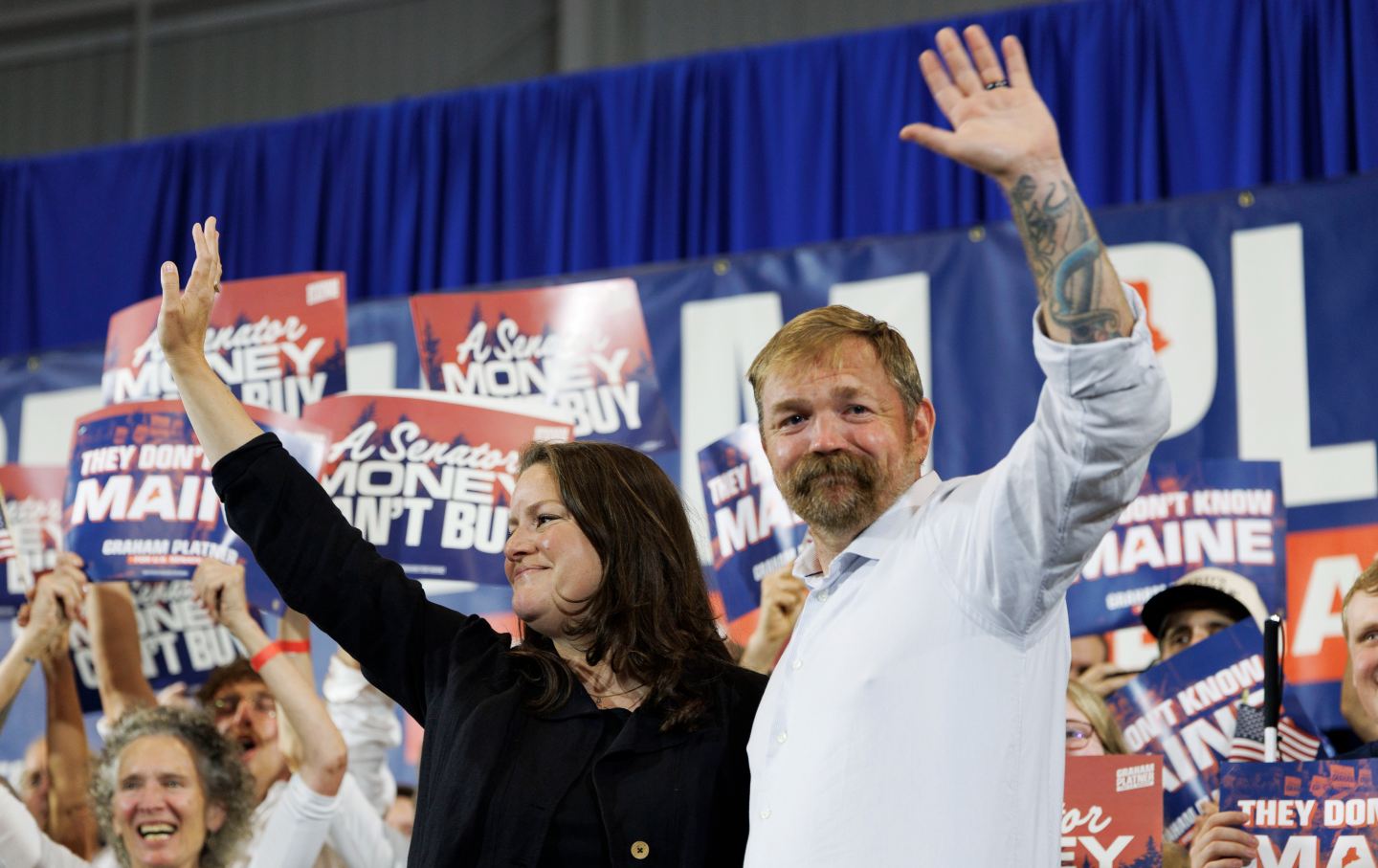
Is Graham Platner Fit to Be a US Senator? Is Graham Platner Fit to Be a US Senator?
The Democrats of Maine answered that question.
Trump’s AG Appointee Is a Literal Sock Puppet Trump’s AG Appointee Is a Literal Sock Puppet
Todd Blanche might be the most craven attorney general yet. Thankfully, he’s also incompetent.

Sonny Rollins Lived to See Justice for His Wrongly Convicted Father Sonny Rollins Lived to See Justice for His Wrongly Convicted Father
The jazz legend fought for nearly 80 years to clear his father of racially motivated charges.

America Is Due for a Deep Clean America Is Due for a Deep Clean
This country cannot deliver on its promises until we collectively act to to ensure equal protection for all.

