Quantcast

January 7, 2002 | The Nation

In the Magazine

January 7, 2002

Cover:

Browse Selections From Recent Years

2012

2011

2010

2009

2008

2007

2006

2005

2004

2003

2002

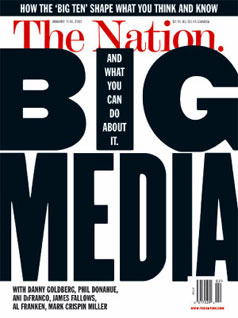
Mark Crispin Miller details the media cartel and its cultural effects, John Nichols and Robert McChesney call for a new national media reform movement, Jeffrey Chester explains why the public policy battles being waged to rein in the "old media" are important to the future of the "new media," Lauren Sandler looks at where Ms. is heading and Salih Booker examines the other world war.

Articles

John Stossel has high Q-ratings, so he doesn't have to worry about the rules.

Outspoken critic of organic farming, Dennis Avery, is supported by generous contributions from Monsanto, DuPont, Novartis, ConAgra, DowElanco, The Olin Foundation and the Ag-Chem Equipment Company, all of whom profit from the sale of products prohibited in organic production.

Ben Franklin, who has been called the first citizen of print, established lower rates for newspapers when he was postmaster general (and arranged for magazines to be shipped free of charge by post road). 

Media policy in the digital age.

After compiling our guide to the "Big Ten" media conglomerates, we shared it with cultural producers and critics in a range of fields: music, journalism, television, publishing. Following are their comments.
      --The Editors

Getting serious about media reform.

"The synergies are under every rock we turn over," declared Michael Eisner when the Mouse Kingdom absorbed Cap Cities/ABC in 1996, the same year The Nation's National Entertainment State made its debut. Ever since, the media conglomerates have indeed been looking in every nook and cranny of their ever-expanding empires for ways to cross-promote.

The media cartel and its cultural effects.

Letters

Your Favorite Media Sources

We'd no sooner asked you to send us a brief description of your favorite alternative media outlet than a storm of e-mails (and a few actual letters) began to blow in. When the dust settled and interns Mandy Hu and Emma Pollin had tabulated the results, we had about 1,200 nominations for websites, newspapers, magazines, radio and TV shows, newsletters, zines, listservs and collectives.


Editorials

Whether measured by numbers killed or nations wounded, by economies upended or families crushed, the AIDS pandemic is a deadlier global threat than that posed by terrorist groups. But almost no one draws the logical conclusion: The war on AIDS is more important than the war on terrorism.

As the US war on terrorism hurtles forward into a hazily defined post-Afghanistan phase, the news is not good: Although some of the press has lately made efforts to cover the turbulent world outside our borders, the attention has been too little and too late.

Dick Armey's announcement that he will retire from Congress at the end of 2002 and leave his position as majority leader--the number-two post in the Republican-controlled House--provides an occasion to recall that Armey demonstrated how easy it is to get away with lying in Washington. . . Yet he's a pussycat--a "down-home guy," says columnist David Broder--compared with his likely replacement, House majority whip Tom DeLay.

At the outset of the war on terrorism, President Bush announced a doctrine: Regimes that harbor terrorists will be dealt with as severely as the terrorists themselves. Three months later, the Taliban regime that then ruled Afghanistan is gone, and Washington is scanning the horizon for other regimes to attack. The government of Iraq is the one most frequently mentioned.

George W. Bush's abrogation of the Anti-Ballistic Missile Treaty on December 13 was a reckless act taken without regard for the consequences--it has dealt a severe blow to the idea of a world order grounded in collective security. Bush justified this act of hubristic contempt for the rest of the world as a measure to protect the American "homeland," but it actually will increase the danger of nuclear war and place this country at greater risk.

At Ms. magazine's thirtieth birthday party in early December, Gloria Steinem--in leopard print and we've-come-a-long-way-baby leather pants--delivered some big news: Cash-starved Ms. is moving to Los Angeles and merging with the LA-based Feminist Majority Foundation (FMF), helmed by Second Wave icon and former NOW leader Eleanor Smeal.

For three months now, I've been closely following the coverage of September 11 and its aftermath; how well have the media done?

Reviews

Art

"Loving Rockwell is shunning complexity," the critic of the Village Voice declares, who goes on to concede that "many of Rockwell's illustrations can turn you into a quivering ball of mush." Of how many painters in the history of art is something like that true? It seems to me the pictorial psychology of paintings that can have that effect transcends present knowledge.

Film

Though it's choked with dead bodies and disappointments, The Royal Tenenbaums comes before you with a smile.

Book

Rosalino "Chalino" Sánchez isn't someone you are likely to know about. Yet his legendary role as the revitalizer of the corrido--as the Mexican border folk song is known--is unquestionable among the 24 million people who inhabit the territories that unite or separate Mexico and the United States.

Columns

scheer

Finally, a reporter had the temerity to question Bush on Friday regarding the ignominious collapse of Enron Corp. run by Kenneth L. Lay, a Bush family intimate and top campaign contributor.

I've been trying to explain to my 9-year-old what fundamentalism is. He reads enough of the news to have learned that we are at war with a "fundamentalist Islamic regime" in Afghanistan. But he has classmates who identify themselves as fundamentalist Christians. . . Why is fundamentalism such a bad thing, he wants to know.

Stop the Presses

The New Republic's advertising copy promises "vital intelligence in the war against terrorism." Inside the magazine, its editors publish an "Idiocy Watch" devoted to allegedly dumb things that have been said and written about same. I fear someone has been mixing up the two.

It scarcely seems possible, but two of the staple items on the conversational menu of the left these past years might well be on the edge of disappearance, or at least a change in content. Mumia Abu-Jamal is no longer on death row. Pacifica's wars are amid final settlement. In both instances, it's a good advertisement for pertinacity.