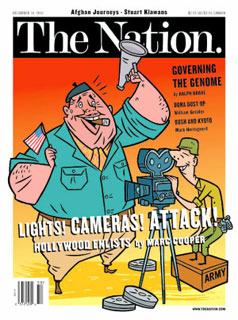
William Greider deconstructs the WTO's agreement in Doha, Marc Cooper examines how Hollywood is answering the call put forth by the Bush Administration, Ralph Brave discusses attempts to govern the genome and Stuart Klawans reviews two new films about Afghanistan.
Research support provided by the Investigative Fund of the Nation Institute.
We are all multilateralists now, or so President George W. Bush would have us believe.
Father Roy Bourgeois, the charismatic Maryknoll priest who has, since 1990, led the annual protest against against the United States' most infamous military training facility, wasn't sure it would
Which genetic modifications should be encouraged and which outlawed?
The Taliban may have met its match: the American Dream Machine.
The automatic double doors at the Institute for Creative Technologies' seaside headquarters in West Los Angeles neatly snap open just as they do on the Starship Enterprise. And sitting inside ICT's sleek virtual-reality theater, which features a Cinerama screen, a "rumble floor" with ten subsonic "transducers" and a ceiling with twinkling blue lights, you could easily imagine you are on the Star Trek command bridge alongside Captain Kirk.
But this is the Pentagon's little piece of Hollywood. So at my side is Dr. Mike Andrews, chief scientist of the US Army and described as "founder of and inspiration behind" the ICT.
ICT was launched two years ago with a five-year, $45 million Army grant. Its mission, as defined by executive director Richard Lindheim, is to "mix showbiz with science...to combine Hollywood magic with the real world." More concretely, ICT seeks to develop the most advanced modeling and simulation technologies to train US troops for modern warfare through the use of virtual-reality computer games. According to Andrews, the first use of ICT games in training is still "a couple of years away."
ICT is administered by the private University of Southern California, which stands to profit from sales of technology and products. In addition to games made solely for the Army, ICT is also developing, with investment from Sony and another firm called Quicksilver, two combat training games that will be used by the Army and sold commercially.
Hollywood veterans abound at ICT: They include Lindheim, a former executive at NBC, MCA Television Group/Universal Studios and Paramount Television Group; James Korris, the creative director, former COO and founder of MCA TV Entertainment; and Jacquelyn Ford Morie, manager of one of ICT's training development projects and a former lead designer for Disney's feature animation department. All this talent, combined with some of the best and the brightest drafted from the digital design trenches, has allowed ICT to come up with world-class games aimed at teaching US troops what are called command decision skills.
As the lights dim in the VR theater, and the exquisitely rendered scenario unfolds on the wraparound screen, the viewer finds himself in the Bosnian countryside, bumping noisily along a back road in an Army Humvee. The ground rumbles and shakes as a chopper also arrives at the pivotal scene--a collision between a US Army vehicle and a civilian car, leaving a Bosnian child seriously injured. The trainee must now make split-second leadership decisions: Soothe the angry crowd that is gathering around the child and his distraught mother, or move on to quell a military confrontation somewhere up the road? The trainee, wearing a virtual-reality helmet, talks to the lifelike characters onscreen who, armed with state-of-the-art artificial intelligence, are able to logically respond to almost any command.
Later, I accompany chief scientist Andrews to an adjacent ICT facility where he cuts the ribbon on the think tank's newest project, "Flatworld"--a room-sized "set" that, when viewed through 3-D glasses, can transform itself from a training site in Bosnia, to one in the desert, to one on an alien planet. At one point, a monarch butterfly flutters outside an artificial window and then, apparently, flies inside the room and hovers at our nose--a technology filched directly from Disneyland.
And that points to a concern: While the technology is impressive, the scripts and scenarios are cooked up by Hollywood writers and video-game masters--not by linguists, historians or political scientists. Some might say that the current conflict in Afghanistan has its roots not in a lack of US technology but rather in a paucity of human intelligence. That thought was impossible to avoid while watching the training scenario set in Bosnia. At the trainee's feet lay the grieving mother of the injured child, the potential catalyst for an explosion by the local villagers. But she conveniently never spoke up. If she had, it would not have been in English, the only language the trainee is likely to understand.
But Dr. Neil Sullivan, vice provost of research at ITC's parent, USC, expresses confidence. "When we started out two years ago, we thought these were very curious communities [academia, the military and the entertainment industry] to be partnering; we thought it would be Mission Impossible. But ITC now has real products that are going to have real effects on Army training. And who can doubt that training isn't helpful?"
More training can never hurt. But even after all the gee-whiz razzmatazz of the virtual-reality immersion experience, one doubt still nags: Wouldn't American soldiers be better off getting trained in the language, history and culture of the countries to which they are dispatched than spending hours talking to people who look like them on a computer screen?
Gerald Nicosia, author of Home to War: A History of the Vietnam Veterans' Movement,
The Price Anderson Act has discouraged the development of safer, less costly sources of energy than nuclear power. Join your voice to those calling for Congress to not renew its status by signing this online petition.
NEW YORK--In the aftermath of September 11, pundits were quick to proclaim the American left a victim of the war on terrorism, for two reasons.
Franklin Serrano, an economist at Federal University of Rio de Janeiro, recently lamented the large proportion of graduate students in economics who leave for the United States. "But there is something worse than them leaving. It's when they come back."
"Brain damage," he says, "is worse than brain drain."
Argentina is the latest Latin American economy to be mismanaged into a crisis by US-trained economists. Unemployment is above 17 percent, the economy is in its fourth year of recession and the country is now in the process of defaulting on its unpayable foreign debt. It's not easy being the poster child of neoliberalism.
Argentina's currency has been pegged to the US dollar since 1991. This worked for a while, but in the past few years the peso has become highly overvalued. Rather than devalue the currency, the country piled up mountains of debt to prop it up and watched its interest rates soar as investors demanded ever higher risk premiums. For comparison, imagine the United States borrowing $1.4 trillion (70 percent of our federal budget) in order to keep our own overvalued currency from falling.
This is not the first time in recent years that the IMF has burdened a country with billions of dollars of debt in order to prop up an overvalued currency. In 1998 it did the same thing in Brazil and Russia, with predictable results. In both cases the currency collapsed rather quickly in spite of the loans. And in both cases the economy responded positively to the devaluation, with Russia in 2000 registering its highest growth in two decades. The fund's argument in the case of Brazil and Russia was that if the currency was devalued, the result would be runaway inflation. But that never happened.
The IMF has also insisted on budget austerity for Argentina--which makes about as much sense during a recession as high interest rates. First in line for cuts have been state pensions, salaries, unemployment benefits and other social spending, insuring that the burden of "adjustment" will continue to fall, as it usually does, on those who can least afford it. And even the debt "restructuring"--i.e., default--now under way may not lead to economic recovery: If the currency remains fixed at a rate that investors still see as overvalued, the crisis will continue until it collapses.
Why does the IMF seem incapable of learning from repeated failures? The interest of foreign bondholders cannot be overlooked: The longer the fixed exchange rate holds, the smaller will be the losses of US lenders--even if the peso eventually collapses. But there has been a broader political concern as well: Argentina has done everything that Washington has told it to do, and the economy is a wreck. As a result the Bush Administration, despite its distaste for IMF "bailouts," was reluctant to be seen as abandoning the Argentine government. It kept pouring money in until it became clear that Argentina's debt could never be repaid.
The sacrifice of Argentina's economy for the sake of Washington's imperial interests and the interests of "emerging market" bondholders fits a pattern at the IMF, including some of the most high-profile interventions of recent years. In Russia and the transition economies, the first priority has been to execute a rapid, irreversible change to a market-driven society, regardless of the economic consequences. Russia lost half its national income in about five years of IMF-led transition, an economic decline never before seen in the absence of war or natural disaster. In Asia, the fund's desire to open these economies to US capital flows--in countries that because of their high savings rates had little need for foreign borrowing--caused a severe financial crisis in 1997-98. The fund then exploited the crisis to further open these economies, worsened it with exorbitantly high interest rates and fiscal austerity and convinced the governments of the region to guarantee the debt owed to foreign lenders.
The IMF is able to decide these major economic policies for dozens of countries because it sits atop a creditors' cartel, much like the OPEC oil cartel. Those who refuse to take the fund's "advice" find themselves ineligible for credit from the World Bank and other multilateral lenders--like the Inter-American Development Bank or G-7 governments--or even for private credit.
The fund's aid packages are generally reported approvingly in the press as "bailouts." But it is the bankers and bondholders, particularly foreign, who are being bailed out; the people, especially the poor, are tossed overboard. Over the longer term, the neoliberal program of the IMF and the World Bank--and their ability to enforce it--has contributed to a substantial decline in economic growth over the past twenty years throughout the vast majority of low- and middle-income countries. In Latin America, per capita GDP has grown a mere 6 percent over the past two decades, as compared with 75 percent in 1960-80.
As Latin America's economies grind to a halt, dragged down by the recession in the United States, the dismal reality of this long, failed economic experiment is sinking in. The reign of US-trained economists and their sponsors in Washington may be coming to an end.
Old habits die hard, especially when it comes to US foreign policy. On November 10 George W. Bush appeared before the United Nations General Assembly and, in a speech praised by the New York Times for its "plain-spoken eloquence," admonished his audience that the responsibility to fight terrorism is "binding on every nation with a place in this chamber." Bush apparently felt no need to practice what he preached about international responsibilities, though. On the same day--indeed, at the very moment--he was lecturing UN members, his own Administration was shunning negotiations in Marrakech, Morocco, to finalize the Kyoto accord on global warming.
"How long can the Administration turn its back on issues the rest of the world cares about--from global warming to trade in small arms--and expect broad support on issues like the war on terrorism?" asked Philip Clapp, president of the National Environmental Trust. Bush's double standard is all the more grating, considering that the United States is the leading source of the greenhouse gas emissions that cause global warming.
Like terrorism, global warming is an issue in which every nation has a stake. Already the Earth's glaciers are melting and catastrophic storms are becoming more severe and more frequent--this, after a mere 1 degree Fahrenheit increase in temperatures over the past century. Scientists expect four to eleven degrees of additional warming by 2100, bringing more violent weather, flooded coastlines and social havoc. New research released in Marrakech by the UN Environmental Program warns that global crop yields could fall 30 percent over the twenty-first century.
The Kyoto accord addresses this danger by ordering industrial nations to reduce greenhouse gas emissions 5.2 percent by 2012, compared with 1990 levels--a very modest target, considering that scientists say global emissions must eventually be cut 60 percent. Last summer in Bonn, 178 nations signed the accord; the meeting in Marrakech, where US officials observed but did not participate, hammered out rules for implementation. "Other countries have chosen their path, and our answer is still no," said a Bush Administration official.
Will Marrakech make much difference? The good news is that the world has put in place a binding framework requiring greenhouse gas reductions, and this framework will likely become law despite the US boycott. To come into force, the accord must be ratified by fifty-five countries, including a group responsible for at least 55 percent of the industrial world's emissions. Forty smaller nations have already ratified it, but with the United States holding out, the 55 percent standard can be reached only if the European Union, Russia and Japan all ratify. The EU has long been on board, and in Marrakech the Russians said they were finally satisfied. Japan's deputy chief cabinet secretary is pushing for a ratification vote in January, and Prime Minister Junichiro Koizumi has signaled his support. So Kyoto could become law as early as next spring (although the United States, because it didn't sign, won't be bound by it). A further bright spot: Delegates at Marrakech authorized $410 million a year by 2005 for a "clean development mechanism" to subsidize the shift from carbon-based fuels in poor countries.
The bad news is that the Kyoto accord got so watered down in Marrakech that it may have very little practical effect during the next ten years, when progress is most needed. The original accord relied heavily on emissions trading, a dubious mechanism that allows countries whose emissions are less than the maximum permitted, like Russia, to sell their excess to countries that are over their quota, like Japan. Now this loophole has been not only codified but expanded. The chief culprit is Russia, which has 120 million tons of emissions to trade and which also demanded twice as much credit as previously agreed on for the role its vast forests can play in absorbing carbon dioxide through photosynthesis. Meanwhile, two studies published in Nature this past July suggest that forests are not nearly as effective in neutralizing emissions as was thought.
Some environmentalists argue that these loopholes can be fixed later, that the emissions targets will be gradually tightened and eventually produce meaningful effects. And it's true that since carbon will now have a price in the marketplace, thanks to emissions trading, corporations, governments and individuals may make better choices about the products they produce and consume. US firms might even obey the accord, despite Washington's stance, in order not to be left behind by foreign competitors. But wouldn't it be easier if the United States simply showed as much commitment to the battle against global warming as it demands from everyone else in the battle against terrorism?
No one will mistake the WTO agreement in Doha, launching a new round of global trade negotiations, as a victory for the people. The usual cast of characters, led by the biggest kid on the block, the United States, orchestrated a familiar drama of high peril--world cataclysm if the negotiations fail--and then congratulated themselves for achieving a comparatively modest agenda for going forward. Poorer peoples of the world did not win; neither did the millions of citizens from wealthier nations who have mobilized to oppose the advance of corporate domination. On one issue after another, those people were losers. What else?
Well, in fact, there was something new about this diplomatic dust-up. The big kids realized they had to make nice with the little kids. If you are among the protesters whom the Wall Street Journal unaffectionately calls "Luddite whackos," you may take a little credit for that. At Seattle, remember, one of the central themes raised by people in the streets was the terrible inequities visited upon developing nations by globalization and its dominant powers, the multinational corporations. The initial reaction from governing elites and their media camp followers was disbelief. What on earth are the rabble talking about? Don't they know that globalization lifts all boats, especially those of the poor? Two years later, those pious sermons have been dropped. The governors instead made confession and solicitude the themes of their speeches. It's true, they announced, the poor have been screwed, but we want to make it up to them. Thus, they claim, this new round will be devoted to "development" and correcting the economic injustices.
That's rhetorical blather, of course, and the poorer countries weren't deluded. Still, it is one more small banner of progress in the long and difficult march toward forcing real reform. The developing countries have gained some leverage for their independent views and sovereign aspirations--not a lot but some. They were assisted in this by those voices in the street.
A far more substantive advance is the great concession made by the United States and others when they accepted that public health in poor countries comes before the patent rights of Big Pharma. The monopolistic greed of the drug companies is so blatantly inhumane that one hardly needs to congratulate our trade officials for recognizing it. Given the spongy nature of these agreements, we cannot even yet be sure that the breakthrough is real. Still, this was another major objective of the grassroots movement, led by ACT UP and other activists who campaigned alongside the ministers from Africa, Asia and Latin America. If the pharmaceutical lobbyists maneuver to undo the achievement in the back room, they will be up against a still broader phalanx of ferocious protest from rich and poor nations alike. If the leaders of globalization slyly try to rescind their concession, the WTO's weakening legitimacy will sink further and faster.
Building power globally by uniting distant peoples who seem powerless is a long march, uphill all the way. But we knew that. The lesson from Doha is that zesty, conscientious and honest dialogues across the vast space of global differences can yield real results. With many more conversations and agitations, the vision of coalescing citizens will endure--vigorous, viable and someday capable of winning much larger victories.
FREE SPEECH WINS ONE
These are dismal times for civil liberties, so it's nice to have a positive story to tell. In a previous item we reported that the city of Columbus, Georgia, citing "security concerns," sought an injunction forbidding SOA Watch from holding a march to the gate of Fort Benning, home of the School of the Americas, the alma mater of some of the most infamous state terrorists in Central America. Magistrate G. Mallon Faircloth denied the injunction, saying, "It's a question of First Amendment rights, and you can't play with that. I am sworn to uphold the US Constitution. I think I did that today."
NEWS OF THE WEAK IN REVIEW
The Rev. Franklin Graham (Billy's boy) reveals his Two-God Policy: "The God of Islam is not the same God. It's a different God, and I believe it is a very evil and wicked religion."
In a week when Attorney General John Ashcroft was struggling with anthrax, investigating September 11 and overhauling his department, he still managed to take on another threat: the voters of Oregon. And the federal courts that have sustained them. Somehow, Ashcroft found time to throw out Oregon's assisted suicide law, which allows doctors to provide lethal drug doses, on request, to terminally ill patients near the end of life. The measure was passed by Oregon voters twice (the second time overwhelmingly) and survived federal court and Congressional challenges--but was targeted by antiabortion and religious right forces.
The law has been in effect four years without setting off the bloodbath darkly envisioned by its opponents. The greatest effect, say many, has been on terminal patients who don't choose assisted suicide but have benefited from the state's greater emphasis on treating pain in late-stage cancer and nerve disease. Still, Ashcroft proclaimed, "I hereby determine that assisting suicide is not a 'legitimate medical purpose'...and that prescribing, dispensing or administering federally controlled substances to assist suicide violates the Controlled Substances Act." To bolster his ruling, Ashcroft cited a recent Supreme Court ruling on medical marijuana that found that federal rules about controlled substances could not be abridged by states--despite states' traditional oversight of medical care.
But Ashcroft ignored the 1997 Supreme Court decision that directly addressed assisted suicide. That ruling declared that while there is no constitutional right to assisted suicide, the Constitution doesn't forbid it. Most of the Justices, in fact, called for testing the idea at the state level. "There is no reason to think the democratic process will not strike the proper balance between the interests of terminally ill, mentally competent individuals who would seek to end their suffering and the state's interests in protecting those who might seek to end life mistakenly or under pressure," wrote Justice Sandra Day O'Connor.
Ashcroft's selective citation may have contributed to the temporary injunction granted Oregon by US District Court Judge Robert Jones, blocking enforcement of the order until November 20. (On that day Jones extended the injunction for an additional five months.) At the time of his original decision Jones questioned Ashcroft's timing, noting that the legal memo backing the order was written in June. "July passed. August passed. September and October passed," pointed out Jones. "We're approaching the second week in November, and suddenly the Attorney General is issuing an edict for instant enforcement."
To the Bush Administration, assisted suicide is a second front in the abortion issue, where conservative allies can be supported at limited political cost. The National Right to Life Committee praised the decision, and the only White House comment on it, from Bush spokesman Ken Lisaius, was, "The President believes we must value life and protect the sanctity of life at all stages." Washington observers speculated that the policy was intended to soothe antiabortion forces, who wanted Bush to attack abortion rights more forcefully and were particularly disgruntled that he didn't completely shut down stem-cell research.
In Oregon, new US Attorney Michael Mosman insisted that he expected no prosecutions: "It's simply not true that there's going to be teams of DEA agents scouring the state." But Ashcroft ordered DEA administrator Asa Hutchinson--formerly a conservative GOP Congressman from Arkansas--to enforce the new policy nationally, especially in Oregon, and Hutchinson pledged to prevent the abuse of pain medication. Hutchinson's pledge should be seen in the context of the October 25 raid by some thirty DEA agents (in the midst of the anthrax scare) on the Los Angeles Cannabis Resource Center, a major provider of medical marijuana. That practice is supported by voters in California and seven other states but is rejected by the federal government--along with Oregon's voter-passed policy.
"If there's one thing I've heard over and over from Oregonians," said an unhappy Representative Greg Walden, the state's only House Republican, "it is this: When does my vote count?"
The Justice Department, in the middle of the country's greatest crisis in fifty years, at a time of constant calls for national unity, is still managing to pursue its right-wing social agenda, even against the clear voice of voters. After all, you have to stick to your priorities.
With the rapid collapse of the Taliban, the world's focus must now shift to the creation of a viable government and relief of the sufferings of the Afghan people. Military victory is worthless unless the urgent humanitarian needs of the populace are quickly addressed and a transitional government--supported by an international security force--is put in place. At this point, the nightmare scenario is that Afghanistan will slide into anarchy, a venue of free-ranging terrorists, clashing warlords and a shadow economy based on drug and contraband smuggling. The precipitate move by the Northern Alliance troops into Kabul, and the re-emergence on the scene of Burhanuddin Rabbani, the alliance's president, raised the specter of endless power struggles, especially as various warlords and ethnic factions seemed poised to carve up the country among themselves. Assurances by representatives of the United Front (as it is now known) to US and UN representatives that they would participate in talks at a neutral place and their opposition to an international military force in Kabul were contradictory signals.
What sort of transitional government will eventually emerge must be left to the Afghans, but it should measure up to the description by the "Six Plus Two" countries of "a broad-based, multiethnic, politically balanced, freely chosen Afghan administration representative of [Afghan] aspirations and at peace with its neighbors." We would add that representatives of Afghan women, excluded from preliminary talks in Rome, must be allowed to participate fully in the conference and in any governing entity that results. And this entity should also incorporate human rights into its charter, exclude perpetrators of war crimes from government posts and police forces and grant no amnesties to those convicted of such crimes.
Beyond these fundamentals we cannot expect democracy to bloom immediately in that ravaged land. UN representative for Afghanistan Lakhdar Brahimi is said to be hoping for at best a representative transitional government that can govern for a two-year period. This entity should provide internal stability while the United Nations helps the Afghans get back on their feet.
Right now everyone agrees that the world must not abandon Afghanistan as it did after the Soviets departed. The UN is committed to national reconstruction for the long haul, but it cannot succeed without US, European and world support. Both Brahimi and UN Secretary General Kofi Annan fear that the West, particularly the United States, will set up the UN for failure by assigning it the herculean task of nation-building without providing it the resources to do the job.
Hunger and suffering pose a collateral threat to internal stability. As many as 5 million people face dire food shortages, and 130,000 refugees live in makeshift camps in Pakistan. Washington and the UN must secure cooperation from relief agencies in Uzbekistan and other food-transit nations as well as insure rapid and safe distribution of food, shelter, warm clothing and medicine inside Afghanistan.
As for the war on terrorism, the United States should clarify its objectives for the next phase. There are already calls by Washington warriors for the United States to take out other groups, like Hamas and Hezbollah, and to make a pre-emptive strike against Saddam Hussein. But the Administration must avoid entering into a campaign against an open-ended list of enemies. Unless there is a demonstrable threat to US security from a specific group, Washington must not get into the business of choosing between terrorists and national liberation groups. Instead, we should be working with other nations and the UN toward an expeditious settlement of the Israeli-Palestinian dispute (we wish Secretary of State Powell had shown more urgency in his November 19 remarks calling for Israel to halt settlements and recognize Palestinian grievances) and toward an end to the sanctions on Iraq.
For the longer term, there must be a new deal for Arab and Islamic peoples, who have been shortchanged by the global economy. The rise of bin Ladenism reflects the failure of reactionary Arab states to provide for their citizens' basic needs; it also reflects the suppression of the democratic dissent that would generate reform. These failures have handed credibility to extremist groups, which provide social services and religious schools while preaching hatred of America for its support of corrupt regimes and the suppression of Palestinians.
Evoking the post-World War II Marshall Plan, British Chancellor of the Exchequer Gordon Brown recently called for an additional $50 billion a year in financial aid to the world's poorest countries. Former President Jimmy Carter termed the gap between the rich and poor "by far the most important single problem in the world." It's time for a new Marshall Plan--a multibillion-dollar World Bank-UN Development Program initiative, funded in part by the West and in part by the wealthy oil-exporting countries in the Islamic world, aimed at bringing economic development, education and subsidized healthcare to the Arab and Islamic world. This is not utopianism--it is hardheaded realism.
Clearly our current spirit of neopatriotism cannot vanquish the old bogyman of racism in America. In fact, it seems that the swelling nationalism is shaping up to be a kind of mask for what many of us know is still a deep-rooted problem in America--the marginalization of poor people and people of color. In the months since the September 11 attacks, for the most part Americans have supported the government's military efforts to hunt down and eradicate those believed to be responsible. But following the recent deaths of two black postal workers who apparently inhaled anthrax while working in mail centers in the Washington, DC, area, it's hard to ignore the possibility that it didn't occur to some government officials that these workers' lives were worth protecting. Tom Ridge, Secretary of Homeland Security, and Tommy Thompson, Secretary of Health and Human Services, obviously didn't sit around and hatch a scheme to put postal workers in danger. Yet the way the October anthrax scare played out--or rather the government's response to it--makes it clear that high-level officials failed to protect the well-being of thousands of government workers, who are mostly black. This failure sprang, in all likelihood, from a cultural-awareness shortcoming closely tied to the new face of racism in America--what I call the "can't we all just get along and live in a colorblind society" brand of early-twenty-first-century racial denial.
For once, this shortcoming did not go completely unnoticed. But the media's performance has been bittersweet. On one hand, the press was quick to cover the immense contradictions in the government's response to anthrax outbreaks--i.e., the fact that workers on Capitol Hill were immediately evacuated, tested for anthrax and given weekslong supplies of Cipro, while postal workers weren't told of the high level of risk they operated under, weren't tested once the anthrax was found in their midst and were given only short-term doses of the drug. But most stories stopped short of pinpointing the full implications of this official oversight and failed to interview local activists or politicians who might have called it for what it was. But the earliest stories did let the postal workers' anger speak for itself.
One of the more telling quotes in this regard came in an October 25 New York Times story: "So far I don't see any baseball caps for postal workers like everyone's wearing for the firemen and police lost in New York," said Patricia Johnson, a veteran mail carrier and union president for workers in the facility where the two dead workers are believed to have contracted pulmonary anthrax. "No one's starting a fund for the families of the two postal workers," Johnson noted.
Also uncovered was the possibility that the government's slow response in protecting and treating the postal workers is feeding into longstanding fears held by many blacks about the government's healthcare services. The Tuskegee syphilis experiment, in which hundreds of black men were denied treatment for sexually transmitted diseases so the government could study the progress of the illness, is one of the better-known cases in which the medical establishment authorized or tacitly approved the abuse or neglect of blacks. The sad truth is that millions of African-Americans remain skeptical about government health programs and even private healthcare systems. I found the concerns of one DC postal worker especially poignant: "I feel like I'm an experiment," 27-year-old Darryl Jones told the Times.
In that same story, reporter Katharine Seelye described the anger, fear and frustration of hundreds of postal workers who showed up at DC General Hospital to receive doses of Cipro. "Workers were most baffled about why the government was handing out Cipro without determining whether anyone had symptoms, since the White House has said it would be counterproductive for people to take antibiotics if they have had no contact with anthrax.... No officials addressed the workers [gathered] outside the hospital." Yet, when Postmaster General John "Jack" Potter held a press conference, after announcing that the two workers had died of anthrax, his big plea was for calm. "This is not a situation where America should be pointing fingers at anyone else other than the terrorists," the postmaster said in an October 23 Washington Post story. His comments were a clear effort to diffuse black postal workers' complaints that they had been shafted. But for me, Potter's comments simply raised new fears that all the psychic energy we are expending on this war effort, and all the material sacrifices we are being called upon to make, will be particularly burdensome for a people who for centuries have given their all with little help or return from our government.
As I was saying: When you look at certain films side by side, you begin to see reality shape the imagination. Here's Jung (War) in the Land of the Mujaheddin, a blood-and-guts documentary about life in Afghanistan two decades into the present slaughter. Right next to it is Kandahar, which addresses the same subject in the mode of poetry. The first film, made by the Italian team of Alberto Vendemmiati, Fabrizio Lazzaretti and Giuseppe Petitto, comes at you with the urgency of war-front journalism. The second, written and directed by Iran's brilliant Mohsen Makhmalbaf, operates under an entirely different kind of pressure. It's driven by a need to describe things clearly and, in the same gesture, to transform them.
Do you need to choose between these two approaches? I'd say no. In the first place, circumstances have given must-see status to both pictures. In the second place, the films keep overlapping.
Both Jung and Kandahar begin with the arrival of would-be rescuers, whose helicopters bob like mechanical gnats over the deep-cleft mountains. First we see the terrain, which is vast, daunting, magnificent; then come the people, who are starving and shattered. Many figures are incomplete, with limbs ending abruptly in a stump; and too often the bodies have vanished altogether, to be replaced by ambulatory drapes. What's it like to be an Afghan woman, buried within the burqa's folds? In both films, the camera tries to show you, taking an outward peep through the face-covering mesh.
The filmmakers who ventured into this country in 1999 and 2000--outsiders who came not just to rescue but to report and polemicize--seem to have built their statements from the few available terms: hunger, pain, displacement, vastness, obscurity. Think of these elements as representing a base condition, and tremble--because what you're seeing was the irreducible experience of yesterday's Afghanistan, before the United States started bombing.
Jung doesn't pretend to build its limited vocabulary into anything shapely. The movie wants you to see that it's been jerry-rigged, in much the same way as its protagonists improvise a hospital with whatever comes to hand. The rescuers in this case are two medical professionals from the aid group Emergency--surgeon Gino Strada and nurse Kate Rowlands--who enter Afghanistan with the veteran journalist Ettore Mo. Thanks to his longstanding relationship with the Northern Alliance, Mo is able to introduce the medical team to Burhanuddin Rabbani, the ousted president of Afghanistan, and to the (now late) military commander Ahmed Shah Massoud, who grant permission to build a hospital within their territory. The hospital, Strada explains, is intended for civilian casualties of landmines. In the next breath--perhaps insuring his hosts' cooperation, perhaps bowing to reality--Strada adds that he'll treat combatants as well.
But what does it mean to be a noncombatant in Afghanistan? The filmmakers bring us to the marketplace of Charikar, the town selected for the hospital, to meet the civilians: war widows reduced to beggary, young children employed as metalworkers. A scrawny boy rattles off his workshop's list of products, and then, as if having reached the end of his possibilities, rattles them off again. A woman, bent and desiccated, tells us her life is unbearable, yet cannot be escaped: "Not even Death wants the people of Afghanistan."
As for the fighters: The camera takes us into the hovel that was serving as Charikar's dispensary, so we can see how Strada pulls shrapnel from the hole that used to be a man's eye, or how he removes the bloody pulp dangling from a teenager's thigh. Strada works with no X-rays and precious little anesthesia, in an operating room heated by a dung-burning stove. When he learns that he can't change his scrubs between operations or use a fresh amputation saw--where's the autoclave, by the way?--he temporarily stalks out, leaving the teenager strapped to a cruciform table.
Can things get any worse? Sure. The Emergency medics fly back to Italy to arrange for a shipment of supplies; by the time they return, the Taliban have taken Charikar. Strada and Rowlands have to set up in another area, amid the tents of refugees. Medical care? "There are 100,000 people out there with nothing," Rowlands snaps.
Things can also get better. In August 1999, seven truckloads of supplies and equipment get through from Italy, and Strada and Rowlands set up a real hospital in Anbar. They hire a staff, 80 percent of whom are Kurds; they banish weapons and burqas from the wards and even persuade the Northern Alliance to park its tanks elsewhere. Considering what you've witnessed till now, you will perhaps excuse Jung for treating these achievements as a climax, and for turning Strada and Rowlands into heroes. There, too, reality seems to have shaped the storytellers' imaginations.
Besides, in its final effect Jung is anything but celebratory. The film ends with scenes of Afghans in the midst of mourning and burial, and of the Emergency team making plans to open another hospital--this one, for the sake of political neutrality, to be built in the Taliban zone. You don't need the perspective of recent events to see the irony. All of the Emergency facilities may have been blown up by now, and all the patients with them; yet as Strada, Rowlands and the filmmakers seem to have understood, the likelihood of futility was in this case no excuse for inaction. Jung is rough, visceral and harsh--but it's also undespairing, and indispensable.
Kandahar, too, is an indispensable film, though in an utterly different mode. Shot in Iran, in and around a village of Afghan refugees, it's more fantasy than reportage, like Makhmalbaf's earlier Gabbeh. The director found dunes and wretched sojourners and shaped them into a country of his own; he looked into the face of Nelofer Pazira, listened to her hopes and fears, and dreamed a story. Upon seeing Makhmalbaf's vision of Afghanistan, some have been shocked at its lighter-than-air beauty. Yes, the film is marvelous to look at, for all its horror, chaos and absurdity. Rotting plants sometimes give off a wonderful phosphorescence.
It's useful to know that Pazira, a Kabul native who now resides in Canada, came to Makhmalbaf in the late 1990s and asked for his help. She wanted to enter Afghanistan to search for an old friend, whose most recent letter, about life under the Taliban, amounted to a suicide note. Would Makhmalbaf accompany Pazira and film her journey? No, he said. But then he sneaked into Afghanistan on his own, threw himself into research and started writing a screenplay, with the lead role crafted for Pazira.
So we have Kandahar: a story about an Afghan-born journalist with the suggestive name of Nafas, or breath, who comes back from Canada hoping to rescue her sister. Having been left behind years ago when the family fled, this sister has now sent a letter announcing her intention to commit suicide during the last eclipse of the twentieth century. By the time Nafas reaches a camp on the Iranian side of the border, the eclipse is only two days away. Nafas must now cross the desert to Kandahar as a lone woman, outfitted only with a tape recorder, a wad of dollars and the unaccustomed weight of a sage-green burqa.
It's easy enough to locate Kandahar within a tradition of symbolically charged, quasi-documentary road movies. (Think of Viaggio in Italia, Apocalypse Now, Lamerica.) The challenge, once the categorization is done, is to watch Makhmalbaf's uncanny images and characters without becoming giddy. The astonishment starts with the revelation of Nafas's face, with its gently elongated features and clear hazel eyes. She lifts her burqa to say her name, and the veil's mesh casts a sharp grid across her forehead: a stamp of prison darkness, you might say, on a face briefly turned to the light. Soon this woman will be courted with a ring torn from the finger of a skeleton. A scoundrel by the roadside will offer to sell her a set of prosthetic legs--his mother's, he claims--saying it's good to keep a pair handy. A doctor will examine her through a tiny peephole in a curtain, which reduces Nafas to scattered parts: an eye, an ear, a mouth. Then, in English, he will warn her of the danger she faces, just before he removes his false beard.
It seems that everyone in Kandahar is disguised in some way. There's Nafas, who crosses the border pretending to be someone's fourth wife; the doctor (Hassan Tantaï), who lacks a medical degree but knows enough to prescribe bread, three times a day; the young ring-bearer, Khak (Sadou Teymouri), expelled from a Koranic school for faking his way through the chanting; the roadside scoundrel, who winds up hiding under a burqa. He's the comic relief. The real import of the burqa becomes clear when Nafas at last sees the eclipse: not an astronomical event, but the masking of sunlight through the veil.
Jung has just begun a theatrical run in New York City, at Cinema Village, with a wider release to follow. Kandahar will go into nationwide release beginning in January, following a special screening at Lincoln Center's Walter Reade Theater.
When police officers kicked down the door of Randolph Cuffee's studio apartment on August 2, 1998, they found him lying naked on the floor. Under him were two unrolled condoms and two leather whips. The walls were sprayed with blood, and Cuffee had more than twenty stab wounds in the back of his head and along his spine. It was the one, small wound in his chest that had killed him, however.
Randolph Cuffee, better known as Antigua, had been a regular in the gay bars of the West Village. Manhattan police began their investigation by asking area hospitals whether they had treated anyone with lacerations on his hands or arms during the preceding night. When one frantically and repeatedly stabs another human being, and the knife becomes wet and slippery, one is apt to cut oneself. The police quickly discovered that a young man named Monte Milcray had been admitted to St. Vincent's Hospital. The small finger on Milcray's right hand--the very finger that would slip from handle to blade--had nearly been severed. Police had brought him to the hospital during the night after Milcray, wandering through the neighborhood without a shirt and with overalls and shoes covered with blood, asked someone with a cell phone to get him help by calling 911.
Milcray told the police who brought him to St. Vincent's that he had been attacked by five males and that he had lost his shirt in an ensuing struggle, so detectives visited Milcray in the hospital under the ruse of trying to locate his attackers. Milcray's shoes and overalls were collected, which, lab tests later showed, had both Cuffee's and Milcray's blood on them; when Milcray came out of surgery they asked him to the station house to look at mug shots.
Milcray was put in a small room with a book of photos. He spent some time disinterestedly perusing the book, during which time he was observed through a one-way mirror. After a while, two detectives interrogated him more directly. Exhausted and in pain--two steel screws had been surgically screwed into the bone of his right hand to reconnect the finger--Milcray soon abandoned the story about being attacked and agreed to make a statement. He told his story twice, first to one of the two detectives who interrogated him (he agreed to talk only to the junior, male detective and refused to make a statement while the senior, female detective was present), and then again to a police videotape crew.
According to the videotaped version, Milcray was taking a stroll during a work dinner break when a longhaired woman stopped him by exclaiming, "You're sexy!" The woman said her name was Veronique. They flirted. She gave him her phone number and address, and invited him to visit her after work. Milcray finished work just before midnight and made his way to her apartment. Veronique was wearing a short robe, and an erotic movie played on the television. Milcray sat next to Veronique on a futon. They chatted. At Veronique's suggestion, Milcray got undressed. But when Veronique pulled down her panties, Milcray saw she had a penis.
While Veronique started to put on a condom, Milcray--by his testimony--tried to scramble to his feet and put his overalls back on. Veronique pushed Milcray to the floor and started to pull down his overalls and lower herself on top of him. "Once it gets in, it's not gonna hurt," Veronique said. Milcray pulled his knife from the pocket of his overalls and opened it with a one-handed flick. The first stab in the chest did not dissuade Veronique, so Milcray reached around and stabbed her in the back until she was weak enough so that he could extricate himself.
Eventually, Milcray modified this version of the story too. Confronted with telephone records showing that Cuffee and Milcray had both called a telephone chat room at the same time during the night in question, Milcray claimed that this is how he met Veronique. Milcray said he made up the story about meeting her during a walk because he did not want his fiancée to know he had called a date line.
Milcray was charged with second-degree murder and manslaughter. D. Graham Burnett--a young historian of science whose first book, Masters of All They Surveyed, was about how the history of cartography influenced the creation of Guyana--served on the jury that heard the case. A Trial by Jury is his memoir of that seventeen-day experience.
Burnett writes with the elegant simplicity of a serious student of poetry. (We learn along the way that he is particularly fond of Wallace Stevens.) Every word has been chosen with care. The book is a pleasure to read. And it is interesting--in more ways than Burnett may have intended. He does not begin this adventure with favorable impressions of the other participants. Through his eyes we observe a judge who is rude to everyone, a prosecutor who bumbles a cross-examination and a defense counsel who miscalculates during closing arguments by trying to appeal to homophobia. "I don't know how many of you have children," he said during his closing argument to the jury, "but if you do, I ask you: Would you trust Hector, or Nahteesha, or Stevie"--three flamboyantly gay witnesses who testified that they had seen Cuffee and Milcray together before the night of the murder, which if true meant that Milcray was concealing a pre-existing relationship with Cuffee--"with your children? If not, I ask you not to trust them with my client." This backfired; the jury recognized the crude appeal to prejudice for what it was and resented it.
It is when Burnett found himself locked inside the jury room with eleven of his fellow citizens that things really looked bleak. "There are some jurors here who are such idiots, so thoroughly oblivious to good judgment, or so thick (regardless of their intentions), that it seems improper to aid them in depriving a man of his liberty," he wrote in his notebook one evening.
The judge appointed Burnett foreman after the juror originally assigned to that position mysteriously went AWOL. It may have been a random assignment--Burnett happened to be the second juror selected for the case--but it had consequences, if not for the ultimate result then at least for how the jury happened to get to it. Burnett appears to be a control freak. When, for example, he learned the jury would be sequestered, he packed a duffel bag full of bread, nuts, fruit and hearty vegetables. He was not going to be at the mercy of restaurants.
As foreman, Burnett began by offering a simple proposition: The jury should consider the question of self-defense first. The jurors had been instructed to return a verdict of not guilty if they found that Milcray reasonably believed that he was in imminent danger of being raped or forcibly sodomized. The question of self-defense, therefore, could resolve the entire case. It made no sense to wrestle with questions of whether Milcray intended to kill Cuffee and therefore might be guilty of second-degree murder, or whether he acted instead with depraved indifference, or with recklessness, which is the hallmark of manslaughter, if Milcray had acted in self-defense.
Burnett's approach was eminently logical, and he was exasperated when the other jurors rejected it. They included a vacuum-cleaner repairman, an interior decorator, an actress who also tends bar, a part-time security guard, a mattress-store manager, a software developer, two advertising copywriters and several jurors with no discernible occupation. Burnett was taken aback when a juror named Adelle also rejected his approach. She was, by strange coincidence, not only another academic but a historian. Burnett never doubted her intelligence and decided that her rejection was a clever ploy: Adelle wanted to return a guilty verdict but believed most of the jurors were leaning toward self-defense. If jurors considered self-defense first, the deliberations might have concluded too quickly, before she could persuade them to find Milcray guilty. Thus, she preferred to begin with discussions that would emphasize the brutality of the killing--or so Burnett theorized.
Burnett never seems to consider that the jurors rejected his approach because they were afraid he was rushing them to judgment. This was a serious matter, and they had a grave responsibility. One human being had stabbed another to death. Only two individuals would ever truly know what happened in that room; one was dead, and the other was the defendant. They had heard the defendant's versions of the events--one recorded in the police interrogation room on videotape and a second delivered live from the witness stand (with the revised story of meeting Cuffee in a telephone chat room). While self-defense was not implausible, there was the matter of more than twenty stab wounds in Cuffee's back.
What then followed was four grueling days of jury deliberations. It was not always pretty. One of the jurors appears to have been a borderline psychotic who had difficulty differentiating between reality and television soap operas and periodically launched into irrelevant, anti-Semitic rants. Many of the jurors were not practiced at the kind of linear thought that Graham Burnett is used to. Tempers flared, and at times the process became so unpleasant that some jurors wanted to end it at almost any cost. Nevertheless, the group persevered. The deliberations were conducted with great diligence, and by the end, they were exceedingly thorough. Burnett initially reacts to some of the jurors' efforts with disdain. He admits to rolling his eyes when they tried reenacting the struggle on the jury room floor to see whether Milcray could have gotten the knife from his pocket while Cuffee was lying on top of him, as Milcray had described. But when, by scrutinizing video and still photographs of the crime scene, jurors made important discoveries overlooked by both the police and the defense, Burnett is surprised and impressed; he left the process with a jumble of conflicting thoughts and emotions but, I think it is fair to say, with a more positive impression of the system and its participants.
The author's initial air of superiority was not necessarily due to hubris: He came to the process--as, of course, does everyone--with preconceptions that colored his observations. These preconceptions are not random. For years, the court system has taken a beating in popular perception. It was, of course, bruised by the O.J. Simpson trial, in which, to many people's minds anyway, a jury was manipulated into acquitting a man of a double murder despite substantial evidence of guilt.
Less obvious but far more pernicious has been a concerted propaganda campaign to disparage the judicial system. The objective of this campaign--conducted by big business through entities established specifically for this purpose, including the American Tort Reform Association, which hundreds of the nation's largest manufacturers, trade associations and insurance companies formed in 1986--has been to enact legislation making it more difficult for citizens to file lawsuits, especially product-liability lawsuits, against corporations. At least forty-five states have enacted some form of regressive but misleadingly labeled "tort reform." George W. Bush made it a principal plank of his 1994 Texas gubernatorial campaign, and his first act as governor was to ram a tort reform package through the legislature. The strategy has been to weaken confidence in the court system by telling a series of horror stories (the McDonald's hot-coffee case is the most notorious) that create an image of a Mad Hatter world of wacky judges, unscrupulous lawyers and fluff-headed jurors. While the specific target has been the civil justice system rather than the criminal courts, campaigns of this type hardly make fine distinctions.
Time and again, the reader can see Burnett's unconscious preconceptions at work. He expected to find loathsome or incompetent characters, and that is how he perceived them. The judge--a "sourbone, a humbug autocrat"--earns low marks during jury selection when a potential juror--a "soccer-mom type"--tells him that she does not think she can be fair "in the circumstances." When asked what circumstances she is referring to, she simply gestures around the room. "The judge dismissed her with undisguised irritation," writes Burnett. (Early on, Burnett fastened on the strange idea that he would maneuver the jury into deadlock. This would be something of a personal protest against a trial that, he believed, was not worthy of what was at stake. Yet, while the judge may not have been Benjamin Cardozo and neither of the lawyers Daniel Webster, the trial seems to have been essentially fair.)
Near the end of the deliberations, the jury decided the law did not allow them to do justice. The jurors found a judge's laminated sheet of sentencing guidelines and learned something they were not supposed to: If convicted, Milcray could go to prison for life. They were not supposed to know this because under New York law the jury's only job is to determine whether the defendant is guilty of the charged offenses; it is the judge who decides the sentence. The jurors believed the state did not prove beyond a reasonable doubt that Monte Milcray had not acted in self-defense, but they were uncomfortable about letting him off scot-free. At the very least, after Milcray was safe, he left another human being to die rather than call for medical assistance.
In many ways, this real-life story is reminiscent of Twelve Angry Men. In both, a jury had to decide whether a killing was justified. The defendant was the only living witness, and evidence both supported and cast doubt upon his version of events. The police investigation and the trial itself were commonplace, competent but not brilliant. The jury appreciated the gravity of its responsibility and considered the case with great thoroughness. It understood the burden-of-proof standard but, even taking it properly into account, the decision remained difficult. There was no "eureka" moment, no solution to the ambiguities. The jury finally decided the case as best it could, and its members left the courthouse with mixed feelings.
While no trial can accurately represent the system in all respects, Burnett's story is consistent with much of what we know about juries generally. Research has confirmed, time and again, that jurors take their duties seriously, listen carefully and deliberate earnestly. Studies show high rates of agreement between judges and juries on the decision about guilt or liability--indeed, an agreement rate of about 80 percent in both criminal and civil trials.
No one can say whether the jury made the correct decision in this case; but one would be hard pressed to say that anyone could have made a better decision. This real-life story of citizens struggling to do their duty is, as a result, both illuminating and, ultimately, uplifting.
The instinct for retribution is part of the nature of man, and channeling that instinct in the administration of criminal justice serves an important purpose in promoting the stability of a society governed by law. When people begin to believe that organized society is unwilling or unable to impose upon criminal offenders the punishment they "deserve," then there are sown the seeds of anarchy--of self help, vigilante justice, and lynch law.
--from Justice Potter Stewart's justification of capital punishment in his 1976 opinion in Gregg v. Georgia, which restored the death penalty
Capital punishment, a direct descendent of lynching and other forms of racial violence, remains one of America's most prominent vestiges of slavery and racial oppression.
--Stephen Bright, "Challenging Racial Discrimination in Capital Cases," The Champion, January/February 1997
Sometimes a single story can tell us more about our history than volumes of statistics. How slavery gave birth to lynching and lynching to America's embrace of the death penalty is revealed in its starkest clarity in Mark Curriden and Leroy Phillips Jr.'s invaluable book, Contempt of Court. Subtitled The Turn-of-the-Century Lynching That Launched a Hundred Years of Federalism, it is the story of one innocent black man, Ed Johnson, convicted and sentenced to death for the rape of a white woman in the St. Elmo section of Chattanooga, Tennessee, in 1906. When Johnson's attorneys had the temerity to appeal his conviction to the US Supreme Court, which stayed Johnson's execution, he was lynched with the cooperation of Chattanooga's criminal justice establishment. In part because the lynching led to an unprecedented trial for contempt of the Supreme Court, there exists an unusually complete historical record of the events leading up to the lynching. One of the most forceful aspects of the book is how the participants, in their own candid words, explained their actions.
The authors set the scene well. Forty years earlier the South had lost the Civil War militarily but not politically. The economic and political powers of the North had long since made their peace with their white brethren who led the Confederacy. Slavery was illegal but new laws, customs, economic relationships and institutions had been created to keep blacks in their place. Contempt of Court quotes one Tennessee newspaper columnist as explaining that "black people may no longer be slaves, but whites must find means to retain control over the coloreds." One of those "means" was the law. Tennessee enacted statutes that created separate crimes and punishments only for black people. "Any black person found guilty of assault upon a white woman, impersonating a white man for carnal purposes, or stealing a horse, a mule or baled cotton would automatically be punished by death. There was no similar law for white people."
At the same time, extralegal means--the Ku Klux Klan and the lynch mob--grew and spread. The authors provide a valuable appendix listing the number of lynchings, their places and the alleged "crimes" for which those acts were committed, from 1882 through 1944. Black people were lynched throughout the Old Confederacy for everything from murder to insulting a white person. During this period 3,417 black people were lynched, some before arrest and some after.
Contempt of Court paints the most thorough picture we have of the tension between the bloodlust of the white mob and the concerns of the white propertied establishment. The wealthy and powerful, on the one hand, supported and encouraged the mob's desire for speedy "justice." On the other hand, their fear that the lower-class elements that made up the mob would get out of control and threaten larger social stability led them to favor quick execution by the state over lynching as the preferred means of maintaining white supremacy without undermining class rule. This is what Justice Stewart, in his apologia for capital punishment, calls "channeling" "the instinct for retribution" in order to avoid "anarchy...vigilante justice, and lynch law."
The statements by establishment spokespeople--newspaper editorial writers and ministers of the major denominations as well as heads of the criminal justice system--also make plain their concern with appearances. They wanted to avoid criticism from the North and from their commercial partners abroad.
This mix of interests led to the creation of a system that at its core guaranteed the entire white community "retribution" while at the same time creating the appearance of due process. Thus two contradictory messages could be put forth simultaneously. To the larger world they said the black man had a lawyer, had a fair trial, was convicted, sentenced and executed under color of law. To the white community there was a wink. The lawyers appointed would be inexperienced and given no time or tools to prepare for trial. The outcome would be preordained. The execution would be quick.
One of the book's central characters, Chattanooga Sheriff Joseph Shipp, repeatedly made public statements that reflected this duality of the power structure's position. The sheriff, who was commonly called "captain" rather than "sheriff" because of his rank in the Confederate Army, was also quartermaster of the Confederate Veterans Association. Even before Ed Johnson was arrested, and just after the white rape victim had been convinced to say her attacker was black, Shipp issued a statement saying, "I know the people thirst for judgment of the Negro who did this. I can assure the people that all at the courthouse agree and will be satisfied with nothing less. I am confident we will find this beast and he will feel the vengeance of our community upon him." Shipp was later convicted of contempt of the US Supreme Court for enabling the mob to lynch Johnson. When he returned to Chattanooga from his sentencing in Washington, Shipp was greeted by more than 10,000 supporters and a band playing "Dixie."
Another of the book's central characters is Chattanooga's criminal court judge, Samuel McReynolds, who if anything was even more conscious than Shipp of the relation of the criminal justice system to the lynch mob. As soon as Johnson was arrested a mob formed, but it was rebuffed in its initial attempt to hang the prisoner. Judge McReynolds addressed the mob:
I know you want justice and punishment. I do as well. But this is not the way. We have laws we must follow. I have called for a special session of the county grand jury for next Saturday to take up the case. Following an indictment, I will give the criminal trial precedence over all other trials. I hope that before week's end, the rapist will be convicted, under sentence of death and executed according to law before the setting of Saturday's sun.
True to his word, McReynolds immediately impaneled a grand jury, instructing them that "such outrages as this must have the immediate attention of the law, that the law may be preserved. It is the 'law's delay' that brings about mob spirit." The judge initially appointed a white lawyer with no criminal experience to represent Johnson.
Sheriff Shipp said, "The rape that has so inflamed the community is a capital offense in Tennessee. It is time for the people to allow the law to do what the mob wants done." The sheriff was further quoted in the Nashville Banner as saying, "Justice is quick enough when it really wants to be. This is not quite so quick as lynching, but it reads better in the statistics."
The Chattanooga News both supported law enforcement's claim that Johnson would be quickly tried and executed, and at the same time supported the mob's pressure to insure that outcome. "The noose around the Negro's neck is tightening.... In case of the guilt of Johnson being proven there will be no unnecessary delay in executing the sentence of the court. A gallows stands in the jail.... Hangman's ropes are in possession of the sheriff already stretched with the knot already tied."
But just days later the same paper reported, "There have been expressions of concern that the Negro was enjoying too long a lease on life after his crime. There exists a determination to see that the Negro Johnson shall pay the extreme penalty for his terrible crime."
No spokespeople for Chattanooga's white establishment were more articulate than the Protestant clergy in explaining the preferences for execution by the state over that by the mob.
On the Sunday after Johnson was lynched, the act was criticized in a sermon by the minister of Chattanooga's First Baptist Church that was based on much the same fears of anarchic social consequences that scared Justice Stewart seventy years later:
The white man rules in this community. I am using an old phrase oft used by you, when I affirm that he always has and he always will. The honor of rule involves a burden of responsibility. If the white man rules and this community is condemned with a charge of anarchy and lawlessness, then the white man must face the responsibility.... The worst elements among the white men of this community took over the reins of government.... So far as Ed Johnson was concerned, the mob only deprived him of a life which in all probability he would only have possessed for a few weeks longer. But consider what it has done to our community.
So, the desire of the establishment for a speedy trial, conviction, sentence and execution was apparent to all. Judge McReynolds gave Ed Johnson's lawyers no time to prepare for trial. However, thanks to the fact that at the time of the rape the defendant was in a saloon a great distance from St. Elmo with a dozen other people, the defense had a parade of alibi witnesses that unquestionably proved Johnson's innocence. Not surprisingly, the jury of twelve white men rejected the testimony and convicted him. The judge quickly sentenced him to death and set the execution date for the following week.
One of Johnson's lawyers, William Thomas, convinced his client not to appeal his death sentence by telling him: "Ed, there are two choices here. You can accept the verdict of the court and die in an orderly, lawful manner. Or you can die horribly by the hands of the mob." The lawyer later wrote, "The life of the defendant, even if the wrong man, could not be saved. An appeal would so inflame the public that the jail would be attacked." Thomas proved to be correct in his prediction. When Styles Hutchins and Noah Parden, the two black attorneys who, along with Ed Johnson, are the heroes of the book, convinced Johnson to change course and appeal, they not only sealed Johnson's fate but their own as well. So angry was the white community at these two lawyers that when the Supreme Court granted a stay of Johnson's execution pending his appeal of the denial of a writ of habeas corpus, Hutchins's and Parden's legal careers in Chattanooga were through.
And so the mob came to lynch Ed Johnson with the blessing and contrivance of the sheriff, as Judge McReynolds and the district attorney watched from the courthouse window. The leader of the mob addressed it before the lynching. "Friends, we are here for one reason. We are here for the sake of the purity of our wives and daughters and all the women of the South. We are here to protect them from the savagery of the Negro brutes. We cannot stand by while Negroes defile and ruin our precious women. We must make an example of this Negro to show the other Negroes that they must leave our women alone."
After Ed Johnson was hanged and shot, one of several Chattanooga police officers who participated in the lynching cut off Johnson's finger as a souvenir. The Chattanooga News blamed the lawyers and the Supreme Court: "The lynching is a direct result of the ill-advised effort to save the Negro from the just penalty of the laws of Tennessee.... There is no community south or north which will submit to delay in punishment for this particular crime. The Supreme Court of the United States ought in its wisdom to take cognizance of this fact."
Of course, Justice Stewart's opinion in Gregg did just that. It says that if the courts don't condone capital punishment, lynch law will result. But at the time of Johnson's lynching the Supreme Court came to the opposite conclusion. Speaking for a majority of the Court in United States v. Shipp, Chief Justice Melville Fuller said:
In our opinion...this lamentable riot was the direct result of opposition to the administration of the law by this court. It was not only in defiance of our mandate but was understood to be such. The Supreme Court of the United States was called upon to abdicate its functions and decline to enter such orders as the occasion, in its judgment demanded, because of the danger of their defeat by an outbreak of lawless violence. It is plain that what created this mob and led to this lynching was the unwillingness of its members to submit to the delay required for the appeal.... if the life of anyone in the custody of the law is at the mercy of a mob, the administration of justice becomes a mockery.
Both the News, by claiming that "no community south or north" would tolerate such a delay in execution, and Justice Stewart, by claiming that "retribution is part of the nature of man," tried to sidestep the central racist truth of lynching in the United States. It was overwhelmingly practiced against black people by white people, and it was overwhelmingly practiced in the former Confederacy. For instance, in the sixty-two-year period covered by the book's appendix, not a single lynching took place in any of the six New England states. If Stewart's and the News's reasoning was correct, that zero figure would be the result of numerous and speedy legal executions. But the opposite is true. New England trailed the nation in capital punishment.
The experience of the Western democracies with the abolition of capital punishment over the past fifty years, as well as that of the American states that don't execute people, proves the fallacy of Justice Stewart's claim in Gregg that the death penalty "is essential in an ordered society that asks its citizens to rely on legal processes rather than self-help." While the South used the death penalty disproportionately to control its black population, many Northern industrial states, like New York, used capital punishment disproportionately to keep its immigrant population in line. As the great waves of black migration from the South enlarged the black population of the North, the death penalty migrated with them as the states' ultimate weapon of choice for social control of the descendants of slaves. But to this day, nowhere else in America is capital punishment used with nearly the frequency it is in the former Confederacy. The moves of the Rehnquist Court, Congress, the executive and the states to shorten the appeals process and deny effective legal representation in capital cases carries on the tradition of bending the law to support white supremacy, a tradition well exposed in Contempt of Court. At the same time, numerous bar associations, Congressional supporters of the Innocence Protection Act and human rights legal advocacy groups carry on the effort of Styles Hutchins and Noah Parden, reflected in Chief Justice Fuller's Shipp opinion, to strengthen the rule of law for the protection of all people.
If Contempt of Court has any real weakness, it is the hesitancy of the authors to analyze and draw conclusions about the relationship of slavery, lynching and capital punishment that the story gives rise to. The book clearly demonstrates that the problem with the death penalty in America is not just that it is practiced in a racially discriminatory manner but rather that it owes its very existence and continuation to protecting an entire system of racial discrimination. The sleeping, drunk, ill-prepared and poorly paid and equipped lawyers we've heard so much about in recent years are not the result of a system that is just too cheap to expend greater resources. Rather, they are the result of a system intentionally created to give the appearance, but not the reality, of due process--to, as Sheriff Shipp said, "allow the law to do what the mob wants done."
No matter the hour
of night or day,
she's there--always
at one shaded bank
of the pond
or the other.
Always alone.
Once, it almost frightened me--
she was in the center,
not a ripple on the lake,
not her mate,
nor another wading bird in sight--
so regal and pure, and unharmed,
so unafraid--it seemed
of solitude,
so sure.
Imagine, desire gone,
no longer essential.
Not touch, perhaps one luxury--
memory--to sustain her.
And then as night falls
so brilliant and still in that darkness,
a splash of white.
Richard Greenberg became more than just a blip on the theatrical radar screen a dozen years ago with Eastern Standard, a hip comedy about being a liberal who has to cope with financial success. It was geared to appeal to the self-conscious yuppies it portrayed, no less than their detractors. Though Greenberg's sharp wit and elevated language were widely noted at the time, Eastern Standard was perceived as a superficial look at the hot-button issues it trafficked in, including AIDS and homelessness. It had at least one powerful advocate in the New York Times's Frank Rich, however, whose influence prompted the play to sell out its limited run quickly at the Manhattan Theater Club and then transfer to Broadway.
Greenberg's reputation should have soared with a number of superior offerings that followed Eastern Standard. These include The American Plan, a well-disguised variation on Washington Square, set in the Catskills in 1960 to comment on the conformity of the Eisenhower era; and The Author's Voice, a whimsically fiendish, one-act gem about a vacuous author with a secret: his gnomelike ghostwriter. And, although it opened at the Manhattan Theater Club in 1997, Three Days of Rain has yet to be recognized for the masterpiece it is. This cleverly crafted play concerns a triangle composed of a pair of middle-aged siblings and their intimate friend in the first act, before it backs up thirty-five years to focus on their respective parents. While it zooms in on one generation's inability to comprehend its parents' behavior--as well as its tendency to repeat their mistakes--Rain leaves us with the haunting realization that the past can be every bit as unknowable as the future.
Today Greenberg is back with his ambitious new play, Everett Beekin, at Lincoln Center's Mitzi E. Newhouse Theater. By introducing us in Act I to a Jewish family just after World War II, and then to their offspring fifty years later in Act II, Beekin expands upon a number of themes Greenberg handled so gracefully in Rain. Part One, "The Shabbos Goy," is set on the Lower East Side in the late 1940s, evoking an old-fashioned family drama by Clifford Odets, with a good deal of humorous repartee added for some verbal shpritzing. In contrast with their émigré mother, Anna (Bebe Neuwirth) and Sophie (Robin Bartlett) are doing their best to assimilate in the new, heterodox world. With husbands and homes of their own in the new suburbs, they have made their weekly pilgrimage to Ma's tenement, where eventually we also meet their frail and ailing younger sister, Miri (Jennifer Carpenter).
The "goy" of the act's title is Jimmy (Kevin Isola), a gentleman caller who ultimately divulges that he and Miri have plans to marry--much to Ma's dismay. We also hear a good deal about Everett Beekin VI, an Army pal with whom Jimmy plans to open a pharmaceuticals company in Southern California.
Though the eponymous Beekin remains an offstage figure in Part One, he is represented by both his son Bee (Jeff Allin) and his grandson Ev (also Isola) in Part Two, titled "The Pacific." Set in Orange County, California, in the late 1990s, the second half of Beekin feels like new territory for Greenberg, and may prove jarring to those members of the audience who felt particularly comfortable with the more conventional first part. In lieu of the ultrarealistic kitchen-sink set and the familiar sitcom terms that preceded the intermission, the stage is now stripped bare, the playwright's realm more abstract. Along with the suddenly fragmented language and a reliance on Donald Holder's bold lighting effects to indicate the setting, this is all a part of Greenberg's larger scheme, reinforcing the notion that Old World traditions have yielded to the flimsy or more transient values of today.
Into this terra-far-from-firma arrives Celia (played also by Bartlett), with whom Anna was pregnant in Part One. With a couple of family secrets in tow, the frumpy Celia has just flown in from New York to attend the wedding of her niece Laurel (Carpenter), who's slated to marry Ev. Meanwhile, Laurel's mother, Nell (Neuwirth), is having an affair with Ev's father, Bee. Given that the sleek Nell is Celia's younger sister, any number of connections to the Beekin clan suddenly seem feasible. But as Celia tells Nell about an aunt they never knew they had, it becomes clear that Miri died quite young, before marrying Jimmy or moving to California.
With her razor-sharp wit and a cynicism she occasionally wields against herself, Celia is a typical Greenberg creation. She feels out of her element in Southern California; but then, everyone--and especially the younger, verbally challenged characters--has difficulty expressing themselves in this new and alienating environment. Laurel calls Aunt Celia to tell her, with incomplete thoughts and broken phrases, that she doesn't want to go through with the marriage. "It's like I'm...my whole life...I want to live my life! Do you know how young I am? Fuck!" she offers by way of explanation. After the bride-to-have-been runs away to New York, it's Ev's turn to phone the visiting New Yorker and reluctant analyst. "Could we talk a little?" he asks awkwardly. "Yes, sure," says Celia. After a loaded pause, Ev asks, "Could you start?" Or consider this exchange: When Celia sardonically asks Bee, "Do you ever say anything interesting?" He responds, "Nope. Don't have to. Got money."
Greenberg may veer toward the cliché by revisiting such well-traversed territory, but he captures today's Orange County lingo with fresh-squeezed precision. He also introduces certain trite notions only to disabuse us of them later. Bee, for instance, may indeed seem like just another empty-headed Californian or a self-proclaimed "venture capitalist" with nothing to say, but he ultimately delivers an eloquent monologue about the first five Everett Beekins. To add that his tale is presented as family lore and possibly mythical is to further the playwright's ongoing message about a past we can only try to piece together.
Under the sympatico direction of Greenberg's longtime collaborator Evan Yionoulis, the actors burrow deep to locate the emotional truths their characters have difficulty articulating. With skillfully modulated accents and magisterial authority, Bartlett and Neuwirth flip from playing Sophie and Anna to become Celia and Nell in Part Two. As the Yiddish-inflected matriarch in part one, Marcia Jean Kurtz conjures the late, great Molly Picon. And Isola and Carpenter prove particularly effective in rendering the California newspeak of Ev and Laurel. Having actors double up to become their characters' descendants (in Beekin) or their ancestors (in Rain) may be confusing at first, but it also adds another dimension to Greenberg's already multifaceted designs.
While inviting us to compare an older generation with a younger, Jews and WASPs, West Coast and East, Everett Beekin becomes a thought-provoking prism, refracting innumerable connections as they spin in and out of our purview. With this play, Greenberg has mastered the art of telling a story between the lines, of using hints and nuance, like Chekhov, to say far more than can be said directly. This is not only characteristic of poetry but a part of Greenberg's overriding message: Life is always to be found--or missed--in the details.
When a playwright's mission to challenge the status quo arose as a topic during a Lincoln Center symposium this past summer, Edward Albee quipped, "We write plays in the hopes that they won't be necessary." Though he was referring to himself as well as fellow panelists Arthur Miller and John Guare, he may as well have been speaking for Lee Blessing. Blessing is not only, like Greenberg, an underestimated playwright, but also one of our most politically motivated.
In addition to his antiracist Cobb, his highly pro-feminist Eleemosynary and his grappling with decades of heartland homophobia in Thief River, Blessing wrote a probing play about Kimberly Bergalis, the "innocent" victim of AIDS who was infected by her dentist in Florida. (Given Blessing's evenhanded treatment of the thornier aspects of the story, anyone who saw Patient A would probably be surprised to learn that it was commissioned by the Bergalis family.) A Walk in the Woods, Blessing's Broadway and West End hit, concerned nuclear disarmament talks. In addition to being staged in Moscow, Woods became the only Broadway play ever performed in its entirety for the Senate and the House of Representatives--where, alas, it should be revived today.
In light of its focus on Arab terrorists, Blessing's Two Rooms might seem a timely response to the events of September 11. Rather, this 1988 drama--in revival at the tiny Blue Heron Theater through late November--emerges as a potent reminder that our war with various factions in the Middle East commenced long before the World Trade Center attacks. As Michael Wells (Thomas James O'Leary) says in the play's opening monologue, "These people have been taking hostages for thousands of years. They know how to do it." A thirtysomething American who had been teaching in Beirut, Michael was captured a year before the play begins. The scenario shifts between Michael in his cell and his wife, Lainie (Monica Koskey), who has returned to their home in the United States. Lainie has emptied Michael's office of all its furnishings in her desperate attempt to duplicate what she imagines to be his prison environment.
In her introductory remarks, Lainie talks about the problems she's had dealing with both Damascus and Washington. "It's hard to know which was worse," she says, before deciding that it was "definitely Washington. The Arabs wouldn't help me, but at least they'd respect the pain. In Washington, I was the pain."
The thrust of the drama is less on Michael's plight than on Lainie's response, encompassing the ways she's manipulated by both Walker (Steve Cell), a journalist, and Ellen (Beth Dixon), a State Department bureaucrat assigned to the case. Servicing their own ends, these two puppeteers provide Lainie with contradictory advice. While Walker points out that the government can't be trusted in hostage situations, Ellen is dismayed that the writer has been briefing Lainie. "We have no way of knowing what public statements by hostage relatives may do," Ellen admonishes Lainie. "It could make it even harder for us to secure a safe return."
Typical of Blessing, he makes his more academic points in Two Rooms without harming the integrity of his drama--even though he includes a couple of lectures, replete with slide shows. The lecture that opens Act II seems uncanny, as if it were written in the wake of September 11. As she begins to project a dizzying number of slides of young Shiite terrorists, Ellen says:
He may be college-educated.... He may be a shepherd, with no education whatsoever. He may speak English, or only Arabic.... He may be utterly committed to his cause, or only doing this because it provides work and food and some measure of security.... Here's another one.... And another.... And another, and another, and--thousands in the country. And this of course is only one country. Think of it--enormous numbers of people all over the world hating Americans.... Why? They watch our television, you know. See our films, wear our clothes, drive our cars, listen to our music. They use our technology--what they can afford of it. They learn in our universities. What do they learn? That by sheerest accident, they have been born in a part of the world which has no power. That to be an uneducated person in a small country, speaking a bypassed language, worshipping an old-fashioned god is worse than death.... In a real sense, the Crusades are here again. We in the State Department understand that. It's our job to be ready to sacrifice the few for the many when necessary, and we do.
There are few actors who could remain in character while delivering such didactic oratory. But clad in a pinstriped suit and frizzled hair, Dixon is always on target as the no-nonsense, if ultimately sympathetic, Ellen; and O'Leary keeps finding deeper layers to Michael, especially as the prisoner's incarceration spans three years and his apprehension of time deteriorates. Although O'Leary's performance goes a long way toward making this production of Two Rooms the searing drama it has the potential to be, it is slightly undermined by Roger Danforth's uneven direction, and by Koskey and Cell's over-emoting as Lainie and Walker.
While a number of more established playwrights continue to command the limelight with lazy and rehashed works, the frequently rewarding fare of Richard Greenberg and Lee Blessing remains relatively undervalued. Both Everett Beekin and Two Rooms remind us that the theater can compel us to reconsider what we thought we knew. And that's theater at its best.
Ronald Reagan celebrated them as "freedom fighters" for upholding "the ideals of freedom and independence" and declared a day in their honor.
I was sitting in the public library the day Bush's order creating military tribunals was issued. A loud young man was in a froth about it, and he announced to a companion that the "friggin' Nazis is takin' over. It's, like, secret police time." He rattled off the elements of the new order, and, despite the geeky over-the-top colloquialism with which he cloaked every phrase, got it entirely right: The President wants to allow the military to try noncitizens suspected of terrorism in secret tribunals rather than courts. No requirements of due process, public charges, adequacy of counsel, the usual rules of evidence or proof beyond a reasonable doubt. The cases would be presented before unspecified judges, with rulings based on the accusations of unidentified witnesses. The tribunals would have the power to execute anyone so convicted, with no right of appeal.
The young man's friend, a dour bespectacled sort, was unruffled. "This is America, man. That can't happen. If they tried to do it, you'd see. The American people would be up in arms in a minute." The minutes have been ticking right on by since then. With the exception of rather muffled and nonspecific reports of broad consternation among the "usual suspects" of human rights groups, most Americans remain remarkably unconcerned.
"Foreign terrorists who commit war crimes against the United States, in my judgment, are not entitled to and do not deserve the protections of the American Constitution," says John Ashcroft in defense of the tribunals. There are a number of aspects of that statement that ought to worry us. First, the reasoning is alarmingly circular in Ashcroft's characterization of those who have not yet been convicted as "terrorists." Most lawyers fresh out of law school know enough to refer to "the accused" rather than presuming guilt before adjudication. Our system of innocent until proven guilty is hardly foolproof, but it does provide an essential, base- line bulwark against the furious thirst for quick vengeance, the carelessly deadly mistake--albeit in the name of self-protection. In the wake of even so vast a horror as the Holocaust, the orderly gravitas of the Nuremberg trials provided a model we might do well to follow.
Second, it is worrisome when the highest prosecutor in the land declares that war criminals do not "deserve" basic constitutional protections. We confer due process not because putative criminals are "deserving" recipients of rights-as-reward. Rights are not "earned" in this way. What makes rights rights is that they ritualize the importance of solid, impartial and public consensus before we take life or liberty from anyone, particularly those whom we fear. We ritualize this process to make sure we don't allow the grief of great tragedies to blind us with mob fury, inflamed judgments and uninformed reasoning.
In any event, Bush's new order bypasses not only the American Constitution but the laws of any other democratic nation too. It even exceeds the accepted conventions of most military courts. (I say this provisionally, given that the Bush Administration is urging that similar antiterrorism measures be enacted in Russia, Britain and the European Union.) Moreover, since our system of justice is the model for international human rights generally, in bypassing it we position ourselves outside virtually all international human rights treaties.
As the hours and days have passed since the order was published, a number of popular defenses of it have emerged: We should trust our President, we should have faith in our government, we are in a new world facing new kinds of enemies who have access to new weapons of mass destruction. Assuming all this, we must wonder if this Administration also questions whether citizens who are thought to have committed heinous crimes "deserve" the protections of American citizenship. The terrorist who brought to a standstill all three branches of government with mailed anthrax is, according to the FBI, probably a lone American microbiologist. Although authorities have not yet rounded up thousands of microbiologists for questioning, I wonder whether the government will soon be hauling them before military tribunals--for if this is a war without national borders, the panicked logic of secret trials will surely expand rather than contract domestically. A friend observes wryly that if the reasoning behind the order is that the perpetrators of mass death must be summarily executed, then there are some CEOs in the tobacco industry who ought to be trembling in their boots. Another friend who works with questions of reproductive choice observes more grimly that that is exactly the reasoning used by those who assault and murder abortion doctors.
As weeks go by, such thoughts seem not to be the subject of public debate. "There are situations when I do think you need to presume guilt over innocence," one citizen from Chattanooga told the New York Times. Conservative talk-show host Mike Reagan leads the pack in such boundlessly presumed guilt by warning that you might think the guy living next door is the most wonderful person in the world, you see him playing with his children, but in fact "he might be part of a sleeper cell that wants to blow you away." We forget, perhaps, that J. Edgar Hoover justified sabotaging Martin Luther King Jr. and the "dangerous suspects" of that era with similar sentiments. "A Communist," he said, "is not always easy to identify.... He is trained in deceit and uses cleverly camouflaged movements to conceal his real purposes.... Report your information immediately and fully to the FBI."
As an American citizen and as a lawyer, I want to just scream: This is a dangerous path. Few would argue that we be passive in the face of September 11, but what is shaping up now resembles the kind of secret global force that has created havoc in various parts of Africa and Latin America--where outfits like Executive Outcomes and other corporatized armies have been such efficient, brutal, invisible executioners. In such places, the devastation has been profound. People know nothing, so they suspect everything. Deaths are never just accidental. Every human catastrophe is also a mystery, and mysteries create ghosts, hauntings, "blowback" and ultimately new forms of terror.
Now that we know that Al Gore not only beat George Bush by roughly 537,000 votes nationally, but also handily defeated him among legally cast votes in Florida, I suppose we can expect accelerated efforts on the part of the President to try to counter his proven political illegitimacy. This is actually a pretty frightening notion. Well before we received the much-misreported results of the Florida recount, the Administration gave every indication of being so addicted to secrecy that it would happily stretch the bounds of democratic accountability beyond their breaking point.
This tendency was evident even pre-9/11--for instance, when Dick Cheney refused repeated Congressional demands that he identify the lobbyists crafting the Administration's multibillion-dollar giveaway to the oil and gas industry. (Oddly, the journalistic holy warriors who demanded that Hillary Clinton do just that during the crafting of her ill-fated healthcare plan have remained remarkably understanding this time around.) Osama bin Laden's terrorism has now given Bush & Co. an excuse to try to close off virtually every possible avenue of inquiry from those who seek to question their policies.
Among the highlights so far are: a decision to jail more than 1,000 people, without charge and without explanation; an executive order allowing secret military tribunals for immigrants accused of involvement in the still-undefined crime of terrorism; an attempt by John Ashcroft to emasculate the Freedom of Information Act; and an order to clamp down on information available from military contractors, from government websites and even information given to Congress.
While some new security measures are obviously necessary, the Bush people's zeal to shut down the free flow of information goes well beyond any legitimate need. Consider November's Executive Order 13233, which eviscerates the nation's access to its own history, effectively overturning the Presidential Records Act (PRA) of 1978 by fiat.
Current law insists that all presidential papers be declassified within twelve years, with an exception made for those whose publication could demonstrably affect our national security. Bush now wants to allow Presidents to refuse to declassify the decision-making process virtually forever. And he wants to do this regardless of whether the ex-President in question wants his papers released. This is a catastrophe not only for historians but also for history. The secrecy it enshrines can only invite future Watergate- or Iran/contra-style abuses.
The obvious target of the new law is the Reagan papers. For the past nine months, Reagan's people have refused--with the Bush Administration's backing--to release more than 68,000 pages they owe the nation under the 1978 law. The Bush Administration is filled with Reagan-era retreads whose questionable actions might leave them vulnerable to criticism and/or ridicule. Among these are Elliott Abrams, John Negroponte, Otto Reich as well as Colin Powell, budget director Mitch Daniels Jr. and Chief of Staff Andrew Card. And then there's the matter of Reagan's Vice President, who, like Abrams et al., lied about his awareness of the commission of Iran/contra crimes.
The outrageousness of Bush's action is matched only by the blithe indifference with which he apparently expects to carry it off. He claims that his executive order insures "a process that I think will enable historians to do their job." Call me a cynic, but this looks like yet another situation where the guy can't possibly be as clueless as he pretends.
As Scott Nelson of Public Citizen recently testified, the new order gives any sitting President unregulated power to prevent the US Archivist from releasing any materials to the public simply by making a claim of privilege, however indefensible. It reverses the burden of proof by putting it on the historian and demands that "a party seeking to overcome the constitutionally based privileges that apply to Presidential records must establish at least a 'demonstrated, specific need' for particular records, a standard that turns on the nature of the proceeding and the importance of the information to that proceeding."
The Bush order also demands that the Archivist alert both the former President and the incumbent President of requests for access to presidential records subject to the PRA and provide them with copies of the relevant records upon their request. They can then review these documents, with the de facto ability to hold up their release indefinitely, even if the incumbent President disagrees. Steven Aftergood of the Federation of American Scientists points out that the new order creates a brand-new category of executive privilege, one belonging to a Vice President or family member of a deceased President. It will therefore allow W to protect HW's papers long after Poppy joins Grandpa Prescott in that Grand Old Connecticut Prep School in the Sky.
Keep in mind that Bush is professing to issue all these restrictions on the basis of current law. As Democrats Henry Waxman and Jan Schakowsky note in a letter to the President, this assertion could hardly be more disingenuous. The Bush order, they argue, "tries to rewrite the Act by withholding records that are a part of the deliberative process." With zero legislative basis, they complain, it wrests authority for the disposition of the papers from the Archivist to the sitting President and misuses the provisions of the Freedom of Information Act, deliberately undermining its intentions.
I happened be in Independence, Missouri, when the order was issued, doing research at the Truman Library for my dissertation and my next book, on the consequences of presidential deception. The staff was knowledgeable and professional, entirely disinterested in the nature of my prospective arguments. Reading the actual telegrams and memos that document the outbreak of the cold war added immeasurably to my understanding of the challenges our leaders then faced. If George W. Bush has his way, such research and the truths that emerge from it will themselves become part of history--and with them, a small piece of our freedom.
"The Red Cross hears America,"
The full-page ads now say--
Regretting funds for victims
Were spent another way.
The money will be focused now,
Let no one be misled:
It's not for salaries or rent;
It's spent on ads instead.
The weekend before Thanksgiving, as the Taliban fled into the Hindu Kush and America's children flocked to Harry Potter, the nation's opinion formers suddenly discovered that the Bush Administration had hijacked the Constitution with the Patriot Act and the order for military tribunals. Time burst out that "War Is Hell (on Your Civil Liberties)." The New York Times began to run big news stories about John Ashcroft as if he were running an off-the-shelf operation, clandestinely consummating all those dreams of Oliver North back in Reagan time about suspending the Constitution.
In the Washington Post for November 15 Richard Cohen discarded his earlier defenses of Ashcroft and declared the Attorney General to be "the scariest man in government." Five days earlier, a New York Times editorial was particularly incensed about suspension of attorney-client privileges in federal jails, with monitoring of all conversations. For the Hearst papers, Helen Thomas reported on November 17 that Ashcroft "is riding roughshod over individual rights" and cited Ben Franklin to the effect that "if we give up our essential rights for some security, we are in danger of losing both."
In this sudden volley of urgent barks from the dogs of the Fourth Estate, the first yelp came on November 15, from William Safire. In fine fury Safire burst out in his first paragraph that "misadvised by a frustrated and panic-stricken attorney general, a president of the United States has just assumed what amounts to dictatorial power." Safire lashed out at "military kangaroo courts" and flayed Bush as a proto-Julius Caesar.
Even mainstream politicians began to wail about the theft of liberty. Vermont's independent Senator Jim Jeffords proclaimed on November 19 that "I am very concerned about my good friend John Ashcroft. Having 1,000 people locked up with no right to habeas corpus is a deep concern." Jeffords said that he felt his own role in swinging the Senate to Democratic control was vindicated because it had permitted his fellow senator from Vermont, Democrat Patrick Leahy, to battle the White House's increased police powers, as made legal in the terrorism bill.
Speak, memory! It is not as though publication on November 13 of Bush's presidential order on military tribunals for Al Qaeda members and sympathizers launched the onslaught on civil liberties. Recall that the terrorism bill was sent to Congress on September 19. Nor were the contents of that proposed legislation unfamiliar, since in large part they had been offered by the Clinton Administration as portions of the Antiterrorism and Effective Death Penalty Act of 1996. Well before the end of September, Ashcroft's proposals to trash the Bill of Rights were available for inspection and debate.
At the time when it counted, when a volley of remonstrance from the watchdogs might have provoked resistance in Congress, amended the Patriot bill and warned Bush not to try his luck with military courts, there was mostly silence from the opinion makers, aside from amiable discussions of the propriety of torture. Taken as a whole, the US press did not raise adequate alarm about legislation designed to give the FBI full snoop powers on the Internet; to deny habeas corpus to noncitizens; to expand even further the warrantless searches unleashed in the Clinton era with new powers given in 1995 to secret courts. These courts operated under the terms of the Foreign Intelligence Surveillance Act, passed in 1978, in the Carter years.
In the run-up to Bush's signing of the Patriot Act on October 25, the editorial columns of the major papers offered only nugatory comment about the dangers of the bill. While not as bad as the silence of the press over the internment of Japanese-Americans after Pearl Harbor, the tepid reaction of the media had disastrous consequences.
It would have taken only a few fierce columns or editorials, such as were profuse after November 13, to have given frightened politicians cover to join the only bold soul in the Senate, Russell Feingold of Wisconsin. It was Feingold, remember, whose vote back in the spring let Ashcroft's nomination out of the Judiciary Committee, at a time when most of his Democratic colleagues were roaring to the news cameras about Ashcroft's racism and contempt for due process. The New York Times and the Washington Post both editorialized then against Ashcroft's nomination.
But then, when the rubber met the road and Ashcroft sent up the Patriot bill, which vindicated every dire prediction of the spring, all fell silent except Feingold, who made a magnificent speech in the Senate the day the bill was signed, citing assaults on liberty going back to the Alien and Sedition Acts of John Adams, the suspension of habeas corpus sanctioned by the Supreme Court during the Civil War, the internments of World War II (along with 110,000 Japanese-Americans there were 11,000 German-Americans and 3,000 Italian-Americans put behind barbed wire), the McCarthyite blacklists of the 1950s and the spying on antiwar protesters in the 1960s. Under the terms of the bill, Feingold warned, the Fourth Amendment as it applies to electronic communications would be significantly curtailed. He flayed the measure as an assault on "the basic rights that make us who we are." It represented "a truly breathtaking expansion of police power."
Feingold was trying to win time for challenges in Congress to specific provisions in Ashcroft's bill. Those were the days in which sustained uproar from Safire or Lewis or kindred commentators would have made a difference. Feingold's was the sole vote against the bill in the Senate. Just like Wayne Morse and Ernest Gruening in their lonely opposition to the Gulf of Tonkin Resolution in 1964, Feingold will receive his due and be hailed as a hero by the same people who held their tongue in the crucial hours when a vigilant press could have helped save the day. Instead, as Murray Kempton used to say of editorial writers, they waited till after the battle to come down from the hills to shoot the wounded.