
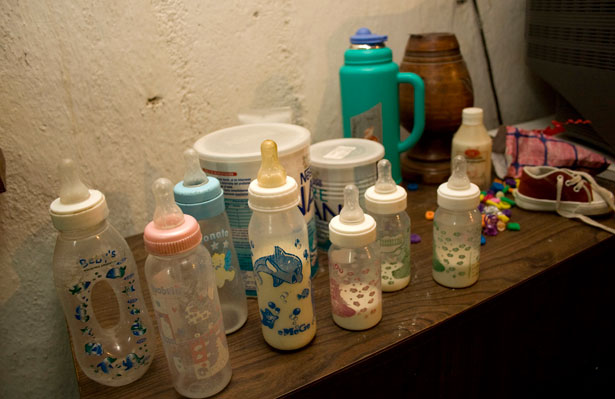
Feeding Bottles (Reuters/Carolina Camps)
Here’s a little window into poverty, American- style. According to a Yale University study published in August in Pediatrics magazine, almost 30 percent of low-income women with children in diapers can’t afford an adequate supply of them, with Hispanic women and grandmothers raising grandchildren the most likely to be in need. Some women are forced to make one or two nappies last the whole day, emptying them out and putting them back on the baby. Based on a survey of almost 900 low-income women in and around New Haven, Connecticut, investigators found the lack of diapers—such a simple thing—had profound and complex effects. The risks to children’s health are obvious: rashes, urinary tract infections, painful chafing. (If a mom is too poor to afford diapers, she probably can’t afford diaper cream or wipes or baby powder, either.) But to their surprise, the study authors also found that not being able to provide this necessary item (to say nothing of having a baby prone to fussing because of the discomfort of a constantly wet and dirty bottom) was a major cause of mental problems like stress, anxiety and depression in mothers. Maternal depression, we know, is associated with all kinds of problems in children, especially for poor kids, who need heroic parenting to overcome the many obstacles they face. Diapers are also necessary for kids entering daycare—no diapers, no enrollment. And no enrollment may mean a mother can’t take a job. For want of a diaper, a future could be lost. Two futures.
How could something so basic be in such short supply? Diapers are expensive—up to $100 a month—particularly for women who don’t have transportation and must rely on bodegas and local convenience stores. Some women reported spending 6 percent of their total income on paper nappies. And before you say, “Let them use cloth,” Marie Antoinette, bear in mind that diaper services are expensive, few poor women have their own washing machines, most laundromats don’t permit customers to launder dirty diapers and most daycare programs don’t allow cloth diapers. Like fresh fruit and vegetables, humanely raised meat and dairy products, and organic baby food, cloth diapers are the province of the well-off.
Despite this clear need, however, diapers are not covered by the food stamp program (SNAP) or by the Women, Infants, and Children feeding program. The government apparently finds them unnecessary, like other hygiene products (toilet paper, menstrual supplies, toothpaste, even soap), which are also, unlike food, subject to sales tax. Never mind that babies can’t choose not to pee and poo and did not select their parents. Never mind, too, that those grandmothers who are the hardest hit caregivers are performing a crucial social task—and saving the taxpayer millions—by keeping those kids out of foster care.
Food, it’s true, is even more basic than diapers. But some people believe low-income children don’t really need that either. If House Republicans have their way, 4 to 6 million SNAP recipients may soon find themselves bounced from the rolls. This, at a time when the Department of Agriculture tells us that 17.6 million households regularly go hungry, up from 12 million ten years ago. Proving yet again that there really is a difference between the parties, Republicans want to cut the food stamp budget by $40 billion over the next ten years. Let them drink tea! Seriously, are they out of their minds?
Don’t believe them when they say the cuts are fiscally necessary. Governments can always find money for the things they want—like increasing subsidies for rich farmers (or bombing Syria). Food stamps are one of the most effective government programs, keeping countless people from outright destitution. This is about ideology—the dismantling of a social compact that goes all the way back to the New Deal, and the promotion of inequality as a civic virtue.
Tennessee Tea Party Congressman Stephen Fincher must not have been thinking about his $3.5 million in crop subsidies when he told The New York Times’s Sheryl Gay Stolberg that the Bible says, “The one who is unwilling to work shall not eat.” Of the 23 million households currently receiving SNAP, three-quarters include children, the disabled or the elderly. What sort of work should they be doing to earn their supper? Forty-one percent of food stamp recipients live in a household where someone has a job—but they don’t earn enough to feed their families. If anyone is freeloading, it’s employers like Walmart who in effect have the taxpayer subsidize their workforce. The Bible-quoting reactionaries conveniently forget that Jesus also said, “The laborer is worthy of his hire.” And he may have said the poor will always be with us, but he didn’t add, “And let’s make sure we keep it that way.”
America has always had a mean streak where poor people, especially poor people of color are concerned, but at our best it’s been tempered by a sense of collective responsibility and, dare I say it, common sense. Are those days gone? On Fox News earlier this month, New Jersey school therapist and counselor Thomas Kersting spoke in favor of a school policy of denying lunch to low-income children whose parents had neglected to fill out eligibility forms. He thought it was “a little harsh” to throw the food into the garbage in front of the child, but hey, if the kid goes hungry, it’s “a teaching moment.” Kersting goes Dickens’s Mr. Bumble one better: Oliver Twist got in trouble for wanting seconds. Kersting doesn’t think poor children even deserve firsts.
Diapers, food stamps, even the lowly school lunch. God bless the child who’s got her own.
September 8–14 is National Diaper Need Awareness Week. Can you help a mother out? Visit diaperbanknetwork.org to donate and find out about volunteering at a local diaper bank—or starting your own. No computer? You can mail a check to National Diaper Bank Network, 129 Church Street, Suite 611, New Haven, CT 06510.
Last month, Greg Kaufmann blogged about the difficulties faced by homeless families.

