
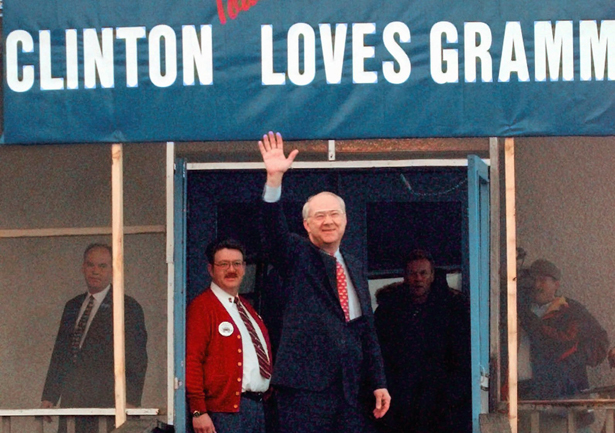
Sen. Phil Gramm waves as he enters the Clinton Boat Club in Clinton, Iowa. Thursday February 8, 1996. The Republican presidential hopeful is campaigning across the state in preparation for the Iowa Caucus Monday February 12, 1996. (AP Photo/Michael S. Green)
This story originally appeared at Truthdig. Robert Scheer is the author of The Great American Stickup: How Reagan Republicans and Clinton Democrats Enriched Wall Street While Mugging Main Street (Nation Books).
Where is Phil Gramm hiding? The former Republican senator from Texas, who wrote the radical banking deregulation of the 1990s and was rewarded for his efforts to enrich the banks with a plum job at Switzerland-based UBS, has not been heard from since his bank got nailed by the G-men. Or, as The New York Times put it, UBS now has the distinction of being “the first big global bank in more than two decades to have a subsidiary plead guilty to fraud.”
Surely Gramm, who retired from the bank last year, must know something about the nefarious activities conducted over a timespan when he was helping to manage the firm. This latest scandal, involving the rigging of a major trusted banking interest rate, might finally test the theories that he has long written into law that assume banks are best when regulated by themselves—a now obviously dumb idea.
As The Wall Street Journal reported on Thursday: “US, U.K. and Swiss authorities alleged a vast conspiracy led by UBS AG to rig interest rates tied to trillions of dollars in loans and other financial products, indicating the practice was far more pervasive than previously known.” But what did Gramm know about this criminal behavior at a bank he helped govern, and when did he know it?
In a deal brokered with the criminal division of the US Justice Department, UBS was also fined $1.5 billion in the massive Libor interest-rate-fixing scam that evidenced a pattern of deep corruption across a score of top banks. But Gramm, the man most responsible for the repeal in 1999 of sixty years of sensible banking regulation that enabled the financial industry to run wild, has not responded to a single question from the mainstream media concerning UBS’ criminal behavior. I assume he has been queried, given his important prior contribution to the sorry state of banking.
When Gramm was still at the bank, his bio page on the UBS website paid tribute to his prior achievements in government: “As chairman of the Banking Committee, Senator Gramm steered through legislation modernizing the nation’s banking, insurance and securities laws.”
That “modernization” in 2000 made legal the mergers that created the too-big-to-fail banks that had to be bailed out by taxpayers, as well as insuring that the burgeoning markets in toxic derivatives and credit default swaps were summarily freed from all government regulation. Bill Clinton signed off on the new laws, and his successor, George W. Bush, enthusiastically enforced them.
How fitting then to find the two presidents united again on several occasions documented on the UBS website participating in bank-sponsored panels on “Revitalizing America.” Clinton’s foundation has partnered with UBS in mentoring small businesses in poorer communities, the very communities hit hardest by the banking shenanigans of the past decade. Ever the optimist, Clinton promised that “Our partnership with UBS Wealth Management Americas will give these businesses essential new opportunities to expand and to make a positive difference in underserved communities.” With friends like these…
The cozy bipartisan reunion of Gramm with the two presidents under the auspices of UBS goes a long way toward explaining the source of our economic misery. It would be instructive to now ask all three whether the crimes of UBS had been enabled by their own actions while they were still running the US government.
That is why I assume the normally loquacious Gramm is on the lam, or surely we would have heard from him by now, at least on the Fox News Channel that has been so solicitous of his wisdom in the past. But not just on Fox. Gramm and his wife Wendy, who was rewarded with a position on Enron’s board of directors after her own stint in government undermining consumer protections, were the high priest and priestess of the religion of radical deregulation that captivated US presidents from Ronald Reagan through Bill Clinton and on to George W. Bush.
Or does Gramm still blame the economic crash on those of us he condemned as “a nation of whiners,” a statement that caused his ejection from a leading role in the 2008 presidential campaign of Sen. John McCain?
If Phil Gramm were to feign ignorance in response to that line of questioning, the way Wendy did after the caper at Enron, where she was a member of the audit committee, it would certainly make the case for ever more government supervision of corporate accountability.
This was, after all, one of the most powerful couples to ever swirl through the platinum revolving door between the highest level of government and corporate power, an exhibit of crony capitalism performed with such exquisite finesse, and yet wild abandonment, that it can almost be considered kinky in its indifference to real-world outcomes.
For more on cronyism, read Lee Fang on new ALEC documents that show regulatory capture in action.

