
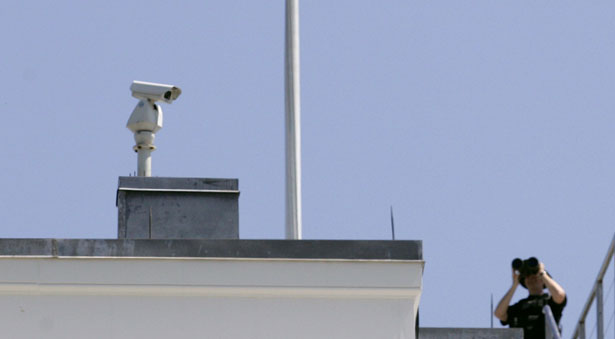
 A member of the US Secret Service looks out from the roof of the White House. (REUTERS/Richard Clement)
When attorney and feminist blogger Jill Filipovic landed at Newark Airport in October, her checked bags had been opened and scrutinized by the Transportation Security Administration. Later that evening when she unpacked, she found the requisite TSA slip acknowledging the search inside her suitcase. It’s unsettling enough to find such a note under the best of circumstances. Most of us do not tuck our dainties, toiletries, computer discs and diaries into our luggage with the thought that an unseen stranger will lay hands on it all and maybe pass untoward judgment. If we do think about it, most of us try to rationalize it as a necessary evil; and we minimize it by imagining a mechanistic bureaucrat, a stern and steely sort, having no emotions beyond a gimlet eye for weaponry.
Anonymous searches like these are nevertheless—by their nature—very intimate interactions. Filipovic discovered this firsthand when the Oz-like mask of the imagined automaton was torn off in the most uncomfortable way. She had packed what she later described as a “discreet miniature vibrator” in her suitcase. The vibrator apparently gave the TSA agent quite a chuckle, for he scrawled a handwritten note across the form: “Get your freak on, girl!” Not surprisingly, when the incident went public, a firestorm of protest forced the TSA to take steps to fire the agent. The search of Filipovic’s suitcase was carried out by a real human being—who is no doubt suffering some remorse—not by our imagined soulless machine.
In the case of United States v. Jones, argued in the Supreme Court on November 8 and likely to be decided in the spring, the false comfort of the single-minded, weapons-hunting machine-man comes into more menacing focus. The appeal questions whether the government can place GPS devices on our cars without a warrant or our knowledge. The Justice Department asserts a right to do just that, with Deputy Solicitor General Michael Dreeben arguing that citizens—even Supreme Court justices—have no expectation of privacy outside their homes. As Justice Roberts succinctly queried, “Your argument is you…don’t have to give any reason. It doesn’t have to be limited in any way, right?” Without a flicker of hesitation, Dreeben responded, “That is correct, Mr. Chief Justice.”
The Constitution protects our right to be free from unreasonable searches and seizures by the government. At the same time, searches by the government exist against a very different backdrop from when the Fourth Amendment was written. How do we guard our “space” when it is neutralized as mere geography-beyond-the-house rather than the mobile positioning of the body politic? We live in an era when new technologies make the most personal information easily accessible, whether the government collects it or not. Our private lives are available “privately” everywhere, even if it’s deemed “data mining” by businesses. The market for information is as thorough as a laser; it is as inescapable as the air we breathe: our lives are online. Our medical records are stored in “clouds.” We date through websites. Our genetic code is decipherable from any bit of discarded bubble gum. “Private” security cameras aim their ceaselessly gathering gaze on every public street. Our cellphones blip our location to satellites in space. People send compromising pictures of themselves in “sext” messages that can never be retracted. If our neighbor wishes to surveil us or to stalk us, we are all too vulnerable.
Popular
"swipe left below to view more authors"Swipe →
And if the government wants to do the same, it has never been easier. The ubiquitous and relatively invisible private collection of data serves as a sort of outsourcing of surveillance. The government has merely to dip into that endless sea of factoids and sift for what it wants: the hardest part of the job has already been done by the private sector. Indeed, the only question is whether state actors can openly do what any ad agency does routinely.
Furthermore, while bystanders with cameras are often barred from taking pictures of police actions—like the eviction at Occupy Wall Street—more and more police departments are outfitting their officers with wearable cameras. Who will have access to that footage? Will police be able to keep it from defendants? Ought officers be able to review it in order to conform their reports to what it shows? Should such images be made subject to FOIA requests, or are they more like an officer’s private notes? And if made universally available, how should they be redacted in the interests of citizens’ privacy—as when an officer enters an innocent person’s home?
Filipovic’s experience is a small example of the temptations to which public and private eyes fall prey. New and evolving technology allows the infinite magnification of such intrusiveness, then renders it faceless and unaccountable. Inescapable as well: in order to fly anywhere, bodies as well as bags now pass through a radioactive gaze that sees into the very wisps of our powder and bone. For those who tremble at that option, the TSA also lets us all get our freak on with a personalized pat-down “in private.”
All in all, Filipovic was gracious about the incident, acknowledging that as offensive as it was, the agent meant it as “a joke.” I suppose it is a bit like jokes among undertakers: we know there is something violative and macabre that goes on in the inner operations sanctum, but ultimately we demand that it be constrained by a certain theater of respect. In the context of criminal law, that demands a warrant at the very least. In the context of random airport searches, it demands comportment with the rituals of dignity rather than humiliation. As Filipovic concludes so eloquently, “I get no satisfaction in hearing that someone [lost their job] over this. I would much prefer a look at why ‘security’ has been used to justify so many intrusions on our civil liberties.”

