
Trump’s “Golden Age” Means No End to Palestinian Slaughter
The president’s much-touted foreign policy shake-up is blighted by continued support for genocide.
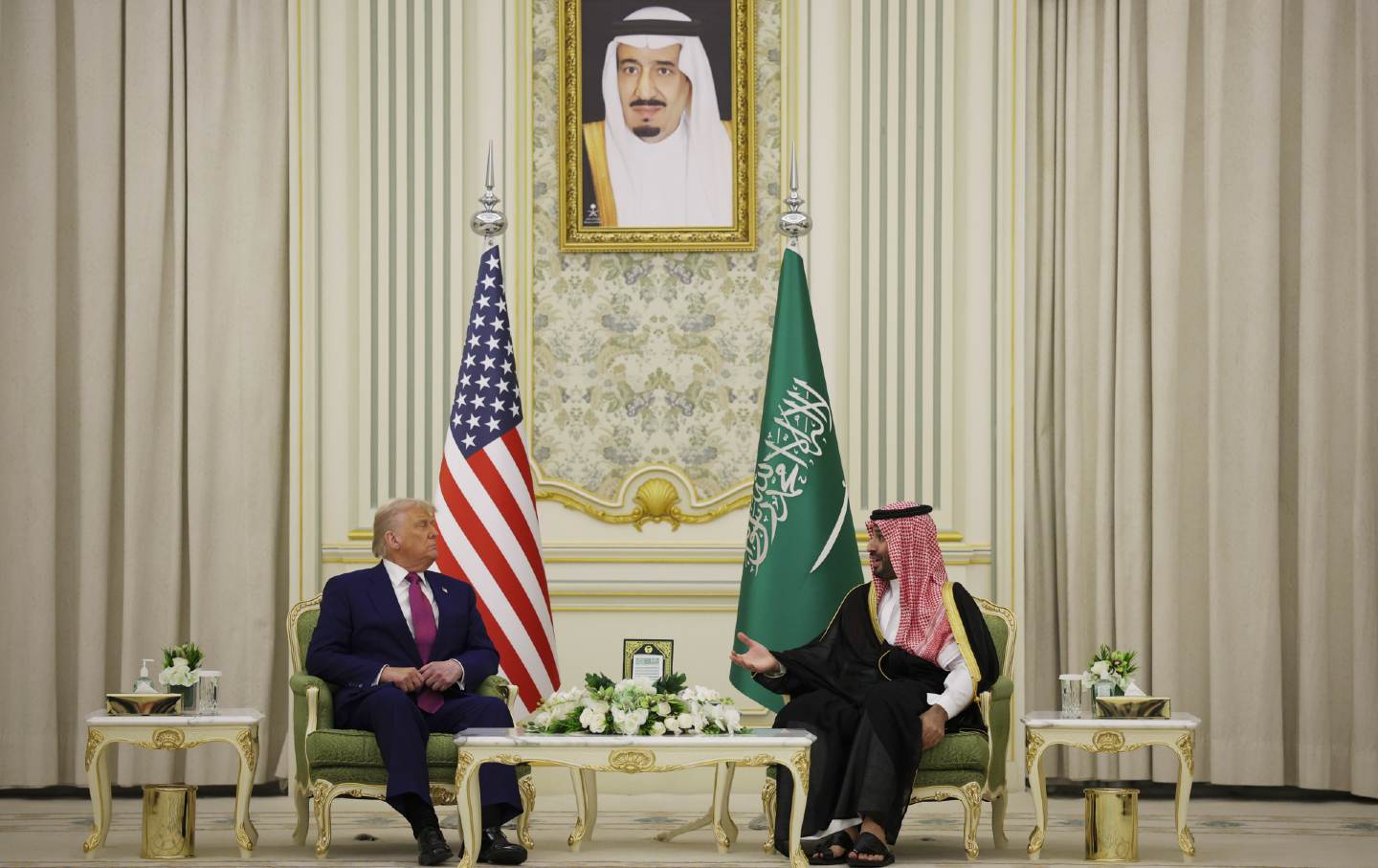
Fate made a mistake placing Donald Trump in the White House, since he is much more suited to be a Saudi princeling than an American president. In last week’s trip to the Middle East, Trump was right at home consorting with Arab nobility, most notably Saudi Crown Prince Mohammed bin Salman (popularly known as MBS). Trump has much in common with MBS: Both are spoiled sons of wealth who mistake the accident of their lucky birth for proof of superior merit, visionary insight, and even divine support. Both are trying to fuse autocracy with unbridled capitalism. Even on the level of aesthetics, Trump and MBS are both fans of ostentatious gaudiness that doesn’t stint on the glittery and golden.
While Trump has praised autocrats of all shapes and sizes—ranging from Russia’s Vladimir Putin to Hungary’s Orbán to North Korea’s Kim Jong Un—Trump reached a new level of effusiveness last Tuesday when showering superlatives on MBS. Trump called the crown prince “an incredible man” and gushed that “I like him too much.”
More substantively, Trump made clear that his foreign policy vision rested not just of strengthening the US relationship with Saudi Arabia and other regional autocracies but also of giving their rulers a free hand. Trump contrasted his approach with that of earlier presidents, both Republican and Democrats, who tried to remake the region:
Riyadh is becoming not just a seat of government, but a major business, cultural, and high-tech capital of the entire world….
And it’s crucial for the wider world to note this great transformation has not come from Western interventionalists or flying people in beautiful planes giving you lectures on how to live and how to govern your own affairs. No, the gleaming marvels of Riyadh and Abu Dhabi were not created by the so-called nation-builders, neocons or liberal nonprofits like those who spent trillions and trillions of dollars failing to develop Kabul, Baghdad, so many other cities.
Instead, the birth of a modern Middle East has been brought by the people of the region themselves, the people that are right here, the people that have lived here all their lives—developing your own sovereign countries, pursuing your own unique visions, and charting your own destinies in your own way. It’s really incredible what you’ve done.
Trump enthused that working with MBS and other Arab autocrats, he could create a new “golden age” in the Middle East.
There’s one aspect of Trump’s foreign policy vision that is genuinely attractive: his critique of the failure of his predecessors—whether the neoconservatism of George W. Bush or the liberal internationalism of Barack Obama and Joe Biden. Both of these policy traditions have shown themselves to have catastrophic consequences, leading to the regional instability and endless wars.
In place of neoconservatism and liberal internationalism, Trump has offered a foreign policy that he calls America First, which purports to be based on realism and national self-interest.
In practice, Trump’s foreign policy might be politely described as transactional dealmaking—and more bluntly characterized as a foreign policy of corruption. Trump is leveraging America’s outsize role in the world to exact imperial tribute from allies while also enriching his own personal coffers. In the Middle East this means touting large arms sales to Arab autocracies, even as the Trump-family crypto business is enriched by investors from those same countries. In 1953, Dwight Eisenhower nominated Charles E. Wilson, president of General Motors, to be secretary of defense. In Senate hearings, Wilson famously said that “for years I thought that what was good for our country was good for General Motors, and vice versa.” In the same vein, Trump is trying to create a foreign policy where what is good for America is also good for Trump’s bank account.
It is a measure of the failure of Trump’s predecessor that this openly corrupt transactional politics is leading to positive changes. Trump might be a crook, but this also means he isn’t bound by the national security consensus that prioritizes maintaining the status quo and discourages negotiations with hostile powers.
As James Landale, diplomatic correspondent for the BBC, notes, Trump’s transactional foreign policy has led to a flurry of activity that is upturning the status quo:
He and his team have done business deals in the Gulf; lifted sanctions on Syria; negotiated the release of a US citizen held by Hamas; ended military strikes on Houthi fighters in Yemen; slashed American tariffs on China; ordered Ukraine to hold talks with Russia in Turkey; continued quiet negotiations with Iran over a nuclear deal; and even claimed responsibility for brokering a ceasefire between India and Pakistan.
Some of these changes are spurious or simply Trump correcting his own errors. After all, the tariffs Trump is slashing are the same ones he himself opposed. Further, with the India/Pakistan conflict, Landale himself acknowledges that the United States played a peripheral role. Trump is merely claiming credit, as is his wont, for positive developments that are the result of others’ actions.
Still, in terms of lifting sanctions on Syria, restarting talks with Iran, directly negotiating with Hamas about hostages, ending the strikes on Yemen, and pushing for a deal between Ukraine and Russia, Trump has been far bolder than Joe Biden.
Biden was averse to negotiating with adversaries. A product of the early Cold War, he believed that a strong foreign policy consisted of building up alliances such as NATO and avoiding even discussion with adversaries. Trump’s transactional foreign policy stinks of corruption—but at least it allows space for trying to find a common ground with adversaries. Further, with his moves on Yemen and Syria, Trump is openly defying Israeli Prime Minister Benjamin Netanyahu, something Biden was notoriously reluctant to do.
Writing in the Financial Times, Philip Gordon, a senior foreign policy adviser to Kamala Harris, echoed these sentiments: “But there is one area where many Democrats grudgingly envy Trump: his ability to take on established orthodoxies without paying a political price.”
Unfortunately, there is a limit to Trump’s foreign policy boldness on an issue that is both a moral blot on the United States and a serious danger to national security: the ongoing slaughter of Palestinians by Israel.
It’s notable that many of Biden’s own advisers are now praising Trump for possessing a boldness that their old boss lacked. Axios gathered together a striking set of comments:
“Gosh, I wish I could work for an administration that could move that quickly,” one admitted.
“He does all this, and it’s kind of silence, it’s met with a shrug,” says Ned Price, a former senior State Department official under President Biden. “He has the ability to do things politically that previous presidents did not, because he has complete unquestioned authority over the Republican caucus.”
“It’s hard not to be simultaneously terrified at the thought of the damage he can cause with such power, and awed by his willingness to brazenly shatter so many harmful taboos,” says Rob Malley, who held senior posts in three Democratic administrations, including handling Iran talks under Presidents Obama and Biden.
Popular
“swipe left below to view more authors”Swipe →Trump deserves credit for defying Netanyahu on Syria and Yemen as well as pursuing direct talks with Hamas. Further, Steve Witkoff, Trump’s Middle East envoy, has been far more blunt than Joe Biden ever was about Netanyahu’s preferring a prolonged war to the return of the hostages. Last Sunday, Witkoff reportedly told former hostages, “We want to bring the hostages home, but Israel is not willing to end the war. Israel is prolonging it—despite the fact that we don’t see where else we can go and that an agreement must be reached.”
But as welcome as this partial break with Netanyahu has been, Trump has combined it with continued support for the onslaught in Gaza—including giving sanction to the policy of ethnic cleansing. Trump is openly calling for the conquest of Gaza and its transformation into a “freedom zone” (a policy that entails the expulsion of the Palestinians).
NBC reported on Friday, “The Trump administration is working on a plan to permanently relocate up to 1 million Palestinians from the Gaza Strip to Libya.”
Human rights scholars are increasingly characterizing Israel’s ongoing slaughter in Gaza as a “genocide.” Trump’s ethnic cleansing plan would only make the United States even more complicit in one of the worst assaults on human rights in this century. The Biden-Trump policy of giving Israel a virtual carte blanche both undermines American national interest and is a moral blot that will never be erased. Trump’s transactional shake-up of American foreign policy, if one is willing to turn a blind eye to the corruption, has some positive features. But Trump’s failure to curtail Israeli war crimes means that on one of the most important foreign policy issues facing the US he’s just continuing the failed policies of his predecessors.
More from
Jeet Heer 
Even Republicans Are Waking Up to Trump’s Corruption Even Republicans Are Waking Up to Trump’s Corruption
And, somewhat shockingly, so are Democratic elites.
Where Is the Outrage Over Trump’s Racist Targeting of Ilhan Omar? Where Is the Outrage Over Trump’s Racist Targeting of Ilhan Omar?
The establishment press and some Democrats are strangely mute over the president’s flagrant abuse of the legal system.
The Real AI Threat Is Already Here The Real AI Threat Is Already Here
Never mind some future apocalypse—AI is being used right now to cause enormous suffering.
Elon Musk’s James Talarico Smear Blew Up In His Face Elon Musk’s James Talarico Smear Blew Up In His Face
But that doesn’t mean the danger from Musk’s lies is over.
Does America First Really Mean Israel First? Does America First Really Mean Israel First?
Mike Huckabee’s aide shows how an extremist agenda dominates Trump’s Middle East policy.

The Death Penalty Has Become a Torture Machine The Death Penalty Has Become a Torture Machine
Christa Pike's botched lethal injection proves there is no humane form of execution.

