The New Face of British Conservatism is Black—and Female
The London-born daughter of Nigerian parents presides over the ruins of 14 years of Tory rule. Can her brand of nativism-lite bring the party out of the wilderness?
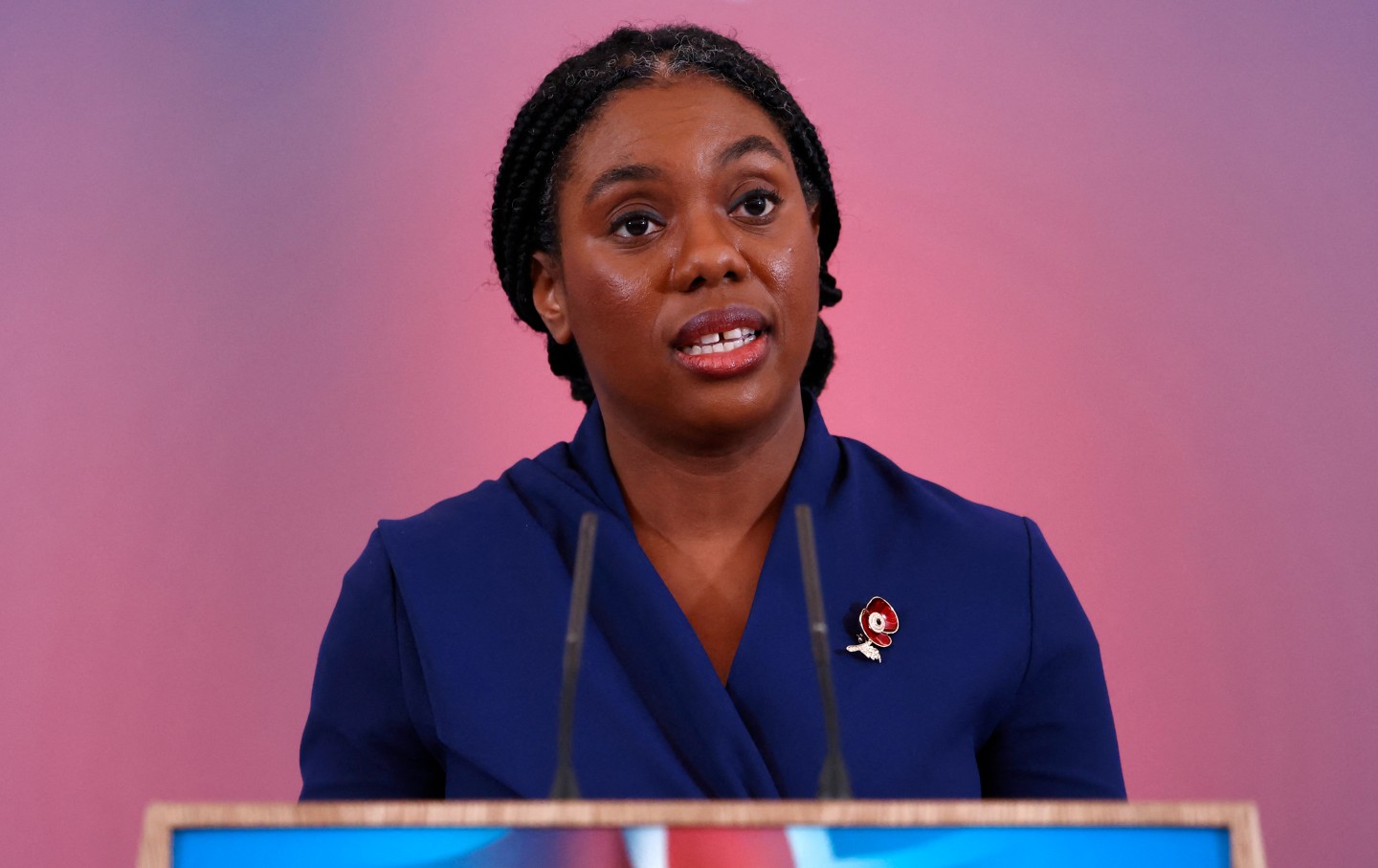
London—In December 2006—a year into David Cameron’s tenure as leader of Her Majesty’s Most Loyal Opposition—Kemi Adegoke, a 26-year-old computer systems analyst for a bank, contributed to an Observer magazine feature on why it was “cool to be Conservative.” Acknowledging that as “a black African woman” she may not “fit the image” of a “stereotypical” Tory party member, Adegoke, who moved to Britain a decade earlier having grown up in Lagos, Nigeria, told the reporter she did not think “every problem in the country is down to [Tony] Blair and the Labour Party.” She believed, simply, that “the Conservatives would do a much better job of running the country.”
Now, Kemi Badenoch, married to a banker she met as a young Conservative activist, sits as member of Parliament for North West Essex, and finds herself running the party that, following 14 years in government, was unceremoniously ejected from office in July this year. In a selection process where less than 100,000 dues-paying Tory supporters voted on who should replace former Prime Minister Rishi Sunak as head of the party, the former business secretary beat ex–immigration minister Robert Jenrick—also residing on the Tories’ right flank—to become the sixth leader in nine years.
Over the past century, nearly every Conservative leader has, at some point, held the office of prime minister—apart from a few brief years at New Labour’s peak at the turn of this century when the party faithful opted for three forgettable middle-aged bald men in quick succession. If Badenoch, a combative communicator of conservative values, is to avoid their fate, her party must recover from the worst general election result in its history, reduced to a rump of just 121 of the 650 seats in the House of Commons.
Since 2010, only two of the five Tory Prime Ministers won outright majorities at the polls: Cameron and Boris Johnson——both of them Old Etonians and, at Oxford University, both members of the Bullingdon Club, an elitist all-male dining society notorious for its expensive tailored uniforms and penchant for vandalizing restaurants. Badenoch, who worked shifts at a McDonald’s while studying at a further-education college, is cut from a different cloth, though it was as equalities minister under Johnson that she first came to prominence, embroiling herself in public rows about single-sex toilets and the contested legacy of the British Empire.
When Johnson was ousted as prime minister by parliamentary colleagues in July 2022, with the party mired in corruption and sex scandals, Badenoch ran to succeed him. She performed better than expected, fighting a culture war where everything—from “identity politics” to “net zero” and a “Ben and Jerry’s tendency” within business toward social justice—became a target.
Once Badenoch was eliminated from the race, a tranche of her supporters defected to the victorious campaign of Liz Truss, whose chaotic prime-ministership abruptly ended just seven weeks later, after she alienated her cabinet and crashed the pound. She was hastily replaced by Sunak—Parliament’s wealthiest MP, richer even than the king—without the party grassroots’ ever being consulted. “We have to be honest—honest about the fact that we made mistakes,” the new leader conceded during her victory speech on Saturday, “honest about the fact that we let standards slip.”
Since the summer, the Tory party in opposition has undertaken little soul-searching, its MPs preoccupied by factional positioning which saw them ultimately short-list two candidates from the populist right. Though vestiges of liberalism have barely troubled the party leadership since Margaret Thatcher’s first term—during which she successfully sidelined ministerial “Wets” opposed to her tough socioeconomic program—every time a contest comes around Britain’s chattering classes yearn for a supposedly unifying “One Nation” candidate (the phrase comes from the Victorian Prime Minister Benjamin Disraeli, who has a plausible claim to governing as a “One Nation” Tory) to emerge—a “moderate” option for the Tory selectorate. The failure of this to happen during the latest campaign, in the aftermath of far-right violence and racist riots flaring up across the country, led to muted mainstream media interest, offering the remaining candidates an opportunity to directly appeal to their members’ basest instincts around the issue of immigration.
Only weeks after mosques and migrant hostels had been targeted by racist vandals, Badenoch proclaimed that Britain “is not a dormitory for people to come here and make money,” adding that “not all cultures are equally valid” when deciding who is allowed to enter and who is not. Her opponent Jenrick—who once ordered a Disney mural at an asylum processing centre for unaccompanied children to be painted over for being too welcoming—argued that his nation’s former colonies owed it a “debt of gratitude,” and that anyone shouting “Allahu Akbar” in the street should be immediately arrested.
The proximate reason for the Conservative party’s descent into nativist rhetoric is simple: the success of Nigel Farage. The leader of the Reform party both electorally disrupted and ideologically influenced the Tories during their most recent stretch in government, finally gaining a parliamentary foothold in 2024 as MP for Clacton in Essex. Depriving his rivals of five seats and millions of votes, Farage—dubbed “Mr. Brexit” by Donald Trump—will be heartened that EU states like France, Italy, Austria, and the Netherlands have, in recent years, seen iconoclastic anti-immigrant parties of the outside right overtake traditional conservative parties in national elections. Badenoch will inevitably face calls to “unite the right’”around policies prescribing strong borders and a “war on woke’” If she is successful, it will see the world’s oldest political party reduced to a mid-Atlantic Trumpist tribute act, floating somewhere between Republican America and the European mainland.
How the Conservative Party, facing a cautious Labour Government under Sir Keir Starmer, will spend its time in opposition still remains to be seen. Those who study British political history know that, even after large-scale national ruptures—from repealing the Corn Laws to Irish Home Rule, from appeasing Hitler to Brexit—the Tories are more than capable of adapting to new realities. Though their parliamentary rump is somewhat shrunken, extra-parliamentary change can be affected through a reliable ecosystem of extractive business interests, secretive think tanks, and reactionary press barons, the latest of whom is Sir Paul Marshall.
A hedge-fund tycoon—whose satellite television channel GB News broadcast the sole head-to-head debate between Conservative leadership candidates, with Nigel Farage and a number of sitting Tory MPs also on the network’s payroll—Marshall recently acquired The Spectator, the print magazine where, less than a decade ago, Kemi Badenoch worked as digital director. Michael Gove, the Machiavellian former cabinet minister who has praised the new leader’s “no bullshit” approach and was widely seen as her political mentor, has just been appointed editor of the two-centuries-old in-house Tory journal, with Charles Moore, (the official biographer of Margaret Thatcher, ennobled under Boris Johnson) installed as chair.
Armed with clear ideological talking points, two viable parliamentary vehicles, and friends in high places, British Conservatism may yet embark upon its boldest transformation since Thatcher became leader of the opposition 50 years ago.
Editor’s Note: Due to an editing error an earlier version of this story stated that Ms. Badenoch was born in Nigeria. She was actually born in Wimbledon, in south-west London. The Nation regrets the error.
More from The Nation
The Specter of Lepenism Looms Over France’s Social Crisis The Specter of Lepenism Looms Over France’s Social Crisis
Joining forces with the “yellow vests,” youth demonstrators are raising the alarm in a country falling to the far right.

Progressives Are Backing Puerto Rican Independence. It’s About Time. Progressives Are Backing Puerto Rican Independence. It’s About Time.
More and more leftists are concluding that statehood for the island is not enough.

The Saudi Phase of the Iran War Signals More Chaos to Come The Saudi Phase of the Iran War Signals More Chaos to Come
The conflict that Donald Trump has repeatedly proclaimed an unequivocal American victory keeps spiraling out of control.
Andy Burnham’s Speech to the Labour Party Conference Could Be the Start of a Positive Social-Democratic Politics Andy Burnham’s Speech to the Labour Party Conference Could Be the Start of a Positive Social-Democratic Politics
But the autumn budget to be released at the end of October will offer needed details.
Why Navi Pillay’s Receiving the Nobel Peace Prize Is So Important Why Navi Pillay’s Receiving the Nobel Peace Prize Is So Important
She believes that human rights and international law are universal principles that must be enforced regardless of violator’s ideology, ethnicity, or geostrategic alignment.