
Why the Women of This Tiny Palestinian Village Went on Hunger Strike
After the murder of local activist Awdah Hathaleen, his loved ones said they wouldn’t eat until his body was returned.
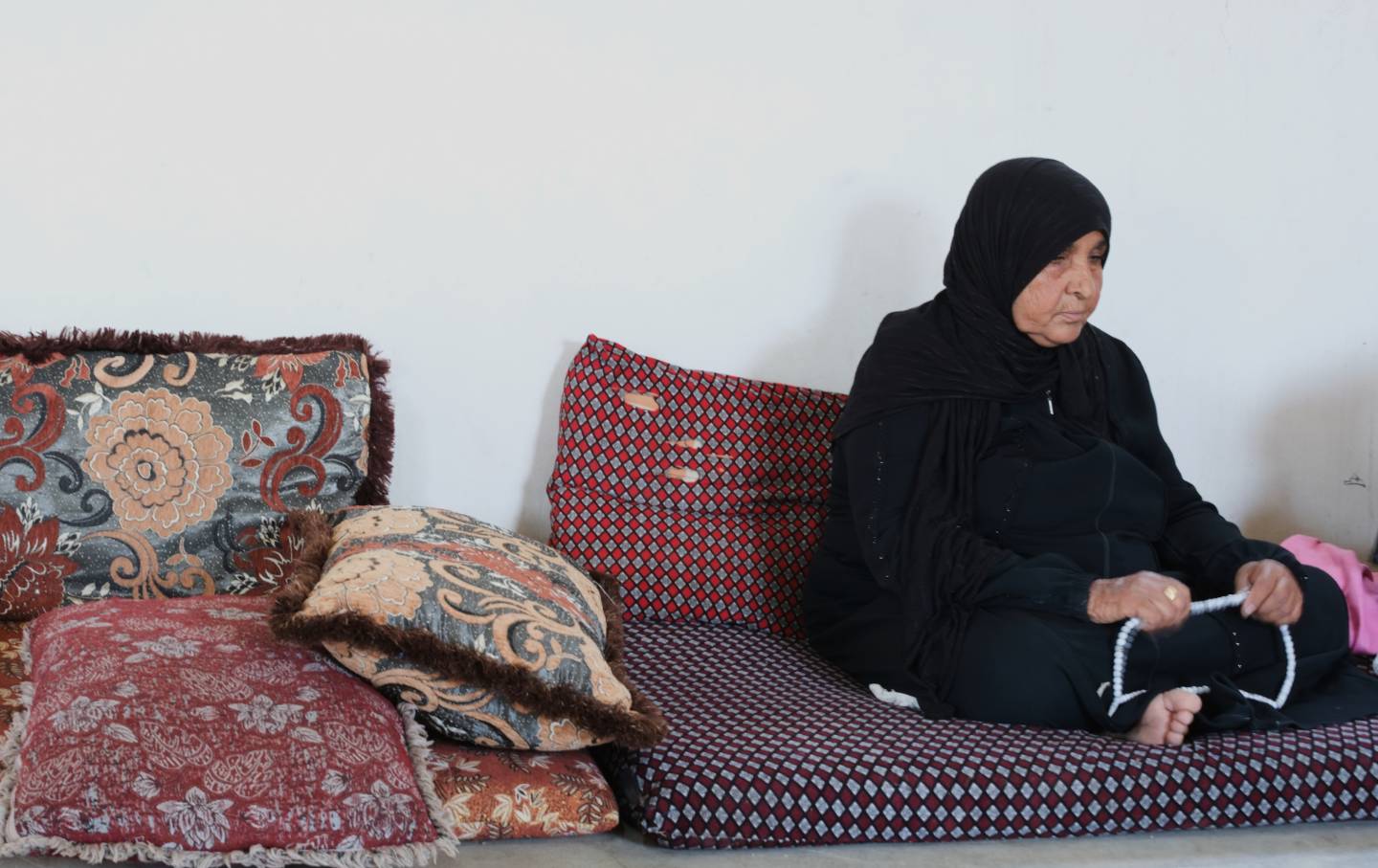
Khadra Hathaleen, mother of a Palestinian activist who witnesses say was shot by an Israeli settler, is seen in Umm al-Khair, West Bank, Monday, August 4, 2025, while on hunger strike to call for Israel to return his body.
(Julia Frankel / AP)Note: a few hours after this story was published, news broke that Israel had returned the body of Awdah Hathaleen to his family. He has now been laid to rest; Al Jazeera reported that Israel “tried to block mourners from joining the funeral.”
Nearly every woman in the occupied West Bank village of Umm al Khair has refused to eat since Thursday, July 31.
The hunger strike erupted as part of a demand that Israeli authorities return the body of slain 31-year-old Awdah Hathaleen—a beloved community leader, father, and activist—to his hometown.
Hathaleen, who helped make the Oscar-winning documentary No Other Land, was killed in broad daylight on July 28 after an Israeli settler armed with a pistol and heavy machinery opened fire on a group of Palestinians. The incident marks yet another episode in the intensifying ordeal of settler attacks and home demolitions in Umm al Khair and across the West Bank.
Hathaleen’s accused killer, Yinon Levi, has faced international sanctions in the past due to his documented history of violence against Palestinians. He owns an illegal farming outpost in the Hebron Hills and a demolition company that contracts with the Israeli military. Levi was released from a brief house arrest on Friday after the Jerusalem Magistrate’s Court concluded that evidence on the ground substantiates his claim of self-defense. However, sources at the scene report that the Palestinians who confronted the settlers were unarmed, and footage of the encounter shows a flustered Levi shooting wildly.
Israeli police say that they will return Hathaleen’s remains only if the family agrees to hold an expeditious burial at night in a nearby city and limit the funerary gathering to 15 people. But community members argue that these conditions are restrictive and hinder a traditional Muslim burial. “Awdah was the person who loved Umm al Khair the most,” says Ekhlas Hathaleen, a striker and wife of Awdah’s older brother. “Why not bury him in the area where he was born? The area he served? All his life, he breathed Umm al Khair’s air.”
“None of us can feel any sense of calm, closure, or rest until we can give him a proper burial,” says Sara Hathaleen, another striker and the sister-in-law of Awdah Hathaleen.
In the week since Hathaleen’s murder, the Israeli military declared Umm al Khair a “closed military zone” and raided the community—detaining several Palestinians and two foreign activists. Sara’s husband was among those apprehended. Most have been released.
The idea of a hunger strike emerged soon after Hathaleen’s murder. The moment she found out about his death, his wife, Hanady Hathaleen, pledged to stop eating and drinking until his body was returned to their village. In solidarity, over 60 women aged 15–70 agreed to participate in the hunger strike. “If Hanady can’t eat, we can’t eat,” says Ekhlas.
“Striking is in our hands. It’s what we feel we can do as women,” says Sara. Ekhlas adds, “If there was anything else we could have done, we would have done it, but we couldn’t. This is all we can offer—abstaining from eating.”
The action was organized on a WhatsApp chat that the women of Umm al Khair share. While hunger strikes have long been a tool used in Palestinian resistance, Ekhlas notes that “it’s the first time we’ve ever taken a step like this in Umm al Khair.”
Awdah’s murder is part of a surge in settler violence across the occupied West Bank. As global attention remains fixed on Israel’s genocide in Gaza, settlers have seized the moment—escalating attacks under the cover of diminished media scrutiny. “I have been living in Umm al Khair for 27 years, but it only became very difficult around two years ago,” says Ekhlas.
Settler assaults against Palestinians in the West Bank since October 7, 2023, now number in the thousands and include murder, the destruction of homes and crops, sexual violence, livestock theft, the forcible displacement of families, and more. The levels of West Bank and East Jerusalem settler brutality in 2024 were the highest ever recorded by the UN.
While settlements and outposts in the West Bank are illegal under international law, the Israeli military has frequently been documented turning a blind eye to settler attacks and, in some cases, actively participating in them.
“They came with one small caravan and then they started to expand and build houses,” says Sara, reflecting on the first settler arrivals to Umm al Khair. “Then Israel began issuing demolition orders on our houses and limiting the land available for shepherding—the primary way that Palestinians have historically made a living in the village.”
Sara agrees with Ekhlas that living conditions sharply deteriorated two years ago, after settlers from Shimon Atiya’s Shorashim farm outpost—which is located roughly 800 meters from Umm al Khair’s homes—began ramping up their attacks on Palestinians. Sara says that Atiya and some of the youths who live in his compound “enter the homes. They hit the children. They harass the residents.” The actions of Shorashim Farm settlers also include, but are not limited to, repeatedly cutting the village’s water pipe, firing live rounds and tear gas into the village, and attempting to occupy the yard of a local family.
Popular
“swipe left below to view more authors”Swipe →Ekhlas tells The Nation that living near settlers has cultivated an environment of fear in Umm al Khair. She no longer feels comfortable leaving her children alone at home, even during the day. “We don’t need much more than bread and water—we just want to live safely and comfortably. We just want our children to sleep.”
On the day that Hathaleen was killed, Umm al Khair’s residents were attempting to block settlers who were bulldozing the land and destroying trees. When Levi shot his pistol into the crowd, Hathaleen was standing in front of the village’s community center, some distance away from the scene. The bullet lodged itself in his chest. Settlers and soldiers were reportedly laughing as he died. Hathaleen was pronounced deceased at a hospital in Beer Sheva, Israel. His body has not been home since.
Ekhlas asks the world to put as much pressure as possible on the Israeli government to release Hathaleen’s body so that he may rest in his rightful grave. Until then, despite being tired, weak, and running out of breast milk, the women of Umm al Khair will continue their hunger strike.
Evoking the words of Umm al Khair activist Hajj Suleiman Hathaleen, who was allegedly purposefully run over by an Israeli tow truck in 2022, Sara promises: “We will stay either on top of the land or under the land. But we will never leave this land.”
More from The Nation
Israel’s Extremist Election Israel’s Extremist Election
The run-up to the vote on Tuesday is exposing the façade of Israeli democracy—and the fealty of the country's so-called opposition when it comes to matters of Jewish supremacy.
“NAZA” and Israel’s History of Automated Warfare “NAZA” and Israel’s History of Automated Warfare
As violent technologies like spyware, predictive targeting algorithms, and 2,000-pound warheads become ordinary instruments of military rule, once-abhorred practices become routin...

Brazil’s Workers’ Party Is Not Stopping Brazil’s Workers’ Party Is Not Stopping
With just a few days remaining before the runoff election, supporters of Lula’s party are doing everything possible to rally support behind the president.

Brazil’s Decision Brazil’s Decision
The moral compass and basic humanity of political leaders really does matter.
Albanian Student Strikes Spur a Political Crisis Albanian Student Strikes Spur a Political Crisis
A new round of protests against the ruling party’s corruption has Prime Minister Edi Rama giving cops bonuses to crack down on dissent.

