
My Years-Long Fight to Say “They”
Over and over again, I would use the pronoun in my writing. Over and over again, editors would try to remove it.
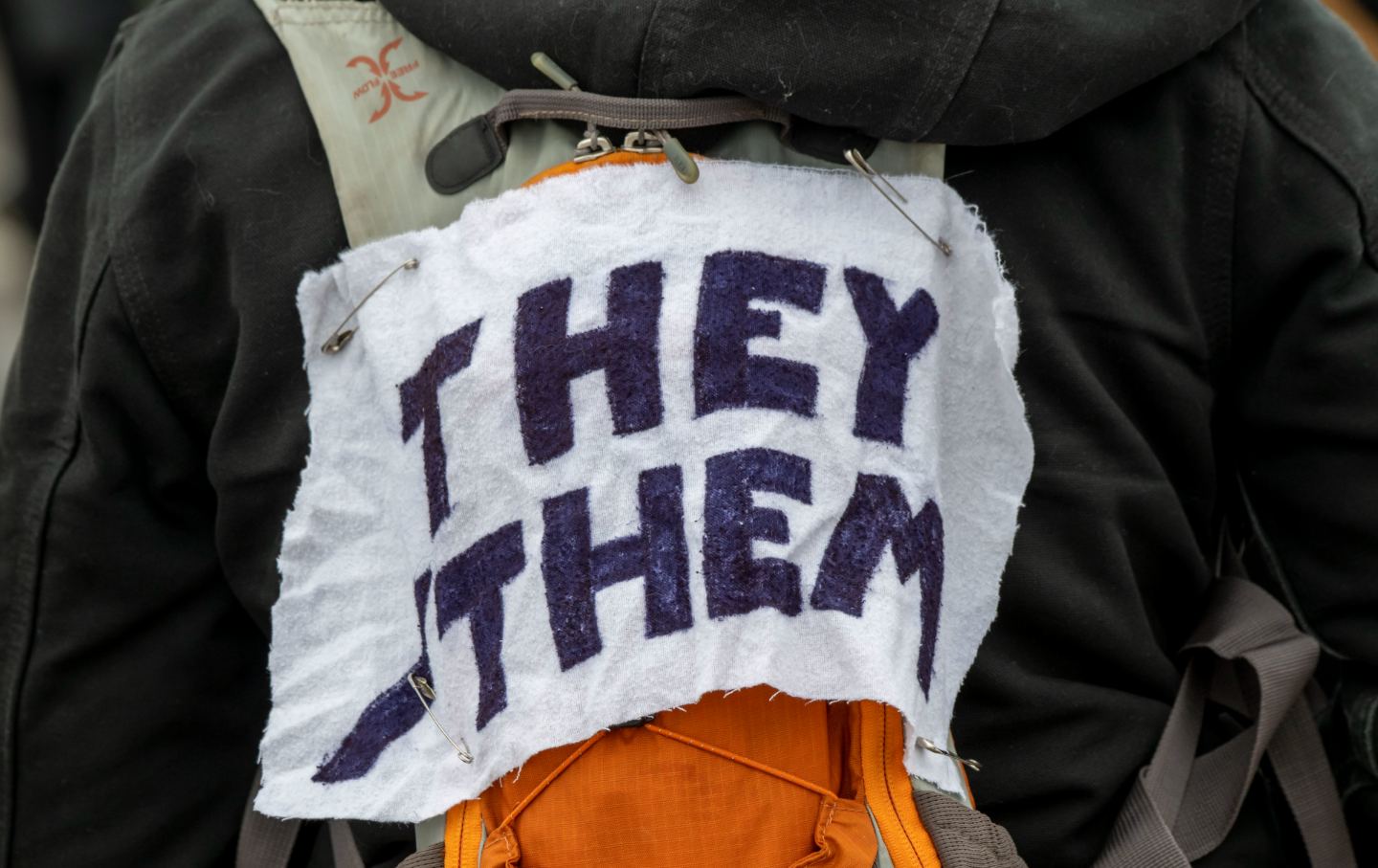
A protester at a rally in St. Paul, Minnesota, on March 6, 2022.
(Michael Siluk / UCG / Universal Images Group via Getty Images)In 2019, I finished revisions on an essay about growing up a Jehovah’s Witness, the first of many I would write about those bizarre years knocking on doors and warning neighbors they’d die in a fiery Armageddon unless they accepted the sweat-stained tract I held and whose every lie I believed. I put everything into that essay, recreating the public and private apocalypses that would dog me long after I stopped shilling for Jehovah.
In the little magazine circuit, first you submit your essay to The Threepenny Review, then you send it to everybody else. The rumor is that it’s easier to get into Harvard than into Threepenny. A rejection from them is a rite of passage, the proof that you’re a real writer. I duly sent my piece to Threepenny, expecting to be turned down. Instead, I was gobsmacked to get an acceptance. I was also excited. This kind of visibility could attract an agent and help get my memoir published. And I could finally warn people about a dangerous cult that had labeled me an apostate, one who “must build their own library of contraband texts,” as I’d written in the piece. Now, thanks to Threepenny, one such text—my essay—would no longer be contraband.
But I’d used the singular “they” throughout the piece, which didn’t sit well with my editor, who made clear that Threepenny doesn’t use that grammar construction. “I am confident that other solutions will arise as time goes on: solutions that all of us, grammar mavens and human rights advocates, can live with more comfortably.” She attached a copyedit with the singular they changed alternately to he or she wherever it occurred. We were undoubtedly heading into conflict, one that kicked off an important process for me: learning to push back, in my writing, against the necessity of a binary world.
I responded objecting to her edits and noting that the use of they had become much more widespread than before. We’d come a long way since 2013, when The Atlantic’s Jen Doll dubbed the pronoun an “ear-hurting, eye-burning, soul-ravaging, mind-numbing syntactic folly” and added, “ Stop the singular they. Stop it now.” (Doll was clear that she objected to the pronoun being used generically, not when referring to a specific nonbinary person.) By 2019, the Associated Press, The Washington Post, and The New York Times had begun to allow the singular they in their copy, albeit not without grumbling. 2019 was also when Merriam-Webster made they their Word of the Year, and when Sam Smith used the pronoun to come out as nonbinary to fans and haters alike.
I hinted that, if The New York Times could change its policy, so could Threepenny. This was a miscalculation on my part, because my editor, it turned out, already had a beef with the Times for using like instead of as. “Threepenny is aware of what some other journals are doing, but we are not about to violate the longstanding rules of grammar to accommodate this particular political moment,” she replied. She told me that, though Threepenny was an ally to the queer community, “I can’t help feeling that my defense of the English language is an important one, even if (or because) everyone else is giving the store away.”
Giving the store away?
When is a moment not political?
“I do not think I have prevented anyone from being represented as non-binary, because I have made the adaptation that allows gender to be interpreted multiply,” she continued, referring to her generous offer of alternating he and she. (This overlooked the fact that, while some nonbinary people may use these pronouns, many others are deathly allergic to them.) “I have simply prevented you from using a grammatical construction that I do not think needs to be the only way to represent these things.” Her point seemed to be that, because I wasn’t referring to any specific nonbinary person, no one was harmed—and that, as a cis person, I shouldn’t mind anyway.
But I minded. I fired back from my soapbox of unchecked wokeness. “If you will not make the exception for me, I wonder if you will make it for other authors, when representing a nonbinary identity is at stake?” I thought about all the nonbinary people who, according to magazine policy, couldn’t be written about without being misgendered—that is to say, gendered. And I found the magazine’s stance incongruous with a 2012 interview where the editor (perhaps unwittingly) uses the singular they in response to a question, proving that it can be done naturally.
She offered a compromise: to convert the nouns in question to plurals. For example, if “apostate” became “apostates,” then they would no longer pose a problem for Threepenny. I refused, withdrew the essay, and watched a golden opportunity vanish, wondering if my story would ever be published. “I will take it very ill if you share our communication on the internet (or anywhere else that is public), especially if you do so in any redacted way,” she said in closing.
This collision with Threepenny and the silence my editor demanded was painful in a house with a trans person in it. My nonbinary partner Wes is misgendered multiple times a week and often bears it silently. They pick their battles. When pronoun mix-ups deny them necessary medical care, it’s worth the fight. When Jordan Peterson drops his latest tautology-ridden manifesto against pronouns, it isn’t. Quebec, where we live, has barred official communications from using gender-inclusive language, which they say is confusing. The government now has no pronoun to refer to Wes. Fantastic. The last thing we need, on top of that, is for their pronouns to be banned in my own writing.
My essay ultimately found a home at Roxane Gay’s The Rumpus, offending pronouns and all. But the problem kept happening. In 2020, an editor at Conjunctions accepted another piece from the same Jehovah series, with caveats. “I’m a traditionalist enough to be bothered by the agreement problem with “a stutterer” and “their…” Maybe change to “stutterers can say their own names”?” He also wanted me to replace the word “homo.” I never got into it with him, since The Malahat Review had already accepted that same essay without any qualms.
Popular
“swipe left below to view more authors”Swipe →In a 2025 piece for Geist , a copyeditor scolded me for referring to a sculpted figure in the Montreal metro using they, writing, “In 1986 when the mural was made this ‘someone’ would have been assumed to be a girl.” I replied that the timeline doesn’t change anything: nonbinary and gender-nonconforming people have always existed, in art and in life. Geist apologized, and the cement figure remains genderless, both in the metro cement and in my essay.
And I am far from alone. In 2019, the same year I was battling Threepenny, Canary Lit Mag refused to let author Sim Kern use their pronouns in their own bio. The editor proposed using s/he instead, and even “(sic).” Kern later publicly took Joyce Carol Oates to task for tweeting that “they will not become part of general usage.” Oates apologized. Then in 2022, The New York Times ran an interview with author Maia Kobabe, but despite naming Kobabe’s e/em/eir pronouns, strangely refused to use them.
There are many other examples, but for most writers to whom this happens, we’ll never hear about it. Making a living as a freelancer means meekly accepting the requested edits and moving on. This is how queerness and gender nonconformity wind up being controlled in elite literary circles. If you can’t use someone’s pronoun, they can’t be written about. Their life is quietly stricken from the record. Gatekeepers don’t outwardly shun gays and theys. We’re welcome to the banquet, but there are rules about how we can refer to ourselves, and hidden trip wires. We’re supposed to be grateful and comply with this erasure of queer life.
Linguistics has always sent humans into paroxysms. As soon as we figured out that we could talk, words were part of how we recognized and protected one another. An awkward grammatical construction or strange word meant an impostor, or even a predator, had infiltrated the group. As our communication grew more sophisticated, we developed in-group talk, and our idiolects began to circumscribe wealth, class, and social standing. Grammatical awkwardness was a slip of the tongue that betrayed poverty, a lack of education, or worse. “Thus emerged the ‘grammar anxiety’ we still see today,” write Anne Lobeck and Kristin Denham in Navigating English Grammar: A Guide to Analyzing Real Language, tied to the idea that “language, or more specifically grammatical change and variation, can be overcome and controlled.” (Call it conversion therapy for the pronoun-challenged.)
Now we’ve become prehistoric once again, fingers curled around messaging devices, afraid to say the wrong word lest our tribe deletes us with a single click. We live in an age when anyone can enact the practice of banishing people guilty of incorrect speech. “Language is the key means by which all degrees of cultlike influence occur,” argues Amanda Montell in Cultish, describing how manipulators use jargon to both create a fuzzy feeling of belonging and extinguish every wisp of independent thought.
Sometimes the tribe is transphobic and prescribes the in-speak accordingly. Trans-exclusionary radical feminists (terfs) fear that the very existence of nonbinary people threatens to erase women. Manosphere podcasters have the same fear about men. You could make a claim that I’m doing this very kind of policing. Maybe the difference is that one agenda expands the scope of a language, whereas the other limits identities. If I have any cultish tendencies, they come from the Jehovah’s Witnesses, a throng of millenarian prescriptivists who have words for everything. Ostensibly, I was disfellowshipped for being queer, but the more likely reason was that I muddied the language of theocracy with that of queerness.
In some quarters, it doesn’t matter that the singular they dates back to a Middle English poem, or that Shakespeare, Charles Dickens, and Jane Austen all used it without anybody caring. It doesn’t matter that every longstanding grammar rule eventually falls. After all, saying you are for one person was categorically incorrect until the thirteenth century. But an ungendered pronoun tears at the fabric of a binary world, and we just can’t have that.
The supposed awkwardness of the pronoun is a smokescreen for this fear. There’s no corner of English that isn’t nonsensical if you pick at it long enough. We speak in paradoxes and spell in enigmas. And yet we simultaneously believe that grammar is inviolable, our meanings infallible. Most writing jobs exist only because English is hardwired to be confusing. We pay the rent by chasing clarity over the edge and into the abyss.
I don’t know why the best progressive literary magazines in the world were comfortable, at least at the time we spoke, with this retrograde stance on pronouns. But I do know that a literary editor familiar with the grammar of gender nonconformity no longer finds it awkward to use the singular they in a sentence. They don’t infantilize their readers and assume they won’t “get” it. They don’t think that someone’s very identity is a political fad. They not only allow agender pronouns but encourage them. They know that descriptivism makes for better literature than prescriptivism. They know that English evolves not to terrorize, but to survive.
We all worship at the altar of words. I want language to serve the people I love, not the other way around.
I would give the store away for them every time.
More from The Nation

The Anti-Intellectualism of the Silicon Valley Elite The Anti-Intellectualism of the Silicon Valley Elite
How the self-styled know-it-alls atop the knowledge economy want to dismantle the pursuit of knowledge for its own sake
The Supreme Court Just Condemned Countless Kids to Psychiatric Abuse The Supreme Court Just Condemned Countless Kids to Psychiatric Abuse
The court’s 8–1 ruling overturning Colorado’s ban on conversion therapy is a disaster for LGBTQ+ kids—and also for the healthcare profession.
The Norwegian Billionaire Who Broke the Iditarod The Norwegian Billionaire Who Broke the Iditarod
Alaska’s last great race has struggled to keep up its finances and increase participation. Now, a $300,000 gift from an “expedition musher” promises to transform the event.
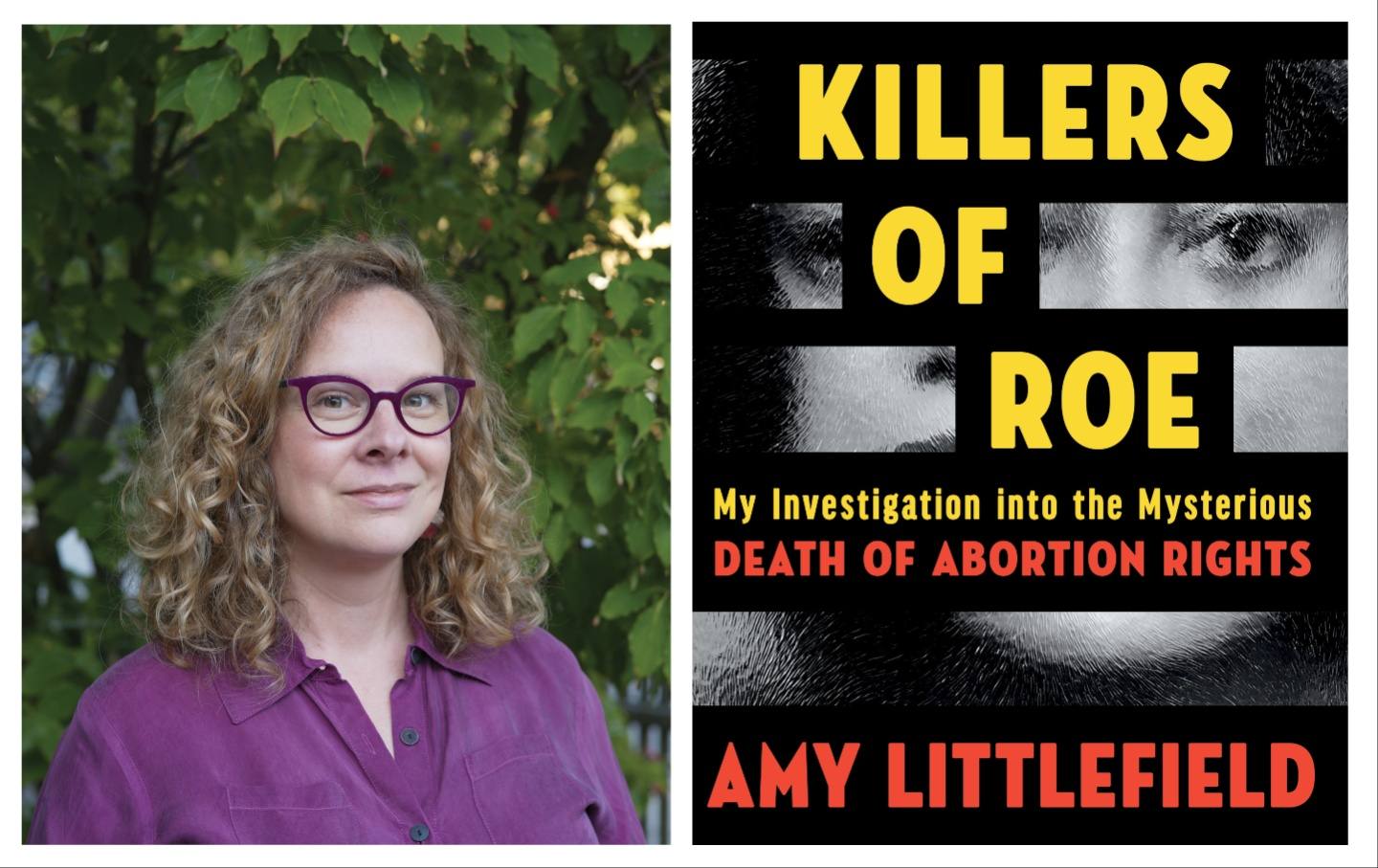
The Whodunit Investigating the Death of Roe: A Q&A With Amy Littlefield The Whodunit Investigating the Death of "Roe": A Q&A With Amy Littlefield
Abortion access reporter Amy Littlefield’s new book reports on the grassroots social movement that amassed enough power to overturn legal abortion, despite being a minority point ...
The Lower Ninth Ward in New Orleans Can’t Get a Break The Lower Ninth Ward in New Orleans Can’t Get a Break
The neighborhood is facing an onslaught of catastrophic projects that could be more damaging than Hurricane Katrina.
The Nap Room Didn’t Love Me Back The Nap Room Didn’t Love Me Back
I left academia for a tech job that offered me the promise of stability. What happens when corporate employers become our most reliable caregivers?

