
Michael Ledeen Was the Forrest Gump of American Fascism
From Iran-contra to Iraq war WMD lies to Trumpism, this right-wing pundit kept subverting democracy.
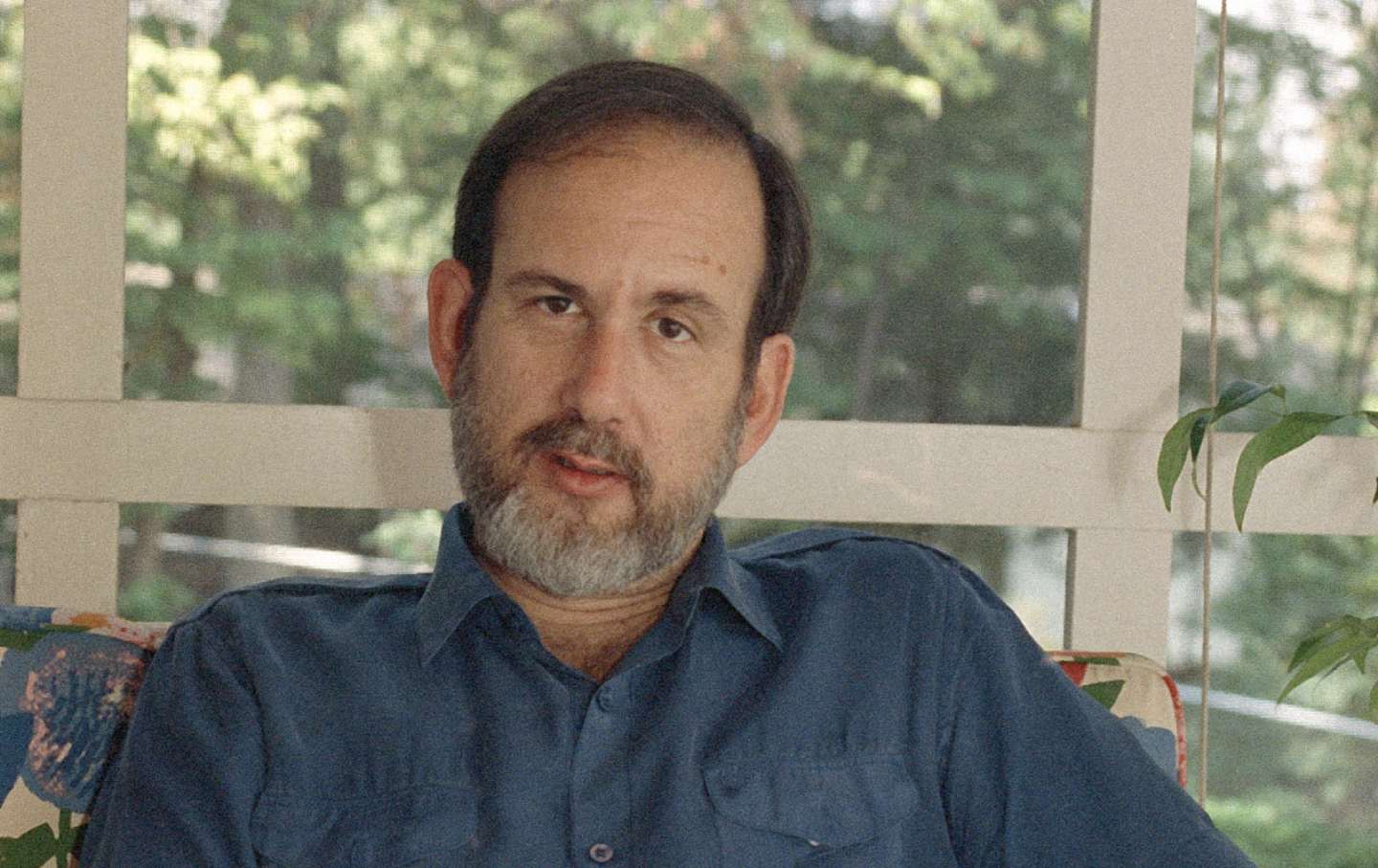
Michael Ledeen, a key figure in launching the sale of US-made weapons to Iran, is pictured in his Chevy Chase, Maryland, home, August 13, 1987.
(Scott Stewart / AP Photo)
I learned what a liar Michael Ledeen was in 2004 when I cowrote a profile of him for The Boston Globe. In an e-mail interview with Ledeen, I found him to be remarkably modest in his claims for himself, which would have been charming if it weren’t one of his many manipulative lies. Asked about his politics, Ledeen replied, “I think of myself as a fairly typical American. I hate tyranny…I love liberty.” Ledeen also wrote to me claiming “I have always thought of myself as a ‘liberal democrat’ in the sense that Walter Lippmann used the word.”
In reality, there was nothing “typical” about Ledeen, who died at age 83 on May 17. He was a historian of fascism who came to emulate the right-wing authoritarianism he studied. For decades, he repeatedly participated in dirty-tricks campaigns and the outright subversion of democracy—most famously as one of the instigators of the Iran-contra scheme. His nefarious activities brought him into contact with many criminals: disinformation specialists, arms dealers, and coup plotters. Most importantly, he had long-standing ties with seedy operatives of the Italian intelligence agency SISMI. Although he himself evaded criminal charges, he was always collaborating with outlaws, usually with a goal of undermining the rule of law and democracy. His uncanny ability to be at the scene of key historical junctures made him the Forrest Gump of American fascism.
Ledeen was born in 1941 to a middle-class family, the child of an engineer and school teacher. Growing up Jewish amid the Second World War and its aftermath, he was, like many in his generation, fascinated by the historical problem of fascism: How could European civilization in the early 20th century so quickly descend into authoritarian barbarism? To solve this problem, Ledeen completed a doctorate in history in 1969 at the University of Wisconsin under the supervision of one of the greatest scholars of fascism, the German-American refugee George Mosse. As against earlier historians who saw fascism in purely political terms, Mosse focused on the cultural dimensions of authoritarian mass movements, taking note of their use of symbols, myths, and media manipulation. This was the approach Ledeen followed in his first book, Universal Fascism (1972), which dealt with the ardent youth movement in Italy that felt Mussolini didn’t go far enough. A similar cultural approach to history is found in Ledeen’s liveliest and most important scholarly book, The First Duce (1977), a sympathetic study of Gabrielle D’Annunzio, the Italian poet and adventurer who in 1919 led a small army that briefly seized control of the city of Fiume and ran it as an independent republic.
Mosse was solidly a man of the left, a socialist and internationalist. For a time, it seemed like his student was the same. Ledeen opposed the Vietnam War and voted for George McGovern in 1972. But even in those years when he was on the left, it was not hard to detect an important difference between Mosse and Ledeen. Mosse had nothing but contempt for the culture of fascism, particularly its strains of nationalism, militarism, and xenophobia. By contrast, Ledeen’s histories are energized by a covert admiration for what he saw as the élan of fascism, its disruptive force and ability to mobilize the masses. What Mosse studied as a warning, Ledeen regarded as a how-to guide.
In 1973, Ledeen’s academic career ended when he was denied tenure at Washington University in St. Louis. He was dogged by rumors of plagiarism, which he always denied—although he acknowledged that there had been questions about footnotes in an essay he wrote.
The end of Ledeen’s career as a tenure-track academic spurred him to reinvent himself as a public intellectual and ideological adventurer with ties to spy agencies and powerful politicians. He taught at the University of Rome from 1973 to 1977, and it was likely during those years that he made contact with the Italian spy agency SISMI, which would play an important part in his career.
During this period, he also swung politically from the left to the right, motivated by an intense anti-communism. This was a common trajectory in the 1960s and 1970s when neoconservativism coalesced as an important intellectual faction. Like other neocons, Ledeen specialized in repurposing the left-wing language of internationalism and human rights for the service of American empire.
In 1977 he delivered a speech on human rights and democracy that was reprinted in the journal of Social Democrats USA—an ostensibly socialist group that was a breeding ground for neoconservatism. In that speech, he rejected the idea of democracy in one country and insisted that America’s revolutionary ideals demanded by their very nature to be “exported.” The idea of a global democratic revolution has a noble ring to it, but in practice Ledeen merely used such rhetoric to justify the crudest sort of imperialism. In 2005, Jonah Goldberg, Ledeen’s fellow neocon and Iraq war supporter, coined what he called the “Ledeen doctrine”: “Every ten years or so, the United States needs to pick up some small crappy little country and throw it against the wall, just to show the world we mean business.” According to Goldberg this paraphrase came “more or less” Ledeen’s own words and Ledeen himself reportedly acknowledged the quote.
Beyond his support for imperialism and militarism, Ledeen’s purported commitment to democracy is belied by his repeated involvement in disinformation campaigns.
In 1980, Ledeen teamed up with Arnaud de Borchgrave, a fellow foreign policy hawk and former Newsweek reporter, to write an article for The New Republic alleging that Jimmy Carter’s foreign policy was influenced by the antics of his brother, Billy, who was being paid by the Libyan government. (TNR, under publisher Marty Peretz, was in that era always eager to promote right-wing smears).
In 1987, The Washington Post called attention to Ledeen’s connections with Francesco Pazienza, a senior SISMI official. According to the Post:
Pazienza was a deputy to the chief of Italian military intelligence and a leading member of a clandestine organization called P-2, a parallel hierarchy of right-wing generals, colonels and politicians, which attempted to stage what the Italian press has called “a silent coup” through “a strategy of tension.” When the influence of P-2 was exposed in 1981, the Christian Democratic government fell. Indictments charged P-2 members with crimes that included “subversive association with the aim of terrorism” and its cover-up.
In 1980, right-wing terrorists bombed a train station in Bologna, killing 80 people and injured over 200. In 1995, Pazienza was convicted of participating in a cover-up that attempted to blame the bombing on a left-wing group.
Popular
“swipe left below to view more authors”Swipe →Pazienza’s criminal activities also brought him into contact with Ledeen. As The Wall Street Journal reported in 1985:
Mr. Pazienza already has been convicted, in absentia, of some charges. Among them: that he abused his intelligence job by using extortion and fraud to obtain embarrassing facts about Billygate, and that he obtained the facts “in collaboration with” Michael Ledeen.…
Mr. Pazienza says that Mr. Ledeen sometimes worked for Italian intelligence and received at least $120,000 from SISMI, plus expenses, in 1980 or 1981. At least some of the money was paid into a Bermuda bank account, Mr. Pazienza says. At SISMI, Mr. Pazienza says, Mr. Ledeen warranted a coded identification: Z-3.
Mr. Ledeen says he was never called Z3 “that I can remember.” He says a consulting firm he owned, ISI, undertook work for SISMI either late in 1980 or early in 1981 and the price “may well have been $100,000, I can’t remember.” SISMI may have paid another fee for other work in 1980, Mr. Ledeen says. He says his travel expenses were also paid. And he says, “I had, I think, for a period of a few months, a personal account in Bermuda.” He declines to discuss further “any of my personal finances.”
Panzienza also organized another disinformation campaign blaming the Soviet Union and Bulgaria for the 1981 attempted assassination of Pope John Paul II by the Turkish rightist Mehmet Ali Agca. Ledeen also helped spread this lie.
Even after Panzienza was in jail, Ledeen continued to have ties with SISMI. In 2003, SISMI forged documents that purported to show that Iraqi dictator Saddam Hussein was trying to buy uranium from Niger. Ledeen was an important conduit for bringing these forged documents to the George W. Bush administration, which used them as part of the “weapons of mass destruction” lie that helped sell the Iraq war.
The New York Times obituary for Ledeen subtly whitewashes his actions as an agent of disinformation:
Some of the theories that Mr. Ledeen espoused in his books and articles were later discredited, among them that Iraq had sought to purchase yellowcake uranium powder from Niger as part of a nuclear arms program; that the attempted assassination of Pope John Paul II in 1981 in Vatican City was orchestrated by Moscow; and that President Jimmy Carter’s brother, Billy, had influenced the president on behalf of Libya.
This account makes no mention of the role of SISMI in forging this disinformation and suggests that Ledeen was only guilty of sloppiness in having “theories” that were “discredited.” In reality, Ledeen was an active participant in propaganda campaigns based on forgeries created by a sinister spy agency.
The Washington Post obituary for Ledeen was similarly inclined to whitewashing. The headline for the Post obituary read “Reagan adviser in early Iran-contra outreach, dies at 83.” It’s strange to use the word “outreach” to describe Iran-contra (which was in fact a criminal enterprise and a constitutional crisis). In the body of the text, the obituary was more honest, describing Ledeen as “a Reagan-era adviser [who] helped open channels for the illegal covert arms deals known as Iran-contra.”
Neither the Times nor the Post confront the fact that Ledeen was an authoritarian who can fairly be characterized as a fascist.
Ledeen’s role as an instigator of Iran-contra clarifies his hostility to democracy. The whole scheme originated in an attempt by the Reagan administration to circumvent a congressional ban on funding the contra guerrillas in Nicaragua, at the time instruments in an American proxy war. Under the Constitution, one of the major checks on presidential power is the control Congress has over the purse strings. The heart of the scandal was the attempt by the Reagan administration to covertly violate that constitutional provision by raising money through a secret arms deal. According to a 2017 Senate report, Ledeen “appears to have played a key role in the initial contacts between the U.S. and Israel vis-à-vis Iran.” Unlike other players in the scandal, Ledeen was cagey enough to get out of the loop after his original instigation, so he avoided any criminal charges.
In contrast to neoconservatives such as David Frum and William Kristol, Ledeen didn’t balk at the rise of Donald Trump. Instead, Ledeen, along with his second wife, Barbara, embraced Trumpism and became active allies of figures such as Michael Flynn and Steve Bannon. In 2019, Ledeen and Flynn cowrote The Field of Fight: How We Can Win the Global War Against Radical Islam and its Allies. The book advocates Ledeen’s major political obsession of recent decades, regime change in Iran.
Ledeen’s claims to being a champion of democracy and a “liberal democrat” were also repeatedly contradicted by his bloodcurdling advocacy of authoritarian repression. In an unpublished article from 1987 written for Partisan Review, Ledeen lambasted the “pseudo-democratic theory according to which everyone is entitled to a say in policy, regardless of his or her qualifications.” He also falsely claimed that only the president is “constitutionally charged with responsibility for foreign policy” and cited with approval the idea that “breaking the law from time to time” is necessary.
Writing in the scholarly journal Society in 1999, Ledeen argued, “New leaders with an iron will are required to root out the corruption and either reestablish a virtuous state, or to institute a new one…. If we bask in false security and drop our guard, the rot spreads, corrupting the entire society. Once that happens, only violent and extremely unpleasant methods can bring us back to virtue.”
The same year, in his book Machiavelli On Modern Leadership, Ledeen offered this advice: “To be an effective leader, the most prudent method is to ensure that your people are afraid of you. To instill that fear, you must demonstrate that those who attack you will not survive.”
In a 2003 speech to the American Enterprise Institute, Ledeen said, “All the great scholars who have studied American character have come to the conclusion that we are a warlike people and that we love war.”
There is no mistaking the thrust of Ledeen’s talk of “iron will” and “fear” as well as his exaltation of war. This is the language of fascism. Fittingly, Israel’s authoritarian Prime Minister Benjamin Netanyahu posted a long eulogy praising Ledeen as a “great scholar.” Netanyahu exalted in particular Ledeen’s efforts pushing for regime change in Iran, a long-standing project of his own that remains a real possibility if the current push for diplomacy by the Trump administration fails.
Donald Trump is often presented as an anomaly breaking from the stolid conservatism of Ronald Reagan and George W. Bush. Ledeen’s career shows that no such break has occurred. The roots of the current authoritarianism are deep within the recent history of the GOP.
Become a Sustaining Donor This September
Between the reemergence of right-wing red-baiting and Donald Trump’s use of the chilling National Security Presidential Memorandum–7 to criminalize left political organizing, we’re seeing McCarthyism reborn before our eyes.
This assault on democracy cannot be ignored or wished away. Resisting it requires bravery in the face of threats and repression, a steadfast commitment to the truth, and the unwavering belief that we can—and will—overcome this darkness.
We must have an independent media that sets the record straight, unearths corruption and abuses of power, and advances a politics of justice and dignity for all if we’re to win this fight.
That’s why I’m writing to you today. This September, The Nation needs to add 100 monthly donors to sustain our progressive journalism. Your contribution makes the next investigative report, the next truth-speaking column, and the next pathbreaking essay all possible.
I hope you’ll support our work with a recurring donation today. If you donate $10 or more a month, we’ll send you a brand new “Hands Off the Free Press!” sticker to recognise your commitment to our cause. Please, donate today.
Onward,
Katrina vanden Heuvel
Editor and Publisher, The Nation
More from
Jeet Heer 
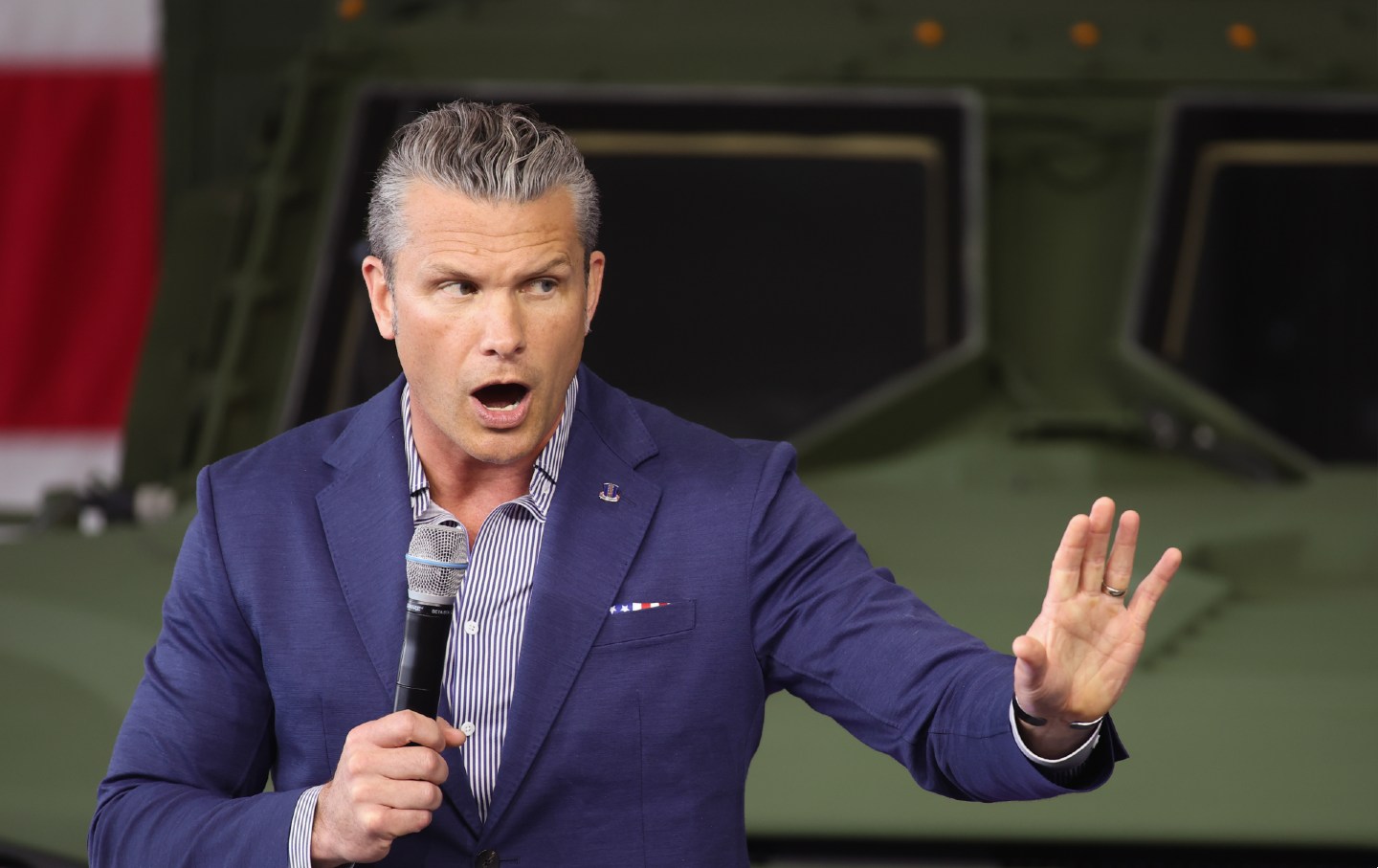
Even Republicans Are Figuring Out That Pete Hegseth Is a Disaster Even Republicans Are Figuring Out That Pete Hegseth Is a Disaster
Hegseth was always a horrible choice for defense secretary. At long last, some in the GOP are admitting it.
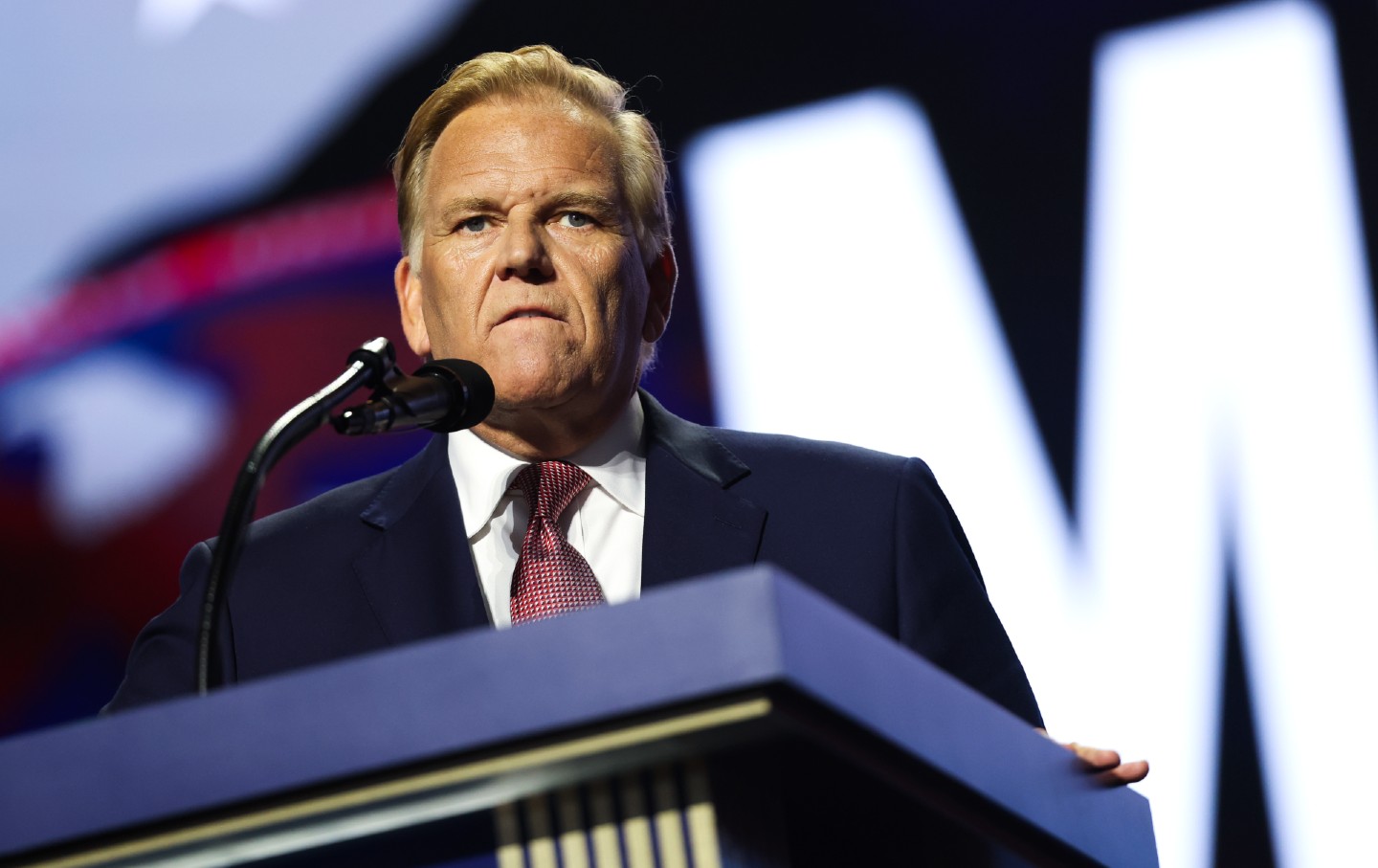
Why Aren’t We Talking About the Warmongering Lies of Mike Rogers? Why Aren’t We Talking About the Warmongering Lies of Mike Rogers?
The media’s relentless focus on Hasan Piker allows the dishonest GOP hawk (and actual Michigan Senate candidate) to evade scrutiny.
MAGA Is Exploiting the Lindsay Clancy Case to Try to End Voting for Women MAGA Is Exploiting the Lindsay Clancy Case to Try to End Voting for Women
As Trump subverts elections, his most ardent fans want to overturn the 19th Amendment.

Accountability for the Gaza Genocide Can’t Focus on Netanyahu Alone Accountability for the Gaza Genocide Can’t Focus on Netanyahu Alone
Getting rid of one bad leader won’t bring justice.
In Trump’s Mafia, Even Goons Can Do Billion-Dollar Shakedowns In Trump’s Mafia, Even Goons Can Do Billion-Dollar Shakedowns
Corey Lewandowski is a disposable underling, but he’s protected enough to scorn the law.

Maria Bartiromo Was Fired for the Wrong Reason Maria Bartiromo Was Fired for the Wrong Reason
For Fox News, blind servility to Trump is fine until it hits the bottom line.

