Universities Like Mine Are Providing an Authoritarian Blueprint for Trump
The potential next president and his allies are looking at the campus-led crackdown on free speech as a perfect dress rehearsal.
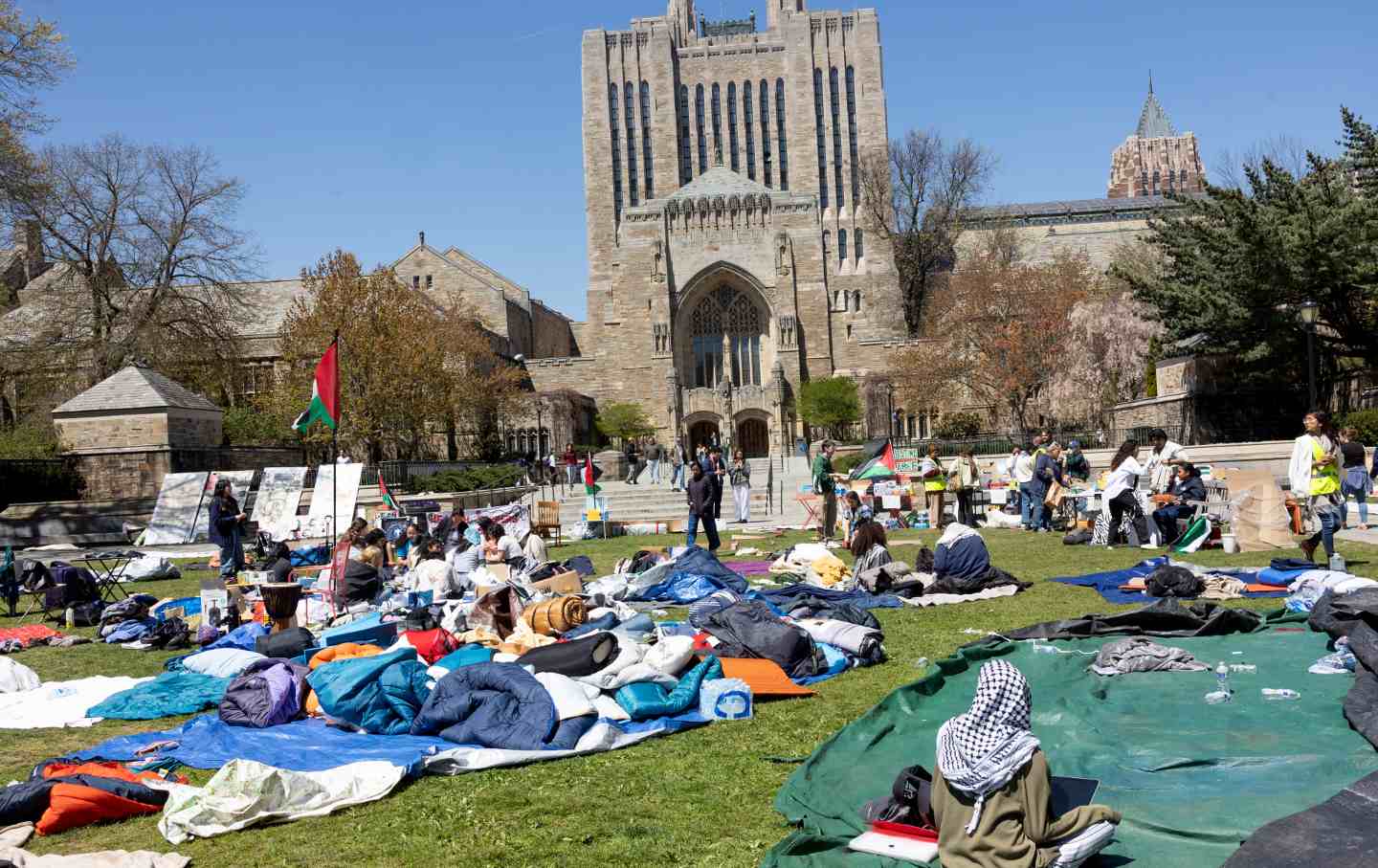
Yale University students reoccupy a central lawn on campus and establish a second Gaza Solidarity camp after the first tents were taken down by campus police, April 26, 2024, in New Haven, Connecticut.
(Andrew Lichtenstein / Corbis via Getty Images)Ihave watched in horror as police have rolled onto college campuses across the nation, including mine, to disperse students protesting the war in Gaza. The rationales have varied from breaking the rules on “time, place and manner” to charges of violence and harassment to invocations of chaos and lawlessness. Columbia President Minouche Shafik even called her own students a clear and present danger to the university. President Biden decided to get in the mix last week paying a pro forma tribute to free speech and protest before—in what can only be a strategic decision—choosing to blame students entirely for violence and campus closures.
In many cases, it is police not students, who have been responsible for the escalation of tensions. Officers have roughed up students and faculty on multiple campuses across the country, including throwing faculty members to the ground, most notably in Atlanta, where they assaulted Emory economics professor Caroline Fohlin, and in New York, where they deployed flash-bang grenades at Columbia. And the cancellation of graduation ceremonies isn’t something students can be blamed for: It is university administrators who have made these decisions.
It didn’t have to be this way. Several universities are finding a path through the current moment without bringing in what Columbia historian Adam Tooze has called “ the state as blunt force.” At Brown, Wesleyan, and elsewhere, university officials have exercised restraint and have been able to avoid the escalation we have seen on other campuses around the nation.
At Yale, where I teach, President Peter Salovey has called in the cops twice already to clear encampments, with police picking off small groups of protesters since then and sending them to the local jail. Over 300 faculty have sent a letter of protest to him and other university leadership but to no avail. President Salovey says he had no choice but to call in the police, but Yale’s own history shows presidents before him allowing protests far larger and longer lasting to remain on campus without calling in the cops.
If all of this weren’t distressing enough, it is becoming clear now that all that has happened over the past few weeks is a dress rehearsal. Should Donald Trump regain the White House, we now have a template for how to shut down protests without bringing in the National Guard as Senators Tom Cotton and Josh Hawley and Speaker of the House Mike Johnson have called for. Just get university presidents to do your dirty work. As my Yale colleague Jason Stanley, the philosopher and scholar of 20th-century fascism, has noted, the first thing authoritarians do is bring the universities to heel, either by force or by acquiescence, as these institutions are hotbeds of dissent, as we have seen over the past few weeks. When conservatives say “roll over,” it seems like college presidents are ready to do it again and again, lest they go the way of Harvard President Claudine Gay and Penn’s Liz Magill.
Let me be clear: I don’t think these protests on college campuses now are perfect. But as New York Times columnist Lydia Polgreen has noted, they may not be perfect, but just because they’re not perfect doesn’t mean they’re not right. The image of the protests as sites of violence, lawlessness, and chaos is not something I or my colleagues at Yale have experienced. We’ve heard the same from colleagues elsewhere too. Critiques of this kind of characterization of the protests are now starting to mount from religious and secular writers. Democrats should be wary. Joe Biden probably just wants to get rid of these student protesters as a matter of political expediency—he likely thinks he can’t afford to be outflanked on law and order by the GOP on this and doesn’t want these protesters to distract from his campaign this summer, but this is shortsighted and dangerous.
If Biden loses in November, it is the students and the young whom we will have to rely on to help confront what happens next. It is exactly this kind of energy, creativeness, and persistence that we will need to fight back against rising authoritarianism. But the response to these protests now from their elders is disgraceful. Biden already struggles with the youth vote; getting them out to do more than that, to stand up to antidemocratic forces that Trump will unleash, is going to be that much harder. Some may not like these young rebels, but we’ll miss them when they’re gone.