Left Alone and Cooked Alive
We non-speaking autistics are often treated as disposable. It’s killing us.
The Stereotypes Killing Us Nonspeaking Autistics
Another autistic person was left to cook alive in a hot vehicle. Far too often, the so-called normal world treats us as disposable.
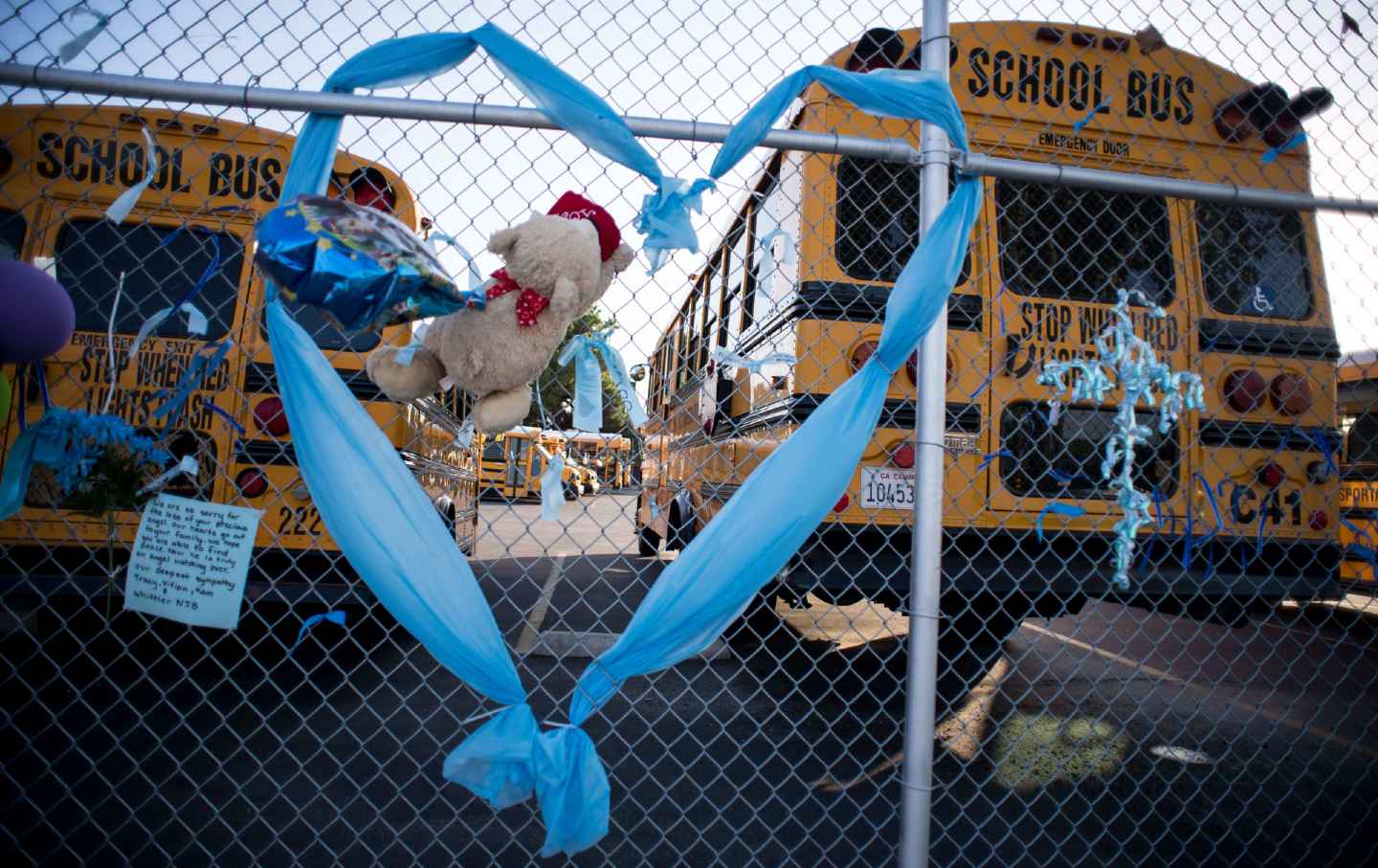
Ribbons hang on September 22, 2015 adjacent to the parking lot where Hun Joon “Paul” Lee was found dead on a school bus. Lee, a 19-year-old autistic student died after being left on a school bus at the Whittier Union High School District parking lot in Whittier, California.
(Sarah Reingewirtz / MediaNews Group / Pasadena Star-News via Getty Images)On August 4, Thomas Anderson, 26, was left unattended in a van for almost eight hours outside a facility for disabled individuals in Dutchess County, New York. It was a hot and humid day, and as the sun beat down on the van, its interior warmed and warmed. Anderson, who had autism, was cooked alive. It was only about 85 degrees outside, but according to Stanford University researchers, the temperature inside a parked vehicle quickly exceeds that of the air outside: Within 60 minutes, a car’s interior can measure more than 130 degrees on an 85-degree day.
Anderson’s death is not an isolated incident. About a year earlier, Robert Bodack, a 42-year-old nonspeaking autistic man from Florida, died after being left for hours in the vehicle that was transporting him to his day program. Those like Bodack and myself who are nonspeaking autistics are especially vulnerable in such situations, because we cannot easily advocate for ourselves. Not only can we not cry out for help; most of us lack the fine motor skills to undo seatbelts or unlock car doors.
Anderson and Bodack surely were aware of the terrible fate that awaited, but their bodies made it impossible for them to escape or to alert others. All the while, the temperature inside the vehicles in which they found themselves trapped climbed ever higher.
We nonspeaking autistics are often treated as disposable pieces of humanity—people who, it is imagined, do not suffer like other human beings. This long-standing failure to recognize our humanity is fundamental to the mistreatment that we receive from the so-called normal world.
The prevailing view of autism is that those of us with the disorder are unable to understand the world around us. We are often accused of what putative autism experts call “mind blindness”: the idea that we cannot comprehend the perspectives of others. Hence, we are thought to be unable to pick up on social cues or carry on a conversation. The concept of “mind blindness” is a pernicious stereotype, but it enjoys prominence in the medical literature and in popular culture through movies like The Accountant and Rain Man. Even a series like Love on the Spectrum, which is intended to show a more sympathetic portrait of autism, perpetuates the stereotype. The Netflix show suggests that we are so bad at intimacy and romance that we need to be coached through the most basic of human interactions. There is never any sense that we can feel and recognize these emotions but just have trouble showing them. Instead, we are treated as if we are curious specimens that do not understand what is so obvious for others.
These stereotypes are all-the-more damaging when it comes to those of us with nonspeaking autism. The assumption is that non-speakers suffer from intellectual deficits along with the other challenges posed by their autism. We cannot produce the sorts of responses that most in the outside world understand as the markers of intelligence, but this is an artifact of our limited ability to communicate—not a measure of our true mental capacity. Only in the past few years have a few of us non-speakers learned to express ourselves by writing. Through typing, we can show the world that we are not mentally impaired; we are just trapped in bodies that fail to manifest all the thoughts and hopes and dreams and fears inside of us.
Right now, teaching nonspeaking autistics to write is rarely included in the curriculum in special-needs schools. That we should be denied this skill seems cruel to me. As best as I can tell, it reflects a belief that any sort of communication is far beyond people with nonspeaking autism. For those of us living in New York State, one step toward rectifying such wrongs would be to pass the Communication Bill of Rights, which states that “all persons with a disability shall have the right to communicate in their preferred manner and utilize any communication supports that meet their needs.” Although this bill was passed by the state Assembly in June, it still needs to pass the state Senate and to be signed by Governor Kathy Hochul. This bill will not help those like Bodack who live in other states, nor will it solve the glaring problem of typing not being taught in most special-needs schools. But it can serve as a model for other states and eventually, one hopes, for the federal government.
Even if Anderson or Bodack had been able to type, there is no guarantee that either might have been able to save themselves. Most of us nonspeaking autistics have poor fine motor skills, making it hard for us to communicate, say, by texting because the buttons on cell phones are so small. But in a larger sense, perhaps learning to type would have saved their lives. Being able to write would have enabled them to communicate in their daily lives so that those around them would have seen them as sentient beings—not objects that could be forgotten in the back of a hot vehicle. Moreover, learning to type might have allowed them to live different sort of lives—lives where they were not in a group home or day program in the first place. We will never know for certain, of course, but there is still time for other nonspeaking autistics to liberate themselves from the structures that confine them and keep them from being able to advocate for themselves. The danger is not only a hot car on a summer day but also the policies and stereotypes that limit what we autistics can do.