Washington, DC, Is Under a State of Siege
Trump has put the nation’s capital under federal occupation.
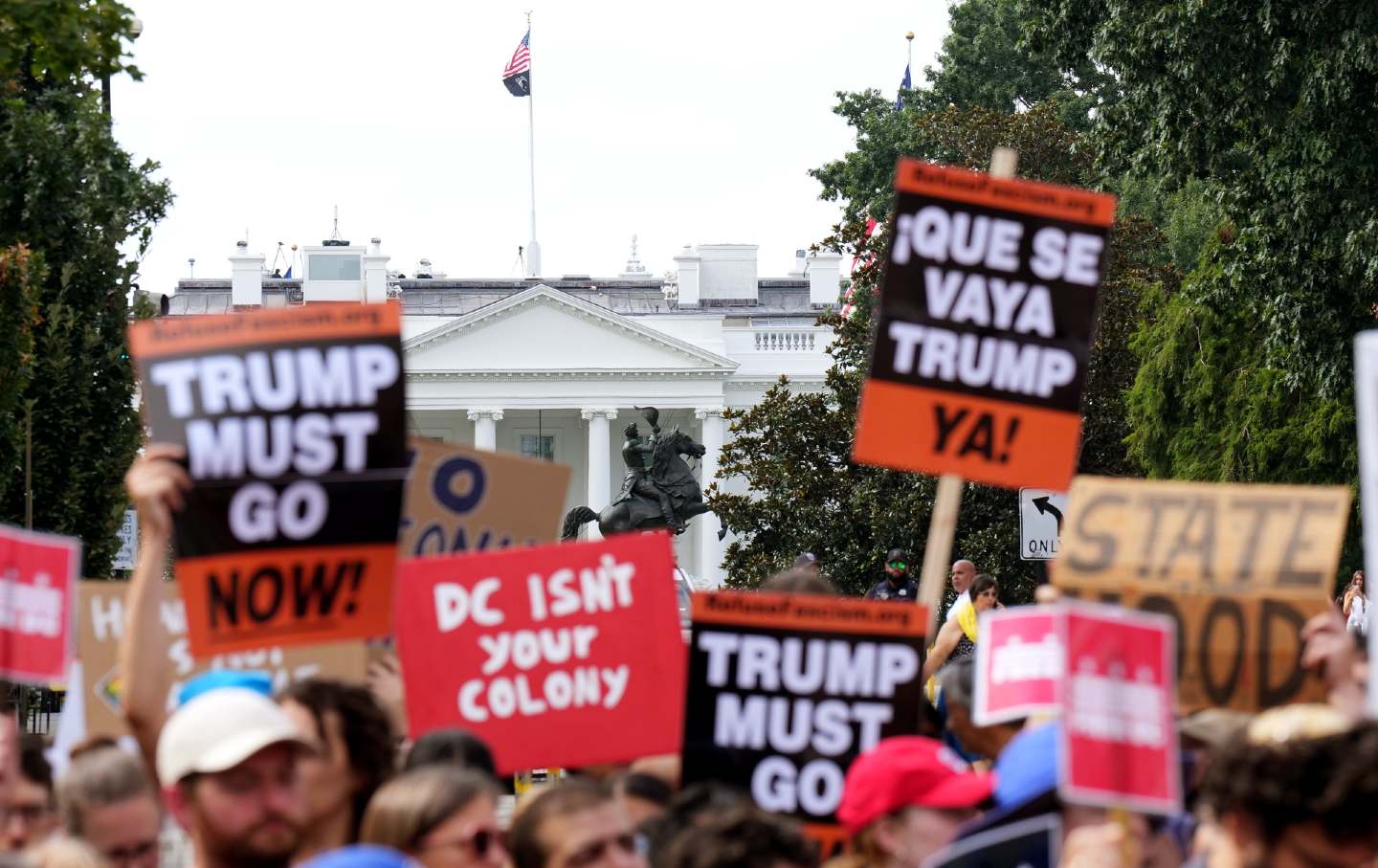
People participate in a rally against the Trump administration’s federal takeover of the District of Columbia on August 11, 2025, in Washington, DC.
(Kevin Dietsch / Getty Images)Washington, DC, already lacks representation in Congress, has no control over its own budget, and cannot pass laws free from congressional interference. Now, under the Trump administration, the city is moving toward bantustan status. By invoking bogus emergency powers under the DC Home Rule Act, President Donald Trump has effectively federalized law enforcement within the district, delegating supervision of DC Metro police to Attorney General Pam Bondi and authorizing Defense Secretary Pete Hegseth to mobilize National Guard troops in Washington. Drug Enforcement Agency head Terry Cole will have operational control over Washington’s Metro Police Department as its interim federal commissioner.
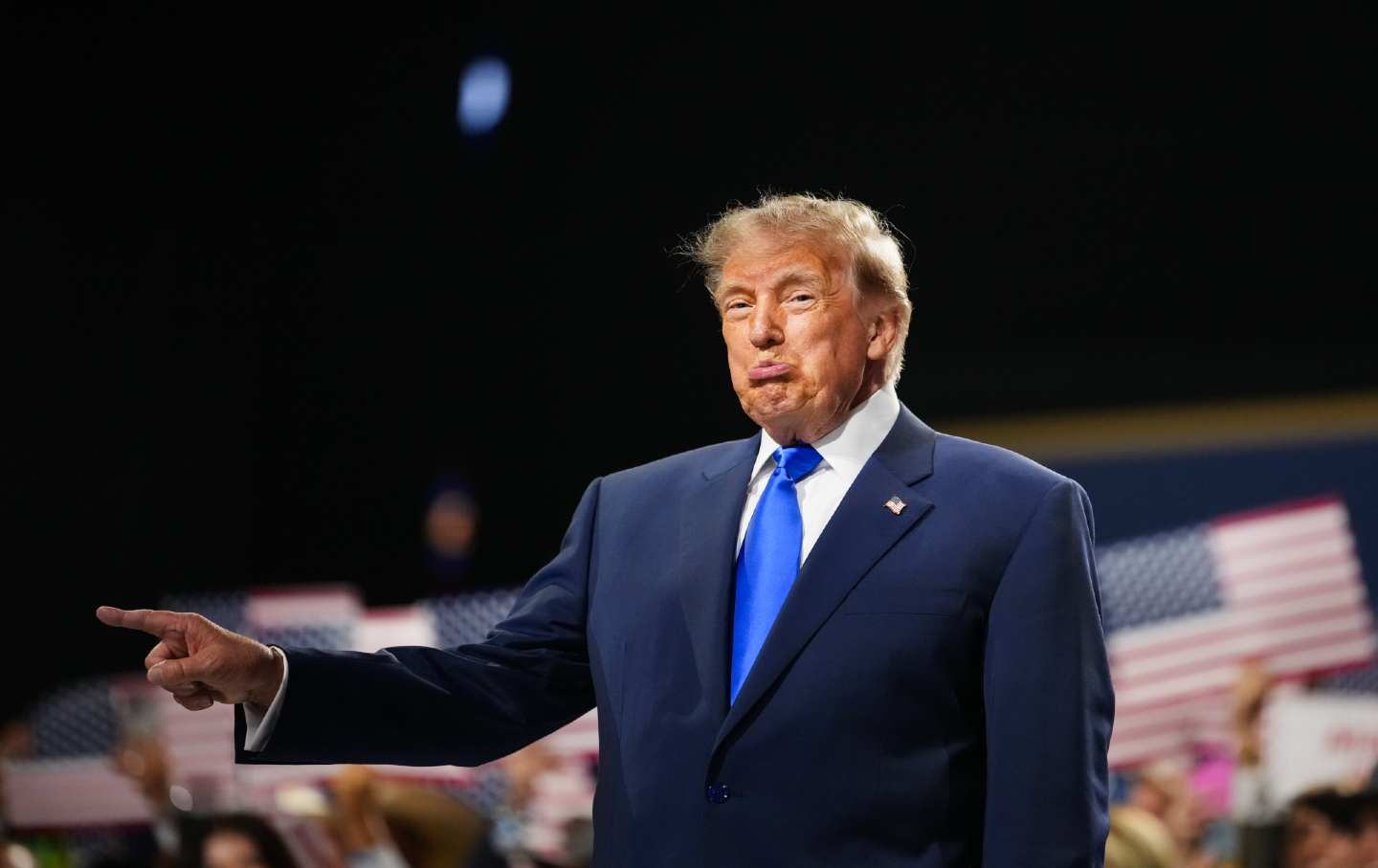
The shock-and-awe show of force is clearly modeled on the administration’s brownshirt raids on churches, schools, and workplaces in Los Angeles to detain and rendition undocumented immigrants. “This is liberation day in Washington, DC,” Trump declared in a rambling Monday morning press conference. In laying out his rationale, Trump conducted a Fox News–style tour through a hellscape of criminal mayhem. “It’s become a city of complete and total lawlessness,” Trump insisted, even as DC experiences a 30-year low in violent crime and a 26 percent reduction over rates reported midway last year. Trump and his supporting cast of administration, legal, and security officials sharing the podium all doted on the image of Washington as a place where families and tourists are lucky to leave alive.
Trump has long been in thrall to the fable of a capital under siege by immigrant gangs and violent homegrown criminals, and punishment-driven social myths like this have fueled his public career. In 1989, he took out full-page ads in New York’s major newspapers to restore the death penalty in the state in order to execute the since-exonerated members of the Central Park Five.”Mayor Koch has stated that hate and rancor should be removed from our hearts,” that MAGA magna carta document read in part. “I don’t think so. I want to hate those muggers and murderers. They should be forced to suffer, and when they kill, they should be executed for their crimes.”
Never mind that, even by Trump’s own reasoning, his dictum made no sense: In addition to demanding the state killing of innocent and unfairly apprehended citizens, Trump was calling for their execution in a case where the victim, while horrifically assaulted, had not in fact been murdered. The point of Trump’s outbursts, then and now, is to create a spectacle of impunity under which state agents are empowered to act under an agitprop hate campaign.
That was instantly clear as Trump sought to describe the plight of Metro DC cops under a “woke” and “radical left” city government. Criminals “will fight back until you knock the hell out of them,” Trump said. “It’s the only language they understand.” Repurposing a myth from the heyday of anti–Vietnam War protests, Trump said that lawbreakers—whom he appeared to be conflating here with demonstrators during the 2020 Black Lives Matter protests—“love to spit in the face of the police, and they’re screaming at them an inch away from their face, spitting in their face.” Some police reported being spat at then—and protesters in turn reported that police were spitting at them—but this set piece served chiefly to drive home the point that federalized agents would be patrolling DC under conditions of maximum impunity. “You spit, and we hit,” Trump proclaimed, asserting that in past cop-protest confrontations, “You could see [the police] wanted to get at it. Now they’re allowed to do whatever the hell they want.”
There was, of course, a glaring omission in Trump’s depiction of criminal life in DC. Trump and his underlings sidestepped the largest direct assault on DC police in the city’s recent history—the January 6 insurrection at the US Capitol, when pro-MAGA rioters, brandishing far heavier weaponry than their own saliva, injured 140 members of both the DC Metro police and the US Capitol Police. Five police officers died as a result of the attack. Apparently untroubled by this, Trump pardoned more than 1,500 convicted January 6 rioters.
This split-screen effect underlined the blatant subtext of most MAGA doomster rhetoric about violent crime: It’s invisible when heroic Trumpist allies are the perpetrators and a dire public emergency demanding unprecedented mobilizations of federal power when allegedly carried out by non-white city dwellers. Again, Trump wasn’t remotely subtle. “The murder rate in Washington is higher than that of Bogotá, Colombia and Mexico City—places you hear about as being the worst places on earth,” he said. He later added a grab bag of other scary-sounding centers of alleged Third World mayhem to the roll call, seemingly at random: “Baghdad, Panama City, San Jose, Costa Rica, Lima, Peru.” “Do you want to live in places like that?” he asked the assembled journalists in horror. If this didn’t make the racial animus behind his power play clear enough, Trump added, “We’ll be getting rid of the slums where [criminals] live,” and congratulated himself yet again for saying something that wasn’t “politically correct.”
Monday’s announcement also extended the Trump White House’s record of ginning up federal emergencies out of thin air to consolidate strongman powers. The border crackdowns relied on the fabricated specter of an “invasion” of the country carried out by undocumented immigrants perpetrating more criminal terror. Trump’s tariff offensive—the last “Liberation Day” announced from the White House—likewise invoked powers under the International Emergency Economic Powers Act. Neither of these claims had any plausible empirical grounding—immigrants commit violent crime at lower rates than America’s native-born population does, and the US economy was in nothing remotely resembling a crisis when Trump debuted his erratic set of tariffs. At a minimum, a less prostrate national political press could profitably raise the question of why, if all these facets of public life are so grievously cataclysmic, they didn’t provoke the same militant crackdowns during Trump’s first administration.
As with the legacy of January 6, the specter of a national emergency is something conjured—or dismissed—purely for political gain. That’s why you no longer hear anything about the pet-eating moral panic that engulfed the Haitian community in Springfield, Ohio, at the height of the 2024 presidential campaign; it’s also why the “immigrant caravan” that consumed acres of right-wing news coverage during the 2018 midterm cycle vanished from public attention the day after the election. The only difference now is that the second Trump White House feels empowered to transform two-minute hates into long-term policy directives.
Yet daily life in Washington may well be an emergency of permanent federal occupation. Trump has already instructed the federalized forces under Bondi’s command to dismantle homeless encampments and to cut a wide swath through the city in search of occasions to flex their muscle. Over the weekend, Trump unleashed 5,000 federal officers in DC, including 120 FBI agents, as a preview of things to come. Reports of their handiwork suggest the same abuse of power that’s now become routine under ICE’s extended siege of Los Angeles. As NPR reports, a small traffic scrape on Sunday produced an overwhelming show of force all the more terrifying for the pointlessness of its summons: “At one intersection, a minor traffic accident between a car and a moped brought at least two dozen agents running, some wearing masks and one carrying a rifle.”
In a separate incident, a member of the DC Metro police taking part in a “federal task force operation” opened fire on a pair of armed suspects near a Metro facility Saturday—a dramatic show of force from officers usually seen striding through Metro cars in anything-but-menacing fashion. Per a Washington Post report, “Officers with Homeland Security Investigations and the Bureau of Alcohol, Tobacco, Firearms and Explosives were at the scene, according to a law enforcement official familiar with the incident. The D.C. police department, which is tasked with detaining and pursuing armed people throughout the streets of D.C., was not present, a police spokesperson said.”
This incipient state of siege is poised to be the new normal in Washington—and Trump and his goon squads won’t stop there. When one reporter asked him what other cities might fall under the authority of this roving police state, Trump, of course, pointed to cities harboring large blue-voting populations. “I’m going to look at New York in a little while, to see if we need to do this,” Trump replied, adding that similar appraisals would determine “if we’re going to do this in Chicago.” In other words, this administration is going to whatever the hell it wants.
Become a Sustaining Donor This September
Between the reemergence of right-wing red-baiting and Donald Trump’s use of the chilling National Security Presidential Memorandum–7 to criminalize left political organizing, we’re seeing McCarthyism reborn before our eyes.
This assault on democracy cannot be ignored or wished away. Resisting it requires bravery in the face of threats and repression, a steadfast commitment to the truth, and the unwavering belief that we can—and will—overcome this darkness.
We must have an independent media that sets the record straight, unearths corruption and abuses of power, and advances a politics of justice and dignity for all if we’re to win this fight.
That’s why I’m writing to you today. This September, The Nation needs to add 100 monthly donors to sustain our progressive journalism. Your contribution makes the next investigative report, the next truth-speaking column, and the next pathbreaking essay all possible.
I hope you’ll support our work with a recurring donation today. If you donate $10 or more a month, we’ll send you a brand new “Hands Off the Free Press!” sticker to recognise your commitment to our cause. Please, donate today.
Onward,
Katrina vanden Heuvel
Editor and Publisher, The Nation