
Trump’s Iran War Could Be an Even Bigger Catastrophe Than Iraq
Remarkably, Trump seems on the verge of outdoing George W. Bush in reckless, stupid militarism.
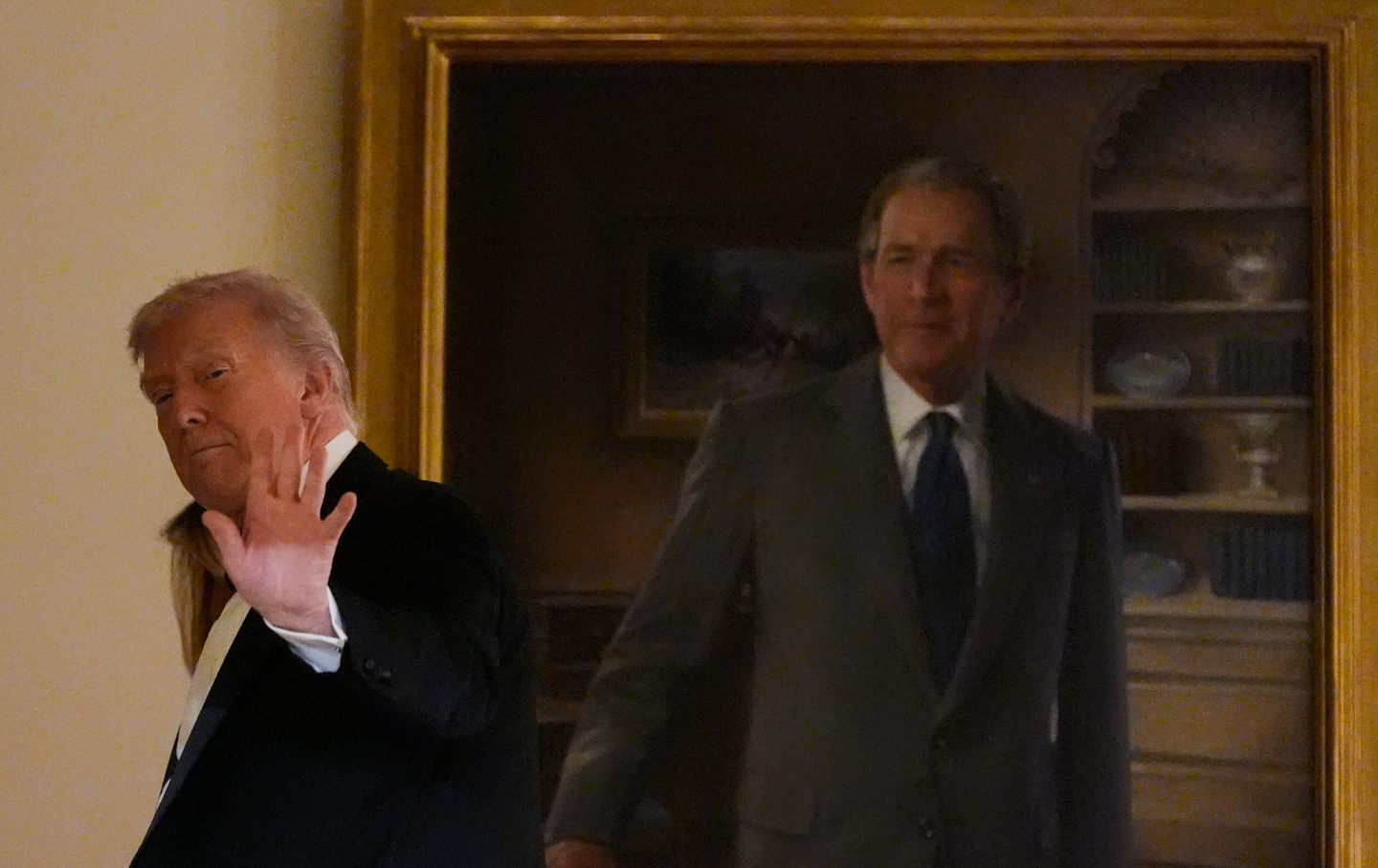
Donald Trump waves as he leaves passing a portrait of former President George W. Bush in the Grand Foyer of the White House during the Congressional Ball, Thursday, December 11, 2025.
(Alex Brandon / AP)Donald Trump has always portrayed himself as an opponent of “ forever wars.” But he is in the midst of cooking up a military disaster in Iran that could rival in size and scale the Iraq War unleashed by George W. Bush in 2003.
Hitherto, Trump has appeared mindful of the US public’s limited appetite for costly and protracted wars post-Iraq. Like Barack Obama and Joe Biden, the other two presidents who followed Bush, Trump has favored quick and easy displays of violence: drone attacks, assassinations, short bombing campaigns, and kidnappings. This has been Trump’s preferred mode of warfare in the Caribbean, Venezuela, Syria, and elsewhere.
But Trump seems to have much bigger plans for Iran. The New York Times reports that “two aircraft carrier groups and dozens of fighter jets, bombers and refueling aircraft are now massing within striking distance of Iran.” This vast armada suggests a campaign far larger than any quick strike. Kelley Vlahos of Responsible Statecraft notes that there are now 108 air tankers (used for refueling) in the region. This compares with 149 refuelers deployed during the first phase of the Iraq War in 2003.
Robert Pape, a political scientist at the University of Chicago, observes that the current Air Force surge into the Middle East “represents 40-50% of the deployable US air power in the world. Think air power on the order of the 1991 and 2003 Iraq war. And growing. Never has the US deployed this much force against a potential enemy and not launched strikes.”
Pape’s invocation of the two Iraq Wars underscores the continuity of imperialist US policy in the Middle East. But there have been significant changes in how that policy is carried out. The 1991 Gulf War was justified as a response to Iraq’s invasion of Kuwait, which was rightly seen as a violation of international law. Whatever the ultimate merits of the war, President George H.W. Bush did get approval from both Congress and the United Nations and was supported by a broad global coalition that included many Middle Eastern countries.
By contrast, George W. Bush was on much more precarious ground in 2003. He had congressional approval to invade Iraq but was unable to secure UN support. The so-called coalition of the willing he assembled was much smaller than his father’s 1991 coalition, and top-heavy with small nations dependent on US patronage. Further, the rationale for the war was a farrago of lies (mythical tales of Iraqi weapons of mass destruction, false suggestions that Saddam Hussein was connected with the 9/11 terrorist attack) and implausible propaganda (claims to want to liberate Iraq and democratize the Middle East).
The Iraq War seemed at the time the height of folly: a war of choice launched on palpably dishonest grounds that would end horribly. Subsequent events more than proved those fears correct. Remarkably, however, Trump seems on the verge of outdoing even George W. Bush in reckless, stupid militarism.
Trump hasn’t sought the approval of either Congress or the United Nations to attack Iran. He hasn’t even had the duplicitous courtesy to conduct the kind of elaborate propaganda campaign that Bush carried out in 2002 and 2003 to manufacture consent for an invasion. Clearly, Trump thinks that his personal desire for war is the only justification he needs. Even more than in 2003, the administration is offering both conflicting pretexts and unclear goals for war. Sometimes, Trump talks as if the goal is to get Iran to sign a nuclear nonproliferation deal only marginally more stringent than its 2015 pact with Obama. On other occasions, the White House talks of regime change.
As The New York Times reports:
Administration officials have been unclear what their objectives are as they confront Iran, a country of more than 90 million people. While Mr. Trump often talks about preventing Iran from ever being able to produce a weapon, [Secretary of State Marco] Rubio and other aides have described a range of other rationales for military action: protecting the protesters whom Iranian forces killed by the thousands last month, wiping out the arsenal of missiles that Iran can use to strike Israel, and ending Tehran’s support for Hamas and Hezbollah.
This lack of clarity is one reason a war seems almost inevitable, despite the fact that some factions of the Trump administration are reportedly hesitant. The Iranian regime can hardly be expected to negotiate with the United States if there is no clear US objective in mind. Based on its past actions, Iran is clearly open to a new nuclear treaty. But the other demands put forward by Rubio, most obviously getting rid of the non-nuclear missile program, are nonnegotiable for the simple reason that no government would ever agree to disarm when its enemies are openly talking about overthrowing it. From the point of view of regime leaders, it’s better to weather an attack and prove they are resilient enough to fight another day.
The government has also been alienating allies that the United States will need for a protracted war. Trump’s threats to annex Greenland have made Europeans increasingly leery. The United Kingdom, traditionally one of the most servile minions in the American empire, is currently refusing to give the US permission to use air force bases for an Iran strike. Mike Huckabee, the US ambassador to Israel, has caused a major scandal in the Middle East by claiming, in an interview with Tucker Carlson, that the Bible gives Israel the right to rule over vast stretches of the Middle East, including lands currently held by US allies, and saying “it would be fine if [Israel] took it all.” This has led to protests by more than a dozen governments, including Jordan and Egypt.
There is still a possibility for an off-ramp, especially if the Trump administration narrowly focuses on a new nuclear deal. But Trump has shown little aptitude for diplomacy, preferring spectacular displays of force that cause immense damage but do little to win agreement or long-term stability. Given the current trajectory, it is more likely that there will soon be a small war, which will fail to win a capitulation. This will set the stage for a much larger war, a sequel to Iraq that has every likelihood of being an even bigger catastrophe.
More from The Nation
We Are All Minneapolis We Are All Minneapolis
ICE attacks are attacks on America.

I’m a Journalist on SNAP. Here’s What I Saw During the Latest Food Crisis I’m a Journalist on SNAP. Here’s What I Saw During the Latest Food Crisis
As for virtually all SNAP recipients, my benefits have never been enough to cover monthly food expenses. Meanwhile, Trump calls any food aid at all “un-American.”
Trump’s Attack on the Supreme Court Was Unhinged Even for Him Trump’s Attack on the Supreme Court Was Unhinged Even for Him
The president went on a wild rant alleging that the justices who struck down his tariffs were part of a vast global conspiracy to destroy him.

Why Trump Is Trying to Steal Jesse Jackson’s Glory Why Trump Is Trying to Steal Jesse Jackson’s Glory
The president wants you to know he had a Black friend, sort of.
Femicides in Spain Femicides in Spain
Femicide deaths in Spain spotlight persistent gender violence. Street posters, Malaga, Spain, 2026.

