
Trump’s Imperial Presidency Has Taken a Hit. Will He Recover?
Trump’s defeat over the Epstein files was a rare instance of Congress defying his authoritarianism. But the resistance is still feeble.
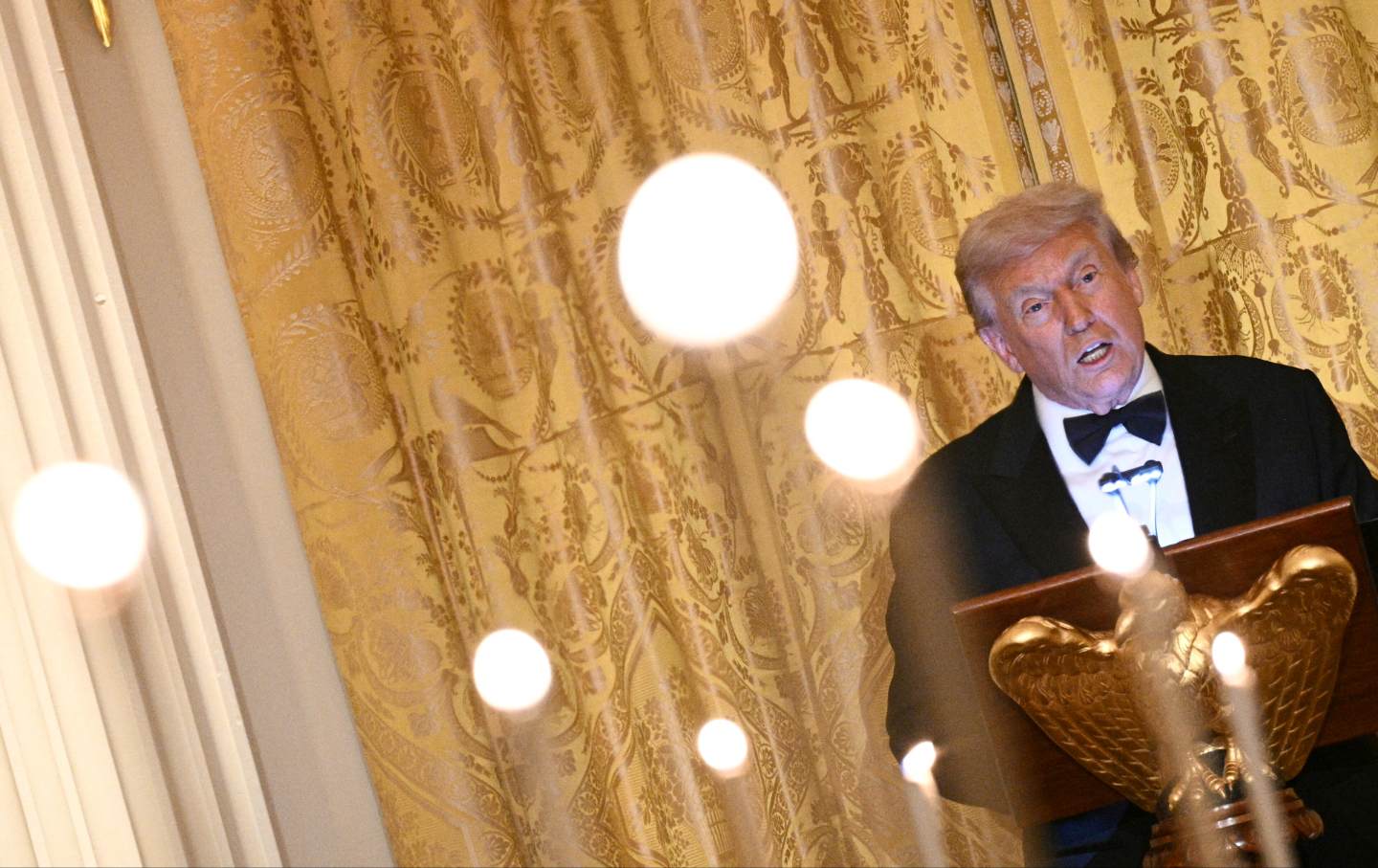
President Donald Trump speaks during an official dinner with Crown Prince and Prime Minister of the Kingdom of Saudi Arabia Mohammed bin Salman in the East Room of the White House in Washington, DC, on November 18, 2025.
(Brendan Smialowski / AFP via Getty Images)
Whenever Donald Trump faces a loss of power, he unleashes threats of violence against his foes. (When he actually does lose power, those threats turn very real, as anyone who lived through January 6 knows.) So it made sense that, after being comprehensively defeated in his fight to stop Congress from voting to release more Jeffrey Epstein files, a weakened and humiliated Trump cranked up the violent rhetoric in response to a video from six congressional Democrats.,
In the video, the Democrats, all veterans, reminded members of the military that they have a duty to resist unlawful orders. Trump responded with a frothing Truth Social post that said, “It’s called SEDITIOUS BEHAVIOR AT THE HIGHEST LEVEL. Each one of these traitors to our Country should be ARRESTED AND PUT ON TRIAL.” Another post read: “SEDITIOUS BEHAVIOR, punishable by DEATH!” White House spokesperson Karoline Leavitt subsequently denied in a press conference that Trump wants to execute members of Congress. House Speaker Mike Johnson, with typical obsequiousness, defended Trump’s comments as an appropriate response to the Democrats. Johnson added that Trump was merely “defining the crime of sedition.”
Trump’s posts are of course unhinged, but in a strange way they, along with the passage of the Epstein Files Transparency Act, could be a sign of constitutional health—or, at least, a reminder that the democratic structures of the United States have not completely collapsed.
The lawless authoritarianism of Trump’s second term in office has happened in part because, contrary to long-standing political traditions, he has rarely faced pushback from the existing checks on presidential power—whether from the coequal branches of government in Congress and the courts, or from civil society more broadly.
The judiciary and the legislature are the only two institutions with the constitutional authority to thwart Trump’s lawlessness. But, thanks to decades of Republican presidents (including Trump himself) stacking the courts with rabidly partisan judges who believe in the theory of the “unitary executive,” Trump rarely faces any serious curtailment of his agenda by the judiciary. Congress has been, if anything, even more servile because of the partisanship of GOP lawmakers.
The imperial presidency is, of course, a problem that long predates Trump. The term was popularized by the late historian Arthur M. Schlessinger Jr. in his 1973 book The Imperial Presidency, which connected the Watergate scandal to decades of political centralization in the executive branch at the expense of Congress. While there was some rollback of the imperial presidency in the wake of Richard Nixon’s resignation in 1974, this reassertion of congressional checks was brief; by the time Ronald Reagan took office in the early 1980s, the pendulum was already swinging back to the pre-Watergate norm. The Iran-contra scandal, which saw the White House brazenly defying the law in order to fund military aid that Congress had refused to support, was a sign that the imperial presidency was back in full force—a reality that was reinforced by the fact that many of the perpetrators of the Iran-contra received only a slap on the wrist and were subsequently pardoned by President George H.W. Bush.
Militarism has long been a force driving the imperial presidency, with the argument that the commander in chief needs a free hand in matters of war offering a ready excuse for overriding congressional power. Naturally, this belief only grew stronger after the 9/11 terrorist attack turned President George W. Bush into an all-too-eager wartime president.
In an important, newly published essay in The Political Science Quarterly, Eric Schickler, a scholar at the University of California–Berkeley, argued that “nationalized polarization” has also led to Congress becoming more submissive. According to Schickler, “The absence of serious congressional scrutiny of the faltering American effort in Iraq in 2003–2006 was a harbinger of the emergent dynamic in which party and committee leaders’ overriding commitment is to defend their party’s president.”
Donald Trump rose to power in this more polarized political system and has used it to assert presidential power in ways that earlier generations would have seen as illegal. As Schickler summarizes:
Donald Trump supercharged this shift in incentives. With very few exceptions, the first essential rule if one wants to survive a Republican primary has been the same regardless of one’s district: “Do not anger Donald Trump or his supporters.” These incentives enabled Trump to adopt a strategy of all-out resistance in the face of Democratic-led investigations in 2019–2020. With Republicans unified behind him, Trump could order a blanket refusal to obey congressional subpoenas and face little political pushback. Republicans’ cohesion behind Trump undercut one of the main mechanisms through which investigations had, in the past, shaped public opinion: voters did not update their views of the president when the signals they received broke perfectly on party lines. Trump’s approval rating did not budge during the first impeachment fight. Even Trump’s second impeachment reinforced the lessons of his first term: the handful of Republicans who voted to convict were far more likely to face negative repercussions at the polls (and, at times, death threats fueled by social media activists inspired by Trump) than the vast majority who voted to acquit. In the aftermath of that vote, it became clear that Congress’s impeachment power is essentially meaningless in the present context. It is thus inconceivable that Trump could act in a manner that would result in his conviction and removal from office.
Schickler paints a stark and convincing picture of the United States descending into presidential authoritarianism. It’s consistent with the way Trump has run rampant for months, eviscerating federal agencies by fiat, sending troops into American cities, and illegally bombing boats in international waters. During this period, the courts only fitfully and partly checked Trump, while Congress was wholly docile. Further, many of the civil institutions that are supposed to serve as a countervailing power to the state were also bending the knee to Trump: a pattern seen (as Schickler notes) in elite universities, the business community, and the mainstream media.
It’s against this record of an out-of-control president that the revolt against him over the Epstein File Transparency Act takes on its full import. Democratic Representative Ro Khanna deserves all credit for taking on the issue and winning the support of not just his party but four brave Republican dissidents: Thomas Massie, Lauren Boebert, Nancy Mace, and Marjorie Taylor Greene. For weeks, they stood alone in their party as Trump terrorized the majority of Republican lawmakers. Eventually, the force of public opinion, fueled by the sheer repugnance of Epstein’s crimes and the possibility that his accomplices would go unpunished, overwhelmed Trump’s stranglehold on the GOP.
The question is: Was the Epstein revolt a one-off event or a pivot point? Could it herald a larger turn against the imperial presidency in its most extremist form?
The New York Times reports that there are other signs congressional Republicans are growing restive about always being under Trump’s heavy thumb, “notably the refusal by Senate Republicans to bow to Mr. Trump’s demand to gut the filibuster during the shutdown fight, and resistance in some states to his intense push to redraw House district maps to cement the G.O.P.’s hold and prevent a Democratic takeover that would imperil the president.”
Popular
“swipe left below to view more authors”Swipe →Unfortunately, the most likely answer is that Trump will regain his hold on the GOP, and by extension on Congress. The imperial presidency, as scholars such as Schlessinger and Schickler have documented, long predates Trump. The same is true of the nationalized polarization Trump has exploited.
It’ll take more than a few brave anti-Trump votes in Congress to solve the deep constitutional crisis the United States is mired in. The best hope is that the Democrats regain control of the House of Representatives and the Senate in the 2026 midterms. If they do so, they have to start thinking about not just checking Trump but also restoring the long-eroded powers of Congress and the courts. This is a project that will take many years, and require the Democrats to first take back the presidency and then rebalance the courts, particularly the Supreme Court. The doctrine of the “unitary executive” as well as the long-encrusted emergency powers of the presidency to wage war without congressional approval will need to be overturned. This project won’t be easy, but it is the only way to make sure that there will be no more would-be dictators in the White House.
Become a Sustaining Donor This September
Between the reemergence of right-wing red-baiting and Donald Trump’s use of the chilling National Security Presidential Memorandum–7 to criminalize left political organizing, we’re seeing McCarthyism reborn before our eyes.
This assault on democracy cannot be ignored or wished away. Resisting it requires bravery in the face of threats and repression, a steadfast commitment to the truth, and the unwavering belief that we can—and will—overcome this darkness.
We must have an independent media that sets the record straight, unearths corruption and abuses of power, and advances a politics of justice and dignity for all if we’re to win this fight.
That’s why I’m writing to you today. This September, The Nation needs to add 100 monthly donors to sustain our progressive journalism. Your contribution makes the next investigative report, the next truth-speaking column, and the next pathbreaking essay all possible.
I hope you’ll support our work with a recurring donation today. If you donate $10 or more a month, we’ll send you a brand new “Hands Off the Free Press!” sticker to recognise your commitment to our cause. Please, donate today.
Onward,
Katrina vanden Heuvel
Editor and Publisher, The Nation
More from The Nation
Zohran Mamdani Hosts the World Zohran Mamdani Hosts the World
In a meeting with mayors from around the globe, Mamdani argued that the left must fix everyday problems—or the right will find someone to scapegoat for them.

Is There Any Good News Left? Is There Any Good News Left?
Despite what our algorithms suggest, there’s still news worth celebrating.

CEOs Are Losing Control of AI CEOs Are Losing Control of AI
With no slowdown from Trump’s administration.
Gina Hinojosa: “We Flip Texas, and It’s Over” Gina Hinojosa: “We Flip Texas, and It’s Over”
Talking to Texas gubernatorial candidate Gina Hinojosa about what redistricting could mean and how a new generation of Democrats is speaking more directly to voters.
Trump Wants to Keep Journalists Out of the White House. He Should Get His Wish. Trump Wants to Keep Journalists Out of the White House. He Should Get His Wish.
The president has banned MS NOW, CNN, and Politico from attending press briefings. The rest of the media should respond with a boycott.

