Protesters Demand Action From Feckless Democrats
At a protest against Elon Musk’s takeover of the Treasury Department, activists turned their ire on the Democratic lawmakers in the crowd and demanded a response that fits the moment.
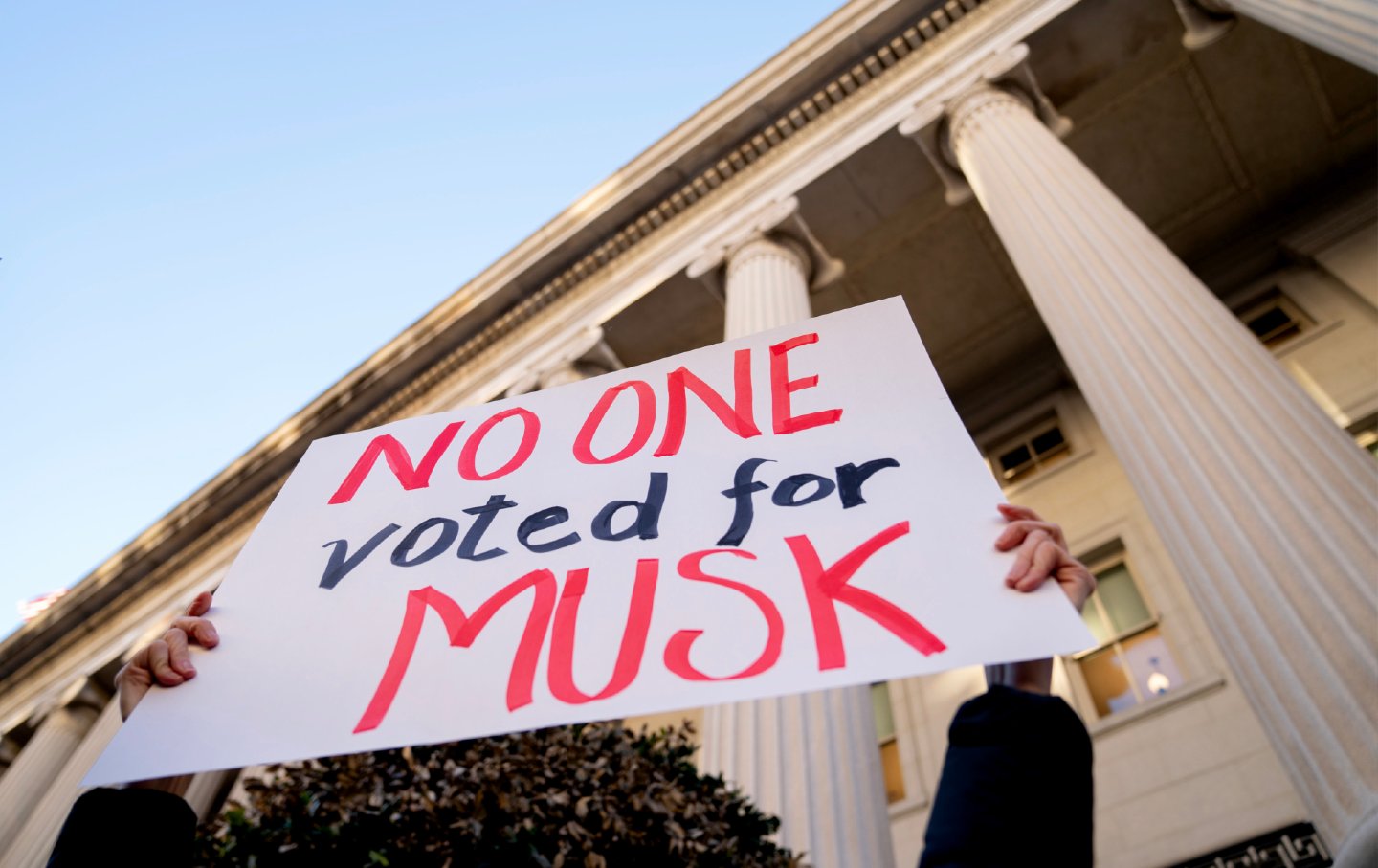
A demonstrator holds a sign during a protest against Elon Musk outside the US Treasury building in Washington, DC, on, February 4, 2025.
(Stefani Reynolds / Bloomberg via Getty Images)
Toward the end of Tuesday’s mass protest outside the US Department of the Treasury, one of the event’s organizers, Indivisible chair Ezra Levin, attempted a rhetorical feat of forbidding difficulty: leading an outraged crowd in the parliamentary-geek chant “Withhold unanimous consent!” It wasn’t exactly “We shall overcome” or “No blood for oil,” as Levin acknowledged: “I know this is wonky and technical.” But the head of Indivisible—the grassroots initiative that mounted successful campaigns to help Democrats regain control of Congress in 2018—stressed that the refrain, which references the upper legislative chamber’s practice of expediting votes via formulaic suspensions of debate, is a crucial step in galvanizing more effective opposition to the rolling Project 2025 coup. This coup now has DOGE director and “special government employee” Elon Musk harvesting sensitive financial and government payment data with zero oversight or accountability—which was why the protesters had converged on the Treasury building, a federal bureaucratic redoubt down the street from the White House that’s the scene of Musk’s crime.
The crowd had been marshaled by a trio of liberal advocacy groups: Move On and the Working Families Party as well as Indivisible. At well over 1,000 strong, it was primed to hear Levin’s pitch. Indeed, the protesters’ impatient wonky disposition came at times as a rebuke to the clutch of Democratic lawmakers who delivered speeches registering anger and outrage at the Musk-Trump administration’s unprecedented assault on the separation of powers, government payments, the privacy of ordinary citizens, and the need to face it all down. As one after another member of Congress outlined the horrors perpetrated by Musk and his team of tech lackeys, protesters would shout back, “Arrest them when they come out!” and “Lock him up!” As the speeches continued, one especially plaintive chant took hold in the crowd: “Tell us what to do!”
Levin obliged that demand, calling not only for the suspension of unanimous consent, but also for a blockade of all pending confirmations of Trump cabinet nominees until the Musk Treasury putsch is scrapped. He noted, however, that for all the lawmaker outrage on display at this event, 22 Senate Democrats had rubber-stamped Trump’s nominee to head the Veterans’ Administration, Doug Collins. (Nor was that the only Senate failure to competently advise or consent; after the rally had broken up, the chamber approved Trump’s massively corrupt choice for attorney general, Pam Bondi—although here there was just one Democratic yea vote, Pennsylvania Senator John Fetterman, aka Joe Manchin in a hoodie.)
This striking disjuncture between an aggrieved public demanding action and a national Democratic Party operating on autopilot was the backstory to the Treasury protest. The resource plan that Indivisible organizers drafted for protesters registers great exasperation with the Democrats’ slow-moving, ideas-challenged posture in the present crisis. “Dems are still playing by the old rules, trying to demonstrate that they’re reasonable in the face of an unreasonable MAGA party,” the document reads. “In their minds, this is how they win back power—ignore the coup, and hope their mealy-mouthed statements help win majorities in 2026 and 2028. But nobody sees your boring statement, and we’re losing power to Trump, Musk, and their cronies every day that Dems don’t fight back.”
It’s not hard to chart the reasons why this exasperation has taken hold in the party’s movement base. Indeed, as Musk was dispatching his data team to illegally hack into the Treasury department’s files and rewrite the system’s coding, Senate minority leader Chuck Schumer took to his X account to rouse public ire with these stirring words: “You’re watching the Super Bowl next week. Wait till Trump’s tariffs raise your pizza prices.” Two days later, he outlined his thinking on how the Democrats should fight the Trump agenda in an interview with Semafor’s Burgess Everett; the party shouldn’t go outrage-chasing, he advised, but should instead wait in the certainty that “Trump will screw up.”
Schumer was among the assembled speakers at the rally, alongside other resistance-minded lawmakers such as Massachusetts Senator Elizebath Warren of Massachusetts, Texas Representative Jasmine Crockett, and Maryland Representative Jamie Raskin. (Not long before the protest, a number of these lawmakers attempted to get into the Treasury building only to be denied entry—a reprise of the lockout that greeted another group of congressional Democrats outside the US agency for International Development on Monday as they sought to gain more information about the Musk-orchestrated freeze on its operations.) Schumer’s presence was at least a signal that the grassroots strategy of prodding lawmakers to act is already starting to bear fruit. Still, Levin made it clear that a cameo at a demonstration won’t be enough to placate movement activists.
“Leader Schumer, he led…some good chants,” Levin said. “But I’ve got a chant for him: Do something!” The crowd took up that one with gusto, along with Levin’s next directive: “Shut down the Senate!”
Most of the Democratic senators in attendance shifted uncomfortably during that call to action; their chamber is, after all, the least democratic branch of representative government, and left to their own devices, they like unanimous consent and bipartisan confirmation votes just fine. (One exception earlier in the evening was a tie-less Connecticut Senator Chris Murphy, an increasingly vocal populist critic of Democratic business as usual, who said “the US Senate shouldn’t approve a single Trump nominee” until Musk stands down, along with “the creepy 22-year-olds” working for him.)
It’s deeply unsettling, with the authoritarian seizure of basic governing operations well under way, to see the battered movement forces in the party having to go to such great lengths to ensure that Democratic leaders maintain their focus and resolve. It’s especially distressing in view of the same leadership’s consistent and properly urgent message, during the presidential campaign, that Donald Trump’s Project 2025 agenda was a plan to install him as a de facto dictator and to trash the bulwarks of American democracy. Now that their dark prophecy has proven true, all too many Democratic leaders are on their heels—when they’re not phoning in confirmation votes.
That’s one reason, amid the wonky uproar of the protest, one chant from the crowd lingered with special force: “What’s the plan?”
Become a Sustaining Donor This September
Between the reemergence of right-wing red-baiting and Donald Trump’s use of the chilling National Security Presidential Memorandum–7 to criminalize left political organizing, we’re seeing McCarthyism reborn before our eyes.
This assault on democracy cannot be ignored or wished away. Resisting it requires bravery in the face of threats and repression, a steadfast commitment to the truth, and the unwavering belief that we can—and will—overcome this darkness.
We must have an independent media that sets the record straight, unearths corruption and abuses of power, and advances a politics of justice and dignity for all if we’re to win this fight.
That’s why I’m writing to you today. This September, The Nation needs to add 100 monthly donors to sustain our progressive journalism. Your contribution makes the next investigative report, the next truth-speaking column, and the next pathbreaking essay all possible.
I hope you’ll support our work with a recurring donation today. If you donate $10 or more a month, we’ll send you a brand new “Hands Off the Free Press!” sticker to recognise your commitment to our cause. Please, donate today.
Onward,
Katrina vanden Heuvel
Editor and Publisher, The Nation