Why the Right Is So Giddy About Sydney Sweeney’s Blue Jeans Campaign
At first, they wanted to claim progressives were delusional for seeing a slide back into white supremacy in the American Eagle ad. Now they’re boasting about it.
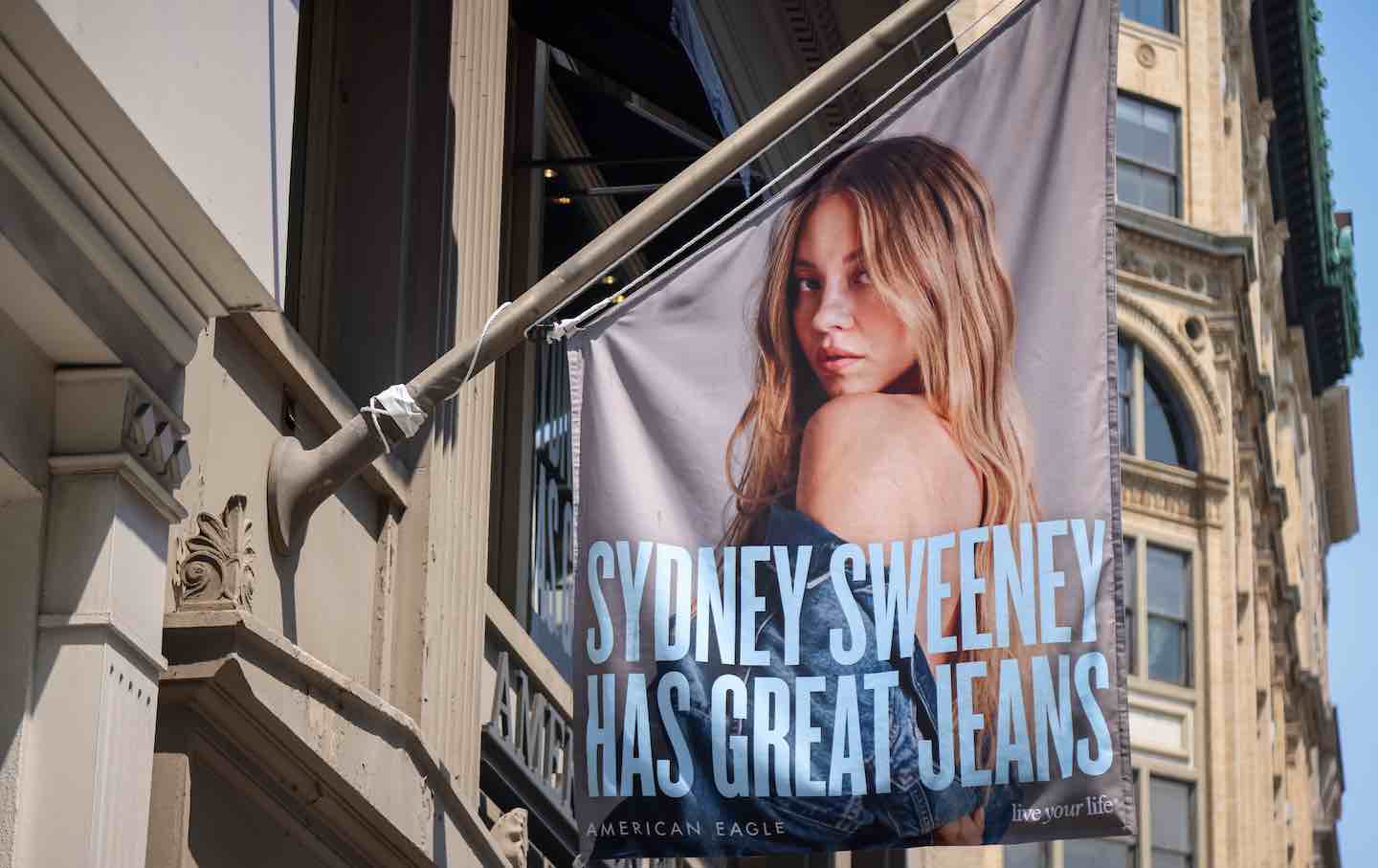
An advertisement featuring actress Sydney Sweeney outside an American Eagle store in New York City, on August 4. American Eagle Outfitters Inc. shares surged after US President Donald Trump came out in support of a controversial ad from the company featuring actress Sydney Sweeney.
(Michael Nagle / Bloomberg)The first thing you notice in actor Sydney Sweeney’s controversial ad campaign for American Eagle blue jeans probably won’t be her jeans but her cleavage as she reclines shirtless under a tight jean jacket. The tagline is, “Sydney Sweeney has great jeans.” I mention this not to boob-shame but to say this ad is operating on so many levels, from sexuality to race to politics, it shouldn’t be surprising that it’s become the latest culture-war battleground. Well played, American Eagle.
Lest you think otherwise, Sweeney’s cleavage isn’t what’s made the ad campaign controversial. It’s the play on jeans/genes. There’s a magazine photo, which prominently features her breasts, as well as a video ad, in which the actor intones, sounding kind of bored: “Genes are passed down from parents to offspring, often determining traits like hair color, personality, and even eye color.” The camera pans to her blue eyes, and she says: “My jeans are blue.”
Progressives pounced, provoked by the apparent introduction of genetics into clothing ads. A TikTok influencer called it “literally…Nazi propaganda.” That may be an overstatement, but there is something sketchy about an ad that references “genes” while featuring the white supremacist ideal of womanhood—blonde, blue-eyed, and busty. An MSNBC columnist called it evidence of “an unbridled cultural shift toward whiteness.”
Perhaps surprisingly, many on the right agree. While at first some mocked progressive outrage as “hysteria,” now they are proud to embrace the ad campaign’s celebration of whiteness, throwing off the yoke of woke. Right-wingers Megyn Kelly and Fox’s Laura Ingraham are declaring the ad part of a long-overdue backlash against definitions of beauty that don’t center whiteness. On social media, on her podcast, and on her own site, Kelly is giddy about the Sweeney ad:
We have been suffering with the elevation of homely people in our fashion ads and our fitness ads for years now, and we are over it. We miss attractive people. We are sick of trying to pretend that these objectively unattractive people are the new beauty standard. They are not.
But here is the piece no one is saying that I think needs to be said because it is real and there is nothing wrong with it: We are sick and tired of the nonsense where you are not allowed to ever celebrate someone who is white, blonde, and blue eyed; that we have to walk into a room apologetic for those things. In a way, this ad is the final declaration that we are done doing that sh-t.
Kelly might be best known for insisting that Santa Claus, a fictional character, is undeniably white, pushing back on the proliferation of Black Santas in department stores and in the media.
Fox’s Laura Ingraham has focused two segments on the Sweeney ad. On X, she circulated a guest’s comment, echoing Kelly: “They don’t actually believe this is the resurrection of the Third Reich. They hate what Sydney Sweeney represents: the fall of wokeness, fat pride, gender androgyny, and DEI. They failed to reprogram the population into thinking ugly is beautiful.”
Bari Weiss’s Free Press, which specializes in making woke backlash stories seem reasonable, also pushed the Kelly/Ingraham line.
Lately the American public has grown used to a very different kind of ad, which tried to convince us beauty is whatever they say it is this week. You know the ones: the sagging swimsuit campaigns, the big-and-proud lingerie shoots, the breathless press releases declaring that representation is the new hotness. For roughly a decade, brands insisted on telling us what we should find sexy—stretch marks, back rolls, visible panic disorders—whether we liked it or not.
The body positivity movement told us, loudly and constantly, that everyone is beautiful, that all bodies are worthy of the spotlight, that a triple chin was not only normal, but empowering. Obesity wasn’t a health crisis, it was an identity. That era wasn’t really about celebrating women. It was about neutralizing beauty. Sanding down the sharp edges of desirability until no one felt left out, and no one stood out.…
Whether she meant to be or not, [Sweeney is] a kind of a walking middle finger to the movement that tried to blow up all of our old-fashioned ideas about beauty.
Sinking in the polls, even Donald Trump got into the action, posting on Truth Social: “Sydney Sweeney, a registered Republican, has the ‘HOTTEST’ ad out there. It’s for American Eagle, and the jeans are ‘flying off the shelves.’ Go get ’em Sydney!” He contrasted her with his Democratic nemesis Taylor Swift, who he insisted is “NO LONGER HOT.” You’d think, given the ongoing news about his ties to the late child sex trafficker Jeffrey Epstein, he might be more cautious about weighing in on the “hotness” of young women, but you would be wrong.
Of course, people of a certain age will be reminded of the uproar over model and actor Brooke Shields’s 1980 Calvin Klein jeans ad, featuring the tagline “You want to know what comes between me and my Calvins? Nothing,” a not too subtle suggestion that the 15-year-old was not wearing panties. Given that Shields had starred as a child prostitute in the film Pretty Baby at age 11, the ad outraged people concerned about the sexualization of young women—and no doubt delighted Epstein and Trump.
But now race and genetics have been added to the mix. Trump is famously a proponent of the “good genes” explanation of racism and inequality. Meanwhile, Megyn Kelly can’t help herself: She slammed Beyoncé’s ad campaign for Levi’s on X today: “This is the opposite of the Sydney Sweeney ad. Quite clearly there is nothing natural about Beyonce. Everything—from her image to her fame to her success to her look below—is bought and paid for. Screams artificial, fake, enhanced, trying too hard.”
Megyn, your post screams “racism.”
At first, the right wanted to claim progressives were delusional for seeing a slide back into white supremacy in the Sweeney ad campaign. Now they’re boasting about it. They’re only convincing me that some of the ad’s critics are right.
Become a Sustaining Donor This September
Between the reemergence of right-wing red-baiting and Donald Trump’s use of the chilling National Security Presidential Memorandum–7 to criminalize left political organizing, we’re seeing McCarthyism reborn before our eyes.
This assault on democracy cannot be ignored or wished away. Resisting it requires bravery in the face of threats and repression, a steadfast commitment to the truth, and the unwavering belief that we can—and will—overcome this darkness.
We must have an independent media that sets the record straight, unearths corruption and abuses of power, and advances a politics of justice and dignity for all if we’re to win this fight.
That’s why I’m writing to you today. This September, The Nation needs to add 100 monthly donors to sustain our progressive journalism. Your contribution makes the next investigative report, the next truth-speaking column, and the next pathbreaking essay all possible.
I hope you’ll support our work with a recurring donation today. If you donate $10 or more a month, we’ll send you a brand new “Hands Off the Free Press!” sticker to recognise your commitment to our cause. Please, donate today.
Onward,
Katrina vanden Heuvel
Editor and Publisher, The Nation