
The United States Is Letting Its People Starve
US leaders have long taken some responsibility to help poor people meet basic nutritional needs. That era appears over.
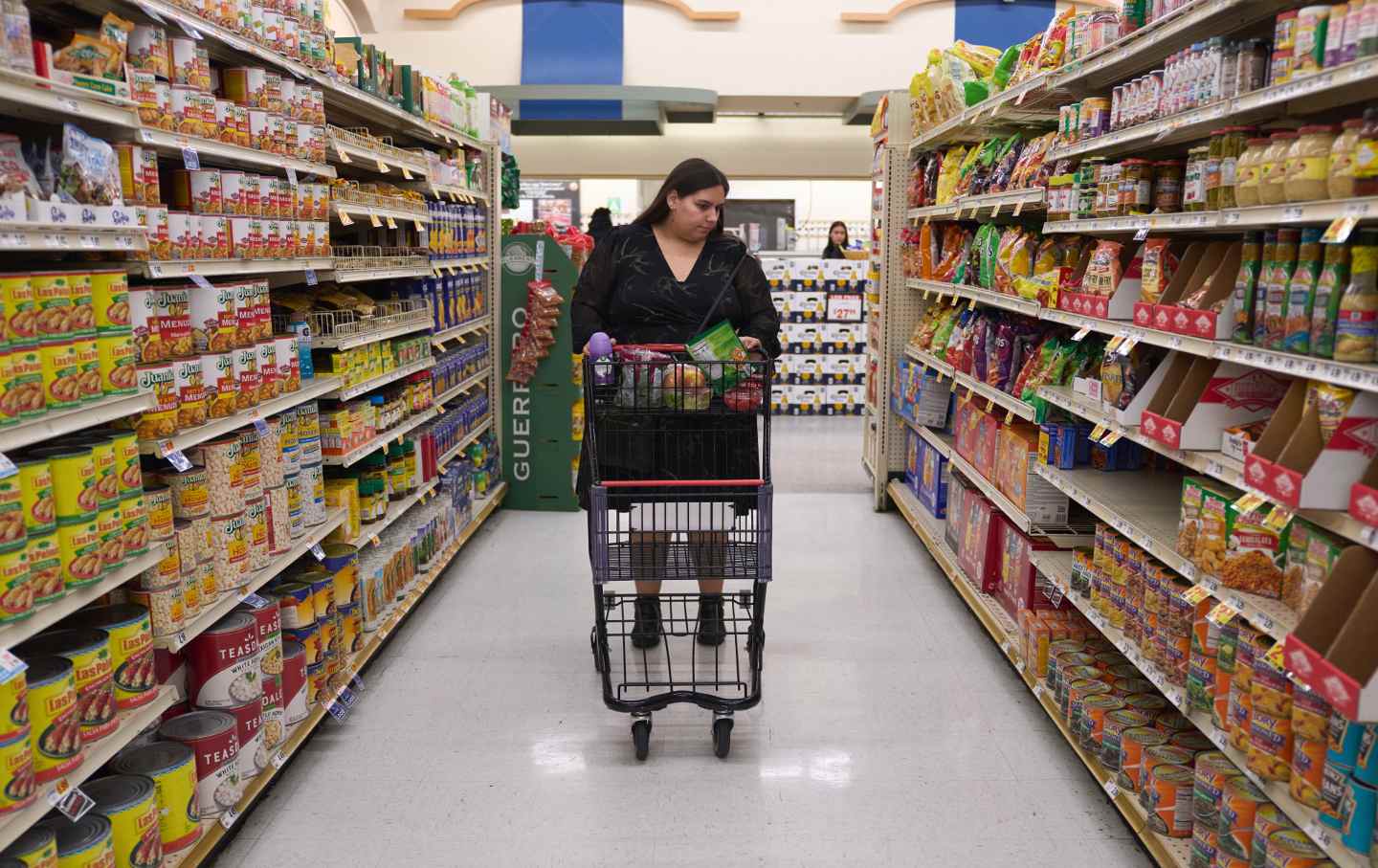
Jacqueline Benitez uses SNAP benefits to supplement her income as a preschool teacher, in Bellflower, California.
(Allison Dinner / AP Photo)In October, millions rallied across America to remind Donald Trump that this nation obeys no kings. Last week, however, a scene worthy of Versailles unfolded: While Trump built his $300 million ballroom, the US prepared to face widespread hunger.
With Supplemental Nutrition Assistance Program (SNAP) funding scheduled to run dry due to the government shutdown, the Trump administration not only refused to prevent the crisis—it fought in court to deprive 42 million SNAP recipients of their grocery money. Thankfully, a federal judge ruled against the government and ordered that SNAP payments proceed. On Monday, the administration said it would fund just half of recipients’ typical benefits. And 2.4 million people soon risk losing their benefits nonetheless, as the $186 billion SNAP cuts in Trump’s benighted budget bill begin taking effect.
America has always faced hunger, yet its leaders have long shown some responsibility to help poor people meet their most basic nutritional needs. That even this small measure of decency is seemingly a thing of the past signals the dawn of an unprecedented era of cruelty.
SNAP, or food stamps, is one of the core provisions of the nation’s frayed social safety net. Over 12 percent of the population receives SNAP benefits to buy groceries, and the program is available only to those whose net household income lands them at or below the federal poverty line. For a family of four, that’s just $32,150 per year.
While top Republicans have insisted that safety net programs are abused by healthy young men who prefer playing video games to holding down a job, most SNAP recipients are excluded from the workforce by age or ability—approximately 40 percent of recipients are children, while another 30 percent are over 60 years old or have a disability. Many of the remaining able-bodied and working-aged SNAP recipients work, as even a full-time job offers no guarantee of lifting a household out of eligibility. Walmart and McDonald’s supersize their profits in part by offering wages so low that, as of 2020, both companies ranked among the top employers of SNAP recipients.
Since the shutdown began last month, the Trump administration has contorted military budgets to fund service members’ salaries, and accepted a possibly illegal $130 million donation, reportedly from the Republican megadonor Timothy Mellon, to bump the payroll stores. But despite sitting on a $5 billion SNAP contingency fund, the US Department of Agriculture (USDA) insisted that it lacked the authority to use this cash.
It’s a patently disingenuous argument. Just weeks ago, the agency’s website featured a shutdown plan outlining its intention to use the emergency chest to keep SNAP afloat. But the information was scrubbed from the site, as, in hopes of pressuring Democrats to end the shutdown, Republicans decided to play a game of chicken that jeopardized 42 million people’s ability to eat. On Tuesday, 25 states sued the USDA to force the agency to fund SNAP. The Rhode Island district court judge John J. McConnell Jr. saw through the government’s flimsy claim and ordered on Friday that the USDA tap its contingency cash.
The White House budget office issued no immediate comment to The New York Times on this setback in its efforts to deprive Americans of food. However, the president did post to Truth Social some striking photos of his all-marble Lincoln bathroom renovation.
The ruling, and the administration’s Monday announcement, are sure to offer some relief to SNAP users. But for those targeted by Trump’s cuts to the program, hunger still looms. Most refugees, asylum seekers, human trafficking survivors, and other non-green-card-holding legal immigrants are set to lose their payments. If they turn to food pantries—newly stripped by the Trump regime of $500 million in federal funding—they’ll find that even these venues of last resort are buckling under rising need. SNAP’s work requirements will also now apply to groups previously exempt from them, including unhoused people, veterans, and young adults who’ve aged out of foster care.
The idea that people out-of-work do not deserve to eat runs contrary to the original purpose of food stamps, which were first introduced during the mass unemployment of the Great Depression. As late as the early 1970s, the simple moral mandate to feed the hungry carried a degree of bipartisan cachet. John F. Kennedy and Lyndon Johnson inaugurated the modern food stamps program, but Richard Nixon expanded it, and even vowed to “put an end to hunger in America.”
Under Ronald Reagan, however, Republican antipathy toward food stamps took on its now-familiar form. Reagan named food stamps among the misbegotten spoils of his infamous welfare queen, and warned of “strapping young bucks” using the program to buy T-bone steaks. He tossed a million recipients from the rolls his first year in office.
Today, Reagan-style demonization of the poor lives on in Newsmax segments that falsely claim most SNAP recipients are immigrants, and in viral but entirely fictional AI-generated videos of Black women raging about losing their benefits. Concerns about luxury purchases have also persisted. In 2015, Scott Walker, the governor of Wisconsin, signed off on a measure that attempted to prevent SNAP users from buying shellfish. Heaven forbid a low-income family cook shrimp scampi.
Decades of punitive and dehumanizing deeds and rhetoric have apparently convinced the Trump administration that it can condemn millions of Americans to hunger without facing devastating political consequences. However, as the White House attempted to abandon the nation it’s tasked with safekeeping, other institutions and individuals rallied to help their communities fend off hunger. Virginia’s and Delaware’s governors, Glenn Youngkin and Matt Meyer, promised that their states would fund SNAP benefits for residents throughout November. Many other states pledged emergency support to food banks. And in local Facebook groups, strangers paired off as “grocery buddies,” with one helping the other buy food.
Still, emergency measures and good deeds are not a long-term solution, particularly for those whose benefits are on the chopping block. As Joel Berg, CEO of the nonprofit Hunger Free America, wrote for The Nation this week, progressives should push for a full slate of social and financial reforms to ensure that Americans are able not just to “get by but actually get ahead.” Until then, far too many Americans will continue to live on a precipice, their next meal determined by White House whims.
Popular
“swipe left below to view more authors”Swipe →More from The Nation

We Were Warned in 2001 We Were Warned in 2001
Science-fiction nightmares are now current events.
2028 Democratic Hopefuls Take on Data Centers 2028 Democratic Hopefuls Take on Data Centers
Data center opposition can foster a bigger Democratic tent by aligning red and blue, and rural and urban communities.

Making America Accountable Again Making America Accountable Again
Corporate leaders say they should be shielded from congressional inquiries because they had no alternative but to collaborate with the Trump administration. History says otherwise...
Minnesota Has Ilhan Omar’s Back Minnesota Has Ilhan Omar’s Back
Minnesotans say the raid on Omar’s home was all about politics. They also argue that it will backfire and generate boosted turnout for DFL candidates.
A Horrific ICE Shooting Is Testing Mamdani’s Approach to Trump A Horrific ICE Shooting Is Testing Mamdani’s Approach to Trump
After a federal agent shot an immigrant in New York, activists are questioning Mamdani’s handling of the NYPD and his relationship with the White House.
Jane Doe: Courage and Dignity Jane Doe: Courage and Dignity
Allegations of gang rape and sex trafficking at Cornell University highlight persistent concerns about rape culture, even years after the #MeToo movement.

