“There Are No Illegal Strikes—Only Unsuccessful Ones”: A Conversation With Sara Nelson
The international president of the Association of Flight Attendants explains how labor solidarity can “set the agenda and make things better.”
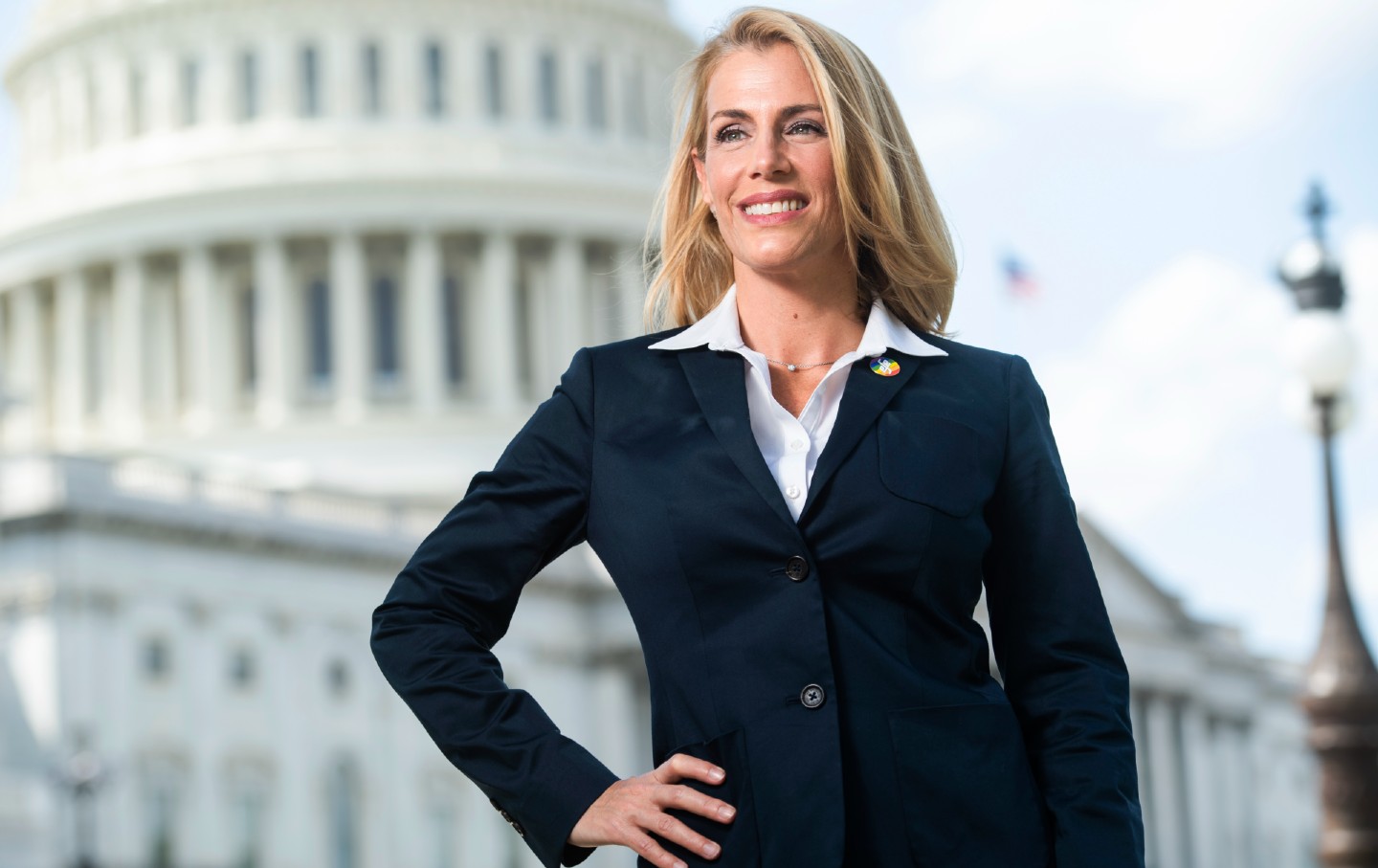
Sara Nelson, the international president of the Association of Flight Attendants–CWA.
(Tom Williams)Representing some 55,000 members at 20 airlines, Sara Nelson valiantly defends her people. Back in 2019, she used the threat of a strike to ground air traffic to help end an extended government shutdown. During the pandemic, she won a $54 billion Covid-relief package for her industry. Nelson is in her third term as the international president of the Association of Flight Attendants and widely regarded as one of the most lionhearted leaders in the labor movement. When Bernie Sanders launched his Fight the Oligarchy tour earlier this year, she joined. When United Auto Workers leader Shawn Fain floated talk of a general strike, she chimed in. A former flight attendant herself, Nelson knows how to leverage worker power, and her strategies are exactly what the labor movement needs in 2025.
—Laura Flanders
Laura Flanders: It helps me as we begin these conversations to kind of settle myself by asking my guests who is uppermost on their minds as we begin to speak. Who are you bringing to this conversation today?
Sara Nelson: I always bring the people that I work with. Whenever I feel like I have lost my way, I think about the people that I have shared a jump seat with, worked across a beverage cart with, had to deal with scary moments in aviation. I also always, always, always think about my friends that I lost on September 11, Flight 175 that slammed into the South Tower of the World Trade Center. I learned that as we were grieving and trying to come together, there were crisis capitalists who were trying to redefine the value of a pilot, a flight attendant, a mechanic, a gate agent, and to do what they had done in so many other industries that didn’t have as high union density as the airline industry: make people work more for less, shed pensions, and legacy costs, transfer more of the cost of the healthcare to people on the front lines. I’m thinking about how to fight back, and I’m thinking about the flight attendants who are calling us now, saying, “I’m terrified because my family is in the process of being properly documented. My family is from another country. My loved ones are, my neighbors are. What can we do to help them?”
LF: We as passengers, as clients of the airlines, see your smiling faces. We see the flight attendants who do all that emotional work of keeping from us what’s going on for them and making us as comfortable and secure as they can. How safe are our skies for customers, clients, passengers, and the people you work with every day?
SN: Aviation is the safest mode of transportation in the world. That is the product of aviation being highly unionized, not only in the United States but also around the world. When we say things like, “Never forget,” and “Never again,” we mean it. We don’t just have companies that are beholden to the shareholders and the financiers that can say all day long that safety is first. But it’s really the people who are putting their lives on the lines, getting onto those flights, who truly have the real interest in keeping safety first.
Our voices are so important, and I will tell you that there are a lot of stresses and strains on aviation right now. We certainly do have disruptions. And the first thing that you learn in safety is to remove all distractions. So when you have programs like DOGE coming in and telling people to justify their work; telling them to write essays about how they will be loyal, not to their country and the oath that they’ve taken, but to Donald Trump himself; telling them that they may not have the people next to them to work with, knowing that this president has said, “Ronald Reagan fired the air traffic controllers in four days. I’ll do it in four minutes.” These are incredible distractions. And then, dismantling all the programs that help aviation—the National Weather Service, USAID—so that we can fly safely around the world, and so that we can identify where communicable disease exists, stop it before it gets to our airports, and we become the conduit to spreading what could be the next pandemic. All of these things are of serious concern to us.
What I would tell the public is that today, look to your flight attendants. Look to your pilots. If it’s not safe, we’re not going to go. It may be very frustrating, there’s a lot of delays and cancellations these days. That is because the people who are on the front lines of aviation are slowing things down in order to keep things safe. It may not be as efficient for everyone, but we’re going to keep it safe.
LF: What are some of the things your union has fought for over the years?
SN: One of the things that I’m proudest of is our efforts to try to improve our minimum rest on the job. It was the last item on the table in the 2018 FAA Reauthorization Bill. I got a message from the leadership of the committees that this was going through, both the House and Senate were meeting together. And they said, “There’s not a single Republican who will sign up to support your 10 hours of minimum rest.” I happened to be in a car with the president of the United Mine Workers of America, Cecil Roberts, at the time, and we had just helped save the miners’ pensions and healthcare that had been promised to them. I said, “Cecil, I need you to call Shelley Moore Capito right now.” And he was able to call the senator and not just say, “Do this favor for me.” But he was able to say, “This is someone and this is a union that fought to make sure that your constituents maintained that retirement security. You need to do this for them now. It’s the right thing to do.” And she did it within five minutes. We finally won those additional two hours of rest that we had been fighting for for over 30 years.
LF: It is contagious, the story that you’re telling about wins, and this is why it is so tragic to me that we get so little coverage of the labor movement, as you described, of working people’s fights and experiences, and wins. I want to say when we fight, we win. Sometimes that slogan rings hollow after the Kamala Harris campaign, but hey, what I’m hearing from you is when we fight, we win. I want to ask how you’re applying that to this moment. I remember back in that time of the government shutdown, hearing you say, we just need to shut down three airports. You had done a kind of power mapping of where the vulnerabilities were in our system or where the pressure points could be. Have you done that mapping now?
SN: Our union does use a strike tactic called CHAOS, “Create Havoc Around Our System.” And part of the power of it is that we don’t announce when or where we’re going to strike. In that shutdown, what we did for 35 days was define the real safety risks of the ongoing government shutdown. We saw in this government shutdown that once again, it was air traffic controllers who were on the line, and other government workers. We said we cannot do what we did in 1981, which was to turn our back on the air traffic controllers and say, “This isn’t our fight.” I gave the speech and called on the rest of the labor movement to talk about a general strike to end that shutdown. Defining worker power was key to ending that shutdown. When there was still no political solution in sight on day 34, and the Senate voted again and voted against it, the very next day, a few flights started to cancel in LaGuardia. That government shutdown ended in a couple hours when there was no solution in sight for 35 days. So we can take that lesson and understand that, first of all, there has to be labor solidarity. We have to understand that if one group is under attack, we’re next. So we have to rush to each other’s sides, but we can also turn this around and not just be on defense. We can actually set the agenda and make things better.
LF: You have union leaders like Shawn Fain, and a few others talking about a general strike. You have others talking about 2028 as a moment where contracts could be coordinated. What are you seeing as critical moments for people to be thinking about? The idea of a strike feels like something from the ’30s, and I’ve heard a lot of skepticism from people, like, “Nice pie in the sky, but will it ever happen? How would it happen?”
SN: You’re right, from the ’30s. In 1934, there was some of the highest amount of strike activity this country has ever seen. There were national strikes. The mine workers were on strike for nine months. There were general strikes in various cities, there was a textile strike across the South. There was massive unrest. That’s actually what brought the corporations crawling to FDR to ask for labor law, because they wanted some stability. It also gave FDR the power to sign the New Deal into law, because these were very clear demands coming from labor across the board.
These were not legal strikes. But as I always say, there are no illegal strikes. There are only unsuccessful ones. If you generate enough power, you can get resolution and protect everyone. You will learn so much by going to a picket line about how to be organized, about how to be very disciplined, about having nonviolent activity.
First and foremost, there is a fight likely going on in your community. Find it, go out there, learn about the fight, take doughnuts to the picket line, contribute to the strike funds, find out what you can do to support in other ways. There will be a catalyst that brings everyone into the streets. It’s coming. I would say, for me, my red line has already been passed. A million workers in the federal government had their contracts canceled. That was my red line. But I know that we’re not all there yet. So we have to continue to define these things. We have to define the commonalities that we have and look for opportunities to build those relationships. And if people just practice these organizing skills that are easy to take part in today in society, you can find these fights anywhere. We can actually build up labor solidarity and a real experience for people to be able to take on the big fight.