How to Place Rural Communities at the Heart of the Anti-Trump Movement
Rural activists are ready to take their place and play their part in the coalitions that are forming.
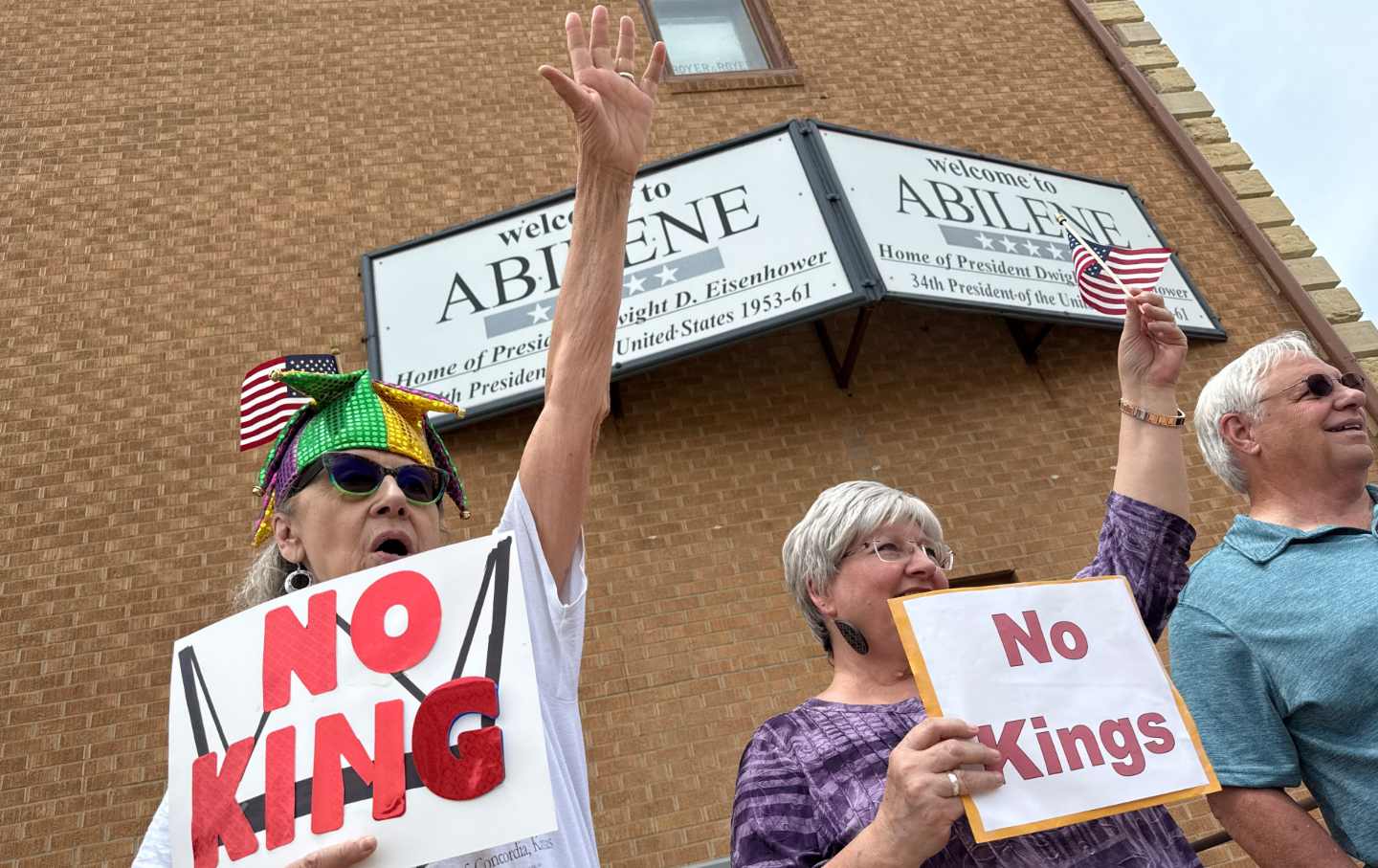
Loretta Jasper, left, and Jo Schwartz, wave to a passing vehicle on Buckeye Avenue in downtown Abilene, Kansas, on Saturday, June 14, 2025, during a “No Kings” protest.
(Brian Kratzer / Missourian via AP)
Democrats and others on the left need to put working people, farmers, and rural communities at the center of the effort to defeat Trumpism. There’s no question that rural activists are ready to take their place and play their part in the coalitions that are forming. That was evident in the demonstrations that took place in hundreds of villages and towns across the country for the October 18 No Kings Day of Action.
But a lot more is going on at the grassroots. In September, for instance, US Representative Ro Khanna (D-CA) joined activists from more than 30 states to address the urgent need to invest in rural and working-class communities and to put forward transformative policies—like the Rural New Deal—which will fight outsized corporate power and help level the playing field for working Americans.
Since the launch, a dozen additional events have been held as part of the campaign, ranging from town-hall-style meetings in rural Appalachia to virtual gatherings focused on what the left must do to win back working people.
Local, regional, and national organizations have joined the campaign, each organizing a range of actions and events that center working-class and rural concerns in different ways. Campaign partners include the Rural Urban Bridge Initiative, Progressive Democrats of America, Rural Democracy Initiative, Field Team Six, Public Citizen, and a dozen others.
The current resistance to Trump has succeeded in organizing thousands of events with millions of participants. However, it has two significant gaps that have hindered its effectiveness in building a broad enough base to stop his most destructive actions: a lack of sustained attention to the severe harms being done to rural and working people, and the absence of a clear pro-worker, pro-rural vision, policy platform, and plan of action. This was evident again in the No Kings rallies, where—outside of rural communities where activists have begun to frame the debate—signs, chants, and social media posts largely ignored the severe pain that farmers and working families in small towns are facing under Trump. These missing pieces are at the center of the Beyond Resistance campaign.
As Jared Abbott, director of the Center for Working Class Politics, put it, “The Beyond Resistance campaign is exactly what we need right now: a clear call-out of the empty promises the Trump administration has made to American workers, coupled with a credible, forward-looking vision for helping working-class people and rural America—a vision sorely missing from both major parties.”
The campaign is comprised of four core elements: first, showing workers and rural people that the left is committed to them by consistently lifting up their struggles and the harms being done to them by the Trump administration. The campaign has created a “Betrayal Tracker,” regularly updated to include some of the many ways in which this administration is undermining and hurting workers, unions, family farmers and small businesses, manufacturing jobs, and consumers. It also provides suggested slogans and statements to use at resistance rallies and other events. Whereas the common fare at these protests is mockery of Trump’s copious flaws and defense of seemingly abstract principles, our slogans are laser-focused on the concrete issues that matter most to working people.
The second element of the campaign spotlights “rural success stories,” examples of local organizations and businesses having real impact on healthcare, small-town revitalization, economic and agricultural revitalization and much more. The campaign provides links to these groups, as well as suggested language to help elevate and build support for them.
The third element of the campaign is to put forth a clear vision, backed by concrete policies, to unrig the system and address the grievances of rural and working-class people. It is essential that the millions of Americans who believe, rightly, that the system is rigged against them see the left offering specific actions and policies that will build a new system, one that levels the playing field and reins in unchecked corporate power. To do this, the campaign offers two major policy platforms now—the Rural New Deal and the Rural Policy Action Plan– with others also in the works.
The final element is supporting and expanding local engagement efforts designed to rebuild trust across the ideological divide through hands-on, concrete local actions. The Community Works initiative, currently operating in six states, provides one successful model of local trust-building efforts Democrats and progressives are taking in rural counties. The campaign provides opportunities, including a Community Works National Summit that was held on October 22, for people to learn more about this approach and take steps to launch local chapters wherever they are.
Beyond Resistance has been fortunate to attract a number of GenZ and other younger participants. One of these young leaders, Lily Forand, who founded The New Populist, summed it up nicely: “There’s never been a more important time for the left to connect with rural and working-class voters. This campaign is doing essential work to link these two worlds and launch a movement that builds genuine working-class political representation.” That’s what the left needs to do now to stop Trump, and it’s what we must do over the long term if we’re going to build a country for the many and not the few.
Become a Sustaining Donor This September
Between the reemergence of right-wing red-baiting and Donald Trump’s use of the chilling National Security Presidential Memorandum–7 to criminalize left political organizing, we’re seeing McCarthyism reborn before our eyes.
This assault on democracy cannot be ignored or wished away. Resisting it requires bravery in the face of threats and repression, a steadfast commitment to the truth, and the unwavering belief that we can—and will—overcome this darkness.
We must have an independent media that sets the record straight, unearths corruption and abuses of power, and advances a politics of justice and dignity for all if we’re to win this fight.
That’s why I’m writing to you today. This September, The Nation needs to add 100 monthly donors to sustain our progressive journalism. Your contribution makes the next investigative report, the next truth-speaking column, and the next pathbreaking essay all possible.
I hope you’ll support our work with a recurring donation today. If you donate $10 or more a month, we’ll send you a brand new “Hands Off the Free Press!” sticker to recognise your commitment to our cause. Please, donate today.
Onward,
Katrina vanden Heuvel
Editor and Publisher, The Nation