
How a Case From 1803 Explains John Roberts’s Approach to Donald Trump
Roberts wasn’t “rebuking” Trump when he issued his statement against impeaching judges. He was bending the knee.
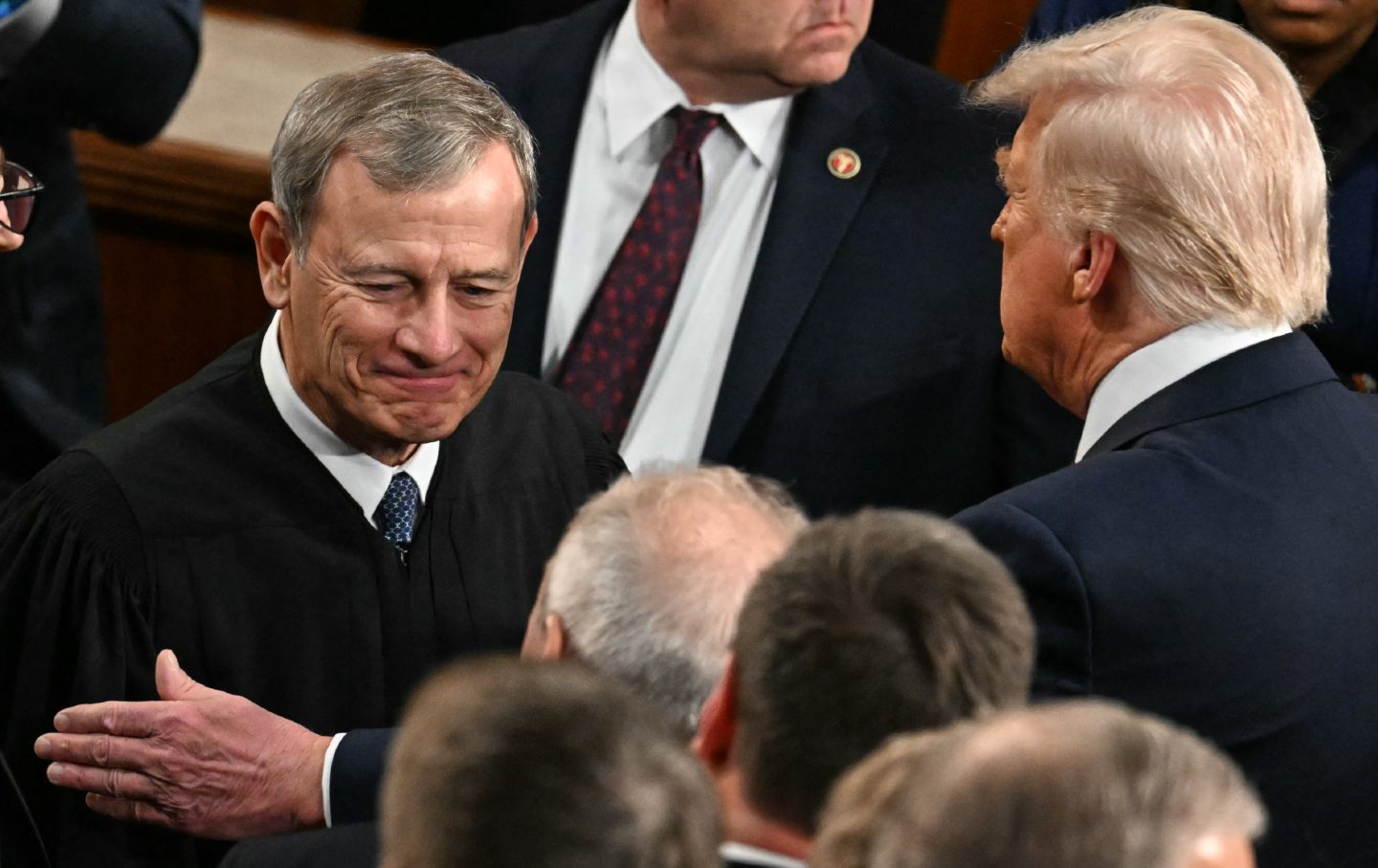
Donald Trump greets US Supreme Court Chief Justice John Roberts on his way to address a joint session of Congress on March 4, 2025.
(Jim Watson / AFP via Getty Images)
Donald Trump, his chief of ghouls Stephen Miller, and his czar of white ethnonationalism Tom Homan have been making the rounds calling out “rogue” federal judges who dare to try to apply the law to Trump and his administration. Most recently, on Tuesday, Trump called for the impeachment of US District Judge James E. Boasberg, who ordered Trump to halt the deportations of Venezuelans to El Salvador—an order Trump ignored.
Trump’s call for impeachment (and the actual articles of impeachment that Republicans in Congress filed in an attempt to do Trump’s bidding) seemed to trigger Supreme Court Chief Justice John Roberts, and prompted him to pull out the weapon most preferred by institutionalists to fight the fascist takeover of the government: the sternly worded letter. Roberts issued a statement which read, in full: “For more than two centuries, it has been established that impeachment is not an appropriate response to disagreement concerning a judicial decision. The normal appellate review process exists for that purpose.”
People who don’t know any better have called this statement a rare “rebuke” of the sitting president from the Chief Justice. I urge people to not fall for the okiedoke, and to understand Roberts’s statement for what it is: meaningless drivel from a man trying to protect his own stature instead of trying to protect the country from a tyrant.
Roberts’s letter telling Trump that impeachment is not an “appropriate response” to a judicial disagreement is like me telling Trump that he can’t jump off his roof and fly. It’s not a “rebuke” to tell somebody they shouldn’t do what they physically can’t do anyway.
For all of Trump’s powers (both the ones he constitutionally has and the ones he unconstitutionally takes), impeachment of federal judges is simply not one of them. Impeachment of a federal judge follows the same rules as the impeachment of a president, so Trump should be familiar with the process. Impeachment charges have to be brought by the House of Representatives, and then the Senate presides over the trial. A two-thirds vote of the Senate is required to convict any federal official (including judges) on impeachment. Trump controls the House, but he doesn’t control two-thirds of the Senate. Judge Boasberg is not Palestinian, so I don’t think Chuck Schumer will give Trump the extra votes he needs.
And Roberts knows all that. His statement is meaningless because it tells Trump not to do something he already can’t do. Roberts is sprinting to the head of a parade already in motion, just to look like he’s leading it.
Now, let’s look at what Roberts didn’t say. Trump is in direct violation of Judge Boasberg’s order, but Roberts didn’t say boo about that. He didn’t say, “For two centuries, presidents have followed judicial orders, including a couple of years ago, when I ruled that women could be left to die from unwanted pregnancies, and the previous president followed my order like a compliant sap.” Instead of admonishing Trump for directly violating a court order, Roberts invoked the “normal appellate review process.” It may sound like Roberts was saying that Trump should litigate his disagreements with Judge Boasberg in the normal way, but what he’s really saying is that Trump should feel free to ignore lower-court orders until the Supreme Court has a chance to weigh in. By refusing to say anything about Trump’s flagrant disregard for the lower court’s judicial authority, Roberts is literally telling Trump what Trump wants to hear.
Roberts is trying to maintain the appearance of power in the face of a president who has shown no inclination to respect it. He is trying, desperately, to avoid a judicial confrontation with Trump, while still wanting to sound like he is in control. That’s why he’s telling Trump to not do something he can’t do (impeachment), but not telling Trump to follow orders that Trump is inclined to ignore.
It’s a delicate game, but not one that Roberts invented. Roberts is taking his cues from another Chief Justice, John Marshall, who tried to maintain the appearance of judicial supremacy in the face of a different president, Thomas Jefferson, who was primed to ignore it. That entire dance played out in the first case every law student learns about in law school: 1803’s Marbury v. Madison.
At issue in that case were commissions (new posts, including court officials and justices of the peace, created by Congress in the 1801 Judiciary Act) that President Jefferson did not want to fill. Congress ordered Jefferson to allow the commissioners (who were appointed by Jefferson’s political rival, President John Adams) to be allowed to take their positions, as he was required to do by law, but Jefferson refused. One of the displaced commissioners, William Marbury, sued to compel Jefferson’s secretary of state, James Madison, to allow him to go to work. (Is this all starting to sound familiar yet?)
When the case reached Chief Justice Marshall’s desk, he knew one thing for a locked fact: Jefferson was never going to fill those commissions. Marshall (who was also appointed by Adams) could have issued all the court orders in the world, and it wouldn’t have mattered one whit to Jefferson. Marbury was never getting his job, and Jefferson would have called Marshall a partisan hack and told him to go pound sand if he ordered otherwise.
So Marshall deferred to Jefferson and reality. He ruled that Jefferson was wrong to not seat the commissioners, but that it didn’t matter because the entire congressional law itself was unconstitutional, meaning that Madison and Jefferson didn’t have to follow it. You could say that Marshall “rebuked” Madison and Jefferson, but he sure as hell didn’t try to stop them, or order them to follow the law. Jefferson didn’t want to seat those commissioners, and those commissioners were never seated.
Popular
“swipe left below to view more authors”Swipe →The case is famous because, with it, Marshall created, out of thin air, the entire concept of “judicial review.” The word “unconstitutional” does not appear anywhere in the Constitution. Marshall made it up, and gave his branch of government the sole authority to rule on what is and is not constitutional. The case is remembered as a stunning power grab by the Supreme Court, but don’t overlook the fact that it was created in response to a president who was not going to follow any Supreme Court order against him, and that the outcome of the case involved an unhinged president getting exactly what he wanted.
So it is with Trump and Roberts. Trump is not going to follow a Supreme Court order he doesn’t like, and everybody paying attention knows that, including Roberts. The only way for Roberts to avoid being exposed by Trump as unimportant is to defer to Trump on any matter of real import.
Roberts will undoubtedly try to pull some John Marshall jujitsu in the coming months: He’ll admonish Trump for his process of ignoring the law, but ultimately rule that the laws Trump won’t follow anyway are unconstitutional. He knows Trump will violate his orders, so his entire plan will be to not issue an order that Trump can violate. The only times he might rule against Trump will be on matters, like birthright citizenship, where Trump cannot enforce his orders without the compliance of state and local functionaries Trump has no direct power over. On matters where Trump has all the power, like abducting immigrants and putting them on federal planes, Roberts will keep his mouth shut and his ass covered.
John Roberts is not rebuking Donald Trump. He’s bending the knee. Trump is an emperor with no clothes, but Roberts is just his Chief Fig Leaf.
Become a Sustaining Donor This September
Between the reemergence of right-wing red-baiting and Donald Trump’s use of the chilling National Security Presidential Memorandum–7 to criminalize left political organizing, we’re seeing McCarthyism reborn before our eyes.
This assault on democracy cannot be ignored or wished away. Resisting it requires bravery in the face of threats and repression, a steadfast commitment to the truth, and the unwavering belief that we can—and will—overcome this darkness.
We must have an independent media that sets the record straight, unearths corruption and abuses of power, and advances a politics of justice and dignity for all if we’re to win this fight.
That’s why I’m writing to you today. This September, The Nation needs to add 100 monthly donors to sustain our progressive journalism. Your contribution makes the next investigative report, the next truth-speaking column, and the next pathbreaking essay all possible.
I hope you’ll support our work with a recurring donation today. If you donate $10 or more a month, we’ll send you a brand new “Hands Off the Free Press!” sticker to recognise your commitment to our cause. Please, donate today.
Onward,
Katrina vanden Heuvel
Editor and Publisher, The Nation
More from The Nation
Zohran Mamdani Hosts the World Zohran Mamdani Hosts the World
In a meeting with mayors from around the globe, Mamdani argued that the left must fix everyday problems—or the right will find someone to scapegoat for them.

Is There Any Good News Left? Is There Any Good News Left?
Despite what our algorithms suggest, there’s still news worth celebrating.

CEOs Are Losing Control of AI CEOs Are Losing Control of AI
With no slowdown from Trump’s administration.

Gina Hinojosa: “We Flip Texas, and It’s Over” Gina Hinojosa: “We Flip Texas, and It’s Over”
Talking to Texas gubernatorial candidate Gina Hinojosa about what redistricting could mean and how a new generation of Democrats is speaking more directly to voters.
Trump Wants to Keep Journalists Out of the White House. He Should Get His Wish. Trump Wants to Keep Journalists Out of the White House. He Should Get His Wish.
The president has banned MS NOW, CNN, and Politico from attending press briefings. The rest of the media should respond with a boycott.

