Is This the Decade of the Youth Vote?
Young voters showed up for Zohran Mamdani. They could reshape American politics elsewhere, too.
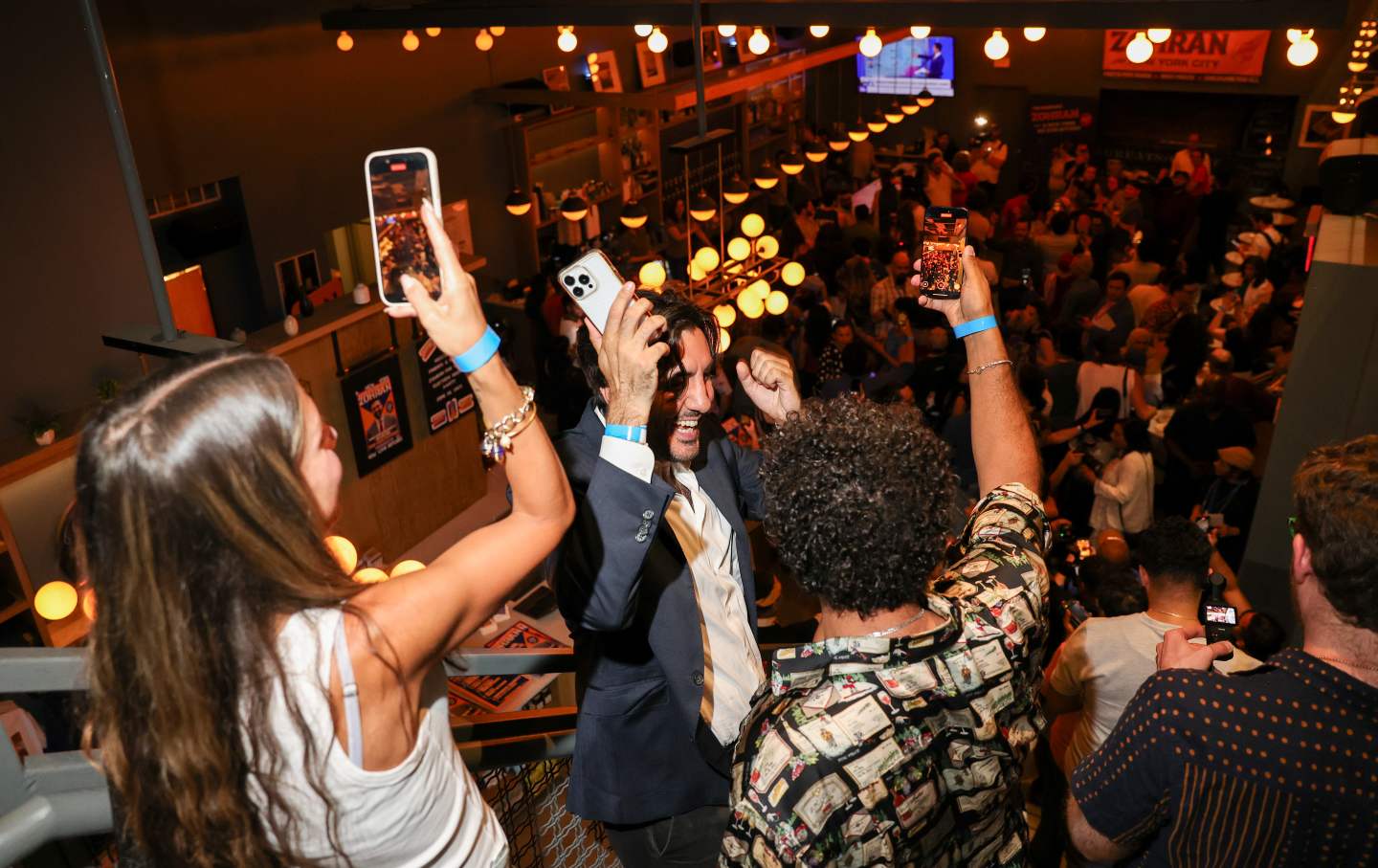
Attendees during an election night event with Zohran Mamdani, New York City mayoral candidate, not pictured, in New York City on Tuesday, June 24, 2025. More than 930,000 New Yorkers cast their ballots in the city’s Democratic primary, with more than half withstanding record temperatures to vote at polling stations on Tuesday.
(Christian Monterrosa / Bloomberg / Getty Images)
You know the adage: Young people don’t vote. But that adage actually has some truth in it. Young voters have been underrepresented in almost every election since 1971, when the 26th Amendment lowered the voting age to 18. While it’s true that young voters have periodically played decisive roles in certain elections, like in 2008, when young voters enthusiastically voted for Barack Obama, or in 2020, when they were a prominent part of Biden’s coalition, there has never been a youth voting bloc in the United States big enough to wield significant electoral power. Expanding the electorate has been the white whale of progressive politics for a long time. Young voters are progressive, the conventional wisdom goes, if only they would go to the polls.
In the past year, two marquee elections have upended that wisdom: the 2024 presidential election, when young voters shifted decisively to the right from previous years, and Zohran Mamdani’s historic mayoral primary win in New York City, where he not only won young voters decisively but convinced enough of them to turn out in higher numbers than any other age group. Mamdani is polling ahead of any other candidate in the general election by double digits, and will likely win in November. A few other mayoral races seem to be following suit. From a bird’s-eye view, the movement seems strong enough to raise the question: Could this be the beginning of a new, ascendant youth bloc? Or at the very least, are there lessons we can learn from the way young people turned out in these elections?
The Trump and Mamdani examples did not come out of nowhere. Over the past two decades, young voters have increased their vote share overall. In 2008, a banner year for turnout and an election typically thought of as being decided by the youth vote, an estimated 51 percent of eligible 18-to-29-year-olds voted, making up 18 percent of all voters that year. In 2020, a similar surge emerged: 50 percent of all eligible 18-to-29-year olds voted, rejecting Trump’s disastrous response to the Covid-19 pandemic at the ballot box and proving decisive in Biden’s win. While 2024 saw a slightly lower youth voter turnout—of only 47 percent—it was still much higher than in 2016. Youth turnout was higher in states with liberal voting laws, such as Minnesota, Maine, and Michigan, and lower in states that have more restrictions on voting, like Oklahoma, Arkansas, and Louisiana.
But what happened with Zohran Mamdani was more singular: The 33-year-old not only won a large percentage of young voters on a strong message of affordability, a massive enthusiastic volunteer operation, and compelling social media content; he also inspired unusually high turnout among young people for an off-year municipal election. His win can be seen as a potential model for youth engagement for the rest of the country for a few reasons. New York City has a progressive reputation, but political allegiances vary wildly between neighborhoods. In cobbling together a coalition to win, Mamdani reached across various demographics that typically do not vote alike; he won Asian and Latino voters handily, outperformed expectations with Black voters, and won young voters of all races. In contrast, Andrew Cuomo’s campaign, primarily defined by the city’s most prominent institutions—most labor unions, real estate, state party leadership, and elected officials, including some who had previously called for Cuomo to step down in 2021 after sexual harassment allegations—proved to have little relevance to the lives of young voters.
Many political scientists have noted that American electoral politics in the 21st century is primarily defined by affective polarization. But new forms of polarization are also beginning to emerge: by gender, education level, and income level. For example, young men ages 18–29 voted for Trump by a 14-point margin of 56 percent to 42 percent, while women ages 18–29 voted for Harris by an even greater margin. But even as young voters become more polarized in response to economic and cultural shifts, postelection polling shows that most young voters don’t approve of Donald Trump now that he’s in office, and both parties in Congress have abysmally low favorables (the Democrats slightly lower). Their policy preferences don’t map onto either of the two parties; according to the Harvard Youth Poll, 51 percent of young people think the government should reduce poverty, while 59 percent believe basic health insurance is a human right. Large percentages do not trust any major institutions—Congress, the president, the Supreme Court—to do the right thing. There is a profound lack of trust among young voters in their elected officials, made worse by how rarely politicians of both parties campaign on issues that are actually relevant to them. (The same poll shows that only 20 percent of young people believe DEI programs reduce fairness, despite their having a prominent place in the election discourse and in pundits’ explanations of why the Democrats lost after the fact.)
While this lack of trust in the future of our institutions doesn’t necessarily mean all Gen Z and young millennial voters are natural progressives, their social interests seem to suggest they are interested in candidates who run on outsider narratives. Trump can hardly be called a political outsider, but in 2024 he was running against the incumbent party with a deeply unpopular president, and Biden’s prolonged reluctance to drop out of the race gave Harris just a few short months to make her case to the American people. During that time, she did not try to differentiate herself from the Biden administration or break from the president’s agenda in any meaningful way, especially regarding the genocide in Gaza. In their desire to turn away from the incumbent party and head in a new direction, young voters were more open to Trump’s candidacy, projecting their own policy preferences onto him even as he campaigned on full-throated support for aid to Israel and mass deportations.
Mamdani’s relentless focus on lowering costs appealed to young voters struggling with the housing crisis and the cost of living, and he won renter-heavy young neighborhoods like Bushwick and Ridgewood in a landslide. In a place like New York, proximity to other young people and the connections built between them may empower young voters to exercise their right to vote. Polling from the Harvard Institute of Politics shows that 40 percent of young people who feel deeply connected to a community are much more likely to be politically active, compared to 14 percent of young people who do not feel connected to a community.
The real test of whether the youth bloc is here to stay will be during next year’s midterms, where dissatisfaction with Trump and the Democrats’ inadequate response to his agenda could empower young people to vote despite traditionally low turnout during off-year elections. But there are two more major mayoral races this year which could provide a glimpse of what is yet to come: Minneapolis and Seattle, which, like in the New York primary, feature charismatic young progressives running on outsider narratives. While these races are officially nonpartisan, both cities have unpopular incumbent Democratic mayors facing strong challenges from candidates to their left. In Minneapolis, DSA candidate Omar Fateh has the official endorsement of the Minnesota Democratic-Farmer-Labor Party. He could still lose the election, but he has the advantage of institutional resources as well as an outsider message laser-focused on the housing crisis and public safety. And in Seattle, Katie Wilson is running neck-and-neck with the tech-backed incumbent mayor who has low approval ratings, and they are both presumed to advance to the general election after next month’s primary.
Turning out to vote in high numbers and making Social Security and Medicare the third rail of American politics, the baby boomer generation reshaped elections in their image for decades. A potential youth bloc could dominate the next several years in the same way in many parts of the country—especially in races where candidates focus on affordability and the economy. Gen Z and young millennial voters, who have grown up in the shadow of 9/11, endless wars in the Middle East, the 2008 recession, and the genocide in Gaza, are entering an increasingly precarious job market amid widespread economic uncertainty. Homeownership rates have plummeted in recent years, and incomes have not risen to meet the cost of living in decades.
Mainstream Democratic leaders have had a lackluster response to these crises. It’s unsurprising, then, that young voters would abandon them. While much noise has been made about how the Democratic Party is a gerontocracy, it’s not just age that’s the problem, and candidates for office who campaign primarily on their youth have largely not found success with young voters. Young voters are showing enthusiasm for candidates who take their economic concerns seriously. Progressives who run on a strong message of affordability and independence from the two parties could find a deep well of support that could change everything.
Become a Sustaining Donor This September
Between the reemergence of right-wing red-baiting and Donald Trump’s use of the chilling National Security Presidential Memorandum–7 to criminalize left political organizing, we’re seeing McCarthyism reborn before our eyes.
This assault on democracy cannot be ignored or wished away. Resisting it requires bravery in the face of threats and repression, a steadfast commitment to the truth, and the unwavering belief that we can—and will—overcome this darkness.
We must have an independent media that sets the record straight, unearths corruption and abuses of power, and advances a politics of justice and dignity for all if we’re to win this fight.
That’s why I’m writing to you today. This September, The Nation needs to add 100 monthly donors to sustain our progressive journalism. Your contribution makes the next investigative report, the next truth-speaking column, and the next pathbreaking essay all possible.
I hope you’ll support our work with a recurring donation today. If you donate $10 or more a month, we’ll send you a brand new “Hands Off the Free Press!” sticker to recognise your commitment to our cause. Please, donate today.
Onward,
Katrina vanden Heuvel
Editor and Publisher, The Nation