
Welcome to the Age of the Robertsmander
The chief justice has let partisan gerrymanders flourish, and created the conditions for near-permanent minority rule.
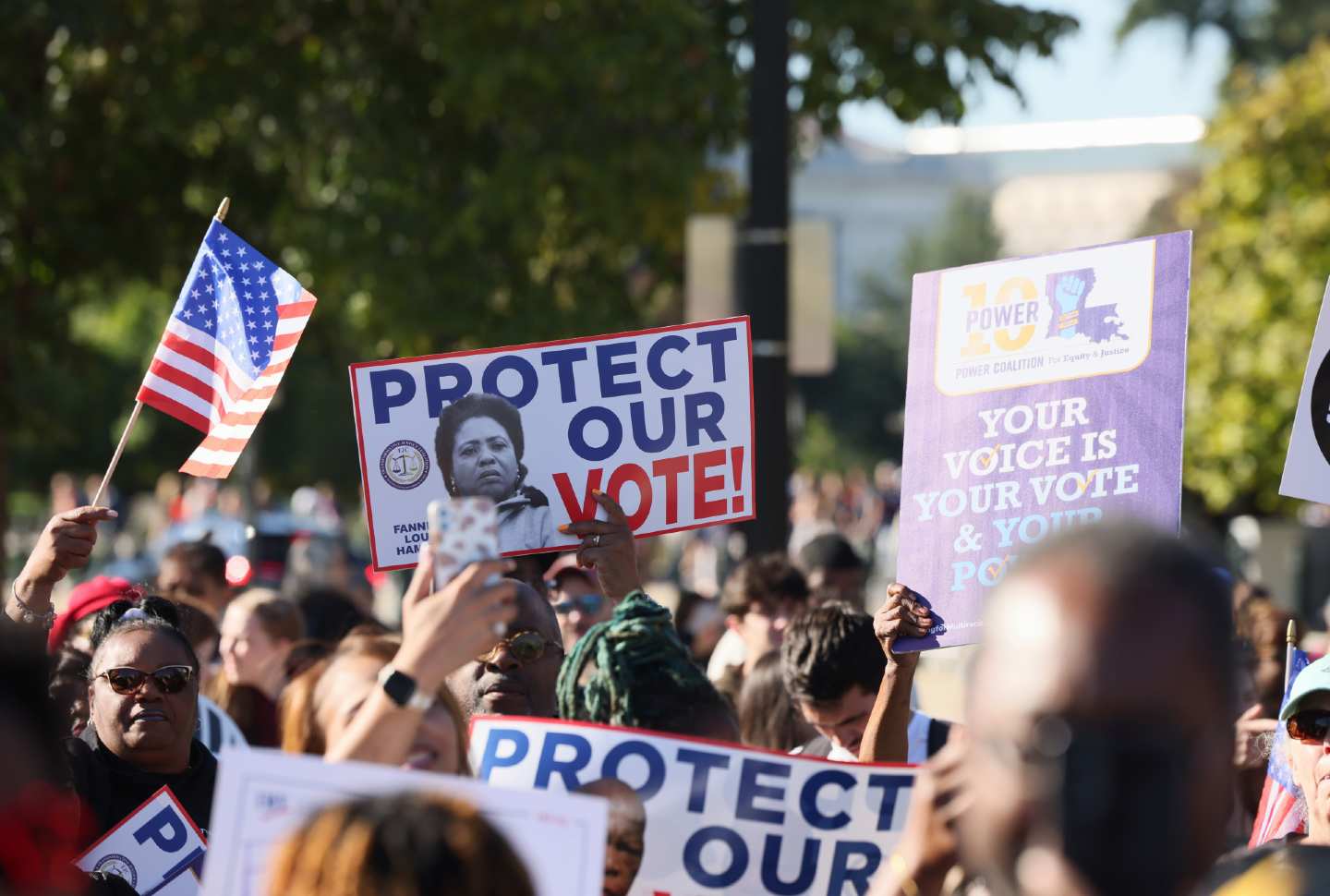
Voting-rights protesters outside the US Supreme Court as the justices heard the reargument of Louisiana v. Callais, which is poised to undo Section 2 of the Voting Rights Act.
(Jemal Countess/Getty Images for Legal Defense Fund)Poor Elbridge Gerry has gotten a bad rap. Gerrymandering is named after the long-ago Massachusetts governor, even though state legislators from his party drew the wildly creative state senate districts around Boston that would keep Federalist candidates out of power and condemn the founding father to infamy.
But today’s gerrymanders aren’t his fault. Perhaps they should bear the name of the man responsible for them. It’s time we call them Robertsmanders, after John Roberts, the chief justice who created this antidemocratic era and has potentially handed his party control of the US House for many years to come.
This year’s Robertsmandering Armageddon has proceeded along two tracks. Unprecedented mid-decade partisan remapping—already enacted in Missouri, imminent in Ohio, North Carolina, and Kansas, forthcoming in Indiana and Florida, and quite possible in New Hampshire, Kentucky, and Nebraska—could push a dozen House seats into the GOP column 13 months before a midterm vote has been cast.
Now there’s an additional threat. If the US Supreme Court declares Voting Rights Act protections for minority representation to be an unconstitutional use of race—as the conservative supermajority appears poised to do after oral arguments this week in Callais v. Louisiana—it could allow GOP states across the South to erase somewhere between 12 and 19 seats currently held by Black Democrats.
John Roberts is the architect of both tracks. That they have created an electoral bonanza for his party is either the happiest of accidents or the entire point.
Much of our partisan gerrymandering nightmare can be laid at Roberts’s 5–4 decision in a 2019 redistricting case from North Carolina, Common Cause v. Rucho. In that decision, Roberts ruled that partisan gerrymandering was a political issue, beyond the reach of the courts. And he shuttered the courts to future claims against partisan gerrymanders, removing any hope that the judiciary would enforce a national solution to a national problem.
When the history of America’s slide into one-party autocracy is written, this decision will echo as one of the most damaging and shameful cases this court has handed down in a century.
Roberts’s decision arrived in what had been a hopeful moment for reformers, who won anti-gerrymandering ballot initiatives in states all shades of red, blue and purple, as well as in the courts. In one case after another before Rucho, federal judges nationwide, appointed by presidents of both parties, struck down maps drawn by Democrats in Maryland and the GOP in Ohio, Michigan, North Carolina, and Wisconsin, insisting that the courts had the tools to handle extreme partisan gerrymanders. They also recognized that the courts needed to step in, because gerrymandering makes it all but impossible to hold lawmakers accountable via elections.
Roberts ended all of that. Rucho told state lawmakers that no one would police them. It liberated them to draw the most extreme maps they could. Sure, state courts in Texas, Florida, and Ohio might theoretically step in—but in those states and others, the GOP had thought ahead and safely packed them with Federalist Society–groomed true believers, so good luck there.
And while Roberts praised state reformers who created commissions in Michigan and elsewhere, offering, he suggested, more proof that the courts need not get involved, he then slit their throats. The US House, after all, is a national chamber created of maps drawn by states. By removing any means of holding the worst actors accountable, Roberts took away the incentive for any state to embrace reform. Partisan lawmakers in places like Colorado would be suckers to disarm and surrender, while Texas and Florida maximized partisan gains.
Yes, in 2021, Democrats jumped in aggressively where they could, after falling asleep on redistricting after the 2010 census. They were left with no choice. The aggressive maps they drew in Illinois, Maryland, Oregon, and New Mexico are Roberts’s creations as well. In the world the chief justice has created, any state that does not draw the most extreme gerrymander possible is simply rewarding the states that do.
This summer and fall, we have seen the Rucho decision pushed to its natural and predictable end: The GOP has gone all in on mid-decade redistricting nearly everywhere that it can. Democrats don’t control enough states to counteract them—in part due to earlier GOP gerrymanders. Roberts has ensured that there are few paths to stop the gerrymanders in federal courts.
And now, thanks in part to Rucho, the Roberts court stands poised to end protections against racial gerrymanders. Rucho has already made it easier for states to get away with racial gerrymanders. Now they can simply pronounce them partisan gerrymanders, and insist that they are trying to lock Democrats out of power—totally permissible!—not Black or Latino voters. We’d never do a racial gerrymander, these lawmakers insist, but the Supreme Court says partisan gerrymandering is just another political issue, so we’ll just call it that!
Yet Section 2 of the Voting Rights Act (VRA) stood in the way in many states, especially across the South. It required states to draw districts that provide racial minorities the opportunity to elect candidates of their choosing when their numbers form a sufficient and compact community, and when states have a history of polarized racial voting. During this week’s oral arguments in Callais vs Louisiana, it was clear that the conservative justices seemed ready, if not eager, to redefine the VRA’s guardrails against racial discrimination as themselves a form of racial discrimination.
The case arrived at the court via the patented Roberts two-step, previously seen in Citizens United and Shelby County. In these test cases for right-wing political control, the court used one smaller case as a vehicle for inviting the larger constitutional question it wanted to decide. The Callais case was teed up by Justice Kavanaugh, who used his concurrence in a 2022 VRA case from Alabama to suggest that he’d be open to a case arguing that these protections needed an end date, but no one in this case had done so. The broad, lecherous wink was not on the page, but Louisiana still picked up what the associate justice was putting down.
If the court takes the districts now being challenged down in some form—and the most likely approach would be to leave Section 2 in place, but create a new test that renders it impossible to enforce—at least a dozen Black-majority districts across the South would be in the immediate crosshairs. Section 2 kept states like Alabama, Tennessee, and Mississippi from jumping into this year’s partisan gerrymandering carnival. Had Republicans moved on those districts, they would have faced an immediate VRA challenge. But if the court decides to wipe those protections away in the Louisiana case, all bets are off. Florida, Texas, and North Carolina might be able to go even further.
Popular
“swipe left below to view more authors”Swipe →We saw a dry run for this basic assault on voting rights 15 years ago, when Roberts used the 2010 Shelby County decision to effectively end preclearance, the VRA’s most effective enforcement mechanism. After the chief justice insisted that things had changed in the South and preclearance was no longer needed, states moved quickly to enact new barriers to the voting booth as soon as they were liberated to do so. Some even had the new suppression measures ready to go the moment that Shelby County dropped. (Roberts, had he been motivated by anything other than partisan concerns, might have seen the early passage of these bills as clear evidence that preclearance was still needed.) Now, with a Callais ruling poised to hollow out the VRA’s second section entirely, Mississippi and Alabama likely have maps ready to go in a state capitol desk drawer. A Callais ruling against Section 2 would create a boom for Republicans that, along with the mid-decade partisan gerrymanders, might not be surmountable for decades.
Democrats entered this summer believing they would need three seats to win the House. Now that number could well be closer to 25. Republicans can thank John Roberts for all of this. The chief justice has failed the nation, but served his party with exceptional aplomb. His service ought to be recognized.
He owns this gerrymandering apocalypse and a looming status quo of one-party minority rule set to last for a political generation. We ought to name it after him.
Become a Sustaining Donor This September
Between the reemergence of right-wing red-baiting and Donald Trump’s use of the chilling National Security Presidential Memorandum–7 to criminalize left political organizing, we’re seeing McCarthyism reborn before our eyes.
This assault on democracy cannot be ignored or wished away. Resisting it requires bravery in the face of threats and repression, a steadfast commitment to the truth, and the unwavering belief that we can—and will—overcome this darkness.
We must have an independent media that sets the record straight, unearths corruption and abuses of power, and advances a politics of justice and dignity for all if we’re to win this fight.
That’s why I’m writing to you today. This September, The Nation needs to add 100 monthly donors to sustain our progressive journalism. Your contribution makes the next investigative report, the next truth-speaking column, and the next pathbreaking essay all possible.
I hope you’ll support our work with a recurring donation today. If you donate $10 or more a month, we’ll send you a brand new “Hands Off the Free Press!” sticker to recognise your commitment to our cause. Please, donate today.
Onward,
Katrina vanden Heuvel
Editor and Publisher, The Nation
More from The Nation

CEOs Are Losing Control of AI CEOs Are Losing Control of AI
With no slowdown from Trump’s administration.
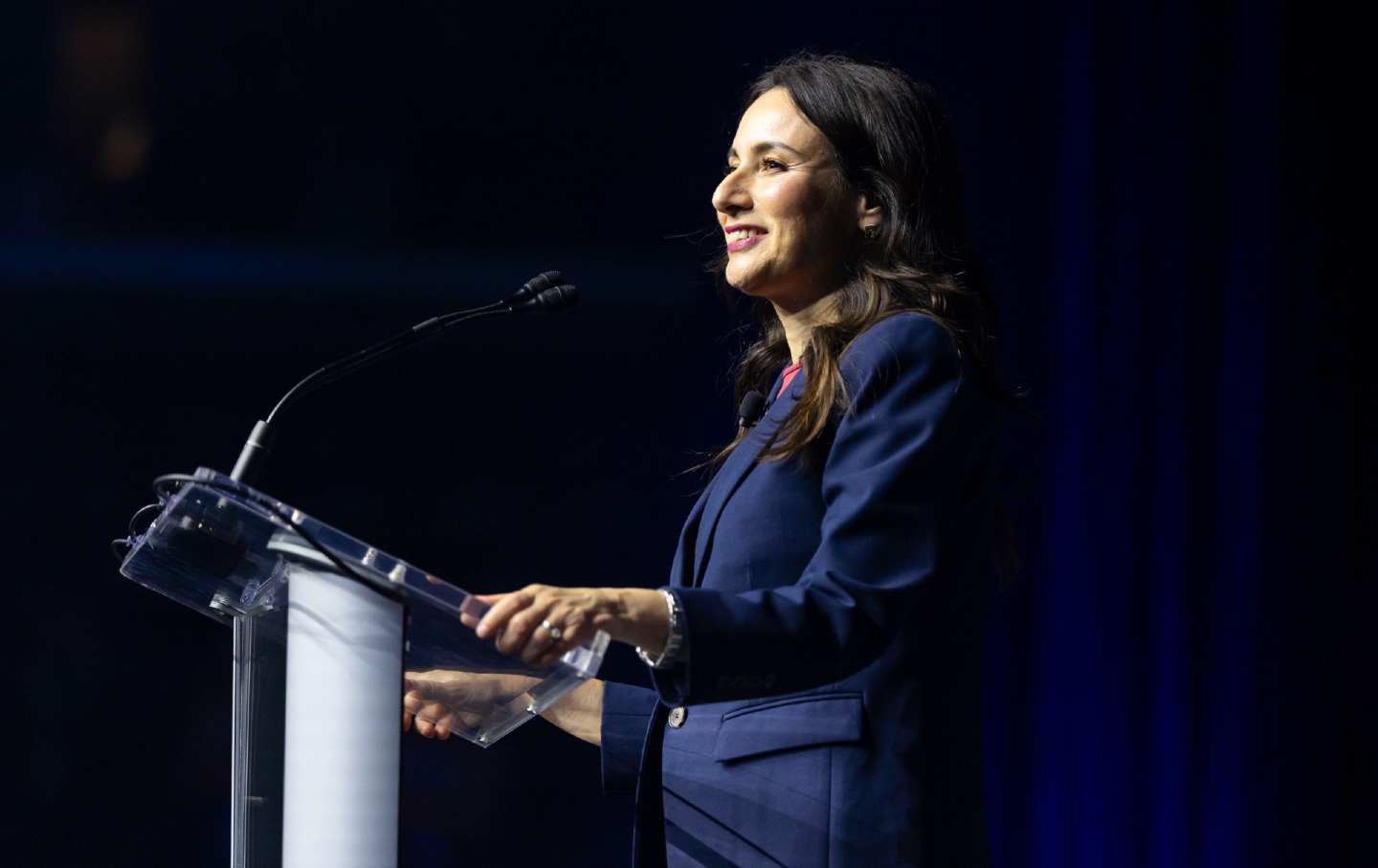
Gina Hinojosa: “We Flip Texas, and It’s Over” Gina Hinojosa: “We Flip Texas, and It’s Over”
Talking to Texas gubernatorial candidate Gina Hinojosa about what redistricting could mean and how a new generation of Democrats is speaking more directly to voters.
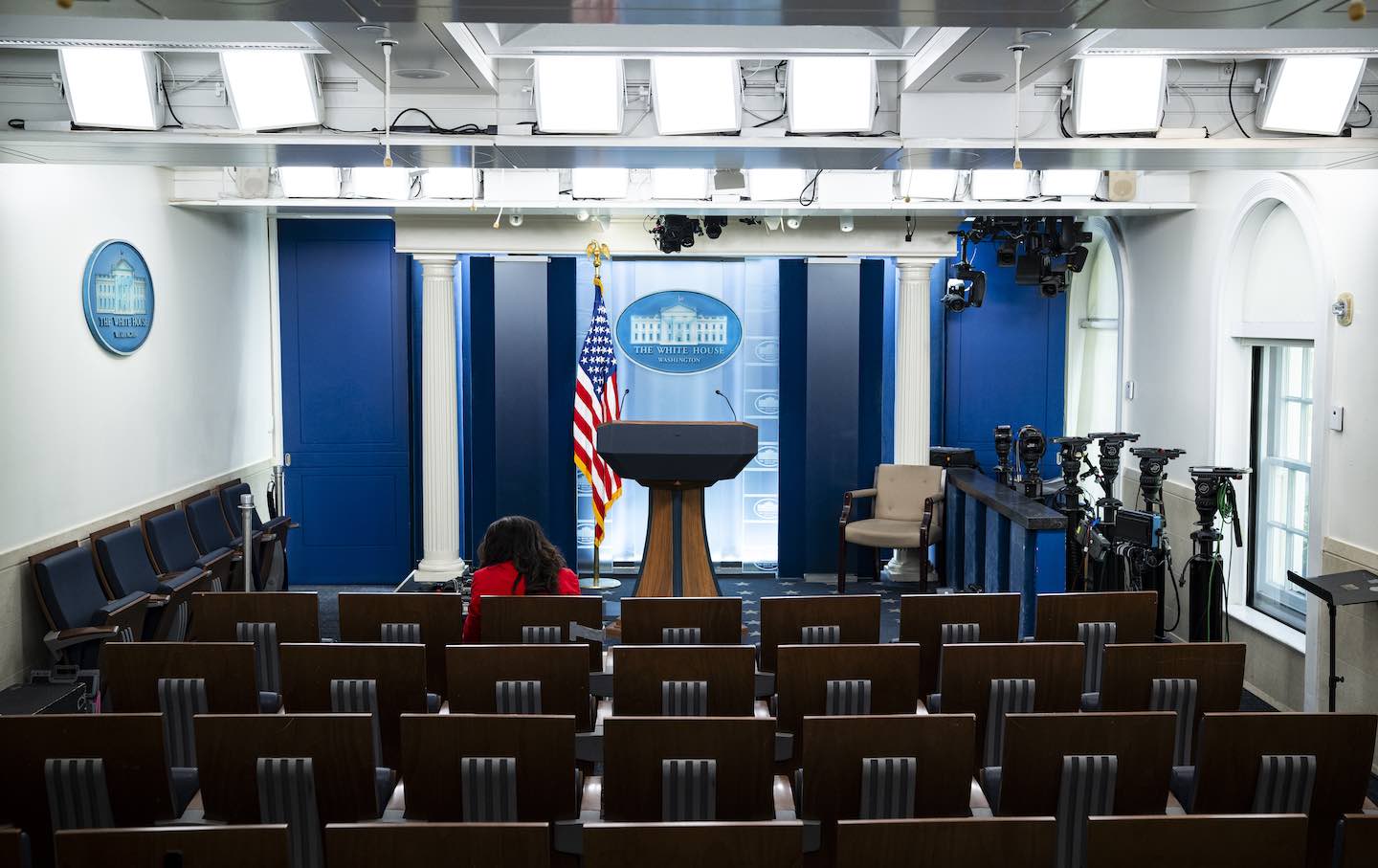
Trump Wants to Keep Journalists Out of the White House. He Should Get His Wish. Trump Wants to Keep Journalists Out of the White House. He Should Get His Wish.
The president has banned MS NOW, CNN, and Politico from attending press briefings. The rest of the media should respond with a boycott.
The GOP’s Incredible Shrinking Senate Map The GOP’s Incredible Shrinking Senate Map
Trump has so badly damaged the Republican Party’s brand that strategists are contemplating bitter fights—and losses—in races they’d been banking on as sure things.
Bernie Sanders: “People Are Sick and Tired of the Status Quo. People Want Change.” Bernie Sanders: “People Are Sick and Tired of the Status Quo. People Want Change.”
Exclusive: Read the text of a major foreign-policy address delivered by the independent senator at Riverside Church.

Even Republicans Are Figuring Out That Pete Hegseth Is a Disaster Even Republicans Are Figuring Out That Pete Hegseth Is a Disaster
Hegseth was always a horrible choice for defense secretary. At long last, some in the GOP are admitting it.

