
What Analyses of the 2024 Election Are Getting Wrong
Postelection autopsies are missing the forest for the trees.
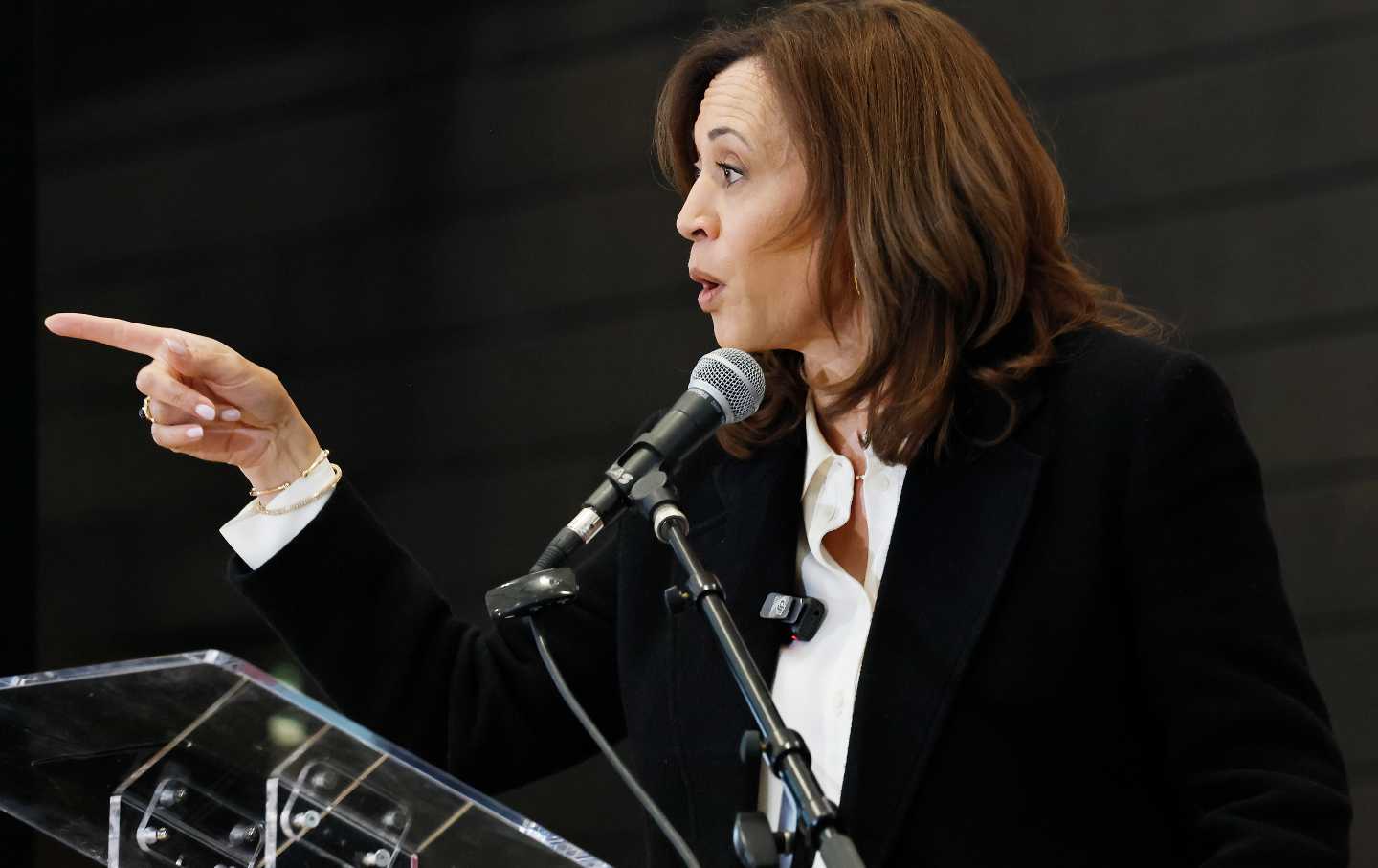
Former Vice President Kamala Harris.
(Mario Tama / Getty)As Democrats sift through the wreckage of 2024, they’re starting to conduct a familiar procedure: the post-election autopsy. Armed with exit polls, turnout data, and demographic breakdowns, analysts are dissecting Kamala Harris’s defeat with surgical precision. But like many autopsies, this one risks missing the cause of death by focusing too narrowly on symptoms. All of these postelection reports are missing the forest of the tribal reality of American politics for the trees of disconnected data points.
The latest analysis from Democratic data firm Catalist offers valuable insights about voter dropoff and demographic shifts. Yet it also perpetuates some of the most problematic tendencies in Democratic political analysis—tendencies that helped create the conditions for defeat in the first place.
The greatest weakness in the Catalist report—and in much other analysis from media and commentators and political operatives—is the reluctance to grapple seriously with the centrality of racial and gender animus and resentment as central organizing forces in American politics. On the one hand, the Catalist report does say that “men moved towards Trump in 2024…. These changes were seen across racial and other demographic groups,” helping to explain his modest improvements among Latinos and African Americans. On the other hand, however, that finding is listed seventh in their 11 “key findings,” making it just one tree in a forest of misogyny.
Similarly with race. In their sixth finding they mention almost in passing that “Harris also saw support drops among white men with a college degree.” In an election where the conventional wisdom is that inflation and the price of eggs defeated the Democrats, what’s the explanation for college-educated white men moving to Trump?
The 14th-century philosopher William Ockham popularized a framework now known as Occam’s Razor that holds that the simplest explanation is usually the best. In a country that has never elected a woman president and engaged in a violent and bloody Civil War explicitly animated by racial politics, the explanation of race and gender having swung the 2024 election is the simplest. Another way Catalist could have framed their findings would have been to say that Kamala Harris won among every single racial group—except white people.
The reality is that Harris lost not because she was too progressive on cultural issues but because Democrats continue to shy away from the battle over the existential questions of whether America should be a white nation or a multiracial democracy and of whether a woman could or should be president. Trump’s appeal has always been explicitly racial—from “Mexicans are rapists” to “they’re eating the dogs”—yet Democrats remain terrified of calling this what it is and mounting a forceful counternarrative. And they remain perplexed about how to run against a man who has been caught on tape proudly bragging about sexually assaulting women.
While it’s true that turnout declined among key Democratic constituencies, the story is more nuanced than a simple narrative of across-the-board Democratic failure. Harris actually increased Democratic vote totals over 2020 in Georgia, Nevada, North Carolina, and Wisconsin. In California, Democratic turnout dropped nearly 20 percent, but this likely reflected the reality that the state wasn’t competitive, so campaigns overlooked it and spent their voter mobilization funds elsewhere. The drop-off wasn’t some fundamental rejection of the Democratic message.
More importantly, Trump’s success came largely from his ability to turn out previously nonvoting conservative supporters—a phenomenon that has been building for years but gets insufficient attention. As I wrote in November, the main thrust of the story behind the many counties that ostensibly “flipped” from blue to red is that the Democratic vote dropped dramatically. And that followed the prior pattern of Trump’s previously nonvoting MAGA voters. In 2020, for example, Trump galvanized 75,000 previously nonvoting Republicans in Hidalgo County, Texas, while Biden attracted 22,000 more Democratic voters than Obama had. The story wasn’t Latino voters abandoning Democrats; it was Republicans finally mobilizing their dormant supporters.
Perhaps the most under-analyzed aspect of 2024 is the role of sexism and misogyny. The United States has never elected a female president. Ever. This isn’t an accident or a statistical quirk—it reflects deep-seated attitudes about leadership and power that don’t disappear just because we’re uncomfortable discussing them.
The emergence of the “manosphere” and its influence on young men across racial lines is real, but it’s building on centuries-old foundations. In a country where women couldn’t vote until the 1920s and couldn’t open bank accounts on their own until the 1970s, the idea that gender played no role in Harris’s defeat is naïve at best.
What’s the difference between Stacey Abrams’s and Raphael Warnock’s performance in Georgia in 2022 and Harris’s and Ruben Gallego’s in 2024? Gender. The Catalist report is on point in its conclusion that “support drops [for Harris] were concentrated among the younger cohorts of voters, particularly young men.” Does this discrepancy reflect a failure of Democratic Party messaging, or is it an unsurprising outcome in a country where women are the majority of people and yet make up just 8.2 percent of the CEOs of S&P 500 companies? To many people, the cultural conception of the picture of leadership does not look like a woman of color, and failure to confront that reality is naïve and foolhardy.
The Democratic Party faces real challenges, but they’re not the ones most analysts are identifying. The party doesn’t need to moderate its positions or chase after Trump voters. It needs to build the infrastructure and craft the message to mobilize its natural coalition—the multiracial new American majority that elected Obama and Biden, and that then stayed home in 2024.
Popular
“swipe left below to view more authors”Swipe →To win going forward will require massive investments in voter registration and turnout operations in communities of color. It will require bold messaging that doesn’t apologize for standing against racism and for equality. And it will need to understand that in a rapidly diversifying country, the path to victory runs through empowering and inspiring the coalition of transformation, not chasing the coalition of restoration, as Ron Brownstein dubbed the Obama and then Trump coalitions.
Democrats didn’t lose the 2024 election because they were too progressive. They lost because they weren’t progressive enough—at least not in ways that inspired their base to turn out in overwhelming numbers. Until we’re willing to face that reality, we’ll keep conducting autopsies on preventable deaths.
Become a Sustaining Donor This September
Between the reemergence of right-wing red-baiting and Donald Trump’s use of the chilling National Security Presidential Memorandum–7 to criminalize left political organizing, we’re seeing McCarthyism reborn before our eyes.
This assault on democracy cannot be ignored or wished away. Resisting it requires bravery in the face of threats and repression, a steadfast commitment to the truth, and the unwavering belief that we can—and will—overcome this darkness.
We must have an independent media that sets the record straight, unearths corruption and abuses of power, and advances a politics of justice and dignity for all if we’re to win this fight.
That’s why I’m writing to you today. This September, The Nation needs to add 100 monthly donors to sustain our progressive journalism. Your contribution makes the next investigative report, the next truth-speaking column, and the next pathbreaking essay all possible.
I hope you’ll support our work with a recurring donation today. If you donate $10 or more a month, we’ll send you a brand new “Hands Off the Free Press!” sticker to recognise your commitment to our cause. Please, donate today.
Onward,
Katrina vanden Heuvel
Editor and Publisher, The Nation
More from The Nation

A Premature Farewell to the Ignominious Speaker Mike Johnson A Premature Farewell to the Ignominious Speaker Mike Johnson
If Democrats win the House in the midterms, as expected, Mike Johnson won’t hold the gavel in any meaningful way again.

Transphobia Isn’t Winning Votes. But It Is Making Our Lives Much Worse. Transphobia Isn’t Winning Votes. But It Is Making Our Lives Much Worse.
Trans people must now live out another election cycle knowing our friends, family, coworkers, and neighbors are being flooded with agitprop designed to dehumanize us.
Zohran Mamdani Hosts the World Zohran Mamdani Hosts the World
In a meeting with mayors from around the globe, Mamdani argued that the left must fix everyday problems—or the right will find someone to scapegoat for them.


Is There Any Good News Left? Is There Any Good News Left?
Despite what our algorithms suggest, there’s still news worth celebrating.

CEOs Are Losing Control of AI CEOs Are Losing Control of AI
With no slowdown from Trump’s administration.

