Biden’s Desperate Bid to Reclaim the Youth Vote Is Missing the Point
Recent policies regarding student debt and cannabis seem like naked appeals to a crucial demographic that cares most about US involvement in Israel’s war on Gaza.
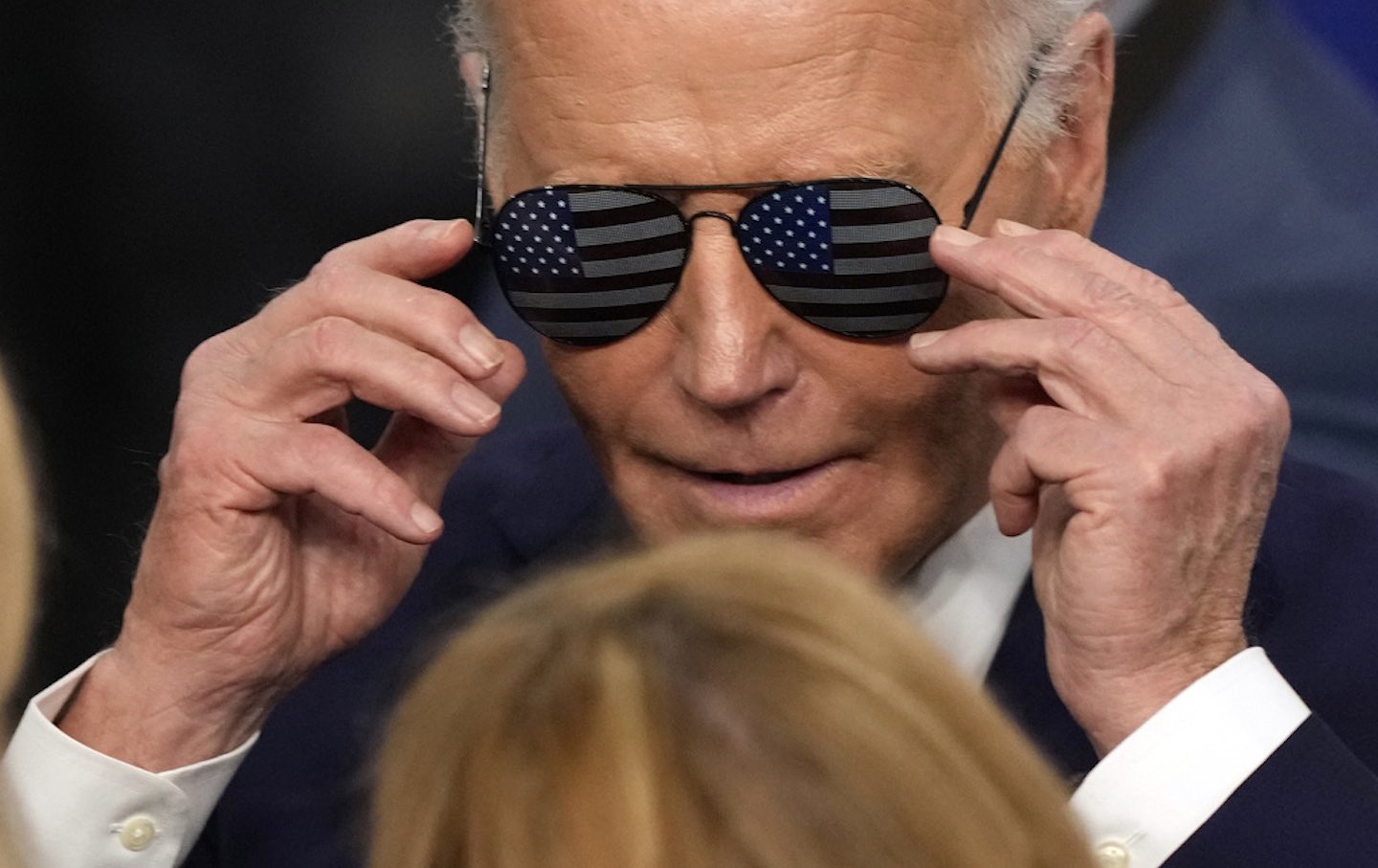
President Joe Biden tries on a pair of sunglasses on May 21, 2024, in Nashua, New Hampshire.
(Robert F. Bukaty / AP Photo)President Joe Biden has stepped up efforts to reverse his disastrous loss of support among young voters, announcing a new round of cancellations for federal student loans. The initiative, covering $77 billion in debts, will forgive loans for some 160,000 borrowers via existing programs—a total that brings the overall ratio of canceled loans to one in 10, or 5 million borrowers, according to administration officials.
The new program comes on the heels of the White House’s decision to reclassify cannabis as a Schedule 3 drug, in order to reduce criminal penalties for its use—and just ahead of the Justice Department’s antitrust suit against the parent company of Ticketmaster, whose price gouging is the bane of music fans. It’s hard to avoid the sense that this grab bag of policy incentives is a desperate bid by Biden reelection strategists to divert attention from the main issue throttling his support among voters in the 18-to-34 demographic: his bear-hug support for Israel’s brutal and inhumane war in Gaza, whose grip has only recently begun to loosen with his threats to withhold US military aid in the event of an Israeli offensive in Rafah. If only we can hunt up enough spare income for kids to get high with at concerts, Biden campaign officials seem to reckon, then they’ll forget about this damn war and the cowardly nationwide crackdown on campus protests against it.
There’s a deeper irony embedded in these don’t-look-at-Gaza pitches to young voters. In reprising the Biden White House’s earlier overtures toward policies aimed at ameliorating inequality for younger Americans, Biden’s campaign is treating them the same way that presidential candidates have historically sidled up to older voters—giving them one-off, interest-group emollients to nail down their allegiance. That was how, for example, George W. Bush wound up pushing through an ambitious if ill-conceived bill to expand Medicare coverage ahead of his 2004 reelection bid; it was also how Barack Obama relinquished the already doomed “grand bargain” with the Republican Congress on entitlement spending, and stressed the granny-starving policy preferences of Mitt Romney and Paul Ryan in his 2012 reelection campaign.
The crafting of election-year sops to key demographics is of course a storied tradition for incumbent presidents seeking reelection, but the fistful of youth-themed Biden policies is striking in overlooking the basis of his formidable advantage over Trump among young voters in 2020. Back then, young voters were drawn to Biden in disproportionate numbers because Biden was able to align his message about Trump’s unstable and authoritarian track record with the surge of activist protest surrounding the police murder of George Floyd. While Biden, the cosponsor of the carceral-state-boondoggle known as the 1994 crime bill, was of course no supporter of defunding the police, he did trumpet his close rapport with Black political leaders, as well as his credentials as Obama’s vice president, to position himself broadly as a change candidate. As a result, Biden ran away with the youth vote in 2020, besting Trump by 24 points; polling now shows that advantage shrinking to just six points.
Of course, it’s still fairly early in the general election jockeying, and wild-card developments can still scramble the campaign dynamics—starting with the non-zero prospect of Trump’s conviction in his pending New York trial. But it’s not exactly robust campaign strategizing to count on deliverance from external sources, and Biden’s messaging remains stubbornly inert in the face of mounting alarms from swing-state polling in particular. Amid rock-bottom approval ratings and waning voter enthusiasm, there’s precious little internal drive to alter the fundamental approach of a Biden reelection campaign organized around a fundamental stay-the-course message. “This is just who Joe Biden is,” an unnamed senior Democratic campaign aide told Time magazine. “This is how he’s always run his campaigns. He and his insider know better. Last time, it worked, so he didn’t learn any of the lessons, and thinks he can run 2020 again.” The policy overtures the campaign is now putting before youth voters falls under this brief: You can trust me with the power to gradually improve your quality of life—just as you did in 2020.
But the dramatic defection of young voters from Team Biden tells a different story. Younger male voters in particular are breaking for Trump early, on the basis of the presumptive GOP nominee’s vows to shake up economic policy and dramatically crack down on immigration. The hemorrhaging is less pronounced on the other side of the gender divide, since younger women voters remain aligned against the GOP’s draconian opposition to abortion and reproductive rights—an advantage Biden and the Democrats will certainly exploit as the election draws closer.
This fragmenting picture strongly indicates that the Biden campaign’s incrementalist course won’t yield reliable large-scale returns. For that to happen, Biden would have to stretch far beyond his comfort zone and address the elephant in the room, firmly repudiating Netanyahu’s war in Gaza. As political scientist David Faris, a longtime observer of youth politics, writes in Slate, the practical scale of such a reversal need not even be all that sweeping:
There’s…no reason that Biden can’t shore up the youth vote while also appealing to older folks. Strong-arming Israeli Prime Minister Benjamin Netanyahu into a cease-fire in Gaza wouldn’t just be the right thing to do; it could be the first step in reversing Biden’s declines among young voters—and not just the ones getting their skulls cracked by cops on university lawns.
The most recent Harvard Youth Poll, the gold-standard survey of America’s young people, showed that even respondents who aren’t in college favor a cease-fire by 30 points. And while polls show that young people don’t rank Gaza particularly high as an issue that will influence their vote, those who do may be disproportionately likely to sit out the election or switch their vote from 2020 as a consequence. Think about it this way: Biden cannot wave a magic wand and make inflation (consistently voters’ top problem across all generations) go away, but he has substantial leverage over the course of the Gaza war that he seemed reluctant to use until his administration paused some arms shipments two weeks ago.
What’s dismaying is just how unlikely this clearly beneficial, and morally urgent, policy pivot would be for Biden to carry out. Michael Kinsley famously described Al Gore as “an old person’s idea of a young person”; Joe Biden is proving to be very much a young person’s idea of an old person—and at pretty much the worst possible moment.