What Biden’s Holocaust Speech Ignored
The president’s ahistorical account of Gaza failed to acknowledge the discomfiting truth that brutalized communities can visit the same traumas on others.
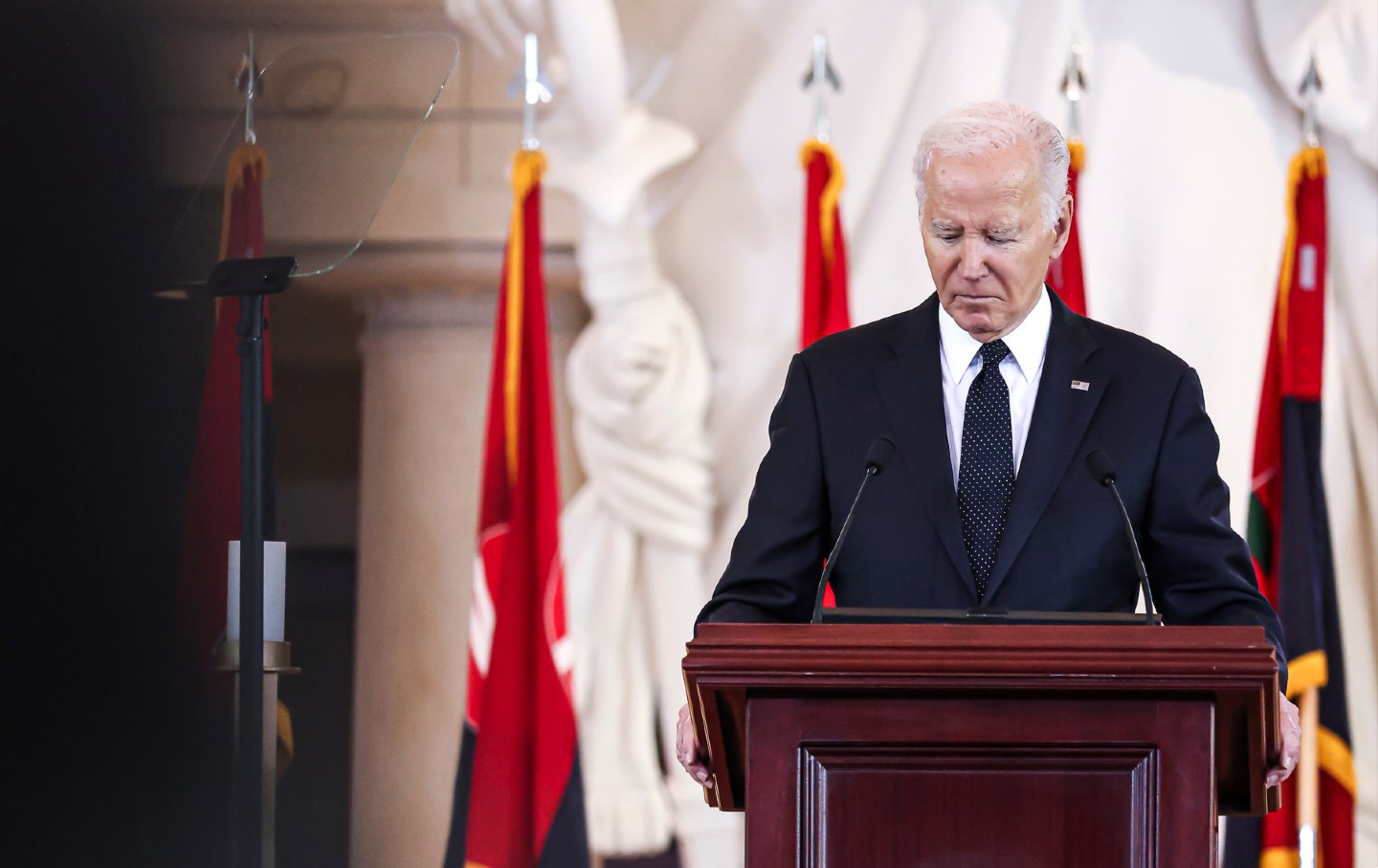
President Joe Biden in Emancipation Hall at the US Capitol in Washington, D.C., on May 7, 2024. Biden denounced antisemitism at college campus protests against Israel during an annual Holocaust commemoration.
(Valerie Plesch / Bloomberg via Getty Images)
The annual commemoration for the US Holocaust Museum’s Days of Remembrance was bound to be awkward this year. The ceremony, a yearly event since the Holocaust Museum’s founding in 1980, honors the liberation of Nazi concentration camps by US troops and their allies. Convened at the US Capitol Visitor Center, it highlights the work the museum does in heightening awareness of the horrors of the Shoah and the ugly and vicious forms of discrimination and political rhetoric that lead up to it. As the roster of speakers at this year’s commemoration all noted, this year’s gathering occurs amid a nationwide wave of student protests against Israel’s war in Gaza that, in their view, has again made antisemitism a looming threat to Jewish identity and well-being.
This was certainly the central theme of the event’s headline oration—President Joe Biden’s discussion of contemporary antisemitism and measures to combat it. Over the past week, the White House had been promoting Biden’s speech as a means of tempering the fraught climate of debate surrounding the war—but like the other speakers at the rostrum, Biden was trapped in a paradox: Even as he was invoking the lessons of capital-h History, and its injunction never again to permit a horrific event like the Holocaust to happen, he could only offer up a foreshortened, decontextualized, and ultimately ahistorical account of the political situation in Gaza, the Middle East, and the United States. Thus, for instance, Hamas’s horrific attacks of October 7, steeped in a political movement dedicated to Israel’s extinction, amount to a reprise of Nazism, while critics protesting Israel’s inhumane conduct of its war, are by definition collaborators at best and overt antisemites at worst. “Not 75 years, but just seven and half months later, people are already forgetting that Hamas unleashed this terror,” Biden said. “I have not forgotten, nor have you—and we will not forget.”
Yet like the other speakers denouncing a purported surge of antisemitism across American campuses, Biden did not mention the reason the protests have taken off: Israel’s brutal war wreaking collective punishment for the October 7 attacks, destroying critical infrastructure, and now manufacturing widespread famine. Instead, the demonstrations were, Biden suggested, the return of a primordial “hatred that continues to lie in the hearts of too many in the world.” As a result, “on college campuses, Jewish students are blocked, harassed, and attacked on the way to class,” while protesters brandish slogans that “call for the elimination of Israel, the world’s only Jewish state.” This is, he continued, the reflection of an “injustice…so heinous and grievous that it cannot be buried.” The only way to fend it off is “to remember our history so we don’t surrender our future to the horrors of the past.”
In spelling out the practical application of this dictum, Biden mostly revisited his earlier remarks on the campus protests. America is still bound to “respect the right to free speech,” Biden conceded, but cautioned that “there is no place on our campuses for antisemitism, hate speech, or violence.” (For an invaluable survey of the actual character of campus anti-war protests, and just how little these three scourges figure into them, see Rick Perlstein’s excellent column on the new anti-antisemitism, in The American Prospect.)
In addition, Biden lectured, “the destruction of property is not peaceful protest—it’s against the law,” Biden announced, overlooking that many civil rights protests in the Jim Crow South were deemed destructive of property—as were, for that matter, Revolutionary-era actions such as the Boston Tea Party. “No one should have to hide or to be afraid to just be themselves,” Biden said—even though this is an accurate description of the Palestinian experience under Israeli occupation, particularly after the Netanyahu government scotched the most recent version of a US-brokered cease-fire and commenced bombing and tank incursions in Rafah on Monday, choking off the principal avenue of aid to Gazans. For all the efforts to conjure the specter of a menacingly intolerant siege of America’s institutions of higher education at the hands of antisemitic ideologues, Biden and the other speakers sidestepped the inconvenient truth that Israeli forces have leveled all 12 of Gaza’s universities and more than 200 schools altogether.
It’s a heartbreaking irony that the country responsible for these inhumane assaults was founded in the wake of the Shoah, as a means of permanently securing Jewish survival. But the current catastrophe in Gaza is also an injunction to heed those lessons of history—including the discomfiting truth that communities brutalized by unimaginable suffering aren’t immunized from visiting the same traumas on other populations. Republican House Speaker Mike Johnson, in keeping with his leadership post in a party exploiting ethnic and racial resentments and his own Christian nationalist worldview, delivered a disgraceful speech equating campus protests against the Gaza war with Holocaust-era hate crimes, both maligning anti-war dissent and trivializing Nazi genocide. “The very campuses that were once the envy of the international economy have succumbed to an antisemitic virus,” Johnson said. “Students who were known for producing papers are now known for stabbing their Jewish peers in the eyes with Palestinian flags”—dramatically escalating a single right-wing Twitterfied talking point based on the willful distortion of an inadvertent scrape at a Yale protest.
He then invoked the horrors of the Holocaust to suggest they’ve directly interpenetrated the present: “If you close your eyes in the quiet of your own heart, you can hear the glass of Jewish storefronts shattered by stormtroopers.… You can hear screams coming from the gas chambers.” He then switched over to the October 7 Hamas attacks and landed on this tidy moral: “Just as in the 1940s, this violence is perpetrated by those who hate the Star of David.… Some are even blaming Israel” for the October 7 attacks, Johnson said: “They’d rather do that than punish the terrorists.”
When Johnson isn’t pledging fulsome support for Israel before Jewish crowds, he’s peddling the vile slander that George Soros—long the villain of first resort for right-wing antisemites in the vanguard of Trumpian bigotry—is funding the anti-Israel protests on campus. Nor was any mention made of Johnson’s equally full-throated support for Donald Trump, who extolled the good character of Nazi protesters chanting “Jews will not replace you” in Charlottesville and hosted Gen Z Nazi propagandist Nick Fuentes at his Mar-a-Lago hate compound. Meanwhile, Johnson’s Christian-nationalist movement harbors an opportunistic enthusiasm for Israel that’s rooted in readings of end-time prophecy that are themselves more than adjacent to bald antisemitism—but these, too, are historical complexities that can’t be neatly contained in the wan injunction to remember a benighted past to reclaim a brighter future.
Indeed, Trump’s repellant gloss on Charlottesville wound up having a grim salience after the proceedings at the Visitor Center wound down. It turned out that, as the assembled speakers were playing up the threat of antisemitic violence on US campuses, a hard-line Zionist protester at Columbia drove his car into a group of anti-war protesters. It further turned out that the accused attacker was Reuven Kahane—a grandcousin of Meir Kahane, the militant, racist founder of the Jewish Defense League and the Israeli Kach Party who now is a spiritual mascot of Israel’s extreme religious right. It’s difficult to conjure a more instructive instance of what Jewish philosopher Walter Benjamin—who’d committed suicide while on the run from the Nazis—used to call the cunning of history: the notion that the solemn course of events often switches abruptly back against our efforts to ascribe our own higher intentions to it. It’s a historical lesson that we all need to learn—and no one more so than the assembled political leaders holding forth on intolerance and violence at the Capitol Visitor Center.