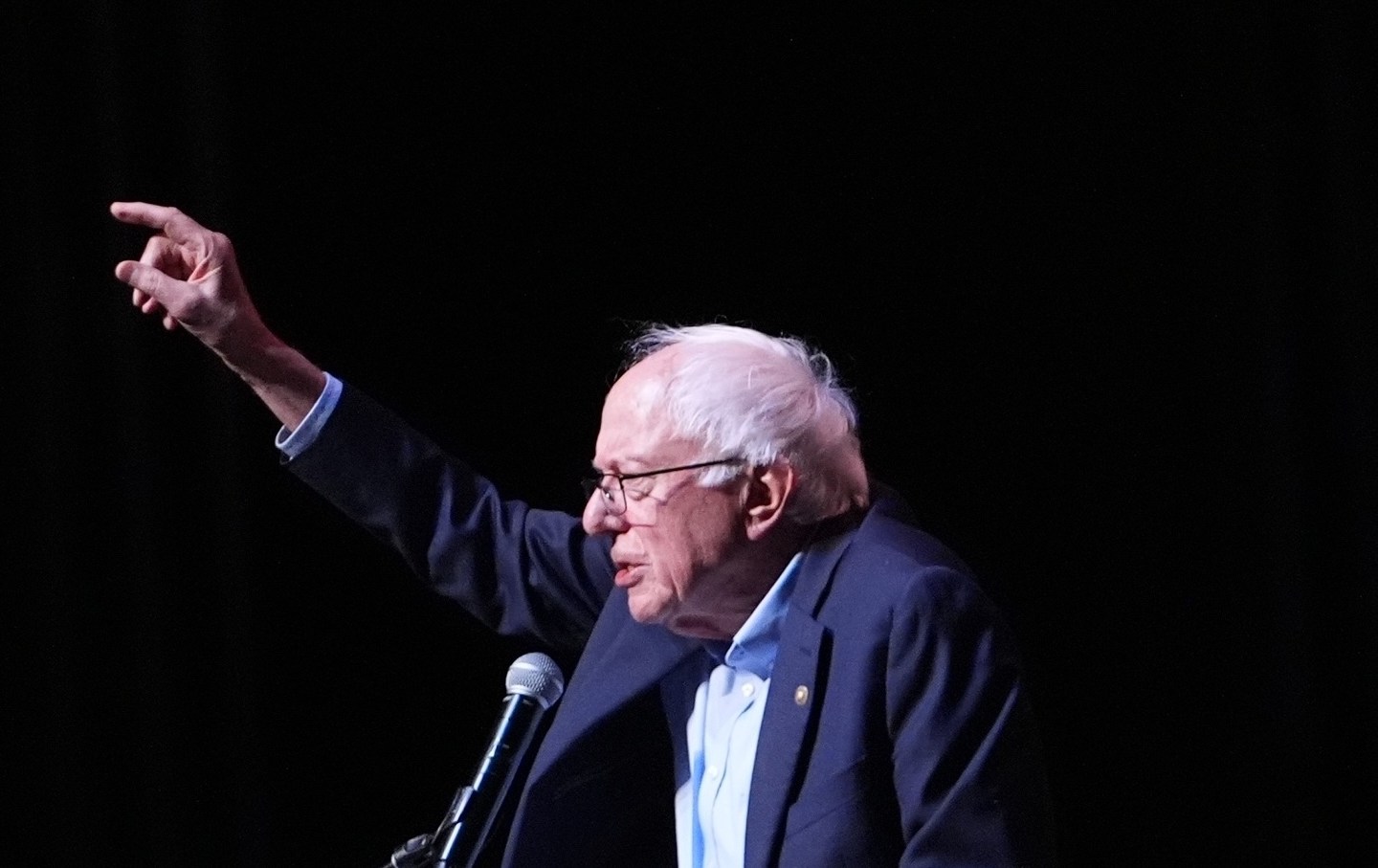
US Senator Bernie Sanders started his career in electoral office in 1981, as the democratic socialist mayor of Burlington, Vermont. His surprise election victory attracted national attention and considerable skepticism among political insiders during what was the first year of Republican Ronald Reagan’s presidency. But Sanders proved to be a highly successful municipal leader, winning three reelection bids before his eventual election to the US House.
Now, 44 years after Sanders won his first mayoral term, Zohran Mamdani seeks to become the democratic socialist mayor of New York City. As the Democratic nominee in an overwhelmingly Democratic town, Mamdani leads in the polls and was just endorsed by New York Governor Kathy Hochul.
Sanders endorsed Mamdani before New York City’s June Democratic primary and has been an enthusiastic supporter ever since. When the senator from Vermont came to New York in early September to campaign with Mamdani, they had a few spare minutes to talk. A conversation about municipal politics and governance ensued, as the 33-year-old mayoral candidate quizzed the 84-year-old former mayor about campaigning in very different cities in very different times—and about the challenges, and the possibilities, that go with leading an American city in an era when the White House is anything but friendly. Mamdani and Sanders shared their conversation with The Nation, and we present it here.
— John Nichols
Zohran Mamdani: Bernie.
Bernie Sanders: Zohran. How are you?
ZM: So many people know you as a senator, as a presidential candidate, but you were also a mayor. For eight years. For eight years, four terms. And the time when you decided to run, Ronald Reagan had just won the presidency. He had even won Vermont. And yet there you were as a democratic socialist deciding to run for mayor. What made you make that decision?
BS: I think Reagan was part of it. During that period, this is ancient history, you know, we were dealing with serious economic problems. We had come off of the war in Vietnam some years before, and basically, it was an attempt to involve people in the political process to revitalize American democracy. And one of the accomplishments that I am most proud of in my life is between my first and second terms. We came close to doubling voter turnout.
ZM: Wow.
BS: How’s that?
ZM: That’s pretty incredible.
BS: So people had given up on the political process. Mostly lower-income working-class people started to get involved.
ZM: How did you do that?
BS: Here’s a radical idea. All right? I don’t want anyone to… We paid attention to the needs of the people. I know. All right. Oh, God. Radical idea. Like many cities, the needs of working-class and low-income communities had been ignored.
So in Vermont, we get a lot of snow. So we made sure that snow removal took place in low-income working-class neighborhoods. We developed programs for the children of those areas. We started an after-school program for the first time. We started a childcare program. We started a teen center. We started a kid’s newspaper, a kid’s cable TV show. We started paying attention to the senior citizens living in low-income and working-class neighborhoods. Made sure that street repaving paid attention to those often-neglected communities.
Today it’s even worse than it was back then. People really feel government has ignored them. And we’ve got to start paying attention to the needs of ordinary people.
ZM: When we started our campaign, we were reading about your path when you ran for mayor. You were in your 30s. You were running against someone who had been in power for quite some time.
BS: Five terms.
ZM: Five terms. And he struggled to pronounce your last name? He called you…
BS: Saunders.
ZM: What took you to the point where you were able to—
BS: If I must say so—you know, what we did back then is exactly what I’m trying to do politically today. You had a city at that time that was dominated by a conservative Democratic establishment. And so many people were left out of the political process. So what did we do? We went to the low-income public housing. We talked to people: What are your needs here? We talked to women’s groups—this is way back when—who did not really have an opportunity. Talked to people in the arts community saying, what can we do more? We had meetings with hundreds of parents to talk about what we can do to improve life for the kids. And then a week before the election, we talked to the Burlington Patrolmen’s Association. The police union. And we said, “Look, you guys are workers, it’s a difficult job being a cop. How can the city play a better role?” And we talked about it.
ZM: You were sharing earlier that that when you won the race, you then came into a city council—
BS: I still shudder. We had 13 people on the Board of Aldermen. And their strategy was very simple. They said it was a “fluke.” That was the word that they used. “He somehow got it in. We’re going to make sure he doesn’t accomplish anything. Two years from now, people are going to come to their senses and reelect all of us, right?” They made life miserable. They denied all of my appointments. So I had to work with people who had spent their whole life trying to defeat me.
One year later, I work so hard knocking on doors. We ran a slate of candidates. On election day, we won three seats. Plus two gave me veto power. Changed the whole direction. And I think even our opponents said, “Oops, we better back off. What Bernie is doing is what people want him to do.”
We did so many things, which brought people together, to help develop a sense of community. I’ll give you an example. It’s a beautiful city. And I said, “Look, I want to plant trees all over the city.”
“Oh it can’t be done.”
Well, we ended up getting money. And you know who planted hundreds of trees in the city of Burlington? The people.
On a given Saturday, all over the city of Burlington, people were out there planting their own trees. We started a jazz festival, which shut down the entire city, for free jazz all over the city. Still going today. Circuses. We just did a whole lot of things to bring people together culturally.
ZM: And where would you find the funding for this?
BS: It was not a lot of money, to tell you the truth. You’d be surprised that small amounts of money can really go a long way—especially in a small city. One of the things in the arts community, and I found that when I ran for president, there’s so many great musicians and artists out there. They want, you give you an opportunity to perform, to be supportive of a working-class ideology. They are there with you. They’re an untapped resource.
ZM: So you established a youth office?
BS: Yup, which was headed up by a young woman named Jane O’Meara Driscoll—who, 40 years later, is still my wife. We got married in the process. So we not only got a youth office, I got a wife.
In the low-income areas, there wasn’t even a Little League. So we started a Little League. And I was one of the coaches.
ZM: I think especially with the youth office, what comes to mind is that in New York City, we often tell kids, especially teenagers, what they shouldn’t do. We spend very little time telling them what they should do.
BS: We did, and it doesn’t seem like a big deal. We established a teen center. And we said to the kids, no drugs, no alcohol, no cigarettes, you decide the music. You decide, you run it yourself under those conditions. Honest to God, I bump into people today who say, I remember that teen center. And we had musical groups, battles of the bands. Terrible music. Loudest music you ever heard in your life. But the kids enjoyed it.
ZM: Bread and roses.
BS: Exactly. Bread and roses. There was a lot of bread, but there was a lot of roses. And I think it created a sense of joy in the community that hadn’t existed before.
ZM: It can’t just be struggle.
BS: No, it cannot. People have a right to enjoy community.
ZM: It speaks to the fact that governance will require everything.
BS: Yes.
ZM: And so often our ideas, our movement, they are thought of as if they could only exist in a purely legislative context. But this is this opportunity to show that the application of all of these ideas could transform the lives of working people.
BS: Absolutely.
ZM: One of the things that really struck me also about what you ran on was taking on a broken property tax system. Can you share a little bit more about what motivated you to pick that, and how you see that as a progressive priority?
BS: You got a tax system where a nurse or a truck driver may pay an effective tax rate higher than a billionaire. That’s absurd. That’s got to be changed. So we led the effort in breaking our dependence on the property tax because it is a regressive tax.
ZM: There are so many echoes with the struggles here in New York City, where you have a property tax system that so many have acknowledged for so long is broken. And yet there’s put forward a vision that would be fair. It wouldn’t be easy. It wouldn’t be simple, but it would be fair. And people lose their faith in government if you can’t address the most glaring example of its failure.
BS: That’s right.
ZM: When you were the mayor of Burlington, you would also speak up against US foreign policy…
BS: I did.
ZM: …that was far out of line with the values of most people across this country. How would you balance leading the city and speaking up for—
BS: First of all, you gotta do your job. You’re not running for president of the United States. You’re running for mayor of New York City. A city, which like every other city in America, has significant problems. That is your job. But sometimes, as the leader of a great city, you do have the right to reflect the views of the people in your city on some of the important issues facing the country. And what I can tell you, having been all over this country, is that the American people do not want to continue to spend billions of dollars supporting Netanyahu’s extremist government, which is wreaking havoc and destruction on the Palestinian people. You have a right to speak out on these issues. I think you do. And I think when you do, you are reflecting the views of the vast majority of the people in this city.
The thing that I have learned, to be a successful mayor, you got to hear from the people. You got to involve the people. And you got to talk to the people. You gotta get through all the media crap that’s out there. And say, “This is what I’m trying to do. What do you think?”
The importance of your election is that from a moral perspective, from a set of values, you’re going to be in sharp contrast to the president of the United States. We don’t believe in pitting one group of people, often politically weak people. We don’t believe in generating hatred against the group. Our understanding is that we bring Black and white and Latino and Asian, everybody else around an agenda that works for all of us. We’re not bullies. You know, if we can say it, we believe in compassion and love. That is what motivates us. Oh my God. I know it’s a radical thing to believe in the Sermon on the Mount. Do unto others as you would have them do unto you, which is true in all religions. So it’s important that we take that value system, that we cherish our kids no matter what their color may be. The elderly who help raise us. That we bring our people together, and that in the richest country in the history of the world, it is not radical. I know. You’re a comm—according to the president of the United States, you’re a communist. Really? Because you want to give childcare—in the city of New York, really?
You’re not the radical. A system which gives so much to so few and denies so many people the basic necessities of life, depriving people of their rights to live full human lives—that’s what’s radical.
So standing up for justice is what the American people want. And that’s what your campaign is about.
So bottom line is, which is going to fall on your shoulders if and when you win, is an enormous responsibility to show the world and people throughout this country that our values system can govern well and efficiently, that we can fight for justice, that we can create a better world. For all people, not just for the 1 percent.
I think when you get inaugurated, you’re probably not going to have the three richest people in the world sitting right behind you, right? I think not.
ZM: We wouldn’t have invited them. I hope they’re not there.
BS: And it’s not just on you. It’s on the people of New York. It’s on all of us. What the system has done is taken away our dreams. And they said, we get it all. I mean, just the other day, our friend Mr. Musk is in line for—I mean, it’s so insane. What was it, eight- or nine-hundred billion dollars bonus?
ZM: He would be he would be a trillionaire.
BS: And yet in this city we got people sleeping out on the streets, and people can’t afford healthcare.
ZM: What is giving you hope in this moment?
BS: I’ll tell you what’s giving me hope. And this is not just rhetoric, it’s real. I have had the opportunity to be in every state in the United States of America. And I have met so many extraordinary people. And the bottom line is, you know what? This country consists of a lot of very, very good people.
Look, one of the things that the whole country is noticing and why your race is so important, it’s not just your ideas. The real question here is whether the will of the people will prevail or whether the oligarchs and the billionaires will continue to run the city. That is the question.
If you could defeat the oligarchs here and say, “You know what? New York City is not for sale.” That will send a message to every community in America that real change is possible.
ZM: You know, Bernie, this this means so much to me because we are sitting here in one of my favorite restaurants in Astoria, Sami’s Kabab House, in the heart of my district as an assembly member. And my journey in running for office in the first place. I launched on October 18, 2019. And the first event that we had was to your Queensbridge rally. I remember the excitement, the elation we had of the rebirth of that campaign and the consequent birth of all of our campaigns. And we canvassed the line to get in. We got $1, $5, $10 donations. We got e-mails. I was being interviewed by journalists from Belgium. I couldn’t even get an interview from anybody in Astoria.
BS: So you took Belgium? Better than nothing.
ZM: And I remember you walking out and sharing your vision for what this country could be. And to have you back here in Astoria again. It’s just the ways in which you’ve inspired us, the path that you have tread, that we now walk on. The very slogans of your mayoral campaigns. We echo them today. And in some sense it is the energy that has powered so many of us for so long. So I just have to say thank you.
BS: That’s very kind of you. That means a lot to me. And I thank you very much for saying that. Look, nobody is an island to himself or herself, right? We all got it from somebody else. And I got it from other people. And they got it from somebody else. The fight for justice has gone on for a few thousand years. And we’re continuing it. And you’re going to be in a position to do a whole lot. So thank you for the opportunity to be able to work with you.
ZM: The pleasure’s all mine. Thank you, my friend.
Become a Sustaining Donor This September
Between the reemergence of right-wing red-baiting and Donald Trump’s use of the chilling National Security Presidential Memorandum–7 to criminalize left political organizing, we’re seeing McCarthyism reborn before our eyes.
This assault on democracy cannot be ignored or wished away. Resisting it requires bravery in the face of threats and repression, a steadfast commitment to the truth, and the unwavering belief that we can—and will—overcome this darkness.
We must have an independent media that sets the record straight, unearths corruption and abuses of power, and advances a politics of justice and dignity for all if we’re to win this fight.
That’s why I’m writing to you today. This September, The Nation needs to add 100 monthly donors to sustain our progressive journalism. Your contribution makes the next investigative report, the next truth-speaking column, and the next pathbreaking essay all possible.
I hope you’ll support our work with a recurring donation today. If you donate $10 or more a month, we’ll send you a brand new “Hands Off the Free Press!” sticker to recognise your commitment to our cause. Please, donate today.
Onward,
Katrina vanden Heuvel
Editor and Publisher, The Nation