
Will the AI Boom Lead to Water and Electricity Shortages?
It’s a steep price to pay so that Mark Zuckerberg can sell AI-enabled spy glasses.

In parched Los Angeles, residents are forbidden to hose down their driveways, and risk fines of up to $600 if they trigger their sprinklers on the wrong day.
But while Angelenos must curtail their water use, California data centers won’t even be forced to disclose their water consumption. Earlier this month, Governor Gavin Newsom vetoed a bill that would have required the facilities, which can guzzle millions of gallons in a single day, to report their water usage.
Amid the artificial intelligence boom—or bubble, as seems increasingly likely—tech companies are pouring money into AI infrastructure. Spending is expected to reach billion next year. In a memo addressing his veto, Newsom wrote that, given the “unprecedented demand” for data centers, he was currently “reluctant to impose rigid reporting requirements about operational details on this sector.” In other words: Why kill (or, in this case, mildly regulate) the golden goose?
Data centers house the computers, servers, and other hardware used to process and store digital information. With their enhanced processing capabilities, large “hyperscale” complexes are the preferred data centers for the computation-heavy training and use of AI models. They can cover an area of over 1 million square feet, roughly equal to 17 football fields. Water is used to maintain humidity and as a coolant for the heat-generating machines, and as American data centers have grown in size and number, so has their water consumption, from 5.6 billion gallons in 2014 to 17.4 billion in 2023.
Communities are already feeling the squeeze. In Newton County, Georgia, a single Meta-owned center accounts for about 10 percent of all water use. Homeowners near the facility told The New York Times they believed the data center’s construction had damaged their wells: Their taps yield brown water, or no water at all. The community is also facing water shortages, and prices have skyrocketed; in the future, locals may have to resort to rationing. That’s a steep price to pay so that Mark Zuckerberg can sell AI-enabled spy glasses.
It’s no wonder that companies are often silent about exactly how much water their facilities use. The Data Center Coalition, an industry lobbying group, opposed the California disclosure bill—the one that Newsom then vetoed. In 2021, a city in the neighboring state of Oregon sued a local newspaper to prevent it from reporting on Google’s water use. (The $3 trillion tech giant was kind enough to pick up the city’s legal tab.) After the case was finally settled, news reports revealed that Google’s data centers accounted for more than a quarter of local water consumption.
Less water-intensive cooling methods tend to burn through more electricity—and AI data centers already devour plenty of that. A standard complex uses the electrical equivalent of 100,000 households, which places a significant demand on electrical grids. Utility companies pass the costs to customers: Residents near data center hubs have seen electricity prices rise as much as 267 percent over the last five years. To top it off, data centers often emit a loud hum and may be floodlit at all hours. Noisy, electricity-poaching night owls—it’s hard to imagine a worse neighbor.
To keep up with rising usage, utility companies are altering their energy plans. Pennsylvania’s Three Mile Island, host to the worst nuclear accident in American history, is restarting one of its reactors to fuel Microsoft data centers. In Mississippi and Georgia, coal-fired plants once slated for retirement will be kept in operation, belching climate-altering carbon dioxide.
In response to the industry’s critics, data center boosters point to the economic investment their construction brings, often to small-town locales. But many jurisdictions attract investment by doling out tax breaks that cut into public profits. In Virginia, home to “Data Center Alley,” the largest concentration of server farms in the world, the state generates 48 cents in revenue for every dollar in sales tax it exempts data centers from paying. And while building the facilities can create thousands of temporary construction jobs, operating them requires a relatively light staff. A Microsoft center in Illinois, for example, created 20 lasting jobs—but reaped $38 million in tax exemptions.
Around the country, communities are increasingly aware of the shortcomings common to many data center deals. They’re circulating petitions, organizing protests, and urging their representatives to regulate the industry. A bill in New Jersey would require centers to use power generated with renewable energy and optimize their water usage, while a new law in Oregon will force data centers and other industrial energy consumers to pay more for electricity.
And activists are seeing results. Last week, local backlash caused Microsoft to abandon a proposed 244-acre complex in Wisconsin. In September, Google withdrew a proposal for a data center just moments before an Indianapolis city council vote on the project’s future. Attendees, some of whom waved signs saying “No Big Tech” and “Stop Oligarch Bailouts,” celebrated the victory.
No one asked for AI to threaten their jobs, or wanted students to have plagiarism machines in their pockets. But AI nonetheless became mainstream with astonishing speed, while everyday Americans have had little power to halt its encroachments. When it comes to data centers, at least, communities are proving they can fight back—and win.
Support independent journalism that does not fall in line
Even before February 28, the reasons for Donald Trump’s imploding approval rating were abundantly clear: untrammeled corruption and personal enrichment to the tune of billions of dollars during an affordability crisis, a foreign policy guided only by his own derelict sense of morality, and the deployment of a murderous campaign of occupation, detention, and deportation on American streets.
Now an undeclared, unauthorized, unpopular, and unconstitutional war of aggression against Iran has spread like wildfire through the region and into Europe. A new “forever war”—with an ever-increasing likelihood of American troops on the ground—may very well be upon us.
As we’ve seen over and over, this administration uses lies, misdirection, and attempts to flood the zone to justify its abuses of power at home and abroad. Just as Trump, Marco Rubio, and Pete Hegseth offer erratic and contradictory rationales for the attacks on Iran, the administration is also spreading the lie that the upcoming midterm elections are under threat from noncitizens on voter rolls. When these lies go unchecked, they become the basis for further authoritarian encroachment and war.
In these dark times, independent journalism is uniquely able to uncover the falsehoods that threaten our republic—and civilians around the world—and shine a bright light on the truth.
The Nation’s experienced team of writers, editors, and fact-checkers understands the scale of what we’re up against and the urgency with which we have to act. That’s why we’re publishing critical reporting and analysis of the war on Iran, ICE violence at home, new forms of voter suppression emerging in the courts, and much more.
But this journalism is possible only with your support.
This March, The Nation needs to raise $50,000 to ensure that we have the resources for reporting and analysis that sets the record straight and empowers people of conscience to organize. Will you donate today?
More from The Nation
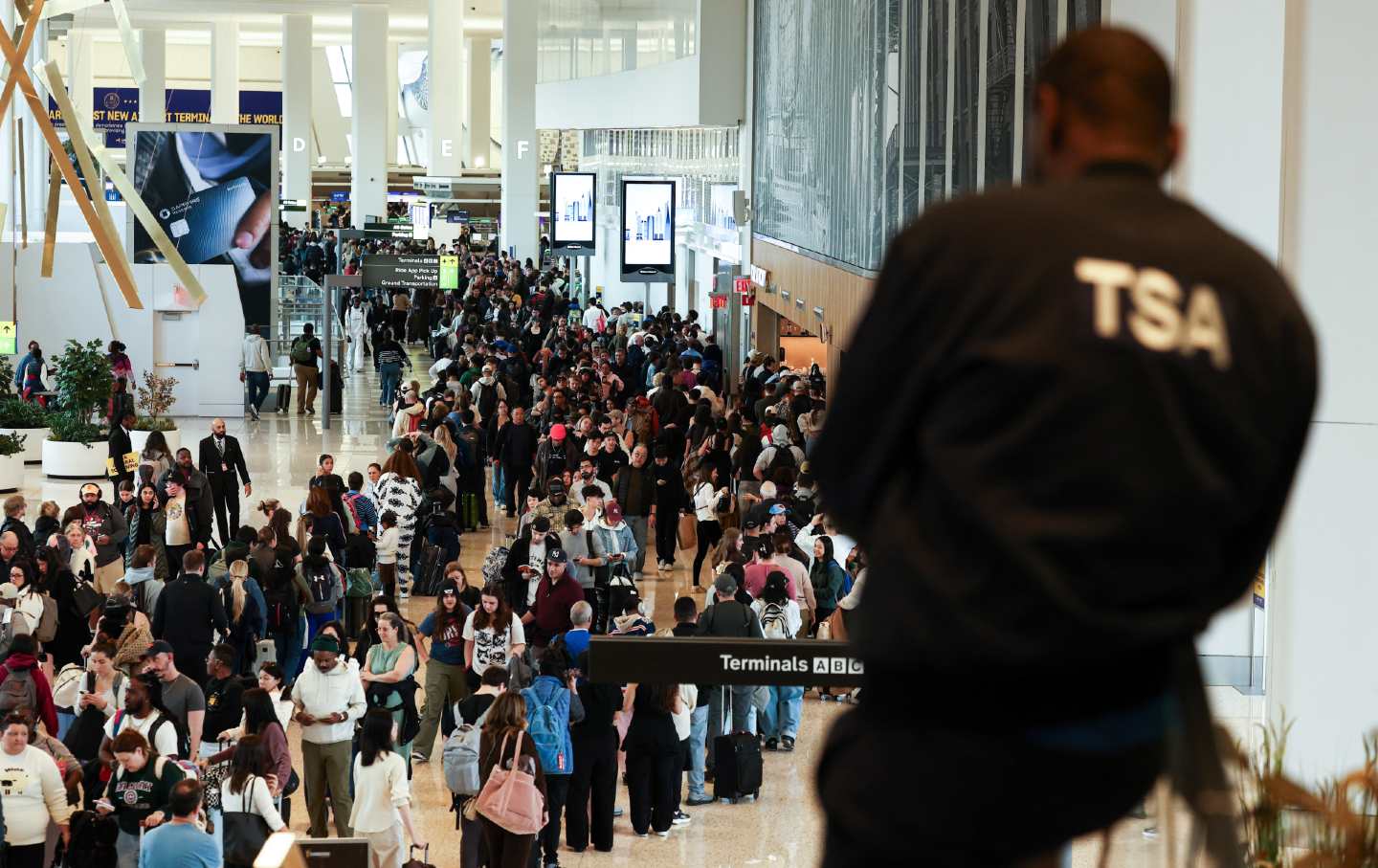
Nothing Works in Trump’s America—Except Racism Nothing Works in Trump’s America—Except Racism
In this week’s Elie v. U.S., our justice correspondent explores Trump’s stunning incompetence. Plus: Baseball is back—for now.


The Politicians Won’t Stop This War. Only the People Can. The Politicians Won’t Stop This War. Only the People Can.
The No Kings movement needs to become a mass anti-war movement.

The New Order? The New Order?
Government sanctioned violence on Americans spreads.
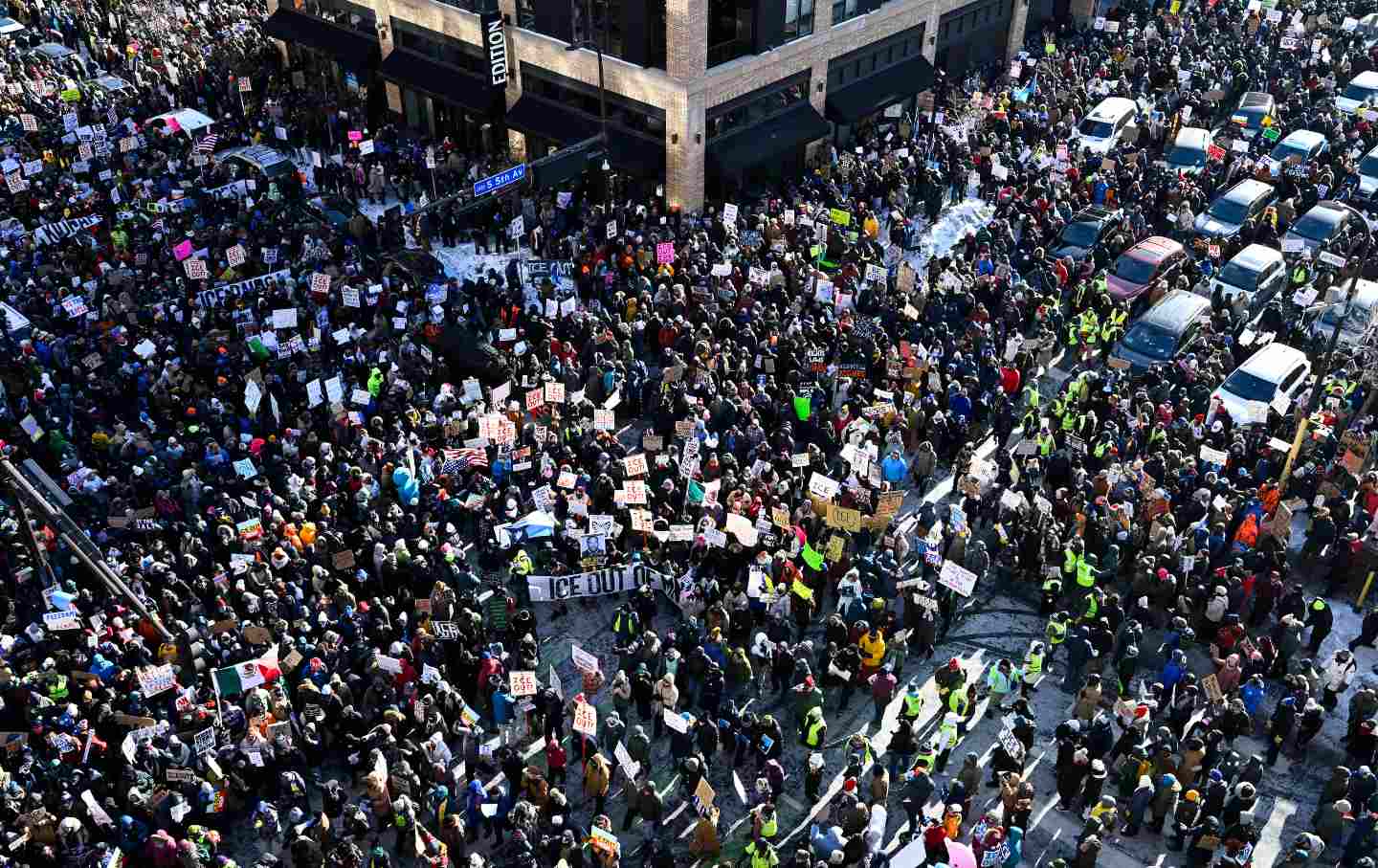
The Bad-News Echo Chamber of Pro-Democracy Substack The Bad-News Echo Chamber of Pro-Democracy Substack
How many pro-democracy Substack authors over-focus on gloom and doom and ignore organizing, and who’s bucking that trend.

The Rapid and “Unprecedented” Collapse of American Democracy The Rapid and “Unprecedented” Collapse of American Democracy
The V-Dem Institute, the world’s chronicler of democracy and autocracy, has determined that the United States is no longer “a liberal democracy.”

