What Does Lina Khan’s Trust-Busting Mean for New York City?
Under-scrutinized monopolies—like the fire truck oligopoly—hinder municipal functions.
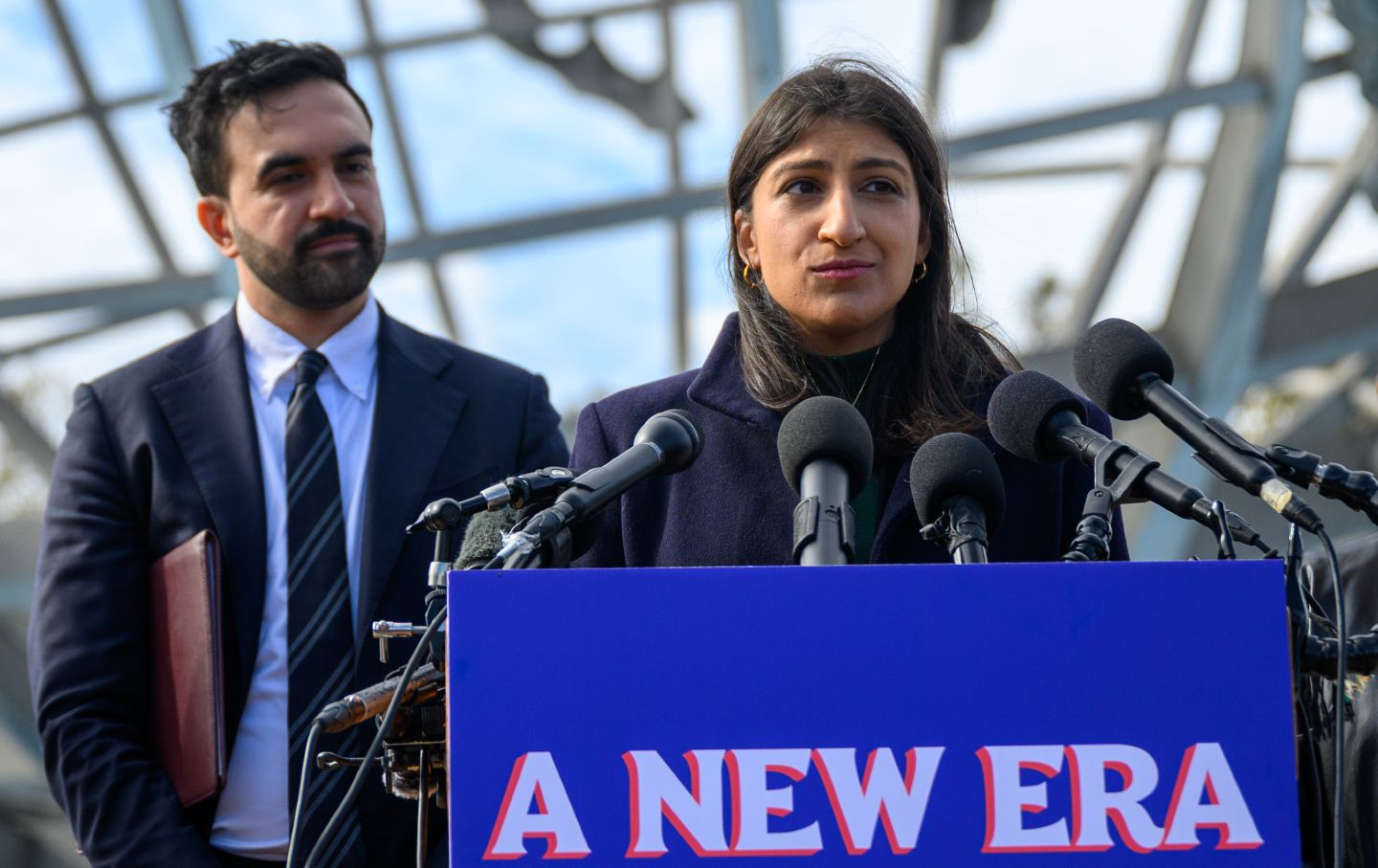
Transition cochair Lina Khan speaks during a press conference at the Unisphere on November 5, 2025, in the Queens borough of New York City.
(Alexi J. Rosenfeld / Getty Images)It’s not often that a mayor-elect’s transition hires are national news. However, most mayors-elect aren’t Zohran Mamdani—and most of their transition teams don’t include former Federal Trade Commission chair Lina Khan.
Fresh from his landmark progressive victory, Mamdani has assembled an experienced array of veterans of local government to lay the groundwork for his mayoralty. But it’s his selection of Khan, the acclaimed legal scholar feared from Wall Street to Silicon Valley, that has attracted the most attention.
While leading President Joe Biden’s FTC, Khan injected trust-busting vigor into an agency that for decades looked on as corporations concentrated their market power, inflating prices, suppressing wages, and stifling innovation. Under her tenure, the FTC racked up impressive accomplishments, including blocking the proposed $24.6 billion merger of chain grocers Kroger and Albertsons, banning hidden “junk fees” that inflate costs for hotel stays and concert tickets, and securing price caps for asthma inhalers. Since joining the Mamdani transition, she has reportedly been poring over New York law in search of mechanisms the administration can use to enforce fairer business practices. (Remember the Martin Act of 1919?)
Antitrust efforts, however heroic, might seem marginal to the work of city governance. And Mamdani’s administration will confront plenty of more direct challenges, from intransigence in Albany to a president who has threatened to starve New York of federal funding. But as antitrust analyst Matt Stoller pointed out in a recent edition of his newsletter, Mamdani will likely also face “economic termites”—the under-scrutinized monopolies that hinder municipal functions, compromising the provision of crucial services and leaving local governments with hefty bills.
Consider firefighting rigs. For decades, local fire departments’ trucks, engines, and other specialized vehicles were manufactured by dozens of independent, often family-owned companies. In the 2000s, however, the private equity firm American Industrial Partners began acquiring and consolidating a series of truck manufacturers. Today that conglomerate, since rechristened Rev Group, controls almost a third of the fire-apparatus industry. Toss in fellow manufacturers Oshkosh Corporation and Rosenbauer, and three companies capture up to 80 percent of the market.
As this fire truck oligopoly took hold, the price of rigs doubled and timelines for the delivery of new parts and vehicles ballooned. According to the International Association of Firefighters labor union, one engine model cost around $600,000 in 2014 and was delivered in around eight months. A decade later, the same machine was priced at over $1.2 million, with delivery expected in 20 months. Wait times for ladder trucks can now stretch past four years, leaving local fire departments to battle flames from jalopies as they await new vehicles purchased many months earlier.
In 2021, as the company sat on a backlog of orders, Rev Group closed two of its factories. And why not? After all, it’s not as though their customers had a robust range of competitors to decamp to.
Today, budget-strapped fire departments are often forced to use outdated equipment and endure regular breakdowns that impede their lifesaving work. In January, a Chicago firehouse held a tongue-in-cheek birthday party to mark a truck’s 30th anniversary. The vehicle, which is now older than many firefighters, was designed to have a 15-year lifespan. The brakes on another Chicago rig, this one comparatively youthful at 20, failed last winter, and the truck crashed into a church. Worse still, fire suppression efforts at a fatal blaze in Camden, New Jersey, were disrupted in 2024 when an engine’s hose malfunctioned. And as wildfires raged across Los Angeles in January, causing hundreds of excess deaths, 100 of the city’s 183 fire vehicles were incapacitated.
Economic termites are also devouring other vital infrastructure. The fire retardant sprayed from planes to smother wildfires is controlled by a single company, which has increased prices by up to 30 percent in the last four years. And during Texas’s fatal summer floods, rescue work was stymied by patchy Motorola Solutions emergency radio coverage. The company dominates as much as 80 percent of its market, and has seen profits grow from 10 percent to nearly 25 percent of sales since the early 2010s. These days, its billionaire CEO is sufficiently flush with cash to hire Elton John to perform at his wife’s Cape Cod birthday party.
Stoller argues that even municipalities far smaller than New York City can fight back by filing joint lawsuits against monopolistic actors. La Crosse, Wisconsin, and Augusta, Maine, are already among the plaintiffs against the big three firetruck manufacturers, in suits alleging that the companies fixed prices and throttled production. In Congress, a bipartisan group of senators, including Elizabeth Warren and Josh Hawley, is now also scrutinizing the fire-apparatus industry.
The firefighters’ union has called for Department of Justice and FTC investigations. And though Donald Trump’s FTC certainly isn’t Lina Khan’s, the president has shown an appetite for some antitrust measures—at least those that he finds politically useful. As part of his effort to co-opt affordability messaging in the wake of Democrats’ recent electoral victories, Trump ordered an investigation into the meatpacking monopoly earlier this month.
Mayor-elect Mamdani, for his part, says that he is open to working with the president to reduce the cost of living. If Trump is truly serious about bringing prices down—as unlikely as that may be—perhaps his administration will recognize that tackling monopolies is one critical way to make things affordable again.
Become a Sustaining Donor This September
Between the reemergence of right-wing red-baiting and Donald Trump’s use of the chilling National Security Presidential Memorandum–7 to criminalize left political organizing, we’re seeing McCarthyism reborn before our eyes.
This assault on democracy cannot be ignored or wished away. Resisting it requires bravery in the face of threats and repression, a steadfast commitment to the truth, and the unwavering belief that we can—and will—overcome this darkness.
We must have an independent media that sets the record straight, unearths corruption and abuses of power, and advances a politics of justice and dignity for all if we’re to win this fight.
That’s why I’m writing to you today. This September, The Nation needs to add 100 monthly donors to sustain our progressive journalism. Your contribution makes the next investigative report, the next truth-speaking column, and the next pathbreaking essay all possible.
I hope you’ll support our work with a recurring donation today. If you donate $10 or more a month, we’ll send you a brand new “Hands Off the Free Press!” sticker to recognise your commitment to our cause. Please, donate today.
Onward,
Katrina vanden Heuvel
Editor and Publisher, The Nation