Why Did UChicago Destroy the Humanities?
The answer is simple: to spend untold sums on useless buildings by starchitects.
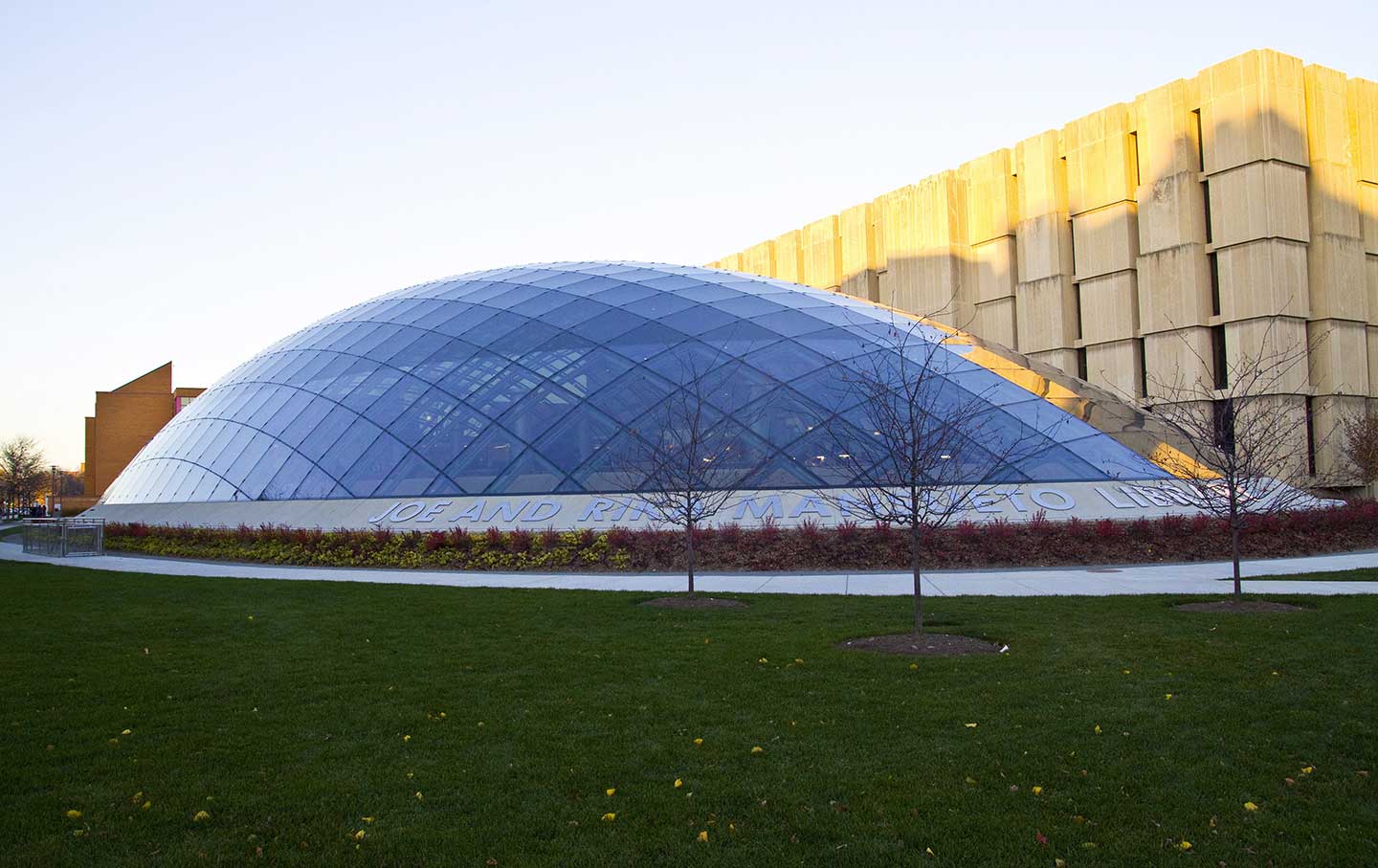
Just for decoration: In UChicago’s Mansueto Library, the bookstacks are all underground and unbrowsable.
(Raymond Boyd / Michael Ochs Archives / Getty Images)
In August, the University of Chicago shocked the academic world by announcing that it would be pausing PhD admissions in nearly all of its world-famous humanities programs. While the ongoing crisis in the humanities—that is, the deliberate marginalization and even elimination of humanities programs by neoliberal administrations in order to reorient schools toward more lucrative business, engineering, and tech programs—is not unique to UChicago, the extent of the damage is especially jarring. What is distinct about the university is its staggering indebtedness. According to Clifford Ando, a professor of classics who has been reporting on the crisis for years, the university’s debt ballooned from $2.2 billion to $5.8 billion between 2006 and 2022—an increase of more than 250 percent, and the equivalent of 68 percent of the university’s total assets. Tuition from 85 percent of the student body is needed just to service this debt. It’s not surprising, then, that UChicago has hollowed itself out by repeatedly robbing Peter to pay Paul. (It is somewhat more surprising, however, that it also gambled—and lost—$20 million on cryptocurrency in 2022.)
Hundreds of millions of dollars of that debt consists of massively overleveraged bonds to finance construction. Yet the university has pledged $1.2 billion toward two new buildings. Building while in debt is not a new phenomenon. Beginning in 2007, UChicago went on a building spree involving some of the most famous architects in the country. The ovular addition to the Mansueto Library, designed by Helmut Jahn, was the first of these projects to come to fruition, costing the university $81 million. The numbers only ballooned from there. The towering Logan Center for the Arts, by Tod Williams Billie Tsien Architects, cost $114 million.
At least those were academic buildings (and, incidentally, the most architecturally worthwhile). But two of the university’s most recent architectural expenditures have nothing to do with learning and everything to do with prestige. The $100 million Rubenstein Forum was ostensibly built to solve a $4 million problem—the cost of having to host large meetings and conferences downtown. Built by Diller Scofidio + Renfro, the forum’s six zinc-colored stacked boxes loom over 60th Street and cannot be breached without an appointment. It is, essentially, an evil lair. Meanwhile, the most expensive of these projects, at $148 million, is Jeanne Gang’s Campus North dorm. It’s built in what we in the biz disparagingly call the “Dutch style,” after the penchant for irregular forms and seemingly pixelated façades pioneered by Dutch architects in the early 2000s. In addition to being an eyesore, the dorm is sited in such a way that the passageway beneath the two parts of the building creates a notorious wind tunnel. It only adds insult to architectural injury that the university constructed such luxury dorms after selling a major research center to—you guessed it—pay off some of its debt.
But now the fun is over and it’s time to pay up. According to Ando, $900 million of the university’s debt will come due over the next five years, forcing it to refinance at much higher interest rates. One must ask: If the university was in such dire financial straits, which only worsened as the years went by, why did it continue to undertake such construction follies? Especially given the fact that the quadrangle—the collection of Collegiate Gothic buildings that house most of the humanities programs—needs $1 billion in deferred maintenance? The answer lies in rank elitism.
The average undergraduate student in the United States pays more than $12,000 for room and board each year. These facilities are a key part of how universities compete against one another in important ratings like the ones provided by the Princeton Review. The University of Chicago may be up to its eyeballs in debt, but hey, you can live in a dorm designed by a famous architect! As many elite universities become less about learning and more like tech incubators with a school attached (or, at worst, elevated diploma mills), buildings like the Rubenstein Forum and Campus North help disguise this sordidness with a patina of prestige. Even a building like the Mansueto Library conveys certain priorities: The stacks are all underground and unbrowsable, so that the reading materials need to be retrieved electronically—rendering the visible half-domed building little more than something interesting to look at.
For most of its history, the university as an institution was a public good. But thanks in part to the good old boys in the UChicago economics department, it is now little more than a generator of real and human capital alike. An education is no longer primarily about the perpetuation of human knowledge, but rather an investment one makes (with increasingly diminishing returns) in order to secure higher wages. Meanwhile, university administrators continue to make things worse for students and researchers by cutting majors, recklessly expanding the student population, and immiserating an army of underpaid adjuncts.
Architecture, like the university, has historically been a public good, something to be evaluated based on whether it contributes to human flourishing. Now it most often seems like part of a marketing ploy. It’s not the fault of the architects that these buildings have been used to starve what little humanity remains of a once-illustrious institution, but it’s a travesty all the same. The University of Chicago’s architecture once paid homage to the medieval trivium and quadrivium—the bedrock of the liberal arts. Now it pays homage only to money.
Editor’s Note: An earlier version of this article inaccurately stated that UChicago threatened to teach languages with ChatGPT.