The Trouble With Adapting Wuthering Heights
Why adaptations of Emily Brontë’s novel, across generations, have misunderstood the work and the its world.
The Trouble With Adapting “Wuthering Heights”
Why adaptations of Emily Brontë’s novel, across generations, have misunderstood the work and its world.
“Icould have told Heathcliff’s history, all that you need hear, in half a dozen words.” We are only a few chapters into Emily Brontë’s Wuthering Heights when Nelly Dean, the servant, foster-sister, and—crucially—narrator apologizes for how longwinded her tale has become. At this point, in fact, she’s barely begun. And just as Nelly is merely one of several narrators in Brontë’s novel, her version of “Heathcliff’s history” is far from the only one. The proliferating narrators set a model for readers’ attempts to adapt and transform Wuthering Heights—attempts that are nearly as old as the novel itself.
These include, for instance, Charlotte Brontë’s 1850 preface to a new edition of her sister’s novel, in which she sought to explain (or excuse) the “coarseness” that had so shocked its first readers (other critics had deemed it “puzzling,” “baffling,” a work of “naked imaginative power”). At the time, Charlotte was still mourning her sister, who had died, at 30, in December 1848. Her preface can be understood as an early adaptation of the novel—an effort to translate it into a more legible idiom. This version of Emily Brontë, however, is nothing if not contradictory: a “homebred country girl” who was also “hewn in a wild workshop.” A savant that could not be held responsible for her creations: “Having formed these beings she did not know what she had done.”
“A publicist’s masterpiece” is how Anne Carson described the preface, in her 1995 poem “The Glass Essay”: “Like someone carefully not looking at a scorpion / crouched on the arm of the sofa.” To be fair, Charlotte had instantly recognized Emily’s gifts when she’d stumbled across her poems several years earlier. It was Charlotte who hatched the idea of publishing the three sisters’ “Poems By Currer, Ellis and Acton Bell,” despite Emily’s initial anger and reluctance. (It was also Charlotte who planned a trip to their London editors to finally expose their true identities; while her sister Anne accompanied her, Emily, typically, refused to go along.) In “The Glass Essay,” Carson’s homage to Wuthering Heights, the speaker is in the throes of a breakup and reads Emily Brontë during a visit to her mother; the poem muses over how many readers have projected onto Emily their own anxieties and desires.
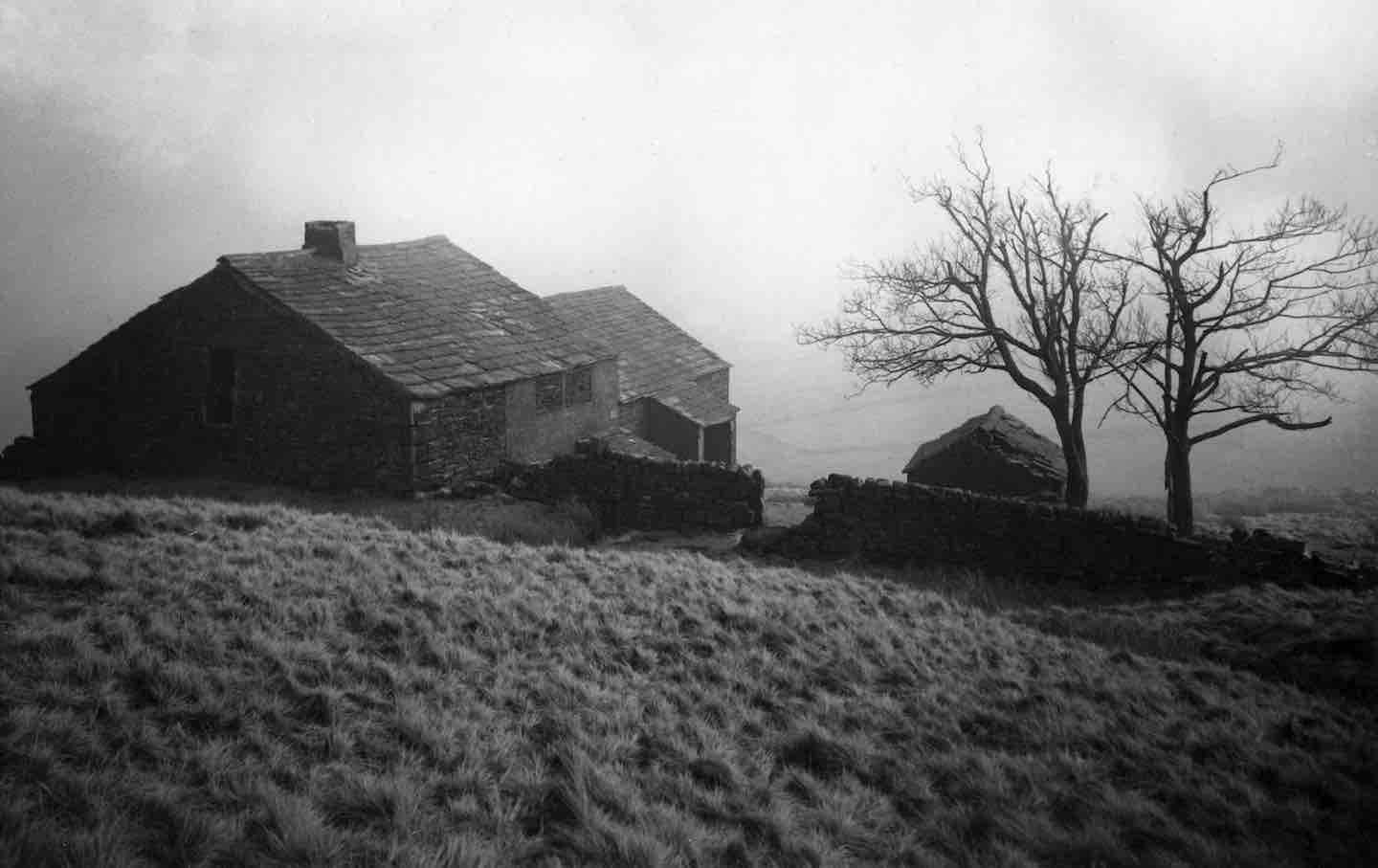
Carson’s speaker realizes she may be one of them: “I feel I am turning into Emily Brontë, / my lonely life around me like a moor.” Such lines ironically allude to what critic Lucasta Miller has called The Brontë Myth, but also, inevitably, end up trafficking in the same romanticized idea of a solitary female writer on the lonely moor. By now it’s well established that the Brontës didn’t grow up in a remote, abandoned setting but rather nearby a bustling industrial town; that their father, Patrick, was hardly the belligerent, cold patriarch he was made out to be in Elizabeth Gaskell’s 1857 The Life of Charlotte Brontë. We know that Emily Brontë’s rich intellectual and literary inheritance included the works of Sir Walter Scott, the stories of James Hogg, and the poetry of Byron and Shelley; in other words, that Wuthering Heights is hardly a work of spontaneous creative genius. Already in 1905, Henry James was ruing what had become the “romantic tradition of the Brontës,” with “their dreary, their tragic history, their loneliness and poverty of life” a myth that “elbowed out” a true appreciation of their work.
Still, there’s a reason the most powerful myths survive long past the moment of their origin. Many have decried Emerald Fennell’s “Wuthering Heights” as an unworthy adaptation, the scare quotes of the title indicating Fennell’s casual disregard of her source material. The problem, however, is not infidelity. Across over a century of Wuthering Heights adaptations, the best of them have ambitiously transposed the original’s language and setting, as well as its details of plot. In doing so, they’ve rebutted Charlotte Brontë’s fear that the novel must prove “alien and unfamiliar,” its meaning “unintelligible, and—where intelligible—repulsive” to anyone outside Yorkshire. That isn’t because Wuthering Heights is a timeless love story, whatever that would mean, but rather because it is a haunting, though utterly recognizable, portrayal of the modern world’s cruelty, exploitation, and violence. This kind of violence, as Brontë teaches us, obeys no borders; it lies not behind or beyond but well within our pious scripts of love, property, and law. Any poet, screenwriter, or novelist wishing to pay tribute to Brontë’s novel would do well to grapple with this bleaker vision.
Afoundling’s arrival; a quasi-incestuous childhood friendship; a betrayal; an escape; a return; eventually, a standoff, followed by a heroine’s wasting away. Almost every adaptation of Wuthering Heights can be pared down in this way. William Wyler’s 1939 Wuthering Heights hits each of these points. But Wyler’s is also a recognizably post–Hays Code film, replete with Hollywood glamour, including an extended ballroom scene at Thrushcross Grange—the genteel home of the Linton family, the Earnshaws’ upper-crust neighbors—in the vein of Victor Fleming’s near-contemporary Gone with the Wind. Laurence Olivier’s Heathcliff is certainly easier to love than to fear, as the handsome but poor “dirty stable boy,” who flees after overhearing Catherine Earnshaw declare that it would be “degrading” to marry him (he misses the avowal that follows: that her love for Edgar Linton may change like foliage, but “My love for Heathcliff resembles the eternal rocks beneath”). After three years away, Heathcliff returns to Yorkshire a rich gentleman, eventually able to wrest control over Wuthering Heights, which Catherine’s brother Hindley has inherited after their father’s death, by bankrolling Hindley’s drunken gambling until the property has been mortgaged over to him. In the novel, no one ever learns how Heathcliff has made his fortune. Wyler’s film has him depart for America: This is Heathcliff as a character out of Horatio Alger, emblem of a quintessentially American, rags-to-riches meritocracy myth.
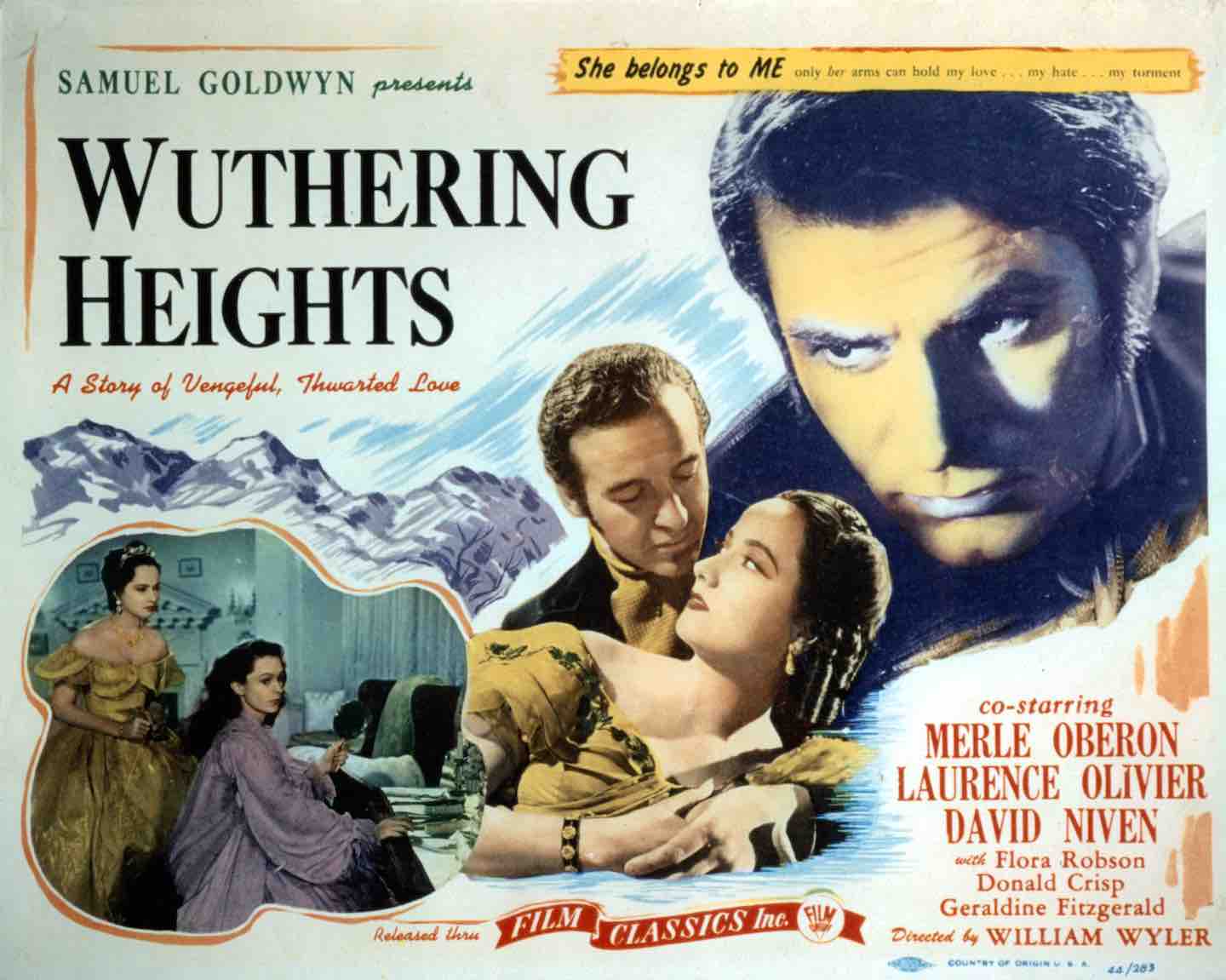
Like most adaptations, including Fennell’s, Wyler lops off the book’s second half following Catherine’s death (though, unlike Fennell’s, it retrieves the famous scene of Heathcliff wrenching the top off of Cathy’s coffin, which is only recounted late in Volume II). Many readers have found the novel’s second volume to be something of a slog compared to the passionate intensity of the first. It’s even been suggested that Emily padded out the novel to oblige her editors, so that it could be published, together with Anne’s shorter The Tenant of Wildfell Hall, in a standard three-volume book. But the second half is also where we see Heathcliff’s carefully plotted revenge play out in the second generation, as he endeavors to gain control over the Grange as well as the Heights, in part by trapping Catherine and Edgar’s daughter, Cathy Linton, into marrying her cousin Linton Heathcliff (Heathcliff’s son with Isabella Linton: “my property,” he sneers). As the early-20th-century scholar C.P. Sanger showed, the novel is impressively proficient in its knowledge of property, marriage, and inheritance law, all of which Heathcliff expediently manipulates.
One exception to the habit of abridgement is Yoshishige Yoshida’s stunning 1988 Arashi-ga-oka, which transposes Wuthering Heights to Muromachi-era (medieval) Japan. As a feud rages between the House of the East and the House of the West around the remote Fire Mountain, the Heathcliff character, “Onimaru” (“oni” meaning “demon”), becomes an expert warrior, gaining the shogun’s favor before plotting his revenge on “Kinu” (Catherine). Peter Kosminsky’s 1992 adaptation takes a different approach, casting a brunette Juliette Binoche as Catherine Earnshaw and a blonde Binoche as her daughter. In different ways, these adaptations effectively dramatize the demonic doublings and repetitions at work everywhere in Wuthering Heights, not least in the family tree. Heathcliff is at once drawn to and repelled by the next generation (Cathy Linton, Linton Heathcliff, Hareton Earnshaw) because he sees Catherine in their eyes. To destroy them, as he wishes, would also mean to lose what he most desires—that his former lover continue to haunt him.
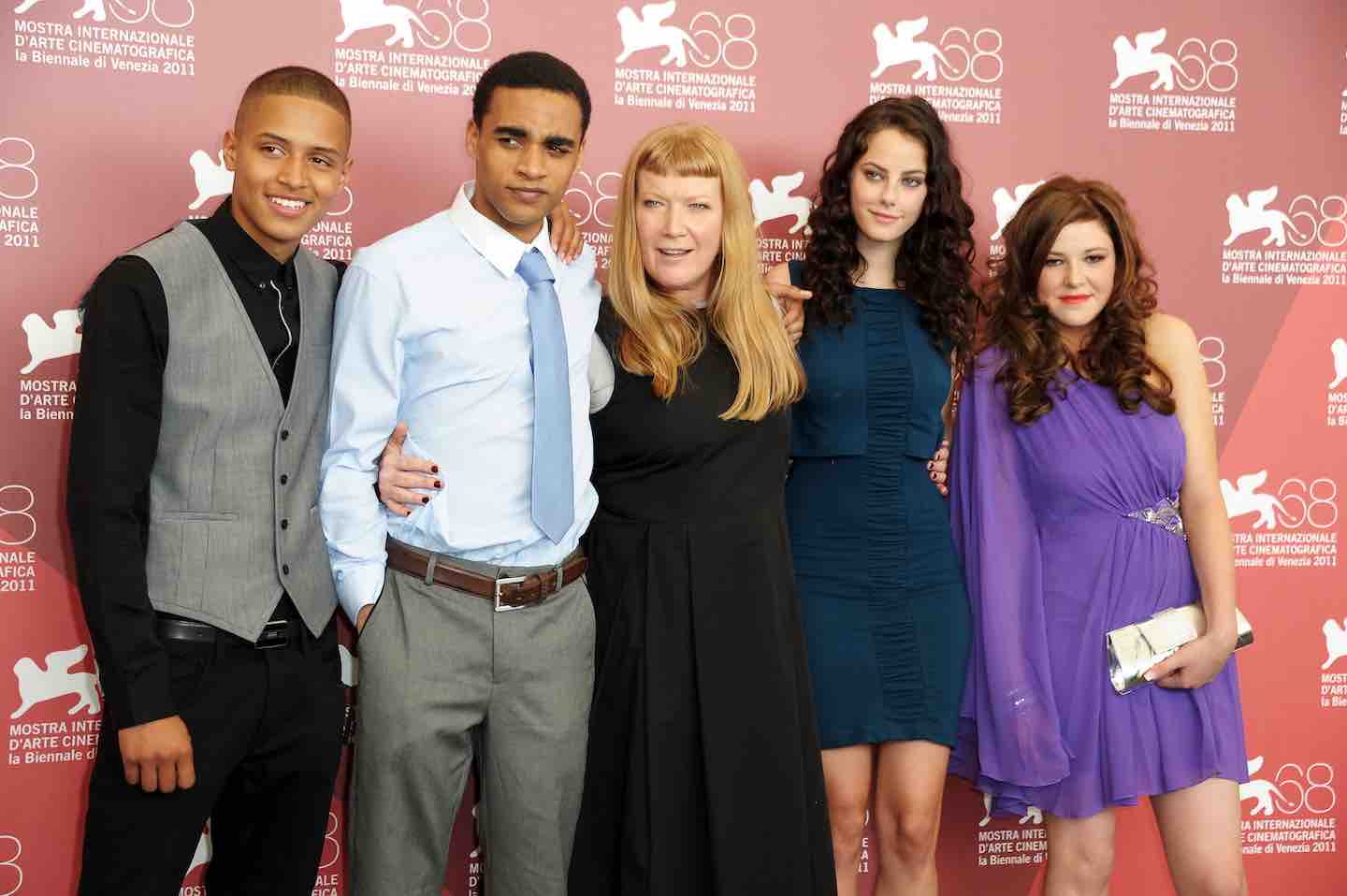
In contrast to Yoshida’s reimagining, Kosminsky’s film established a standard for filming on location in order to foreground Brontë’s beloved Yorkshire moors; others, including Andrea Arnold’s 2011 Wuthering Heights, take equal advantage of the incontrovertibly striking landscape. Critics have recently cited Arnold’s film to make a pointed contrast with Fennell’s casting of Jacob Elordi as Heathcliff: In the 2011 production, the character is played by two Black British actors (Solomon Glave as a child, James Howson as an adult) and the film renders explicit Heathcliff’s status as a victim of racial and ethnic prejudice (famously, he is described variously as “a dirty, ragged, black-haired child” and a “Spanish gypsy”). In Arnold’s Wuthering Heights, Hindley even calls Heathcliff an offensive racial slur. Arnold’s casting also better reflects the actual historical situation of the novel’s setting. Even provincial Yorkshire, in the late 18th and early 19th centuries, was embedded within international and imperial networks; Heathcliff, as a child, was found in Liverpool in the early 1770s, when it was an important node of the international slave trade. So, despite Arnold’s sparse visual aesthetic, privileging long shots and visual language over dialogue, the moors are no romanticized backdrop; human histories and tragedies are scored into them. In contrast, Fennell’s moors are more akin to the two-dimensional Hollywood set where Wyler’s Wuthering Heights was filmed 90 years ago. She adds what seems to be a hefty use of wind and fog machines, which is part of what makes this adaptation seem more like a music video, or an ad.
While it is a received idea that Wuthering Heights is unimaginable outside the Yorkshire moors, many of its more interesting adaptations abandon that setting entirely. Maryse Condé’s 1995 novel Windward Heights takes place in both Cuba and Condé’s native Guadeloupe. In her hands, Cathy is a mixed-race daughter of the man who adopts “Razyé,” and her marriage to the Edgar Linton figure is explicitly coded as a way to join “the world of whiteness.” In Yoshida’s film, the windswept volcanic “moors” resonate unexpectedly with the starkness and violence that he draws from Brontë. Or take Luis Buñuel’s Abismos de pasión (1954), set in rural Mexico between a hacienda and granja, or farm, where “Catalina” (the Catherine figure) describes “Alejandro” (Heathcliff) as a “savage” whom only she can love. Buñuel’s adaptation, like Condé’s, maintains the important structural, architectural, and socioeconomic divisions between the Heights and the Grange, but the film also shrinks the story’s timeline dramatically, beginning only with Heathcliff’s return from abroad. It also transmutes the 19th-century Romanticism of Catherine and Heathcliff’s mystical union, their collapse of boundaries between self and other, into the surrealist ideal of amour fou or “mad passion,” where love is a torment closer to hell than to heaven.
“The love between Alejandro and Catalina is fierce and inhuman,” an intertitle reads at the start. “It can only be fulfilled through death.” Boundary collapse is epitomized here by a kind of telepathy by which Catalina can intuit Alejandro’s thoughts from afar. In the novel, Heathcliff is regularly referred to as a devil; here, the Nelly character repeats that both Catalina and Alejandro have the “devil” in them. But Abismos also troubles other boundaries, not least between civilization and barbarism. At the start, Catalina is shooting vultures outside, while her husband, the Edgar Linton figure, an entomologist, carefully pins a live butterfly to a surface for scrutiny and study. Which is more barbaric, we are invited to ask—the bare violence of the hunt, or the rationalized, Enlightenment world of science?
Jacques Rivette’s 1985 Hurlevent, set in France in the mid-1930s, also follows a broadly surrealistic tradition. Rivette had been inspired by an exhibit of Balthus’s spare, black-and-white mid-1930s illustrations of Wuthering Heights, some of which had been published in the surrealist journal Minotaure in 1935. (It was around this time, too, that Buñuel wrote his screenplay for Abismos de pasión, though it would take several decades before he managed to produce it.) Rivette’s film is set in the scrub of the southern sunlit Cévennes. Its non-diegetic music, the incantatory refrains of a Bulgarian choir, contributes to a dynamic of cultural cross-pollination. As in the novel, dreams proliferate, beginning with the famous scene, replicated in virtually every adaptation, in which Catherine tells Nelly that she dreamed she was in heaven, and felt not at home there but in exile. Rivette’s film also dramatizes other, invented dreams, including its voyeuristic opening scene, in which “Guillaume” (the Hindley figure) dreams that he has been spying on Catherine and “Roch” (Heathcliff) fondling on a granite rock. In Rivette’s film, the actors are younger than in many adaptations, too, teens rather than adults. It’s a fitting choice, showing adolescence to be a world unto itself—as much as adults would like to pretend otherwise—and certainly no age of innocence, but instead a site of sensual intensity, obsession, aggression, and even cruelty.
As in virtually all adaptations, however, Rivette’s Hélène (Nelly) is a character, rather than the narrator—true even for the films that maintain the novel’s nested, Russian-doll-like narrative structure. In Brontë’s text, Nelly’s narration competes with several other voices and is framed by Heathcliff’s tenant Lockwood, who arrives from southern England in 1801 only to be instantly confounded by the ersatz family he encounters at the Heights. Kosminsky alludes to these proliferating frames by beginning his film, somewhat jarringly, with an Emily Brontë figure wandering over the moors and peering up at a ruined estate. A scene in Fennell’s film also creates a mise en abyme effect by having the camera zoom in on a dollhouse replica of the Grange. Fennell foregrounds Nelly’s attempts at obstruction and meddling, and the film tries to account for this as stemming from her own sense of shame and otherness. (Nelly is played by the Vietnamese American Hong Chau; here, as in Fennell’s last film, Saltburn, questions of race and class are displaced onto a minor character.)
If Brontë’s Nelly is an intrusive, manipulative narrator, it’s rather because she would be much happier in a more traditional romance plot—including, probably, the kind of love story that Wuthering Heights has become for so many of its readers. “Her life closed in a gentle dream,” she says to Heathcliff, in a tone of unsettling complacency, after Catherine’s death, “may she wake as kindly in the other world!” (“May she wake in torment!” Heathcliff responds in a rage.)
Despite Nelly’s best intentions, however, Wuthering Heights rejects the Victorian ideal of domestic bliss implied in the marriage plot. Nelly may choose to believe that the law will win out, and that it is essentially good: “There’s law in the land, thank God! there is,” she warns Heathcliff at one point. In doing so she ignores the fact that Heathcliff’s manipulations, coercions, and acquisitions are perfectly legal.
In that sense, Nelly’s narration uncannily rehearses and anticipates a long history of adaptations of Wuthering Heights—beginning with Charlotte Brontë’s own attempt to translate, and to domesticate, her sister’s novel—that try to manage the intensity of a story more frightening and radical than many would like it to be. To see Heathcliff as a romantic hero, as so many have done, is a novice’s mistake. But to see him as a victim or revolutionary is an equally strong misreading. As the Marxist critic Terry Eagleton once wrote, Heathcliff’s rise symbolizes “at once the triumph of the oppressed over capitalism and the triumph of capitalism over the oppressed.” Or, to put it in Heathcliff’s own words, “The tyrant grinds down his slaves and they don’t turn against him; they crush those beneath them.”
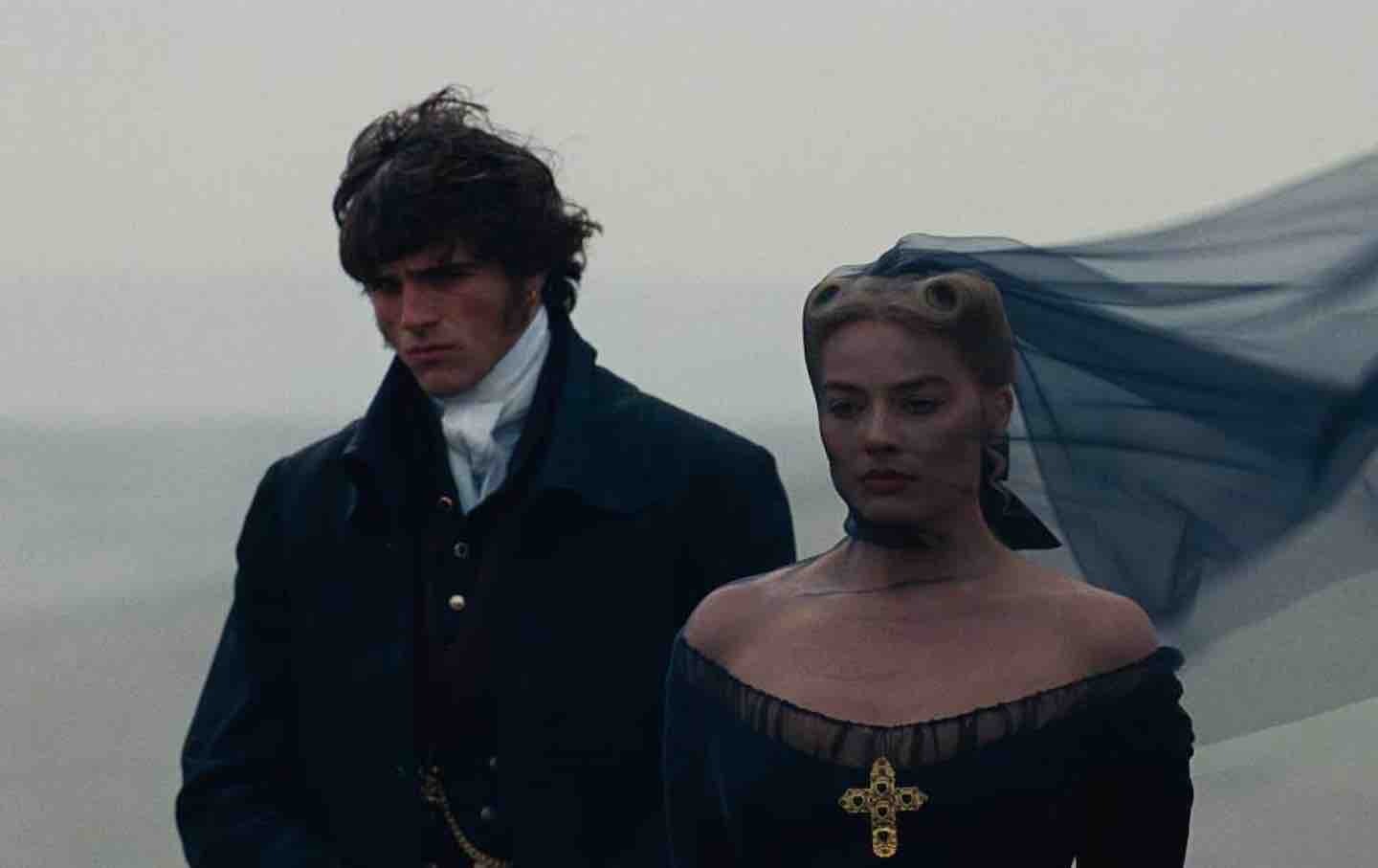
This, unsurprisingly, is an idea that most adaptations of Wuthering Heights have resisted. Fennell’s “Wuthering Heights” is no exception. The few lines in her film that are culled directly from Brontë—“I am Heathcliff”; “I cannot life without my life! I cannot live without my soul!”; “Why did you betray your own heart?” —sound tinny and flat, even half-hearted, in the mouths of Elordi and Margot Robbie. In the novel, Heathcliff utters the last of these lines in his final scene of reunion with Catherine, hours before her death. In Fennell’s version, he pronounces them just before the infidelity begins. As with the other details meant to shock—the close-ups of viscous fluids; a BDSM-coded dog collar Isabella Linton is made to wear—this latest adaptation translates the novel’s real transgressiveness into the commonplace trespass of adultery.
Still, as a story about how stories are translated and adapted, seized, and reworked, Wuthering Heights set the stage for even these flattening readings. What can we bear to see, and what do we choose not to look at? Why is it so much easier to consent to culturally available scripts? Even Brontë’s novel ends with the promise of a happy marriage between Cathy Linton and Hareton. That ending nevertheless lies beyond the book’s narrative, just out of view. By now, Catherine Earnshaw is dead, and so is Heathcliff— “but the country folks, if you ask them, would swear on the Bible that he walks,” just as we too will continue to be haunted by Wuthering Heights.
Support independent journalism that does not fall in line
Even before February 28, the reasons for Donald Trump’s imploding approval rating were abundantly clear: untrammeled corruption and personal enrichment to the tune of billions of dollars during an affordability crisis, a foreign policy guided only by his own derelict sense of morality, and the deployment of a murderous campaign of occupation, detention, and deportation on American streets.
Now an undeclared, unauthorized, unpopular, and unconstitutional war of aggression against Iran has spread like wildfire through the region and into Europe. A new “forever war”—with an ever-increasing likelihood of American troops on the ground—may very well be upon us.
As we’ve seen over and over, this administration uses lies, misdirection, and attempts to flood the zone to justify its abuses of power at home and abroad. Just as Trump, Marco Rubio, and Pete Hegseth offer erratic and contradictory rationales for the attacks on Iran, the administration is also spreading the lie that the upcoming midterm elections are under threat from noncitizens on voter rolls. When these lies go unchecked, they become the basis for further authoritarian encroachment and war.
In these dark times, independent journalism is uniquely able to uncover the falsehoods that threaten our republic—and civilians around the world—and shine a bright light on the truth.
The Nation’s experienced team of writers, editors, and fact-checkers understands the scale of what we’re up against and the urgency with which we have to act. That’s why we’re publishing critical reporting and analysis of the war on Iran, ICE violence at home, new forms of voter suppression emerging in the courts, and much more.
But this journalism is possible only with your support.
This March, The Nation needs to raise $50,000 to ensure that we have the resources for reporting and analysis that sets the record straight and empowers people of conscience to organize. Will you donate today?