
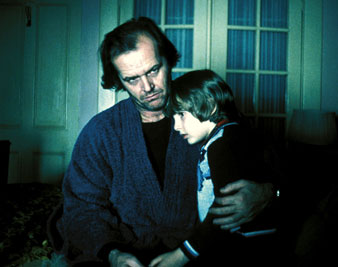
 Warner Brothers/courtesy Everett CollectionJack Nicholson, Danny Lloyd in The Shining, 1980.
If you stay at the Overlook Hotel, best avoid Room 237.
I am not certain what it means to call Stanley Kubrick’s The Shining “the first epic horror film,” as the ads are quoting Jack Kroll of Newsweek, but surely it is one of the strangest of them. It is so because Kubrick (and presumably Stephen King, who wrote the novel) is more interested in his people than in the wringer through which he puts them. In this respect, The Shining is like the Le Carré spy thrillers; it gets you more deeply than plot. The formula for horror is to seize upon some quite average, very nice people, as in The Exorcist, and torment them until their eyes bulge and the audience screams. Jack and Wendy Torrance (Jack Nicholson and Shelly Duvall) are average enough, but Jack is anything but nice. A failed schoolteacher and reformed drunk, now clinging desperately to respectability by declaring himself a freelance writer, he is bitter, cruel, self-loathing, a man who smiles with clenched teeth. Wendy is nice but exasperating–submissive, obtuse, mistress of all the current clichés, defenseless except on behalf of their young son, Danny (Danny Lloyd). She is the sort of friendly wife who will walk in on her husband when he is writing to ask, “Hi, hon, how’s it going?” The Torrances are a couple who could attain to murder in a Larchmont split-level; instead, they have signed on as winter caretakers of an enormous Rocky Mountain resort hotel, built at the turn of the century, a former holiday spot for celebrities like Teddy Roosevelt and William Howard Taft. The hotel has grisly stains on its history. How the manager could have hired such an edgy pair for such a job is the initial mystery, but I got the impression he didn’t have much choice.
Then the film is something of a sport because Kubrick is cavalier with his spookery; it is seldom clear where neurosis ends and haunting takes over. The boy Danny has second sight–called “the shine” by the hotel chef (Scatman Crothers), who is similarly gifted–which enables him to see the past and anticipate the future. Predictably, he sees ghosts, but by the time the snow has begun to fall, it is his father who is fairly surrounded by them; they serve him drinks, rise from a bathtub to embrace him and counsel him to take the strongest possible measures against his family. Knowing Jack by then, I would suppose these visions to be self-engendered, except that the boy also sees such things, among them a pair of ominously identical twins and torrents of blood. Danny’s “voice” tells him the specters are only “pictures,” but they do roll tennis balls down empty corridors, splash drinks on Jack’s jacket and fiddle with locks. As shadows, they are strangely tangible.
Perhaps because one works hard to keep the supernatural horror in focus, the picture is less frightening than its gruesome apparitions should make it. Or perhaps you become so disturbed by the natural problems of the Torrances that you tend to brush the horror aside and worry instead about the three of them on a realistic level. With Nicholson and Duvall in the leads, the human tragedy easily becomes paramount. His performance as a man fighting his most hideous impulses is both pitiful and shocking. Early in the film, Torrance remarks that he feels as though he had known the Overlook Hotel at some time in the past, and in retrospect it is clear that Nicholson has been playing the man at two periods of his life, a stereoscopic view of the character that gives it unexpected depth. Duvall’s job is to be dynamically passive–to act as a barometer of the terror that is rioting through the empty, snowbound building. She sees very little of what bedevils her husband and son, but she sees their faces, hears their voices and reflects their torments as in a magnifying glass. With such performances, The Shining is so compelling that it can afford to leave its mysteries unresolved.
Of course, I would like to have the answers. I wish I knew, for instance, whether the nude whom Danny found in the bathtub was connected with his having heard on TV that a woman was missing in the storm. And, if so, why his father also encountered this most appalling of all the apparitions. In fact–quite outrageously, since it is his picture, not mine–I wish that Kubrick had made The Shining into a melodrama of ill-matched people caught in a trap, and had driven all the unburied dead off the hotel premises. However, as in 2001, Kubrick likes ghost stories more than I do. And he gives me enough else, in the way of acting and bizarrely beautiful surroundings, to keep me happy.

